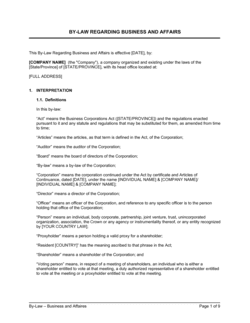
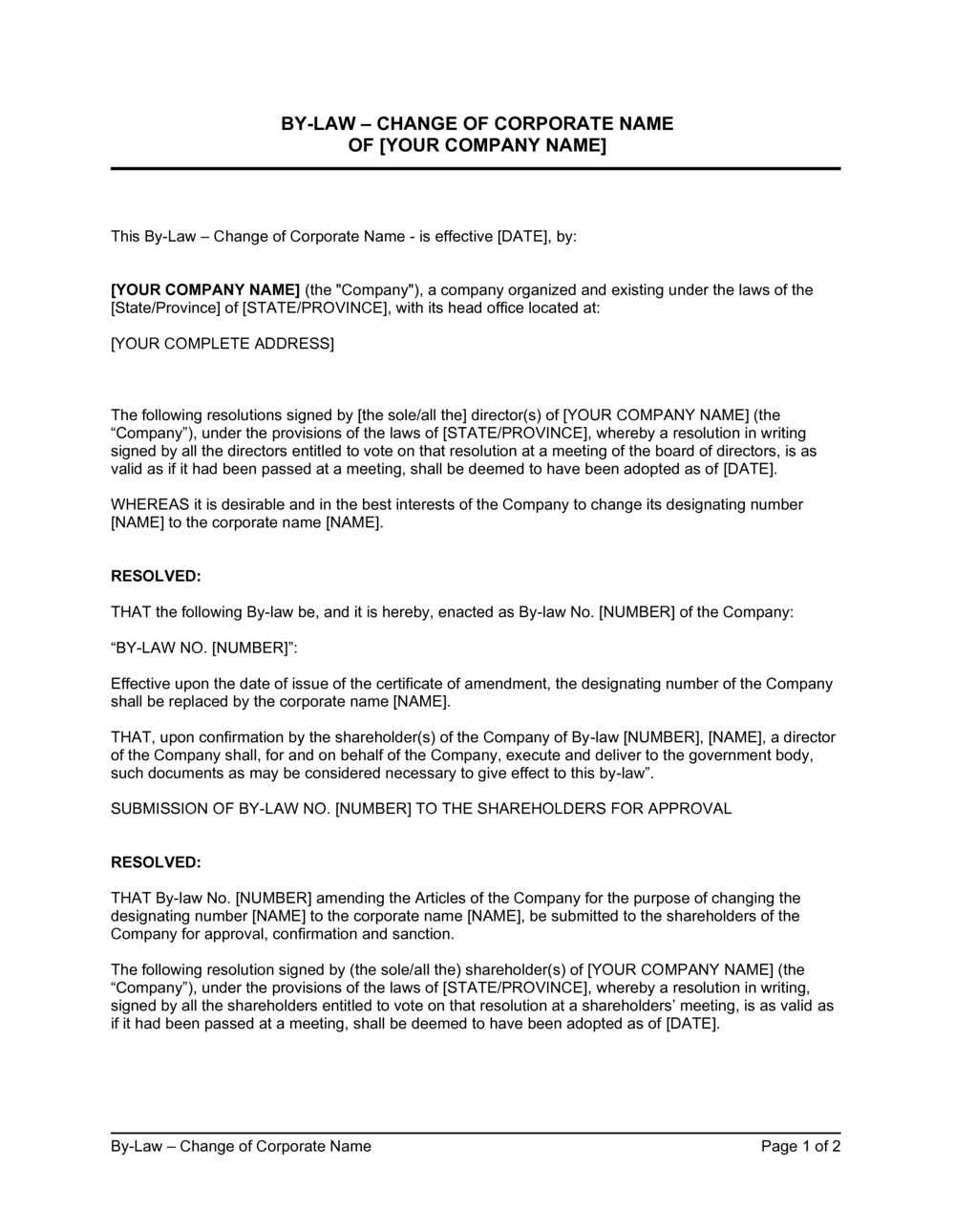
By-Law Change of Corporate Name Template

Free Word download • Edit online • Save & share with Drive • Export to PDF

2 pages20–30 min to fillDifficulty: StandardSignature requiredLegal review recommended
Learn more ↓
FreeBy-Law Change of Corporate Name Template

At a glance

What it is
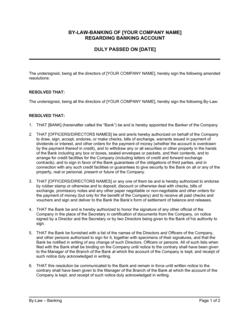
A By Law Change of Corporate Name is a formal internal corporate document that amends a corporation's bylaws to reflect an approved change to its legal name. This free Word download gives you a structured, board-ready template covering the authorizing resolution, the old and new name declaration, voting record, and effective date — editable online and exportable as PDF for filing with the relevant corporate registry.
When you need it
Use it whenever a corporation's board of directors and, where required, its shareholders have approved a change to the company's registered legal name and the bylaws must be formally amended to record that change. It is required before filing the name change with a state, provincial, or national corporate registry.
What's inside
Identifying recitals for the corporation and the proposed new name, the authorizing board resolution, shareholder approval record where applicable, the bylaw amendment clause replacing the old name, effective date, officer certification, and a signature block for executing directors or officers.

What is a By Law Change of Corporate Name?

A By Law Change of Corporate Name is a formal internal corporate document that amends a corporation's bylaws to record and authorize a change to the corporation's registered legal name. It captures the board resolution approving the change, shareholder consent where the jurisdiction or the corporation's own bylaws require it, the operative amendment clause replacing every reference to the old name with the new name, the effective date tied to government approval, and the officer certification confirming due adoption. Unlike a standalone board resolution, this document functions as a self-contained bylaw amendment suitable for the minute book, for presentation to financial institutions, and as the internal authority supporting the articles of amendment filed with the corporate registry.

Why You Need This Document

Operating under a new corporate name without a properly executed bylaw amendment exposes the corporation to a chain of practical and legal problems. Banks and financial institutions routinely require a certified copy of the bylaw amendment before updating account mandates or signing documents under the new name — without it, transactions stall. If the internal governing documents still reference the old name while the government registry shows the new one, contracts signed in the transition period create ambiguity about which entity is bound. In jurisdictions such as Canada and the UK, a name change adopted without the required shareholder approval threshold is procedurally defective and can be challenged as invalid. This template gives you a complete, properly structured bylaw amendment that satisfies corporate registries, banks, and counterparties — and creates the clean internal record your minute book requires.

Which variant fits your situation?

If your situation is…Use this template
Changing the name of a for-profit corporation by board resolution aloneBy Law Change of Corporate Name
Amending articles of incorporation to change the corporate nameArticles of Amendment
Recording a board resolution to change the corporate name without full bylaw restatementCorporate Resolution - Change of Company Name
Approving a shareholder vote to change the corporate name at an annual meetingAnnual General Meeting Minutes
Changing the name of an LLC rather than a corporationLLC Operating Agreement Amendment
Adopting an entirely restated set of bylaws incorporating the new nameAmended and Restated Bylaws
Notifying bank and financial institutions of the legal name changeCorporate Resolution - Banking and Borrowing

Common mistakes to avoid

❌ Using the trade name instead of the registered legal name

Why it matters: The bylaw amendment and government filing must reference the exact name on the corporate registry. A mismatch causes the filing to be rejected and may require a corrected document and additional fees.

Fix: Retrieve the corporation's exact registered name from the government registry before drafting any document, and copy it character-for-character into the template.

❌ Setting the effective date before the government certificate is issued

Why it matters: The corporation's external legal name does not change until the registry records the amendment. An earlier internal effective date creates a period during which the internal and public records conflict, exposing the company to contract and liability disputes.

Fix: Draft the effective date clause as conditional — 'the later of the board approval date or the date the Certificate of Amendment is issued' — so the two records align automatically.

❌ Skipping shareholder approval when the bylaws require it

Why it matters: If the corporation's own bylaws mandate shareholder consent for amendments, a board-only resolution is procedurally defective. Parties relying on the name change — banks, counterparties, registries — can later challenge the amendment's validity.

Fix: Always read the existing bylaws before drafting the amendment. If shareholder approval is required, document it formally using a written consent or meeting minutes.

❌ Failing to update every downstream record after the name change

Why it matters: A legal name change must propagate to bank accounts, tax registrations, licenses, contracts, and trademark filings. Operating under the old name after the change creates compliance violations and potential liability for misrepresentation.

Fix: Build and execute a post-filing checklist that covers every entity and institution that has the old name on record — starting with the CRA or IRS tax accounts and the corporation's primary bank mandate.

❌ Omitting the mandatory corporate designator in the new name

Why it matters: Most jurisdictions require that a corporation's name include a legal element such as Inc., Corp., Ltd., or S.A. A bylaw amendment that omits the designator conflicts with the articles of amendment and will be rejected by the registry.

Fix: Confirm the required designator for the jurisdiction before drafting, and include it consistently in every reference to the new name throughout the document.

❌ Filing the articles of amendment before the bylaw amendment is signed

Why it matters: The government filing triggers the legal name change externally. If the internal bylaw amendment is not yet executed, there is a period where the public record shows the new name but the corporation's governing documents still show the old name — a gap that complicates banking, contracting, and regulatory compliance.

Fix: Execute the bylaw amendment fully — board resolution, shareholder consent if required, and officer signatures — before submitting the articles of amendment to the registry.

The 9 key clauses, explained

Recitals — Identification of the Corporation

In plain language: States the corporation's current legal name, jurisdiction of incorporation, date of incorporation, and the authority under which the bylaw is being amended.

Sample language
WHEREAS [CURRENT CORPORATION NAME] (the 'Corporation') is a corporation duly incorporated under the laws of [JURISDICTION] on [DATE OF INCORPORATION], and is authorized to amend its bylaws pursuant to [APPLICABLE STATUTE / BYLAW PROVISION];

Common mistake: Using the trade name or DBA instead of the exact registered legal name. A mismatch with the corporate registry record can cause the government filing to be rejected.

Proposed New Name Declaration

In plain language: Identifies the exact new legal name the corporation intends to adopt, including any required legal element such as 'Inc.', 'Corp.', or 'Ltd.'

Sample language
The Corporation proposes to change its legal name from '[CURRENT CORPORATION NAME]' to '[NEW CORPORATION NAME]', including the corporate designator '[INC. / CORP. / LTD.]' as required by the laws of [JURISDICTION].

Common mistake: Omitting the mandatory legal designator (Inc., Corp., Ltd., etc.) in the new name. Most jurisdictions require a designator — an omission in the bylaw creates a discrepancy when the articles of amendment are filed.

Board Authorization and Resolution

In plain language: Records the board of directors' formal vote approving the name change, including the meeting date, quorum confirmation, and vote count.

Sample language
BE IT RESOLVED that the Board of Directors of the Corporation hereby approves the change of the Corporation's legal name to '[NEW CORPORATION NAME]', effective [EFFECTIVE DATE], subject to receipt of all required regulatory approvals. Directors in favor: [NUMBER]. Directors opposed: [NUMBER]. Directors abstaining: [NUMBER].

Common mistake: Recording a vote without confirming quorum was met. If quorum is not stated and later disputed, the resolution — and any bylaw amendment based on it — may be challenged as void.

Shareholder Approval (Where Required)

In plain language: Documents shareholder consent to the name change where the jurisdiction or the corporation's own bylaws require shareholder approval in addition to board approval.

Sample language
RESOLVED that the shareholders of the Corporation, holding [NUMBER] of [TOTAL NUMBER] shares entitled to vote, representing [PERCENTAGE]% of issued voting shares, hereby approve the change of the Corporation's legal name to '[NEW CORPORATION NAME]' by [written consent / vote at a duly called meeting held on DATE].

Common mistake: Skipping this clause when the corporation's own bylaws require shareholder approval for bylaw amendments. Even if local statute only requires board approval, a bylaw that mandates shareholder consent must be followed.

Bylaw Amendment — Name Substitution Clause

In plain language: The operative amendment provision that formally replaces every reference to the old corporate name in the bylaws with the new corporate name.

Sample language
Article [NUMBER], Section [NUMBER] of the Bylaws of the Corporation is hereby amended by deleting '[CURRENT CORPORATION NAME]' wherever it appears and substituting '[NEW CORPORATION NAME]' in its place.

Common mistake: Amending only the first mention of the name in the bylaws and leaving subsequent references unchanged. Every instance of the old name must be replaced, or the bylaws become internally inconsistent.

Effective Date and Conditions Precedent

In plain language: States when the bylaw amendment takes effect and lists any conditions — such as government approval or name reservation — that must be satisfied first.

Sample language
This Bylaw Amendment shall become effective on [DATE] or, if later, upon the date on which the [Secretary of State / Director under the applicable Act] issues a Certificate of Amendment confirming the change of name, whichever is later.

Common mistake: Setting the effective date before the government certificate is issued. The external legal name cannot change until the registry records the amendment — a premature effective date creates a gap between the internal record and the public record.

Officer Certification

In plain language: Certifies that the bylaw amendment was duly adopted in accordance with the corporation's bylaws and applicable law, signed by an authorized officer.

Sample language
I, [OFFICER NAME], [TITLE] of [NEW CORPORATION NAME] (formerly [CURRENT CORPORATION NAME]), hereby certify that the foregoing Bylaw Amendment was duly adopted by the Board of Directors [and shareholders] of the Corporation on [DATE] in accordance with the Corporation's Bylaws and the laws of [JURISDICTION].

Common mistake: Having the officer certify the document before the vote is actually taken. The certification must post-date the authorizing resolution — backdating invalidates the certification.

Confirmation of Remaining Bylaws

In plain language: Confirms that all other provisions of the existing bylaws remain unchanged and in full force and effect.

Sample language
Except as expressly amended herein, all other provisions of the Bylaws of the Corporation shall remain in full force and effect without modification.

Common mistake: Omitting this clause entirely, leaving ambiguity about whether other bylaw provisions were inadvertently affected by the amendment. Courts in some jurisdictions will look to surrounding context to determine the scope of an amendment.

Signature Block

In plain language: Provides execution lines for the required signatories — typically the chair of the board, the corporate secretary, and/or the president — with date lines.

Sample language
IN WITNESS WHEREOF, the undersigned, being duly authorized officers of the Corporation, have executed this Bylaw Amendment as of [DATE]. _________________________ [CHAIR / PRESIDENT NAME], [TITLE] | _________________________ [SECRETARY NAME], Corporate Secretary

Common mistake: Using only one signature line where two are required. Many corporate registries and banks require both the president/chair and the corporate secretary to execute bylaw amendments for the document to be accepted.

How to fill it out

  1. 1

    Confirm the corporation's current registered legal name

    Pull the exact legal name from the corporate registry or the original certificate of incorporation — including the legal designator. Use this name verbatim in the recitals and the name substitution clause.

    💡 A single character difference between the bylaw document and the registry record can cause a filing rejection. Copy and paste from the registry rather than retyping.

  2. 2

    Reserve the new corporate name with the registry

    Before drafting or signing the bylaw amendment, confirm the proposed new name is available and reserve it with the relevant corporate registry. Name availability can change between drafting and filing.

    💡 Most jurisdictions allow a name reservation for 30 to 90 days. Get the reservation number and reference it in the conditions precedent clause.

  3. 3

    Check your bylaws and jurisdiction for approval requirements

    Review the corporation's existing bylaws to determine whether shareholder approval is required in addition to board approval. Then check the applicable statute — some jurisdictions require a special resolution (two-thirds majority) rather than an ordinary resolution (simple majority).

    💡 If the existing bylaws are silent on the approval threshold for amendments, default to the statutory minimum — which is typically a majority of directors present at a duly constituted meeting.

  4. 4

    Hold the board meeting or prepare a written consent

    Convene a properly noticed board meeting or have all directors sign a unanimous written consent. Record the quorum, the vote count, and the exact wording of the resolution in the minute book.

    💡 If using unanimous written consent in lieu of a meeting, ensure all directors sign — even one missing signature voids the consent in most jurisdictions.

  5. 5

    Obtain shareholder approval if required

    If shareholder approval is needed, hold a duly noticed shareholders' meeting or circulate a written resolution for shareholder execution. Record the percentage of voting shares that approved the resolution.

    💡 For closely held corporations with one or two shareholders, a signed unanimous written consent is faster than a formal meeting and equally valid in most jurisdictions.

  6. 6

    Complete all fields and set the effective date

    Fill in the old name, new name, legal designator, jurisdiction, meeting date, vote counts, officer name, and title. Set the effective date to be conditional on receipt of the government certificate of amendment.

    💡 Use conditional effective date language — 'the later of [DATE] or the date the Certificate of Amendment is issued' — to avoid a gap between the internal and external records.

  7. 7

    Execute the document and update the minute book

    Have the required officers sign the bylaw amendment. File the signed original in the corporation's minute book and attach a copy of the board and shareholder resolutions.

    💡 Retain the signed original in physical form even if you also store a digital copy. Some jurisdictions and financial institutions require production of the original executed bylaw document.

  8. 8

    File the articles of amendment and update all records

    Submit the articles of amendment (or equivalent government form) to the corporate registry along with the required filing fee. Once the Certificate of Amendment is issued, update bank accounts, contracts, licenses, and government registrations to reflect the new name.

    💡 Create a name-change checklist covering every downstream record: CRA/IRS tax accounts, bank mandates, trademark registrations, domain names, and any registered contracts. Missed updates create compliance gaps.

Frequently asked questions

What is a by law change of corporate name?

A by law change of corporate name is a formal internal corporate document that amends a corporation's bylaws to record an approved change to its legal name. It documents the board resolution authorizing the change, the shareholder approval where required, the operative amendment replacing the old name with the new name, and the effective date. It is the internal governance record that supports and precedes the government filing required to change the name on the public corporate registry.

Do shareholders need to approve a corporate name change?

It depends on the jurisdiction and the corporation's own bylaws. In many US states, a board resolution alone is sufficient to amend bylaws unless the bylaws themselves require shareholder approval. In Canada under the CBCA, a name change requires a special resolution of shareholders (two-thirds majority). In the UK, a change of company name requires an ordinary resolution of shareholders (simple majority) or, in some cases, a special resolution. Always check both the applicable statute and the existing bylaw amendment provisions before proceeding.

What is the difference between a bylaw amendment and articles of amendment for a name change?

A bylaw amendment is an internal corporate document that updates the corporation's own governing rules. Articles of amendment are the government filing that changes the public registry record. For a corporate name change, you typically need both: the bylaw amendment to maintain an accurate internal minute book, and the articles of amendment to make the change legally effective and visible to third parties. Some jurisdictions record the name solely in the articles and do not require a separate bylaw amendment — check the applicable statute.

How long does it take to change a corporate name?

The internal bylaw amendment can be completed in a single day once the board and shareholders (if required) have approved it. The government filing timeline varies by jurisdiction: most US states process articles of amendment in 5–15 business days, with expedited options for same-day or 24-hour processing. Corporations Canada typically takes 1–5 business days for an online filing. UK Companies House processes name changes within 24 hours for standard online filings. Budget 2–4 weeks total including name reservation, drafting, signing, and filing.

What documents do I need to update after changing the corporate name?

After receiving the certificate of amendment, update the following: the corporation's minute book and share certificates, all bank accounts and financial institution mandates, federal and state or provincial tax registrations, business licenses and permits, registered trademarks and domain names, existing contracts where the corporation is named, employment agreements, corporate signage, and any regulatory registrations (e.g., SEC, FINRA, applicable professional regulators). Missing any of these creates compliance gaps that can take months to untangle.

Can a corporation change its name more than once?

Yes. There is no legal limit on the number of times a corporation may change its name, as long as each change follows the required internal approval and government filing process and the new name is available and compliant with naming rules. However, frequent name changes create administrative complexity, particularly for contracts and registrations, and some registries impose a waiting period or additional scrutiny for repeat filings.

Does a corporate name change affect existing contracts?

No, a legal name change does not void existing contracts. The corporation remains the same legal entity with the same rights and obligations — only the name changes. However, it is good practice to notify counterparties of the name change and to execute amendments or novations for long-term contracts to replace references to the old name, reducing the risk of confusion or disputes about which entity is bound by the agreement.

Do I need a lawyer to complete a corporate name change by law?

For straightforward domestic name changes of a closely held corporation in a single jurisdiction, a high-quality template and careful attention to the jurisdiction's requirements is typically sufficient. Engaging a lawyer is advisable when the corporation operates in multiple jurisdictions requiring separate filings, when the name change is part of a broader M&A transaction, when there are potential trademark conflicts with the new name, or when the existing bylaws contain unusual amendment procedures. A lawyer review for a simple domestic name change typically costs $300–$800.

How this compares to alternatives

vs Corporate Resolution – Change of Company Name

A corporate resolution records the board's decision to change the name but does not amend the bylaws or constitute a full bylaw amendment document. The by law change of corporate name template is the complete governing document — it incorporates the resolution and the operative bylaw amendment language in a single instrument suitable for the minute book and the government filing package.

vs Articles of Amendment

Articles of amendment are the government filing form that changes the name on the public corporate registry — they are submitted to and accepted by the regulator. The by law change of corporate name is the internal corporate document. Both are typically needed: the bylaw amendment governs the internal record; the articles of amendment produce the certificate of amendment that makes the change legally effective externally.

vs Amended and Restated Bylaws

Amended and restated bylaws replace the entire bylaw document with a new, consolidated version that incorporates all amendments to date — a more comprehensive undertaking. A by law change of corporate name is a targeted, single-purpose amendment that modifies only the name provisions, leaving the rest of the bylaws untouched. Use the targeted amendment when only the name is changing; use a full restatement when multiple provisions need updating simultaneously.

vs Annual General Meeting Minutes

AGM minutes record all decisions made at a shareholders' annual meeting, which may include approval of a name change among many other items. The by law change of corporate name is a standalone bylaw amendment document specifically dedicated to the name change, providing a clean and self-contained record suitable for the minute book and third-party reliance. For name changes approved at an AGM, both documents should exist — the AGM minutes as the shareholder-vote record and the bylaw amendment as the operative governance instrument.

Industry-specific considerations

Technology / SaaS

Renaming following a product pivot or rebrand often coincides with a funding round, requiring the bylaw amendment and articles of amendment to be executed before investor closing documents are signed.

Professional Services

Law firms, accounting firms, and consultancies changing their corporate holding entity name must update professional regulator registrations and liability insurance policies in addition to the standard government filings.

Retail / E-commerce

Retailers rebranding their legal entity must align the corporate name change with trademark filings, domain transfers, and supplier contract amendments to avoid supply chain and payment disruptions.

Manufacturing

Manufacturers with product safety certifications, export licenses, or ISO registrations tied to the corporate name must update each certification body simultaneously with the registry filing to avoid certification lapses.

Jurisdictional notes

United States

Corporate name changes are governed by each state's corporation statute. In most states, a board resolution is sufficient to amend bylaws and authorize the articles of amendment filing, but some states (e.g., Delaware) require shareholder approval for a name change at the articles level. The corporation must conduct a name availability search and, in many states, reserve the new name before filing. Some states also require publication of the name change in a local newspaper.

Canada

Under the Canada Business Corporations Act (CBCA), a corporate name change requires a special resolution of shareholders — a two-thirds majority of votes cast. Provincially incorporated corporations follow the equivalent provincial statute (e.g., Ontario's OBCA also requires a special resolution). The corporation must obtain NUANS name search approval confirming the new name is distinct before filing Articles of Amendment with Corporations Canada or the provincial registry. Quebec corporations must ensure the new name complies with the Charter of the French Language.

United Kingdom

Under the Companies Act 2006, a private limited company may change its name by special resolution (75% majority) or, if the articles permit, by ordinary resolution or board resolution. The change is effective when Companies House issues a certificate of incorporation on change of name, typically within 24 hours for online filings. The new name must comply with UK naming rules — including restrictions on sensitive words — and must not be the same as an existing registered name. All statutory registers and Companies House filings must be updated.

European Union

Corporate name change requirements vary significantly across EU member states. In Germany (GmbH/AG), a name change requires a notarized shareholder resolution and registration with the Handelsregister. In France (SARL/SAS), an extraordinary general meeting resolution and updated statuts are required, followed by publication in a legal gazette and filing with the Registre du Commerce et des Sociétés. Cross-border groups changing the name of an EU subsidiary must also consider GDPR implications if data processing agreements reference the old entity name.

Template vs lawyer — what fits your deal?

PathBest forCostTime
Use the templateClosely held corporations with a straightforward single-jurisdiction domestic name change and no trademark complicationsFree1–2 hours to complete; 1–3 weeks total including government filing
Template + legal reviewCorporations with unusual bylaw amendment requirements, multiple classes of shares, or a name change tied to a financing round$300–$800 for a lawyer review session3–5 business days
Custom draftedMulti-jurisdiction corporations, M&A name changes, name changes with trademark conflicts, or regulated industries requiring regulator notification$1,000–$3,500+1–3 weeks

Glossary

Bylaws
The internal rules governing a corporation's management, ownership structure, and decision-making procedures — separate from the articles of incorporation filed with the government.
Bylaw Amendment
A formal change to one or more provisions of a corporation's bylaws, requiring the approval of the board, shareholders, or both, depending on the jurisdiction and the existing bylaw provisions.
Corporate Registry
The government body responsible for registering and maintaining official records of corporations, such as the Secretary of State in the US or Corporations Canada.
Articles of Incorporation
The founding document filed with a government authority that legally creates a corporation and records its name, share structure, and registered office.
Articles of Amendment
A government filing that changes one or more provisions of a corporation's articles of incorporation — required in most jurisdictions to make a corporate name change legally effective externally.
Board Resolution
A formal written decision adopted by a corporation's board of directors, recorded in the minute book, authorizing a specific action.
Quorum
The minimum number of directors or shareholders who must be present or represented at a meeting for the meeting's decisions to be legally valid.
Effective Date
The date on which the bylaw amendment — and therefore the name change — takes legal effect, which may differ from the date of signing if a future date is specified.
Certificate of Amendment
The government-issued document confirming that an amendment to a corporation's articles — including a name change — has been accepted and recorded.
Unanimous Written Consent
A mechanism allowing directors or shareholders to approve a resolution without holding a formal meeting, by having all eligible signatories sign a written consent document.
Registered Office
The official address of the corporation on file with the government registry, used for service of legal process and official correspondence.

Part of your Business Operating System

This document is one of 3,000+ business & legal templates included in Business in a Box.

  • Fill-in-the-blanks — ready in minutes
  • 100% customizable Word document
  • Compatible with all office suites
  • Export to PDF and share electronically

Create your document in 3 simple steps.

From template to signed document — all inside one Business Operating System.
1
Download or open template

Access over 3,000+ business and legal templates for any business task, project or initiative.

2
Edit and fill in the blanks with AI

Customize your ready-made business document template and save it in the cloud.

3
Save, Share, Send, Sign

Share your files and folders with your team. Create a space of seamless collaboration.

Save time, save money, and create top-quality documents.

★★★★★

"Fantastic value! I'm not sure how I'd do without it. It's worth its weight in gold and paid back for itself many times."

Managing Director · Mall Farm
Robert Whalley
Managing Director, Mall Farm Proprietary Limited
★★★★★

"I have been using Business in a Box for years. It has been the most useful source of templates I have encountered. I recommend it to anyone."

Business Owner · 4+ years
Dr Michael John Freestone
Business Owner
★★★★★

"It has been a life saver so many times I have lost count. Business in a Box has saved me so much time and as you know, time is money."

Owner · Upstate Web
David G. Moore Jr.
Owner, Upstate Web

Run your business with a system — not scattered tools

Stop downloading documents. Start operating with clarity. Business in a Box gives you the Business Operating System used by over 250,000 companies worldwide to structure, run, and grow their business.

Start free · No credit card required