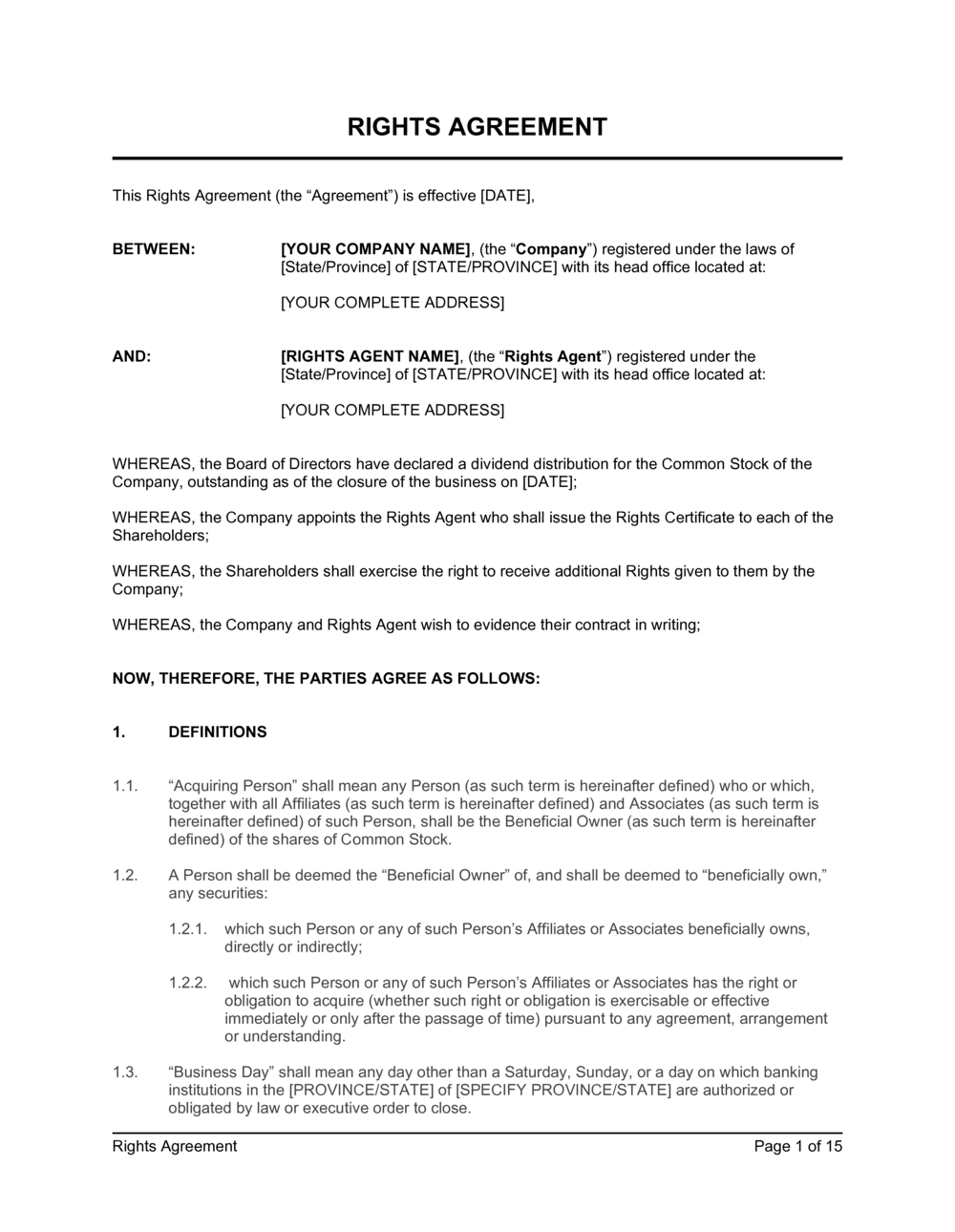
Rights Agreement Template

Free Word download • Edit online • Save & share with Drive • Export to PDF

15 pages30–45 min to fillDifficulty: ComplexSignature requiredLegal review recommended
Learn more ↓
FreeRights Agreement Template

At a glance

What it is
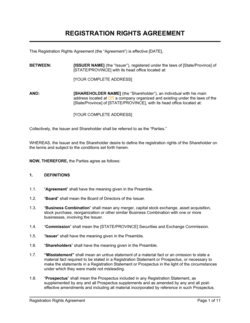
A Rights Agreement is a legally binding contract that defines which rights to intellectual property, content, or creative works are being granted from one party to another — and on what terms. This free Word download gives you a structured, attorney-ready starting point covering scope, exclusivity, territory, royalties, sublicensing, and termination in a single document you can edit online and export as PDF.
When you need it
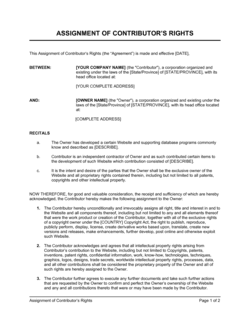
Use it whenever one party licenses, assigns, or otherwise transfers rights to IP, creative works, software, data, or branded content to another party for commercial use. It is equally appropriate for authors licensing publishing rights, companies licensing software or brand assets, and creators monetizing their work through third-party distributors.
What's inside
Grant of rights with scope and exclusivity, territory and term, royalty and payment structure, sublicensing permissions, representations and warranties, confidentiality, indemnification, termination conditions, and governing law. A Schedule A attachment can specify the exact works or assets covered.

What is a Rights Agreement?

A Rights Agreement is a legally binding contract in which one party — the licensor — grants another party — the licensee — defined rights to use, reproduce, distribute, or otherwise exploit an intellectual property asset, while the licensor retains underlying ownership. The asset in question may be a written work, software, photograph, dataset, trademark, brand element, or any other protectable creation. Unlike an outright assignment, a rights agreement structures an ongoing commercial relationship: the scope, exclusivity, territory, and duration of the rights are precisely defined, and the licensor is compensated through royalties, licensing fees, or a combination of both. The agreement governs not just what the licensee may do with the asset, but what happens when the relationship ends, what the licensee may not do, and who bears responsibility if a third-party infringement claim arises.

Why You Need This Document

Operating without a written rights agreement exposes both parties to significant and largely avoidable risk. A licensor who allows use of their IP without a signed agreement has no enforceable basis to collect royalties, restrict the licensee's territory, prevent sublicensing to competitors, or reclaim the work if the relationship breaks down — courts have found implied unlimited licenses in conduct alone. A licensee without a written agreement has no documented right to commercialize the work, leaving every distribution deal, investor disclosure, or downstream sublicense built on an unverifiable foundation. When IP-dependent companies are acquired or audited, missing rights agreements are among the most common transaction blockers. This template gives both parties a clear, professionally structured starting point — covering grant, exclusivity, royalties, termination, and indemnification — that can be reviewed, negotiated, and executed before any rights are exercised.

Which variant fits your situation?

If your situation is…Use this template
Permanently transferring all IP ownership to another partyIP Assignment Agreement
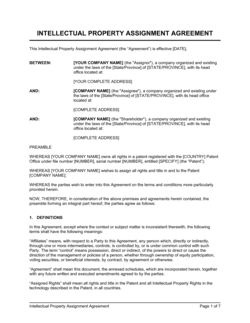
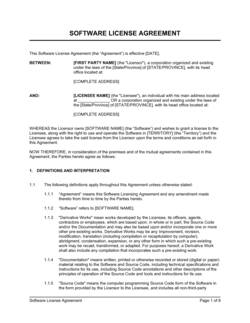
Licensing software to end users under defined termsSoftware License Agreement
Granting a third party the right to use a trademark or brandTrademark License Agreement
Licensing content or creative works to a publisher or distributorContent License Agreement
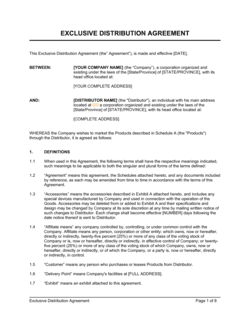
Granting exclusive distribution rights in a specific territoryExclusive Distribution Agreement
Sharing proprietary information before a licensing deal is finalizedNon-Disclosure Agreement
Licensing technology developed under a joint venture or collaborationJoint Venture Agreement

Common mistakes to avoid

❌ Granting 'all rights' without listing them specifically

Why it matters: Overly broad grant language can inadvertently convey rights the licensor intended to keep — including moral rights, adaptation rights, and rights in future media formats — making them difficult or impossible to reclaim.

Fix: List every right being granted by name and exclude everything else with a reservation-of-rights clause: 'All rights not expressly granted herein are reserved by Licensor.'

❌ Leaving 'Net Revenue' undefined

Why it matters: Without a precise definition capping deductible items, licensees may lawfully deduct returns, distribution fees, taxes, and overhead before calculating royalties — reducing the licensor's actual payment to a fraction of the expected amount.

Fix: Define Net Revenue with an exhaustive list of permitted deductions and a maximum aggregate deduction cap, and include an annual audit right to verify reported figures.

❌ No sell-off period after termination

Why it matters: A licensee holding physical inventory or pre-distributed digital copies at the moment of termination is immediately in breach if no sell-off window exists, creating liability for conduct that pre-dated the termination notice.

Fix: Add a 90-to-180-day post-termination sell-off period for physical goods and a 30-day wind-down period for digital distribution, with royalties continuing to accrue on sales made during that window.

❌ Silence on sublicensing rights

Why it matters: Courts in some jurisdictions — particularly in software licensing disputes — have found an implied right to sublicense where the agreement is silent, exposing the licensor's work to unvetted third-party use without compensation.

Fix: Include an explicit sublicensing clause: either 'Licensee may not sublicense without prior written consent' or a defined sublicensing procedure with notice and approval requirements.

❌ No liability cap on indemnification

Why it matters: An uncapped indemnification obligation in a widely distributed content or software license can expose either party to damages far exceeding the commercial value of the license itself, particularly if the licensed work is found to infringe a patent.

Fix: Cap each party's total liability at the greater of fees paid in the preceding 12 months or a fixed dollar amount, and carve out gross negligence, willful misconduct, and fraud from the cap.

❌ Choosing a governing law with no operational connection

Why it matters: A governing law clause that selects a jurisdiction where neither party operates may be overridden by mandatory IP protection statutes in the countries where the rights are actually exercised — especially within the EU.

Fix: Choose the governing law of the jurisdiction where the licensor is domiciled or where the primary commercialization will occur, and confirm that law does not conflict with mandatory local IP statutes in the licensee's territory.

The 10 key clauses, explained

Parties and Recitals

In plain language: Identifies the rights holder (licensor) and the party receiving rights (licensee) by their full legal names, and provides a brief background on the works or assets involved.

Sample language
This Rights Agreement ('Agreement') is entered into as of [DATE] between [LICENSOR LEGAL NAME], a [STATE/COUNTRY] [ENTITY TYPE] ('Licensor'), and [LICENSEE LEGAL NAME], a [STATE/COUNTRY] [ENTITY TYPE] ('Licensee'). Licensor is the owner of [DESCRIPTION OF WORKS] ('Licensed Works') as described in Schedule A.

Common mistake: Using a trade name or brand name instead of the registered legal entity. If the licensor's registered name differs from the brand name on the work, chain-of-title disputes arise when the agreement needs to be enforced or transferred.

Grant of Rights

In plain language: The core clause specifying which rights are licensed — reproduction, distribution, public display, derivative works, sublicensing — and whether the license is exclusive or non-exclusive.

Sample language
Licensor hereby grants to Licensee a [exclusive / non-exclusive], [sublicensable / non-sublicensable], worldwide license to [reproduce / distribute / publicly display / create derivative works of] the Licensed Works during the Term, solely for [PURPOSE].

Common mistake: Listing rights in vague terms like 'all rights' without specifying which rights are included. Overbroad language can inadvertently transfer rights the licensor intends to retain — including moral rights, adaptation rights, or rights in future formats.

Term and Territory

In plain language: Sets the duration of the license and the geographic boundaries within which the licensee may exercise the granted rights.

Sample language
This Agreement shall commence on [START DATE] and continue for a period of [X] years ('Term'), unless earlier terminated pursuant to Section [X]. The license granted herein is limited to [TERRITORY — e.g., the United States and Canada / worldwide].

Common mistake: Omitting a renewal or automatic extension provision. Without one, the licensee's distribution channels and sublicenses terminate abruptly at the end of the term, causing operational disruption.

Royalties and Payment Terms

In plain language: Defines how and when the licensor is paid — percentage of net revenue, flat fee per unit, minimum guaranteed advance, or a fixed periodic payment — and the accounting and reporting obligations.

Sample language
Licensee shall pay Licensor a royalty of [X]% of Net Revenue derived from exploitation of the Licensed Works, payable quarterly within [30] days of the end of each calendar quarter, accompanied by a royalty statement in the form set out in Schedule B.

Common mistake: Failing to define 'Net Revenue' or 'Net Sales.' Licensees have an incentive to deduct broadly — if the deductible items are not capped, royalty income can be reduced to near zero through legitimate accounting choices.

Representations and Warranties

In plain language: Each party confirms it has legal authority to enter the agreement; the licensor specifically warrants that it owns or controls the rights being granted and that exercising those rights will not infringe a third party's IP.

Sample language
Licensor represents and warrants that: (a) it is the sole owner of the Licensed Works or has the right to grant the licenses herein; (b) the Licensed Works do not infringe any third-party intellectual property rights; and (c) there are no pending or threatened claims against the Licensed Works.

Common mistake: Accepting 'to the best of licensor's knowledge' warranty language without requiring the licensor to conduct a clearance search first. Soft knowledge qualifiers shift infringement risk to the licensee.

Sublicensing and Assignment

In plain language: States whether the licensee may grant sub-licenses to third parties, and whether either party may assign their rights under the agreement — including in a merger, acquisition, or asset sale.

Sample language
Licensee shall not sublicense or assign any rights granted under this Agreement without the prior written consent of Licensor, except that either party may assign this Agreement without consent in connection with a merger, acquisition, or sale of all or substantially all of its assets.

Common mistake: Silence on sublicensing. Without an express prohibition, courts in some jurisdictions permit implied sublicensing, particularly in software contexts — which can expose the licensor's work to unvetted third-party use.

Confidentiality

In plain language: Requires both parties to keep non-public terms of the agreement and any proprietary information exchanged during the relationship confidential.

Sample language
Each party agrees to keep confidential the terms of this Agreement and any non-public information received from the other party ('Confidential Information') and shall not disclose such information to any third party without prior written consent, except as required by law.

Common mistake: Omitting a confidentiality clause and relying on a separate NDA that may have already expired. If the NDA predates the agreement, its term may not cover the full license period.

Indemnification and Limitation of Liability

In plain language: Allocates responsibility for third-party claims — typically, the licensor indemnifies for IP ownership issues and the licensee indemnifies for misuse. A liability cap limits total exposure for both parties.

Sample language
Licensor shall indemnify Licensee against any third-party claims arising from a breach of Licensor's representations in Section [X]. Licensee shall indemnify Licensor against claims arising from Licensee's use of the Licensed Works outside the scope of this Agreement. In no event shall either party's liability exceed [the fees paid in the preceding 12 months / $[AMOUNT]].

Common mistake: No liability cap at all. Without one, an IP infringement claim could expose either party to uncapped damages — particularly dangerous where licensed content is distributed at scale.

Termination and Effects of Termination

In plain language: Specifies the conditions that allow either party to terminate — breach, insolvency, convenience — and what happens to sublicenses, inventory, and royalty obligations when the agreement ends.

Sample language
Either party may terminate this Agreement upon [30] days' written notice if the other party materially breaches this Agreement and fails to cure within [15] days of written notice. Upon termination: (a) all licenses granted herein immediately cease; (b) Licensee shall destroy or return all copies of the Licensed Works within [30] days; and (c) accrued royalty obligations survive termination.

Common mistake: No sell-off period for physical inventory upon termination. Licensees holding manufactured goods or printed copies at termination need a limited window — typically 90 to 180 days — to exhaust existing stock without being in breach.

Governing Law and Dispute Resolution

In plain language: Designates the jurisdiction whose law governs the agreement and the mechanism for resolving disputes — litigation, arbitration, or mediation — including venue and language.

Sample language
This Agreement shall be governed by the laws of [STATE/COUNTRY], without regard to conflict-of-law principles. Any dispute arising under this Agreement shall be resolved by binding arbitration administered by [AAA / JAMS / ICC] in [CITY], conducted in [LANGUAGE], except that either party may seek injunctive relief in any court of competent jurisdiction.

Common mistake: Choosing a governing law with no connection to where either party operates or where the rights will be exploited. A governing law choice that conflicts with mandatory local IP statutes — such as EU author's rights rules — can be overridden by those statutes regardless.

How to fill it out

  1. 1

    Identify the parties and the licensed works precisely

    Enter both parties' full registered legal names and entity types. Attach a Schedule A listing every work, asset, or IP element being licensed — title, registration number if any, format, and version.

    💡 Chain of title matters: if the licensor acquired the rights from a third party, confirm that acquisition agreement permits sublicensing before executing this agreement.

  2. 2

    Define the grant of rights with specificity

    List only the rights actually being transferred — reproduction, distribution, public display, adaptation, sublicensing. Anything not listed is retained by the licensor. Specify exclusive or non-exclusive status clearly.

    💡 If the licensee needs rights in formats not yet commercially viable (e.g., VR, future streaming platforms), add a 'new media' clause covering emerging formats within the defined scope.

  3. 3

    Set the term, territory, and renewal conditions

    Enter the start date, duration, and geographic scope. Decide whether the term auto-renews unless either party gives notice, or expires and requires affirmative renewal.

    💡 For content licensed to publishers or distributors, a 3-to-5 year term with a 60-day non-renewal notice window is standard — it gives both parties a predictable review cycle.

  4. 4

    Structure the royalty and payment terms

    Choose the royalty basis — percentage of net revenue, flat per-unit fee, or fixed periodic payment. Define 'Net Revenue' by listing all permitted deductions (returns, taxes, distribution fees) with caps where appropriate. Set the accounting period and payment deadline.

    💡 Include an audit right allowing the licensor to inspect the licensee's royalty calculations once per year with 30 days' written notice — this deters underreporting without requiring litigation to enforce.

  5. 5

    Complete the representations and warranties section

    Confirm that the licensor has conducted sufficient diligence to warrant clean ownership. If the work includes third-party elements — licensed images, open-source code, sampled audio — list them in Schedule A and carve them out of the warranty.

    💡 Ask for a copyright clearance report or title search for high-value works before accepting clean-ownership representations without qualification.

  6. 6

    Set sublicensing and assignment permissions

    Decide whether sublicensing requires consent, is permitted automatically, or is prohibited. Address assignment rights in M&A scenarios — most licensees need to assign rights in an acquisition without seeking consent each time.

    💡 A 'change of control' clause that terminates the license automatically if the licensee is acquired by a direct competitor is a common licensor protection for premium exclusive licenses.

  7. 7

    Draft the termination and post-termination obligations

    List all termination triggers: material breach with cure period, insolvency, convenience. Specify what the licensee must do with copies, sublicenses, and inventory after termination, and how long they have to comply.

    💡 Include a survival clause explicitly listing which provisions — confidentiality, indemnification, accrued royalties, governing law — survive termination. Courts have found ambiguity here even in well-drafted agreements.

  8. 8

    Sign before any rights are exercised

    Both parties must execute the agreement before the licensee begins using, distributing, or commercializing the licensed works. Post-use execution is not retroactive protection in most jurisdictions.

    💡 Use a countersignature page that includes each signatory's full name, title, and date of signature separately — not just one signature block for both parties.

Frequently asked questions

What is a rights agreement?

A rights agreement is a legally binding contract in which one party (the licensor) grants another party (the licensee) defined rights to use, distribute, reproduce, or otherwise exploit an intellectual property asset — such as a written work, software, image, brand, or dataset — in exchange for compensation. It specifies the scope, exclusivity, territory, term, and payment terms of the rights transfer without necessarily conveying ownership of the underlying asset.

What is the difference between a rights agreement and an IP assignment?

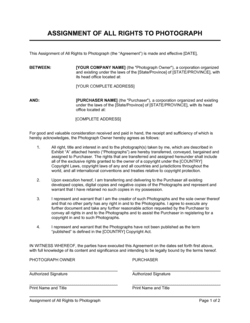
A rights agreement (license) grants the right to use IP for a defined period and scope while the licensor retains ownership. An IP assignment permanently transfers ownership of the IP to the receiving party. If you want to monetize your work while retaining title, use a rights agreement. If you are selling the IP outright — for example, in an asset sale or acquisition — use an assignment agreement.

Does a rights agreement need to be in writing?

In most jurisdictions, exclusive licenses and assignments of copyright must be in writing to be enforceable. Non-exclusive licenses may be implied from conduct in some circumstances, but a written agreement is the only reliable way to define scope, term, royalties, and termination. For any commercial rights arrangement, a signed written agreement is strongly recommended regardless of exclusivity status.

What rights should I reserve in a rights agreement?

At minimum, reserve all rights not expressly granted — adaptation rights, moral rights, rights in future formats or media, and the right to grant licenses to other parties if the license is non-exclusive. Include a standard reservation clause: 'All rights not expressly granted herein are reserved by Licensor.' For publishing and content licenses, separately address audio, film, merchandise, and translation rights even if you do not intend to exploit them immediately.

How are royalties typically structured in a rights agreement?

Royalties are most commonly calculated as a percentage of net revenue (typically 5–25% depending on industry and exclusivity), a flat fee per unit sold or distributed, or a minimum guaranteed advance against future royalties. Publishing agreements often combine an upfront advance with an ongoing royalty. Software and data licenses frequently use fixed periodic fees rather than revenue-based royalties. The structure should reflect how the licensee will generate revenue from the rights granted.

Can a licensee sublicense rights to a third party?

Only if the rights agreement expressly permits it. Without explicit sublicensing authority, a licensee generally cannot grant rights it received to a third party. Where sublicensing is permitted, the agreement should require that sublicenses contain terms at least as protective of the licensor as the main agreement, and that the licensee remains liable for any sublicensee's breach.

What happens to a rights agreement when a company is acquired?

Assignment provisions in the agreement govern this scenario. Many agreements permit assignment to a successor entity in a merger or acquisition without requiring consent. Some include a change-of-control clause that allows the licensor to terminate if the licensee is acquired by a direct competitor. Review the assignment and change-of-control provisions in your agreement before any M&A transaction that involves licensed IP.

Do I need a lawyer to draft a rights agreement?

For straightforward non-exclusive licenses between domestic parties, a well-constructed template is typically sufficient. Consider engaging a lawyer when the license is exclusive, involves significant royalty commitments, covers software or data with third-party components, crosses international jurisdictions, or is a prerequisite to a financing or acquisition. A 1-to-3 hour template review by an IP attorney typically costs $400–$900 and is worthwhile for any license valued above $10,000 annually.

What happens if the licensor does not actually own the rights they licensed?

The licensee may have no valid right to use the work, exposing it to infringement claims from the true owner. The licensor is typically liable under the representations and warranties clause for any resulting losses. To reduce this risk, the licensor should conduct a title search or clearance review before signing, and the licensee should require a specific warranty of clean ownership — not merely a 'to the best of knowledge' qualifier — for high-value licenses.

How this compares to alternatives

vs IP Assignment Agreement

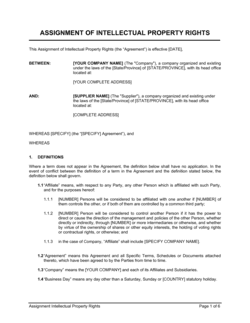
An IP assignment permanently transfers ownership of intellectual property to the receiving party — there is no ongoing relationship, no royalties, and no reversionary right. A rights agreement licenses defined rights while the licensor retains ownership. Use an assignment when you are selling the IP outright; use a rights agreement when you want to monetize it repeatedly or retain control over how it is used.

vs Non-Disclosure Agreement

An NDA protects confidential information shared during negotiations or collaboration but does not grant any right to use IP. A rights agreement grants usage rights and governs the commercial relationship. The two documents serve sequential purposes — an NDA should be signed before sharing proprietary details, and a rights agreement executed once terms are agreed.

vs Software License Agreement

A software license agreement is a specialized form of rights agreement tailored to the technical and commercial characteristics of software — covering installation rights, SaaS access, updates, support, and acceptable-use restrictions. A general rights agreement is better suited to content, brand assets, and creative works where software-specific provisions are not needed.

vs Joint Venture Agreement

A joint venture agreement creates a shared business structure where both parties contribute resources — often including IP — and share profits and governance. A rights agreement is a transactional document: one party grants rights to another without creating an ongoing shared entity. If both parties are co-developing IP together, a joint venture or co-development agreement is more appropriate than a straight rights license.

Industry-specific considerations

Publishing and Media

Territory-by-territory rights splits, translation and adaptation rights, advance-plus-royalty payment structures, and reversion clauses if the licensee fails to publish within a defined window.

Technology / SaaS

API access rights, data licensing, software module sublicensing to enterprise customers, and version-specific license scope tied to product release cycles.

Creative and Design Agencies

Usage-based licensing for photography, illustration, and video assets — specifying media type, campaign duration, geographic reach, and whether exclusivity is included in the fee.

Manufacturing and Consumer Goods

Brand and trademark licensing for co-branded product lines, with quality control clauses, inspection rights, and royalty audits tied to units manufactured rather than units sold.

Jurisdictional notes

United States

Under US copyright law (17 U.S.C. § 204), exclusive licenses must be in writing and signed by the rights holder to be enforceable. Non-exclusive licenses may be implied by conduct but should always be documented. The work-made-for-hire doctrine under §101 can vest copyright in the commissioning party for certain contractor-created works if a written agreement so states — confirm chain of title before executing any license. State contract law governs breach and damages claims.

Canada

The Copyright Act (R.S.C. 1985, c. C-42) requires exclusive licenses to be in writing. Moral rights cannot be assigned in Canada but may be waived by the author — a moral rights waiver should be included for any license involving modification or rebranding of creative works. Quebec's civil law framework applies to agreements governed by Quebec law and may affect interpretation of ambiguous terms differently than common-law provinces.

United Kingdom

The Copyright, Designs and Patents Act 1988 requires exclusive copyright licenses to be in writing and signed by or on behalf of the copyright owner. UK authors retain moral rights that must be expressly waived in writing if the licensee intends to modify the work or use it without attribution. Post-Brexit, UK and EU IP registrations are now separate — a license covering 'Europe' should specify whether it includes the UK.

European Union

EU member states implement the InfoSoc Directive (2001/29/EC) and the DSM Directive (2019/790/EU), which require transparent and proportionate remuneration for creators and impose reporting obligations on licensees in some sectors. Moral rights protections are strong across most civil-law member states and cannot be waived in France and Germany. GDPR applies to any rights agreement involving personal data embedded in licensed content or datasets. Governing law choices are generally respected within the EU under Rome I, but mandatory local IP provisions cannot be contracted away.

Template vs lawyer — what fits your deal?

PathBest forCostTime
Use the templateNon-exclusive domestic licenses for content, creative assets, or software where the annual value is under $10,000Free30–60 minutes
Template + legal reviewExclusive licenses, cross-border rights, royalty-bearing arrangements, or licenses connected to a financing or acquisition$400–$900 (IP attorney review)2–5 days
Custom draftedHigh-value or highly exclusive IP licenses, publishing deals, patent licensing, software platform agreements, or international multi-territory rights arrangements$2,000–$8,000+2–4 weeks

Glossary

Grant of Rights
The specific clause that identifies exactly which rights are being transferred or licensed — reproduction, distribution, public performance, derivative works, or a combination.
Exclusive License
A license that prevents the rights holder from granting the same rights to any other party, giving the licensee sole commercial use within the agreed scope.
Non-Exclusive License
A license that permits the licensor to grant the same rights to multiple parties simultaneously — the licensee has no exclusivity protection.
Sublicensing
The right of a licensee to further license the granted rights to a third party — if not expressly permitted in the agreement, it is generally prohibited.
Royalty
A recurring payment from the licensee to the licensor calculated as a percentage of revenue, a flat fee per unit, or a fixed periodic amount in exchange for the rights granted.
Term
The duration for which the rights are granted — either a fixed period (e.g., three years), tied to a project lifecycle, or in perpetuity.
Territory
The geographic scope within which the licensee may exercise the granted rights — e.g., North America, worldwide, or a specific country.
Moral Rights
Rights retained by a creator under civil law (and some common-law) systems to be credited as the author and to object to distortion of their work, separate from economic exploitation rights.
Work Made for Hire
A legal doctrine under US copyright law whereby work created by an employee within the scope of employment, or under certain contractor agreements, vests copyright ownership directly in the hiring party.
Derivative Work
A new creative work based on or adapted from an existing work — translations, adaptations, sequels, or remixes — the right to create which must be expressly granted.
Representations and Warranties
Statements made by each party confirming they have the authority and ownership to enter the agreement and that the rights being granted are free from third-party claims.
Indemnification
A contractual obligation requiring one party to compensate the other for losses, claims, or legal costs arising from a breach of the agreement or an IP infringement claim.

Part of your Business Operating System

This document is one of 3,000+ business & legal templates included in Business in a Box.

  • Fill-in-the-blanks — ready in minutes
  • 100% customizable Word document
  • Compatible with all office suites
  • Export to PDF and share electronically

Create your document in 3 simple steps.

From template to signed document — all inside one Business Operating System.
1
Download or open template

Access over 3,000+ business and legal templates for any business task, project or initiative.

2
Edit and fill in the blanks with AI

Customize your ready-made business document template and save it in the cloud.

3
Save, Share, Send, Sign

Share your files and folders with your team. Create a space of seamless collaboration.

Save time, save money, and create top-quality documents.

★★★★★

"Fantastic value! I'm not sure how I'd do without it. It's worth its weight in gold and paid back for itself many times."

Managing Director · Mall Farm
Robert Whalley
Managing Director, Mall Farm Proprietary Limited
★★★★★

"I have been using Business in a Box for years. It has been the most useful source of templates I have encountered. I recommend it to anyone."

Business Owner · 4+ years
Dr Michael John Freestone
Business Owner
★★★★★

"It has been a life saver so many times I have lost count. Business in a Box has saved me so much time and as you know, time is money."

Owner · Upstate Web
David G. Moore Jr.
Owner, Upstate Web

Run your business with a system — not scattered tools

Stop downloading documents. Start operating with clarity. Business in a Box gives you the Business Operating System used by over 250,000 companies worldwide to structure, run, and grow their business.

Free Forever Plan · No credit card required