Data Governance Framework Template

Free download β€’ Use as a template β€’ Print or share

12 pagesβ€’25–30 min to useβ€’Difficulty: Standard
Learn more ↓
FreeData Governance Framework Template

At a glance

What it is
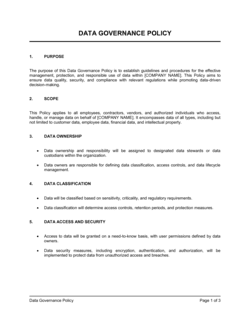
A Data Governance Framework is an operational document that defines how an organization manages, protects, and uses its data assets β€” establishing ownership, quality standards, access controls, and accountability structures across departments. This free Word download gives you a structured starting point you can edit online and export as PDF to share with IT, compliance, and leadership teams.
When you need it
Use it when preparing for a regulatory audit, scaling data operations across multiple teams, implementing a new data platform, or responding to a data quality or security incident that exposed gaps in accountability.
What's inside
Purpose and scope, governance structure and roles, data classification policy, quality standards, access and security controls, lifecycle management, compliance obligations, and a continuous-improvement process with defined review cycles.

What is a Data Governance Framework?

A Data Governance Framework is an operational document that defines how an organization manages, protects, and uses its data assets as a strategic resource. It establishes data ownership at the domain level, sets quality standards with measurable thresholds, classifies data by sensitivity, controls who can access what under which conditions, and maps every data type to a retention and deletion schedule. Unlike a one-off data policy, a framework provides the structural scaffolding that connects people, processes, and technology into a coherent, auditable system for data accountability across the entire organization.

Why You Need This Document

Without a formalized data governance framework, organizations routinely produce conflicting reports from the same underlying data, grant access that is never revoked, and discover compliance gaps only during a regulatory audit or breach investigation. The downstream costs are concrete: GDPR fines start at 2% of annual global turnover, HIPAA penalties can reach $1.9 million per violation category per year, and data quality failures cost organizations an estimated $12.9 million annually on average according to Gartner. A governance framework prevents these outcomes by assigning clear ownership before disputes arise, setting quality baselines before dashboards mislead executives, and documenting access controls before an auditor asks to see them. This template gives you a structured, immediately actionable starting point β€” eliminating the blank-page problem that causes most governance initiatives to stall before they begin.

Which variant fits your situation?

If your situation is…Use this template
Large enterprise with multiple business units and a dedicated data teamEnterprise Data Governance Framework
Small or mid-size business establishing data governance for the first timeData Governance Framework
Organization primarily focused on personal data and privacy complianceData Privacy Policy
Team needing to define how data is stored, retained, and deletedData Retention Policy
Business documenting who can access which systems and under what conditionsData Access Control Policy
Company preparing for a SOC 2 or ISO 27001 auditInformation Security Policy
Analytics team defining how data flows between source systems and reportsData Management Plan

Common mistakes to avoid

❌ Scoping the framework to 'all data' without naming domains

Why it matters: Without domain-level scope, no team has a clear mandate and the framework becomes a policy document nobody acts on.

Fix: List specific data domains (customer, financial, HR, product) in the scope section and assign an owner to each before publishing.

❌ Assigning data ownership to IT instead of business leadership

Why it matters: IT can enforce technical controls but cannot make decisions about how data is used, interpreted, or prioritized β€” those are business decisions.

Fix: Assign data owners from the business units that depend on each domain, and make IT the custodian responsible for technical implementation.

❌ Publishing quality standards without measurable thresholds

Why it matters: A standard that says 'data must be complete and accurate' cannot be audited, reported, or enforced β€” it is unactionable.

Fix: Attach a numeric threshold to each quality dimension (e.g., '95% completeness on mandatory customer fields') and name the system that measures it.

❌ No defined process for access revocation on role change or departure

Why it matters: Stale access permissions are one of the most common sources of data breaches and audit findings β€” and the simplest to prevent with a documented process.

Fix: Add an access revocation step to your HR offboarding and role-change workflows, with a maximum revocation window of 24–48 hours.

❌ Conflating compliance obligations with governance policy

Why it matters: Embedding specific regulatory text inside an operational framework creates a maintenance burden β€” every regulatory update forces a framework revision.

Fix: Reference regulations by name and link to a separate compliance obligations register that can be updated independently of the main framework.

❌ Publishing without a scheduled review cycle

Why it matters: A framework without a review date becomes outdated as regulations, systems, and organizational structures change β€” often within 12 months of publication.

Fix: Set a specific annual review month, assign an owner, and list the triggers for out-of-cycle updates in the document itself.

The 9 key sections, explained

Purpose, scope, and objectives

Governance structure and roles

Data classification policy

Data quality standards and measurement

Data access and security controls

Data lifecycle and retention

Compliance and regulatory obligations

Data incident management

Continuous improvement and review cycle

How to fill it out

  1. 1

    Define the scope and priority data domains

    List the data domains your organization manages (e.g., customer, financial, product, employee) and identify which ones carry the highest regulatory or operational risk. Start the framework with those domains rather than trying to govern everything at once.

    πŸ’‘ Limit your initial scope to three to five domains β€” a narrow, well-governed framework delivers more value than a comprehensive one nobody follows.

  2. 2

    Map the governance structure to existing roles

    Identify who will serve as the data governance council chair (typically a CDO, CTO, or COO), assign data owners from business leadership for each domain, and name data stewards from operational teams.

    πŸ’‘ Data owners should be VP-level or above β€” ownership without budget authority is ineffective.

  3. 3

    Complete the data classification tiers

    Define three to four sensitivity tiers, provide concrete examples of data that belongs in each tier, and write the handling rules for each. Cross-reference your existing IT security policy to avoid conflicting standards.

    πŸ’‘ Run the draft classification scheme past your legal or compliance team before publishing β€” misclassifying regulated data (PII, PHI, financial records) creates liability.

  4. 4

    Set measurable data quality thresholds

    For each priority domain, define at least two quality dimensions (e.g., completeness and accuracy), set a numeric threshold for each, and identify the system or process that will measure them.

    πŸ’‘ Set thresholds based on current baseline measurements, not aspirational targets β€” a threshold you already miss on day one destroys credibility.

  5. 5

    Document access control rules and the approval workflow

    For each data classification tier, specify who can request access, who approves it, how access is provisioned, and how it is reviewed and revoked. Include the timeline for each step.

    πŸ’‘ Tie access review to your HR offboarding checklist β€” automated triggers from your HRIS are more reliable than manual processes.

  6. 6

    Fill in the retention schedule by data category

    Research the retention minimums for each data type under applicable regulations (GDPR, HIPAA, SOX, state law), then set your retention periods at or above those minimums. Document the deletion method and logging requirement.

    πŸ’‘ Build the retention schedule in a separate reference table within the document β€” it will be referenced frequently and is easier to update as a standalone table.

  7. 7

    Define the incident response thresholds and escalation chain

    Specify what triggers a data incident declaration, who is notified first, the maximum response time, and the root-cause analysis requirement. Align this section with your existing IT incident response or security policy.

    πŸ’‘ Run a tabletop exercise with the data governance council within 30 days of publishing β€” undiscovered gaps in the escalation chain surface faster in a drill than in a real incident.

  8. 8

    Schedule the annual review and assign the owner

    Enter a specific calendar month for the annual review, name the person responsible for initiating it, and list the triggers for an out-of-cycle update (regulatory change, platform migration, acquisition).

    πŸ’‘ Add the annual review as a recurring calendar event for the governance council chair on the day you publish the framework β€” not after the first review cycle is missed.

Frequently asked questions

What is a data governance framework?

A data governance framework is a structured document that defines how an organization manages, protects, and uses its data assets. It establishes data ownership, quality standards, access controls, classification tiers, retention schedules, and compliance obligations across all departments. It functions as the authoritative policy reference for anyone in the organization who creates, uses, or is accountable for data.

Why do organizations need a data governance framework?

Without a governance framework, organizations accumulate inconsistent data definitions, conflicting reports, uncontrolled access, and undocumented compliance obligations. These gaps lead to regulatory fines, failed audits, poor business decisions based on bad data, and significant remediation costs when a data incident occurs. A framework establishes clear accountability before those problems arise.

What is the difference between data governance and data management?

Data governance defines the policies, roles, and standards β€” the rules of the road. Data management is the operational execution of those rules: building pipelines, maintaining systems, running quality checks, and storing backups. Governance without management is just a policy document; management without governance produces inconsistent, ungoverned data assets.

Who should own the data governance framework?

In larger organizations, the Chief Data Officer or a Data Governance Council typically owns the framework. In mid-size businesses, ownership often falls to the COO, CTO, or a senior IT director. What matters more than the title is that the owner has cross-functional authority to enforce policy decisions across IT, business operations, and compliance.

How long does it take to implement a data governance framework?

A basic framework covering three to five data domains can be drafted in two to four weeks using a structured template. Full implementation β€” including role assignments, tool configuration, quality measurement baselines, and staff training β€” typically takes three to six months. Enterprise-scale implementations with dozens of domains and legacy system complexity can run 12–18 months.

What regulations does a data governance framework help address?

A well-structured framework directly supports compliance with GDPR (EU personal data protection), CCPA (California consumer privacy), HIPAA (US health data), SOX (financial reporting controls), and ISO 27001 (information security management). The framework does not replace legal counsel for any of these regulations, but it documents the operational controls auditors expect to see.

What is a data governance council?

A data governance council is the cross-functional body responsible for approving data policies, resolving escalated data disputes, prioritizing governance initiatives, and reviewing compliance status. It typically includes the data governance owner, data domain owners from key business units, the IT or security lead, and a legal or compliance representative. It meets monthly or quarterly depending on organizational scale.

How is a data governance framework different from a data privacy policy?

A data privacy policy is a narrower document focused specifically on how personal data about individuals is collected, used, and protected β€” often a public-facing statement for customers. A data governance framework is an internal operational document covering all data assets across all domains, including non-personal data such as financial records, product data, and operational metrics. The privacy policy is one output of a governance framework, not a substitute for it.

How often should a data governance framework be reviewed?

An annual review is the standard minimum for most organizations. Out-of-cycle reviews should be triggered by material regulatory changes (a new privacy law, an updated HIPAA rule), significant platform migrations, data incidents, or acquisitions that introduce new data assets. The review owner and triggers should be named explicitly in the framework itself.

How this compares to alternatives

vs Data Privacy Policy

A data privacy policy addresses how personal data about customers and employees is collected, used, and disclosed β€” it is often customer-facing and legally required. A data governance framework is a broader internal document covering all data assets, roles, quality standards, and operational processes. The privacy policy is one component that a governance framework should reference, not a replacement for it.

vs Information Security Policy

An information security policy focuses on protecting systems and data from unauthorized access, breaches, and loss β€” covering network security, device management, and incident response. A data governance framework addresses data quality, ownership, classification, and lifecycle in addition to security. The two documents are complementary and should cross-reference each other, particularly on access controls and incident management.

vs Data Management Plan

A data management plan is typically a project-level document β€” common in research and grant contexts β€” describing how data will be collected, stored, and shared for a specific initiative. A data governance framework is an enterprise-wide policy document that governs all ongoing data operations. A project's data management plan should operate within the rules set by the enterprise framework.

vs IT Policy

An IT policy governs how technology systems, devices, and networks are used and maintained. A data governance framework governs the data that flows through those systems β€” defining ownership, quality, classification, and lifecycle independently of the underlying technology. Both are needed; IT policy handles the infrastructure, governance handles the asset.

Industry-specific considerations

Financial services

SOX compliance for financial reporting data, strict access controls on transaction records, and data lineage requirements for regulatory capital calculations.

Healthcare

HIPAA-mandated PHI classification, minimum necessary access standards, breach notification timelines, and audit logs for all access to patient records.

SaaS / Technology

Multi-tenant data isolation, GDPR and CCPA obligations for customer PII, and data quality standards for the analytics pipelines that drive product decisions.

Retail / E-commerce

Customer PII governance across marketing, CRM, and fulfillment systems, PCI DSS alignment for payment data, and data retention schedules for purchase history.

Manufacturing

Operational data quality for production metrics, IP protection for proprietary product specifications, and supply chain data sharing agreements with tier-1 suppliers.

Professional services

Client confidentiality obligations, matter data classification for legal and consulting firms, and conflict-of-interest data controls across practice groups.

Template vs pro β€” what fits your needs?

PathBest forCostTime
Use the templateSMBs and startups establishing initial data governance covering three to five domainsFree2–4 weeks to draft and socialize
Template + professional reviewOrganizations subject to GDPR, HIPAA, or SOX needing a compliance-aligned framework$500–$2,000 for a compliance consultant or data governance advisor review4–6 weeks
Custom draftedEnterprises with dozens of data domains, legacy system complexity, or an upcoming regulatory audit$5,000–$25,000 for a data governance consulting engagement3–6 months

Glossary

Data Governance
The set of policies, processes, roles, and standards that define how an organization manages data as a strategic asset.
Data Owner
The individual or team accountable for the accuracy, security, and appropriate use of a specific data domain or dataset.
Data Steward
A person responsible for the day-to-day management of a data domain β€” enforcing quality rules, resolving issues, and maintaining metadata.
Data Classification
A tiered labeling system that assigns sensitivity levels to data (e.g., public, internal, confidential, restricted) to determine handling and access rules.
Data Lineage
A traceable record of where data originated, how it has moved through systems, and how it has been transformed β€” used to diagnose quality issues and validate reports.
Metadata
Descriptive information about a dataset β€” its source, format, owner, update frequency, and definitions β€” that makes the data discoverable and interpretable.
Master Data Management (MDM)
A discipline that ensures a single, authoritative version of core business entities β€” customers, products, locations β€” is maintained and shared across systems.
Data Quality Dimensions
Standard criteria for evaluating data quality, typically including accuracy, completeness, consistency, timeliness, and validity.
Access Control
Rules that define which users or systems can read, write, or delete specific data, typically enforced through roles and permissions.
Data Catalog
A centralized inventory of an organization's data assets, including definitions, ownership, quality scores, and lineage β€” the searchable index of governed data.
PII (Personally Identifiable Information)
Any data that can identify a specific individual β€” such as name, email, Social Security number, or IP address β€” subject to privacy regulations.
Data Lifecycle
The full arc of a dataset from creation or ingestion through active use, archival, and eventual deletion or destruction.

Part of your Business Operating System

This document is one of 3,000+ business & legal templates included in Business in a Box.

  • Fill-in-the-blanks β€” ready in minutes
  • 100% customizable Word document
  • Compatible with all office suites
  • Export to PDF and share electronically

Create your document in 3 simple steps.

From template to signed document β€” all inside one Business Operating System.
1
Download or open template

Access over 3,000+ business and legal templates for any business task, project or initiative.

2
Edit and fill in the blanks with AI

Customize your ready-made business document template and save it in the cloud.

3
Save, Share, Send, Sign

Share your files and folders with your team. Create a space of seamless collaboration.

Save time, save money, and create top-quality documents.

β˜…β˜…β˜…β˜…β˜…

"Fantastic value! I'm not sure how I'd do without it. It's worth its weight in gold and paid back for itself many times."

Managing Director Β· Mall Farm
Robert Whalley
Managing Director, Mall Farm Proprietary Limited
β˜…β˜…β˜…β˜…β˜…

"I have been using Business in a Box for years. It has been the most useful source of templates I have encountered. I recommend it to anyone."

Business Owner Β· 4+ years
Dr Michael John Freestone
Business Owner
β˜…β˜…β˜…β˜…β˜…

"It has been a life saver so many times I have lost count. Business in a Box has saved me so much time and as you know, time is money."

Owner Β· Upstate Web
David G. Moore Jr.
Owner, Upstate Web

Run your business with a system β€” not scattered tools

Stop downloading documents. Start operating with clarity. Business in a Box gives you the Business Operating System used by over 250,000 companies worldwide to structure, run, and grow their business.

Start freeΒ Β·Β No credit card required