Conflict Of Interest Policy For Board Members Template

Free Word download β€’ Edit online β€’ Save & share with Drive β€’ Export to PDF

3 pagesβ€’20–30 min to fillβ€’Difficulty: Standard
Learn more ↓
FreeConflict Of Interest Policy For Board Members Template

At a glance

What it is
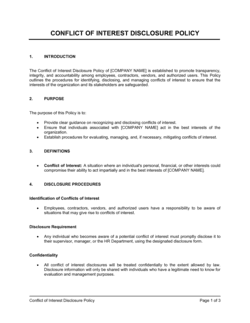
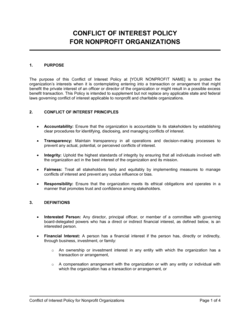
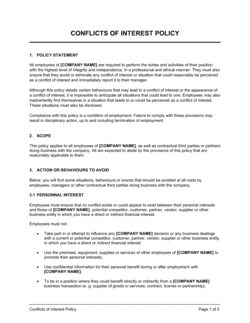
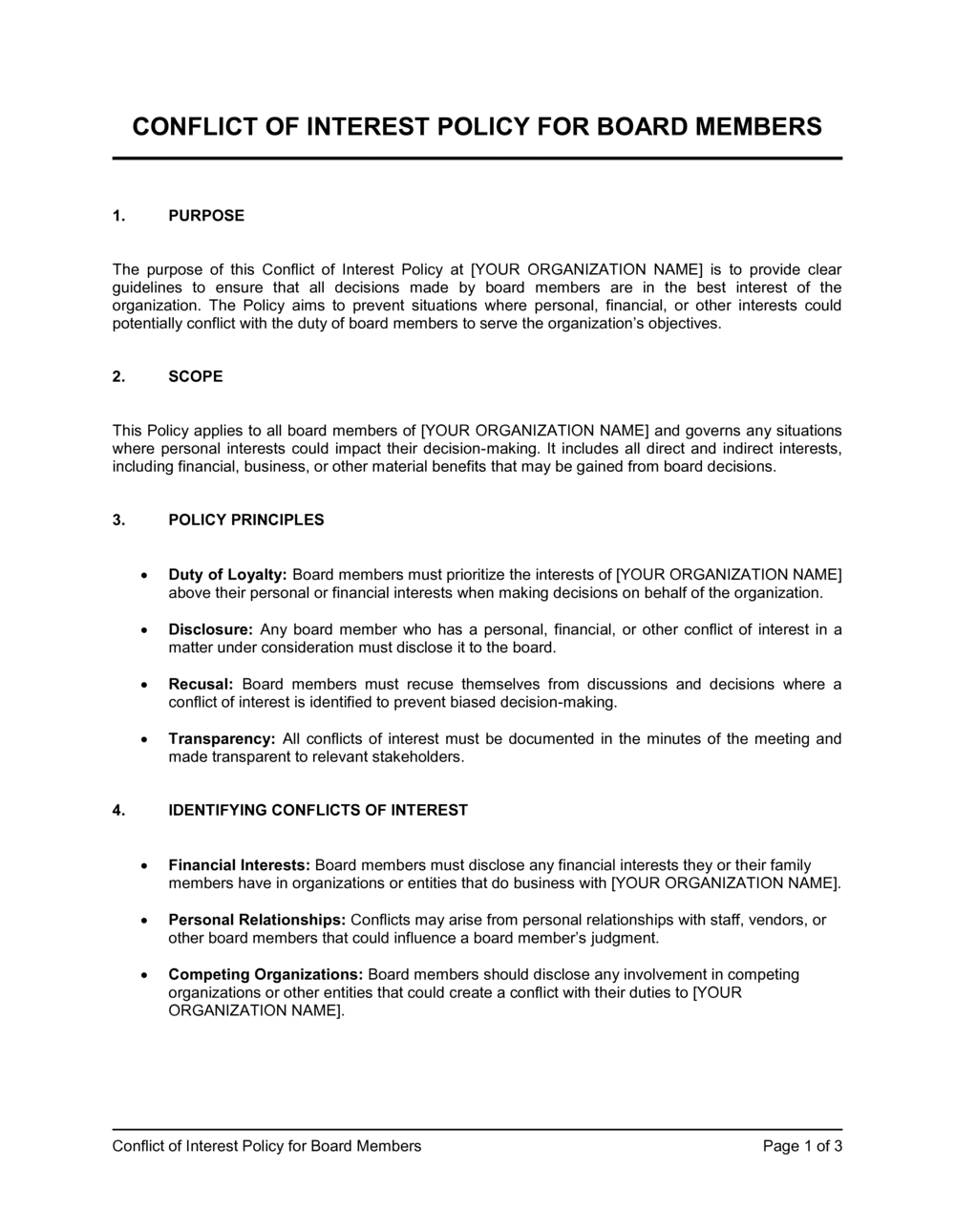
A Conflict of Interest Policy for Board Members is a governance document that defines what constitutes a conflict of interest, requires board members to disclose financial or personal interests that could influence their decisions, and establishes a formal recusal procedure for affected votes. This free Word download gives boards a ready-to-use policy they can edit online and adopt at a board meeting, then export as PDF for distribution and annual certification.
When you need it
Adopt it when forming a new board, when an existing board has no written policy, or when applying for nonprofit tax-exempt status β€” the IRS Form 990 asks directly whether your organization has a conflict of interest policy in place. It is also triggered any time a board member discloses a financial relationship with a vendor, partner, or transaction the board is considering.
What's inside
Purpose and scope, definitions of covered interests and conflicts, annual disclosure and certification requirements, procedures for identifying and managing conflicts during meetings, recusal and abstention rules, recordkeeping obligations, and consequences for policy violations.

What is a Conflict of Interest Policy for Board Members?

A Conflict of Interest Policy for Board Members is a governance document that identifies when a board member's personal, financial, or professional interests could compromise their judgment on a decision made on behalf of the organization. It establishes three core obligations: disclosure of any interest that could create a conflict, recusal from deliberation and voting when a conflict is identified, and documentation of the process so the board can demonstrate it acted independently and in the organization's best interest. The policy applies to nonprofits, private companies, and public institutions alike β€” anywhere a board member's outside relationships could intersect with decisions they are entrusted to make.

Why You Need This Document

Without a written conflict of interest policy, a single undisclosed related-party transaction can trigger IRS scrutiny, jeopardize a nonprofit's tax-exempt status, or expose individual board members to personal liability for breach of the duty of loyalty. The IRS Form 990 asks directly whether an organization has a written conflict of interest policy β€” answering "no" invites examination. Beyond compliance, the policy protects board members themselves: a clear recusal procedure shields a disinterested majority from allegations of self-dealing when the record shows who disclosed what, who left the room, and what alternatives were considered. Without that paper trail, a challenged transaction becomes a credibility contest rather than a documented governance process. This template gives boards a structured, ready-to-adopt policy that closes the disclosure gap, standardizes the recusal process, and creates the annual certification record that regulators, funders, and auditors expect to find.

Which variant fits your situation?

If your situation is…Use this template
501(c)(3) nonprofit seeking or maintaining tax-exempt statusNonprofit Conflict of Interest Policy
For-profit corporation with a board of directorsCorporate Conflict of Interest Policy
Collecting annual disclosures from individual board membersConflict of Interest Disclosure Form
Governing employee or staff conflicts, not board-level conflictsEmployee Conflict of Interest Policy
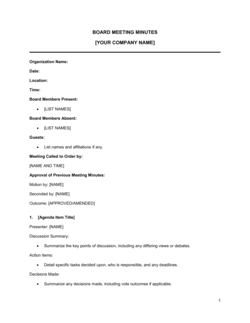
Documenting a specific transaction reviewed under the policyBoard Meeting Minutes
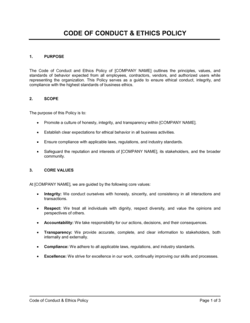
Establishing a broader ethics framework beyond conflict managementCode of Ethics and Business Conduct
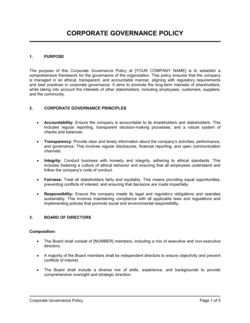
Setting up comprehensive board governance in a single documentBoard Governance Policy

Common mistakes to avoid

❌ Collecting disclosures only once at onboarding

Why it matters: Board members' financial situations change β€” new investments, family member employment, or business partnerships can create conflicts that did not exist when they joined the board.

Fix: Require a signed annual disclosure at the start of each fiscal year and a mid-year update obligation for any new interest that arises between annual cycles.

❌ Allowing the interested person to stay in the room during deliberation

Why it matters: Physical presence during deliberation creates social pressure on other board members even if the interested person says nothing β€” undermining the independence the policy is designed to ensure.

Fix: Require the interested person to leave the meeting room for the full duration of the deliberation and vote, and document their absence in the minutes.

❌ Skipping the alternatives analysis before approving related-party transactions

Why it matters: Approving a related-party contract without documenting that alternatives were considered is the pattern regulators and plaintiffs cite when alleging self-dealing or breach of duty of loyalty.

Fix: Require the disinterested board members to document at least one alternative or explain in writing why no comparable arrangement is available before any vote.

❌ Omitting compensation decisions from the conflict framework

Why it matters: Executive compensation approved without a documented, disinterested process is the most common basis for IRS excess-benefit transaction findings against nonprofit organizations.

Fix: Add a dedicated compensation section to the policy requiring disinterested board approval and comparability data from at least two independent sources for every compensation decision.

❌ No consequences stated for policy violations

Why it matters: A conflict of interest policy with no enforcement language signals that the board does not treat the policy as binding β€” which is exactly the argument a regulator or plaintiff will make.

Fix: Include a clear consequences section listing corrective actions ranging from censure to transaction rescission to board removal, and reference the organization's bylaws for removal procedures.

❌ Defining 'conflict of interest' too narrowly

Why it matters: Limiting the definition to direct financial interests misses family member relationships, honorary positions, and indirect business ties that courts and the IRS treat as conflicts.

Fix: Expand the definition to cover spouses, domestic partners, children, siblings, and entities in which any of these persons hold a material interest β€” and list examples in the definitions section.

The 10 key sections, explained

Purpose and scope

Definitions

Disclosure requirements

Procedure for managing conflicts during meetings

Determining whether a conflict exists

Alternatives investigation and approval

Recordkeeping

Annual disclosure and certification

Violations and consequences

Compensation decisions

How to fill it out

  1. 1

    Insert your organization's legal name and entity type

    Replace all instances of [ORGANIZATION NAME] with the full registered legal name. Note whether the entity is a nonprofit corporation, for-profit corporation, LLC, or other structure β€” this affects which provisions are most relevant.

    πŸ’‘ Confirm the legal name matches your articles of incorporation or certificate of formation exactly β€” not a trade name or abbreviation.

  2. 2

    Define the threshold for 'financial interest'

    Set the ownership percentage that triggers a disclosure obligation β€” typically 5% for nonprofits following IRS guidance. Adjust the compensation threshold to reflect your organization's size and the types of arrangements board members are likely to have.

    πŸ’‘ IRS guidance and state nonprofit laws often reference 35% ownership for 'substantial' interests β€” consider including both a 5% disclosure threshold and a 35% presumptive-conflict threshold.

  3. 3

    Identify who receives disclosures

    Designate a specific role β€” board chair, governance committee chair, or corporate secretary β€” to receive completed disclosure forms and flag potential conflicts before meetings.

    πŸ’‘ Avoid designating the executive director if they report to the board; a conflict involving the ED should go to the board chair directly.

  4. 4

    Set disclosure and update timelines

    Fill in the number of days (typically 30) after the fiscal year start for annual disclosures, and the number of days (typically 10) for mid-year updates when a new interest arises.

    πŸ’‘ Calendar the annual disclosure deadline in your board meeting schedule so it happens consistently β€” tie it to the first board meeting of the fiscal year.

  5. 5

    Customize the recusal procedure to match your meeting format

    Decide whether the interested person must leave the room entirely or may remain but not vote. The stronger approach β€” leaving the room β€” is recommended for nonprofit boards subject to IRS scrutiny.

    πŸ’‘ Reference this section in your board meeting agenda template so the chair knows exactly which steps to follow when a conflict arises in real time.

  6. 6

    Attach the annual disclosure statement as Exhibit A

    Complete the disclosure form template included in the document, listing the categories of relationships and interests each board member must affirmatively address. Include a signature and date line.

    πŸ’‘ Keep completed disclosure statements in a dedicated governance file for at least five years β€” Form 990 auditors and state charity regulators commonly request them.

  7. 7

    Adopt the policy by board resolution

    Present the final policy to the full board for a formal vote. Record the adoption date, vote count, and policy version number in the board meeting minutes.

    πŸ’‘ Include the policy adoption resolution in your governance records alongside your bylaws β€” not just in the meeting minutes β€” so it is easy to locate during due diligence.

  8. 8

    Distribute and collect signed acknowledgments

    Send every current board member a copy and collect a signed acknowledgment that they have read the policy. Repeat this process for every new board member at onboarding.

    πŸ’‘ For new board members, make policy acknowledgment part of the onboarding packet alongside the bylaws and the most recent annual disclosure form.

Frequently asked questions

What is a conflict of interest policy for board members?

A conflict of interest policy for board members is a governance document that defines when a board member's personal or financial interests could improperly influence their decisions on behalf of the organization. It requires disclosure of those interests, establishes a recusal procedure for affected votes, and creates a recordkeeping trail that demonstrates the board acted with independence and in the organization's best interest.

Is a conflict of interest policy required by law?

No federal law requires private companies to adopt a conflict of interest policy, but the IRS Form 990 β€” filed annually by most tax-exempt organizations β€” asks whether the organization has one. Many states require nonprofits to have a written conflict of interest policy as a condition of charitable registration. For publicly traded companies, stock exchange listing standards and SEC rules create de facto requirements through audit committee independence rules.

What should a board conflict of interest policy include?

At minimum: a definition of what constitutes a conflict and who is covered, an annual disclosure requirement with a signed statement, a procedure for identifying and managing conflicts during board meetings, a recusal rule requiring the interested person to leave deliberations, a requirement to consider alternatives before approving related-party transactions, recordkeeping obligations, and stated consequences for violations.

How often should board members complete a conflict of interest disclosure?

Annual disclosure at the start of each fiscal year is the standard minimum. Board members should also be required to update their disclosure within 10 days whenever a new interest arises β€” a new investment, a family member joining a vendor, or a new board position at another organization. Collecting disclosures once at onboarding and never again is the most common compliance gap boards face.

What is the difference between recusal and abstention?

Recusal means the board member removes themselves entirely from deliberation and the vote β€” typically leaving the room. Abstention means the member stays in the room, participates in deliberation, but does not cast a vote. For conflict of interest purposes, recusal is the stronger and generally recommended standard because it removes both the vote and the implicit influence over other members during discussion.

Does a conflict of interest policy apply to nonprofit and for-profit boards equally?

The policy applies to both, but the stakes differ. For nonprofits, an inadequate conflict policy can jeopardize tax-exempt status and trigger IRS excess-benefit transaction penalties. For for-profit corporations, inadequate conflict procedures can expose directors to breach of fiduciary duty claims and shareholder derivative suits. The core structure of the policy β€” disclosure, recusal, alternatives analysis, and recordkeeping β€” is appropriate for both types of boards.

What happens if a board member fails to disclose a conflict?

Failure to disclose can expose the board member to personal liability for breach of the duty of loyalty. The affected transaction may be rescinded or voided if challenged. For nonprofits, undisclosed related-party transactions are the basis for IRS excess-benefit findings, which carry excise taxes on both the recipient and approving board members. The policy should specify consequences including censure, transaction rescission, or removal from the board.

How does this policy interact with the organization's bylaws?

The conflict of interest policy supplements the bylaws but does not replace them. Bylaws typically govern board composition, quorum, and voting procedures. The conflict policy adds a procedural layer for situations where a board member's interests may compromise their vote. Reference the bylaws in the policy's consequences section for removal procedures, and ensure the two documents are consistent on quorum rules when recusals reduce the number of voting members.

Can a board member vote on their own compensation under this policy?

No. Compensation decisions involving a board member, officer, or key employee should be approved exclusively by disinterested board members following the same disclosure and recusal process used for other conflicts. For nonprofits, IRS guidance also requires the board to rely on comparability data from at least two independent sources and document the basis for the compensation determination in the minutes.

How this compares to alternatives

vs Code of Ethics and Business Conduct

A code of ethics sets broad behavioral standards β€” honesty, fairness, respect β€” for all employees and board members. A conflict of interest policy is narrower and more procedural: it targets the specific situation where a personal interest could bias a board decision. Organizations need both; the code of ethics establishes culture while the conflict policy establishes the mechanics for a specific governance risk.

vs Board Meeting Minutes

Board meeting minutes record what happened during a meeting, including any conflict disclosures, recusals, and votes on related-party transactions. The conflict of interest policy is the standing rule that defines how those situations must be handled. Minutes document compliance with the policy; they are not a substitute for it.

vs Employee Conflict of Interest Policy

An employee conflict of interest policy governs staff-level situations β€” vendor relationships, outside employment, gifts from customers. A board-level policy addresses fiduciary duty, related-party transactions, and self-dealing at the governance layer. The two documents serve different audiences and should be maintained separately, though both can reference a shared definitions section.

vs Corporate Governance Policy

A corporate governance policy is a comprehensive framework covering board composition, committee structure, director independence, executive compensation oversight, and stakeholder engagement. A conflict of interest policy is one component of that framework β€” it addresses the specific risk of biased board decisions. For small boards, a standalone conflict policy is the practical starting point before a full governance framework is warranted.

Industry-specific considerations

Nonprofit and philanthropic organizations

IRS Form 990 compliance, excess-benefit transaction rules, and grant-funder requirements make a written policy essential for maintaining tax-exempt status.

Healthcare

Hospital and health system boards face conflicts involving physician referral arrangements, medical device vendor relationships, and affiliated foundation transactions requiring documented recusal procedures.

Financial services

Regulatory examiners from the FDIC, OCC, and SEC routinely review board governance policies; investment and lending decisions involving board-related parties require documented independent approval.

Professional services

Law firms, accounting firms, and consulting practices with advisory boards manage conflicts between client relationships, referral arrangements, and partner interests in board-reviewed transactions.

Template vs pro β€” what fits your needs?

PathBest forCostTime
Use the templateNonprofits filing Form 990, small corporate boards, and startups adding outside directors for the first timeFree1–2 hours to customize and adopt
Template + professional reviewOrganizations with complex related-party transactions, state charity registration requirements, or funder due diligence reviews$300–$800 for a nonprofit attorney or governance consultant review3–5 business days
Custom draftedPublicly traded companies, regulated financial institutions, or large health systems with board-level M&A and compensation committees$1,500–$5,000+2–4 weeks

Glossary

Conflict of Interest
A situation where a board member has a personal, financial, or professional interest that could improperly influence their judgment on a board decision.
Interested Person
Any board member, officer, or key employee who has a direct or indirect financial interest in a transaction or arrangement the organization is considering.
Financial Interest
An ownership stake, compensation arrangement, or potential benefit a person holds in an entity that does business with or competes against the organization.
Recusal
The act of a board member removing themselves from deliberation and voting on a matter in which they have a disclosed conflict.
Annual Disclosure Statement
A signed form each board member completes at the start of each fiscal year listing all known relationships, interests, or affiliations that could create a conflict.
Arm's Length Transaction
A transaction conducted as if the parties had no prior relationship, with terms reflecting fair market value β€” the standard against which related-party transactions are measured.
Related Party
A family member, business partner, or entity in which the board member holds an ownership interest greater than a defined threshold, typically 5% or more.
Duty of Loyalty
A board member's legal obligation to act in the best interest of the organization rather than in their personal or financial interest.
Abstention
A board member's formal decision not to vote on a resolution, typically recorded in the minutes alongside the reason for the abstention.
IRS Form 990
The annual information return filed by most tax-exempt organizations in the United States, which includes a question asking whether the organization has a written conflict of interest policy.

Part of your Business Operating System

This document is one of 3,000+ business & legal templates included in Business in a Box.

  • Fill-in-the-blanks β€” ready in minutes
  • 100% customizable Word document
  • Compatible with all office suites
  • Export to PDF and share electronically

Create your document in 3 simple steps.

From template to signed document β€” all inside one Business Operating System.
1
Download or open template

Access over 3,000+ business and legal templates for any business task, project or initiative.

2
Edit and fill in the blanks with AI

Customize your ready-made business document template and save it in the cloud.

3
Save, Share, Send, Sign

Share your files and folders with your team. Create a space of seamless collaboration.

Save time, save money, and create top-quality documents.

β˜…β˜…β˜…β˜…β˜…

"Fantastic value! I'm not sure how I'd do without it. It's worth its weight in gold and paid back for itself many times."

Managing Director Β· Mall Farm
Robert Whalley
Managing Director, Mall Farm Proprietary Limited
β˜…β˜…β˜…β˜…β˜…

"I have been using Business in a Box for years. It has been the most useful source of templates I have encountered. I recommend it to anyone."

Business Owner Β· 4+ years
Dr Michael John Freestone
Business Owner
β˜…β˜…β˜…β˜…β˜…

"It has been a life saver so many times I have lost count. Business in a Box has saved me so much time and as you know, time is money."

Owner Β· Upstate Web
David G. Moore Jr.
Owner, Upstate Web

Run your business with a system β€” not scattered tools

Stop downloading documents. Start operating with clarity. Business in a Box gives you the Business Operating System used by over 250,000 companies worldwide to structure, run, and grow their business.

Start freeΒ Β·Β No credit card required