Application Policy Template

Free Word download β€’ Edit online β€’ Save & share with Drive β€’ Export to PDF

4 pagesβ€’20–30 min to fillβ€’Difficulty: Standard
Learn more ↓
FreeApplication Policy Template

At a glance

What it is
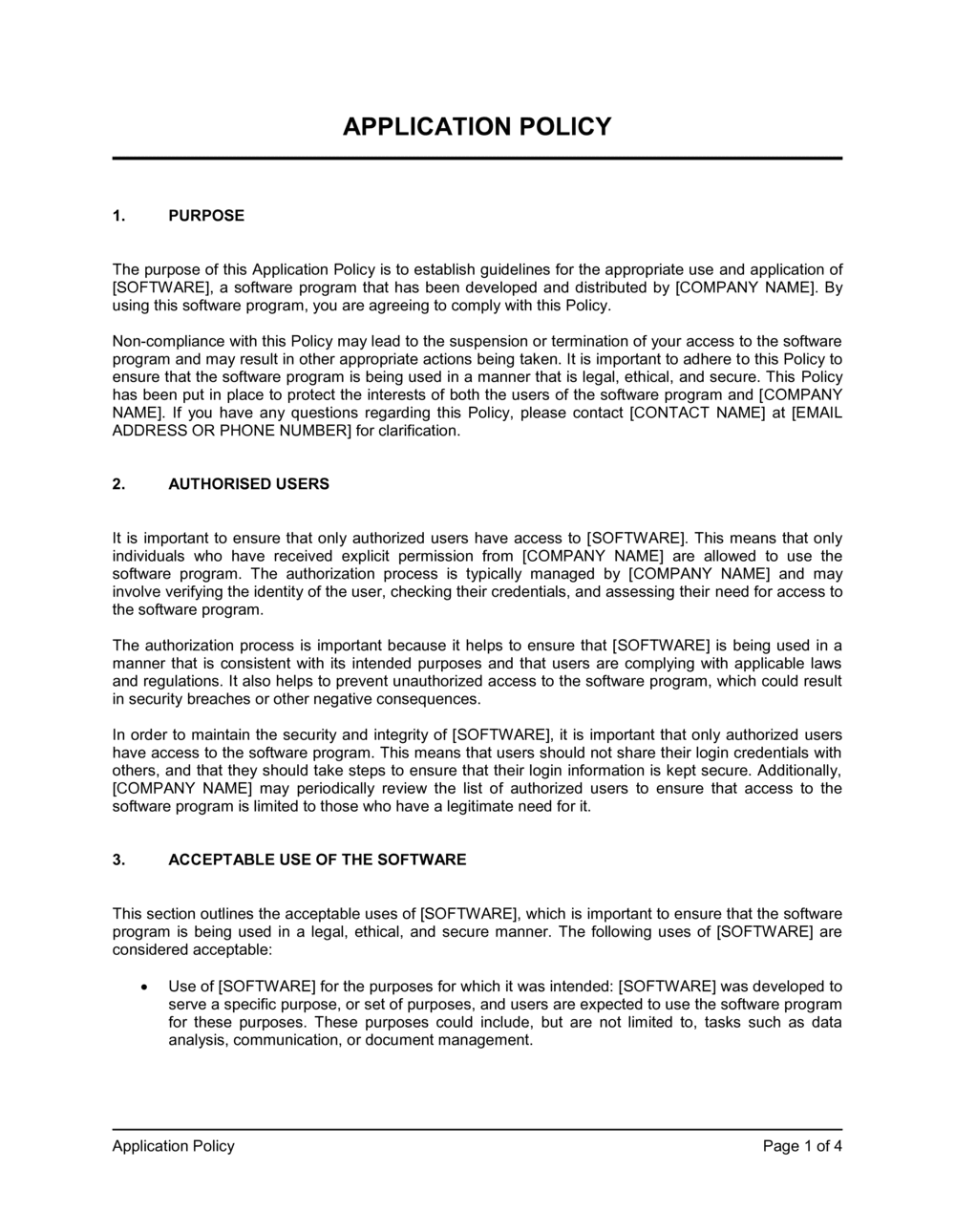
An Application Policy is an internal operational document that establishes the rules, procedures, and standards your organization follows when receiving and processing applications β€” whether for employment, grants, programs, or vendor enrollment. This free Word download gives you a structured, editable starting point you can adapt to your organization's workflows and export as PDF for distribution to staff, applicants, and reviewers.
When you need it
Use it when your organization receives recurring applications and needs consistent criteria, timelines, and accountability across all reviewers. It is especially important before scaling a hiring program, launching a grant or scholarship round, or onboarding a vendor qualification process.
What's inside
Purpose and scope, eligibility criteria, required application materials, submission procedures, review and evaluation standards, decision-making authority, notification and communication protocols, record retention rules, and an appeals or reconsideration process.

What is an Application Policy?

An Application Policy is an internal operational document that defines the rules, procedures, and standards an organization follows when receiving, screening, evaluating, and deciding on applications β€” whether for employment, grant funding, vendor qualification, program enrollment, or similar competitive processes. It establishes eligibility criteria, required submission materials, evaluation rubrics, decision-making authority, applicant notification timelines, and record retention rules in a single reference document that all staff involved in the process are expected to follow. By codifying these standards in writing, the policy ensures that every application is handled on a consistent, comparable, and documentable basis rather than left to individual discretion.

Why You Need This Document

Without a written application policy, each hiring manager, program officer, or procurement team operates on their own informal rules β€” creating inconsistent applicant experiences, unequal evaluation standards, and gaps in documentation that become serious liabilities when a rejected applicant files a discrimination complaint or an auditor requests records. A missing or inconsistently applied evaluation rubric is among the most common findings in EEOC investigations and nonprofit funding audits. The cost of that inconsistency is concrete: legal defense fees, funder penalties, reputational damage, and the operational burden of re-running a flawed process. A well-structured application policy closes those gaps before they become problems, giving your team a clear procedural foundation and giving every applicant β€” regardless of who reviews their submission β€” the same fair shot. This template gives you a complete, customizable starting point you can adapt and deploy in a matter of hours.

Which variant fits your situation?

If your situation is…Use this template
Managing employment applications and candidate screeningRecruitment Policy
Evaluating vendor or supplier qualification applicationsVendor Selection Policy
Processing grant or funding applications for a nonprofitGrant Application Policy
Reviewing internal promotion or transfer requestsInternal Transfer Policy
Handling scholarship or bursary applicationsScholarship Application Policy
Screening applicants for a licensing or certification programProgram Enrollment Policy
Documenting the full end-to-end hiring process including offersRecruitment and Selection Policy

Common mistakes to avoid

❌ Setting eligibility criteria that cannot be defended as job-related

Why it matters: Blanket requirements β€” such as requiring a four-year degree for roles that don't need one β€” can constitute adverse impact discrimination. Regulatory complaints or legal challenges become significantly harder to defend.

Fix: Audit each eligibility criterion against the actual requirements of the role or program. Remove or replace any criterion that is not directly tied to the ability to perform the function.

❌ Publishing notification timelines the team cannot consistently meet

Why it matters: Applicants who don't hear back within the stated window lose confidence in the organization, generate high volumes of follow-up inquiries, and may withdraw strong candidacies.

Fix: Validate timelines against past application cycles before publishing. Build a 20% buffer into every deadline to account for review panel scheduling delays.

❌ Allowing reviewers to apply personal weighting to evaluation criteria

Why it matters: When reviewers independently decide which criteria matter most, you lose comparability across applications and create conditions where bias β€” conscious or not β€” drives outcomes rather than documented standards.

Fix: Require all reviewers to use the standardized rubric with fixed weights. Hold a calibration session before the evaluation window opens and audit a sample of completed scoresheets.

❌ Retaining rejected application records without a destruction schedule

Why it matters: Holding personal data beyond the minimum necessary period creates data privacy liability and β€” for employment applications β€” potential exposure under GDPR, PIPEDA, or US state privacy laws.

Fix: Set a specific retention period (typically 1–2 years for employment, depending on jurisdiction) and schedule an annual purge of records that have passed that threshold.

❌ Not requiring conflict-of-interest declarations from reviewers

Why it matters: A panelist who reviews a personal contact's application without disclosure taints the entire process. If the decision is later challenged, the organization has no documented evidence that conflicts were managed.

Fix: Require every panel member to sign a conflict-of-interest declaration before accessing the application batch. Log all declarations and replacements centrally.

❌ Allowing merit-based appeals without a defined limit

Why it matters: Unrestricted appeals create a second full evaluation process for every dissatisfied applicant, consuming substantial reviewer time and effectively rendering the original decision provisional.

Fix: Limit appeals strictly to procedural grounds β€” failure to follow the stated process, evidence of conflict of interest, or material scoring error. State explicitly that disagreement with a merit-based outcome is not grounds for appeal.

The 10 key sections, explained

Purpose and scope

Eligibility criteria

Required application materials

Submission procedures

Screening and completeness check

Evaluation criteria and scoring

Review panel and decision authority

Applicant notification and communication

Record retention and data handling

Appeals and reconsideration

How to fill it out

  1. 1

    Define the policy's scope and application types

    Identify all application types this policy will govern β€” employment, vendor enrollment, grant applications, program admissions, or a combination. Name the specific departments or programs covered and list any exclusions explicitly.

    πŸ’‘ If your organization runs multiple distinct application processes, consider separate policies rather than one document with too many carve-outs β€” simpler policies get followed more consistently.

  2. 2

    Set eligibility criteria tied to genuine requirements

    List only the minimum qualifications that are directly necessary for the role or program. For employment applications, review each criterion against EEOC or applicable anti-discrimination guidance before finalizing.

    πŸ’‘ Test each eligibility requirement by asking: 'Would rejecting someone who doesn't meet this be defensible in a review?' If the answer is uncertain, remove or revise the requirement.

  3. 3

    Specify required materials precisely

    List every document or piece of information an applicant must submit for their application to be considered complete. Include file format requirements (PDF, Word), page limits, and naming conventions if your submission system requires them.

    πŸ’‘ Request only materials you will actually use in evaluation. Each additional requirement reduces application completion rates and may deter qualified candidates.

  4. 4

    Set deadlines with time zone and extension rules

    Enter the specific application window dates, closing time, and time zone. Define who is authorized to grant extensions and require that all extensions be documented in writing with a reason.

    πŸ’‘ Build in at least two business days between the application deadline and the start of screening to give your team time to organize submissions before evaluation begins.

  5. 5

    Build the evaluation rubric and attach it as a schedule

    Define the evaluation criteria, their weights, and the scoring scale. Attach the rubric as Schedule A so reviewers have a single reference point during the evaluation. Confirm all reviewers are trained on the rubric before the review window opens.

    πŸ’‘ Run a calibration exercise with your review panel on one or two sample applications before the real round. Calibration reduces inter-rater variability by roughly 30–40%.

  6. 6

    Name decision authority and conflict-of-interest rules

    Specify the role with final approval authority and require all panel members to sign a conflict-of-interest declaration before accessing any application. State clearly what happens when a conflict is declared β€” recusal and replacement with an alternate reviewer.

    πŸ’‘ Keep a log of all conflict-of-interest declarations and recusals. This log is your primary defense if a rejected applicant alleges that the process was compromised.

  7. 7

    Write notification timelines and draft template communications

    Set specific business-day targets for each notification stage and confirm your team has the staffing to meet them before committing the timelines to policy. Draft template emails for acknowledgment, shortlist, rejection, and selection at the same time.

    πŸ’‘ Automate acknowledgment emails through your applicant tracking system or email platform. Manual acknowledgments are the first stage to slip when volume spikes.

  8. 8

    Set retention periods and align with your privacy policy

    Define how long unsuccessful application records are retained and when they are destroyed. Confirm alignment with your organization's privacy policy and any applicable data protection regulations.

    πŸ’‘ Two years from the date of the final hiring decision is a common retention period for employment applications in the US β€” it covers the typical statute of limitations for EEOC complaints without holding data indefinitely.

Frequently asked questions

What is an application policy?

An application policy is an internal document that defines the rules and procedures an organization follows when receiving, screening, and deciding on applications β€” whether for employment, grants, vendor qualification, or program enrollment. It sets eligibility criteria, required materials, submission deadlines, evaluation standards, notification timelines, and record retention rules. Its primary purpose is to ensure that all applications are handled consistently, fairly, and in accordance with applicable legal requirements.

Who needs an application policy?

Any organization that receives recurring applications in a structured process benefits from a written policy. HR departments managing hiring, nonprofits running grant or scholarship programs, universities handling admissions, and procurement teams evaluating vendor applications all use application policies to reduce inconsistency, document decision-making, and protect against discrimination or bias complaints.

What is the difference between an application policy and a recruitment policy?

A recruitment policy covers the full talent acquisition lifecycle β€” workforce planning, job posting, sourcing, interviewing, offer, and onboarding. An application policy is narrower, focusing specifically on the application intake and review phase: what applicants must submit, how submissions are screened, how decisions are made, and how outcomes are communicated. A recruitment policy typically incorporates or references an application policy as one component.

How do I ensure our application policy is compliant with anti-discrimination laws?

Review every eligibility criterion to confirm it is directly tied to a genuine requirement of the role or program. Avoid blanket requirements β€” such as degree mandates or experience minimums β€” that are not demonstrably necessary. Use standardized evaluation rubrics to reduce subjective decision-making, document all screening and selection decisions, and require conflict-of-interest declarations from all reviewers. For employment applications specifically, consider having an employment counsel review the policy before it goes live.

How long should we retain rejected application materials?

For employment applications in the US, the EEOC recommends retaining application records for at least one year from the date of the hiring decision; federal contractors must retain them for two years. In Canada, provincial human rights codes typically imply a minimum of one year. Under GDPR in the EU, organizations must retain application data only as long as necessary for the stated purpose and must document their retention rationale. A practical default for most organizations is two years from the date of the final decision, after which records should be securely destroyed on a scheduled basis.

Should our application policy allow applicants to appeal rejected decisions?

Yes, but limit appeals to procedural grounds rather than merit. An appeals process that allows applicants to challenge the substance of evaluation decisions creates an unworkable second review cycle. A well-designed appeals process addresses only identifiable procedural failures β€” a failure to apply the stated criteria, evidence of a conflict of interest, or a material scoring error β€” and sets a short deadline for filing, typically 5–10 business days after the rejection notification.

Can one application policy cover multiple application types?

It can, but only if the core process is substantially the same across application types. If your organization runs both employment and grant applications with significantly different eligibility criteria, review structures, and timelines, separate policies are cleaner and easier to follow. A combined policy with too many conditional carve-outs becomes difficult to train staff on and harder to audit for compliance.

What should we do when an applicant submits after the deadline?

The policy should state clearly whether late submissions are accepted under any circumstances and, if so, who has authority to grant an exception. The most defensible approach is a firm deadline with a narrow exception process β€” for example, allowing extensions only when a documented technical failure on the organization's submission platform prevented timely filing. All exceptions should be documented in writing to protect the organization if the process is later challenged.

How detailed should the evaluation criteria section be?

Detailed enough that two independent reviewers applying the rubric to the same application would produce scores within one rating level of each other. This typically means naming four to six specific criteria, assigning each a percentage weight that totals 100%, and defining what a high, mid, and low score looks like for each criterion. Attaching the rubric as a separate schedule keeps the policy readable while giving reviewers the operational detail they need.

How this compares to alternatives

vs Recruitment Policy

A recruitment policy spans the full hiring lifecycle from workforce planning through onboarding. An application policy covers only the application intake and review phase β€” what applicants submit, how submissions are screened, and how decisions are communicated. Most organizations need both, with the application policy operating as a detailed procedure within the broader recruitment framework.

vs Employee Handbook

An employee handbook communicates workplace rules and expectations to existing employees. An application policy governs the pre-employment process for external candidates. The two documents serve different audiences at different stages: the handbook is read after hiring; the application policy operates behind the scenes before any hiring decision is made.

vs Job Application Form

A job application form is the document an applicant completes and submits. An application policy is the internal governance document that defines the rules the organization follows when receiving and evaluating that form. The form faces outward toward applicants; the policy faces inward toward staff managing the process.

vs Hiring Process Checklist

A hiring process checklist is a task-by-task operational tool a recruiter or manager follows for a specific hire. An application policy is the standing governance document that establishes the rules all checklists must follow. The policy sets the standard; the checklist implements it for a single opening.

Industry-specific considerations

Human Resources / Staffing

Governs employment application intake, screening, and selection documentation to support EEOC compliance, audit trails, and consistent candidate experience at scale.

Nonprofit and Philanthropy

Manages grant, scholarship, and program enrollment applications with transparent rubrics and appeals processes required by most funders and accreditation bodies.

Education / Higher Education

Structures admission and program enrollment applications to meet accreditation standards, support equity reviews, and satisfy government reporting requirements.

Government and Public Sector

Formalizes vendor, contractor, and permit applications to comply with public procurement rules, freedom-of-information obligations, and audit requirements.

Template vs pro β€” what fits your needs?

PathBest forCostTime
Use the templateHR teams, nonprofit program managers, and operations leads standardizing an existing application processFree2–4 hours to customize and finalize
Template + professional reviewOrganizations with high application volume, sensitive eligibility criteria, or processes subject to anti-discrimination scrutiny$200–$600 for an HR consultant or employment counsel review1–3 days
Custom draftedGovernment agencies, large employers with federal contractor obligations, or organizations under active EEOC or human rights commission oversight$1,000–$3,500+1–3 weeks

Glossary

Application Window
The defined period during which an organization accepts submissions for a particular role, program, or opportunity.
Eligibility Criteria
The minimum qualifications or conditions an applicant must meet before their submission is considered for review.
Screening
The initial pass over submitted applications to confirm completeness and basic eligibility before detailed evaluation begins.
Evaluation Rubric
A scoring framework that defines the criteria reviewers use to assess each application on a consistent, comparable basis.
Review Panel
A designated group of individuals responsible for evaluating applications and making or recommending selection decisions.
Decision Authority
The person or role with final approval power over application outcomes β€” selecting, rejecting, or placing candidates on hold.
Disposition
The formal outcome recorded for each application β€” accepted, rejected, withdrawn, waitlisted, or held for future consideration.
Record Retention
The policy rule governing how long application materials and evaluation records must be kept before they can be securely destroyed.
Appeals Process
A defined procedure by which an unsuccessful applicant can formally request reconsideration of a rejection decision.
Blind Review
An evaluation process in which identifying information β€” name, gender, age, or institution β€” is removed from application materials to reduce unconscious bias.

Part of your Business Operating System

This document is one of 3,000+ business & legal templates included in Business in a Box.

  • Fill-in-the-blanks β€” ready in minutes
  • 100% customizable Word document
  • Compatible with all office suites
  • Export to PDF and share electronically

Create your document in 3 simple steps.

From template to signed document β€” all inside one Business Operating System.
1
Download or open template

Access over 3,000+ business and legal templates for any business task, project or initiative.

2
Edit and fill in the blanks with AI

Customize your ready-made business document template and save it in the cloud.

3
Save, Share, Send, Sign

Share your files and folders with your team. Create a space of seamless collaboration.

Save time, save money, and create top-quality documents.

β˜…β˜…β˜…β˜…β˜…

"Fantastic value! I'm not sure how I'd do without it. It's worth its weight in gold and paid back for itself many times."

Managing Director Β· Mall Farm
Robert Whalley
Managing Director, Mall Farm Proprietary Limited
β˜…β˜…β˜…β˜…β˜…

"I have been using Business in a Box for years. It has been the most useful source of templates I have encountered. I recommend it to anyone."

Business Owner Β· 4+ years
Dr Michael John Freestone
Business Owner
β˜…β˜…β˜…β˜…β˜…

"It has been a life saver so many times I have lost count. Business in a Box has saved me so much time and as you know, time is money."

Owner Β· Upstate Web
David G. Moore Jr.
Owner, Upstate Web

Run your business with a system β€” not scattered tools

Stop downloading documents. Start operating with clarity. Business in a Box gives you the Business Operating System used by over 250,000 companies worldwide to structure, run, and grow their business.

Start freeΒ Β·Β No credit card required