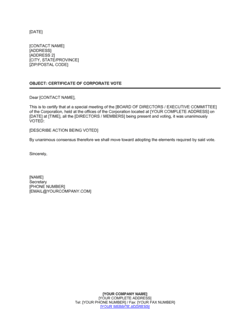
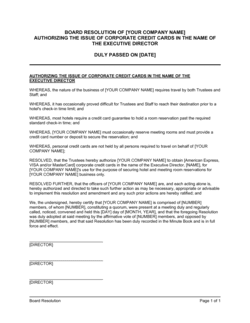
Certificate of Corporate Resolution Template

Free Word download • Edit online • Save & share with Drive • Export to PDF

1 page20–30 min to fillDifficulty: StandardSignature requiredLegal review recommended
Learn more ↓
FreeCertificate of Corporate Resolution Template

At a glance

What it is
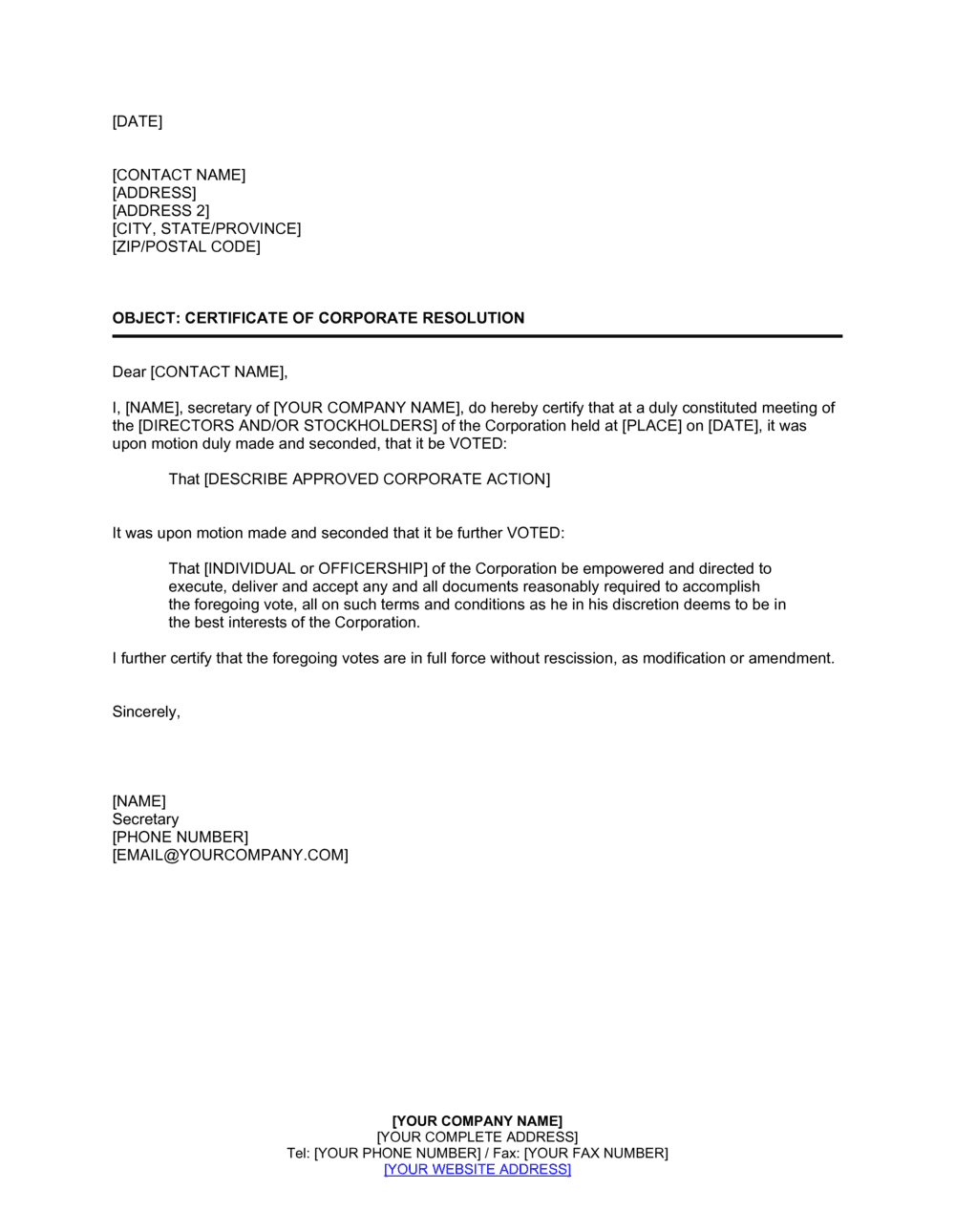
A Certificate of Corporate Resolution is a formal legal document that records a decision officially adopted by a company's board of directors or shareholders. It certifies that a specific action — opening a bank account, authorizing a loan, signing a major contract, or appointing an officer — was approved by the appropriate governing body. This free Word download gives you a professionally structured template you can edit online and export as PDF for submission to banks, lenders, counterparties, or government agencies.
When you need it
Use it whenever a third party — a bank, lender, regulatory body, or contract counterparty — requires documented proof that your board or shareholders formally authorized a specific corporate action. It is also required when onboarding new signing officers, restructuring ownership, or making material changes to corporate governance.
What's inside
Corporate identification and meeting details, a recital of the authorizing vote, the specific resolution language, the names and authority of designated signatories, officer certification, and notarization or witness blocks where required. The template covers both board-level and unanimous written consent formats to handle both meeting and non-meeting adoption scenarios.

What is a Certificate of Corporate Resolution?

A Certificate of Corporate Resolution is a formal legal document that records and certifies a decision officially adopted by a corporation's board of directors or shareholders, authorizing a specific corporate action. It establishes, in binding written form, that the people with governing authority over the company — the directors or shareholders — reviewed and approved a defined action: opening a bank account, executing a loan agreement, entering a material contract, appointing an officer, or consummating a property transaction. The document works in two layers: the operative resolution language creates the internal authorization, and the corporate secretary's certification makes that authorization externally verifiable by banks, lenders, regulators, and counterparties who were not present at the meeting or consent.

Why You Need This Document

Without a properly executed Certificate of Corporate Resolution, banks will not open accounts, lenders will not advance funds, and sophisticated counterparties will not close transactions — because they have no documented proof that the individual signing on behalf of the corporation actually has authority to do so. Acting without one exposes both the company and its officers to personal liability if the authorization is later challenged: contracts signed without board authority can be voided, loans can be called, and officers can be held personally responsible for unauthorized commitments. Beyond third-party requirements, maintaining proper resolutions protects the corporate veil — the legal separation between the business entity and its owners — which courts pierce when governance records are absent or deficient. This template gives you a professionally structured, jurisdiction-aware starting point that satisfies the requirements of major U.S. and Canadian banks, covers both formal-meeting and written-consent adoption scenarios, and takes under 30 minutes to complete for routine transactions.

Which variant fits your situation?

If your situation is…Use this template
Authorizing the opening of a corporate bank accountCorporate Resolution for Banking
Approving a loan, line of credit, or mortgage on behalf of the companyCorporate Resolution to Borrow
Appointing or removing a corporate officer or authorized signatoryCorporate Resolution — Officer Appointment
Approving the sale, purchase, or transfer of real propertyCorporate Resolution — Real Estate Transaction
Authorizing entry into a major contract or partnership agreementCertificate of Corporate Resolution
Documenting shareholder approval of a major corporate actionShareholder Resolution
Recording decisions without a formal meeting via written consentUnanimous Written Consent of Directors

Common mistakes to avoid

❌ Using a trade name instead of the registered legal entity name

Why it matters: A resolution in the name of 'Acme Solutions' when the registered entity is 'Acme Solutions Inc.' will be rejected by banks and government agencies as failing to identify the proper legal party.

Fix: Verify the exact registered name against the state or provincial corporate registry before drafting the resolution, and reproduce it character-for-character including punctuation.

❌ Omitting quorum confirmation

Why it matters: A resolution adopted without quorum is voidable — any director or shareholder can challenge the action taken under it, exposing the corporation to liability or requiring re-execution of affected agreements.

Fix: Always state the number of directors present, the total number of directors, and confirm the number constitutes a quorum under the bylaws.

❌ Vague resolution language without counterparty or dollar specifics

Why it matters: Generic language like 'authorized to borrow funds' gives the bank no basis to determine the scope of authority, and most institutions will return the resolution for revision before processing the transaction.

Fix: Name the specific institution, account type, agreement, and maximum dollar amount in the operative clause. When in doubt, be more specific than you think necessary.

❌ Failing to include specimen signatures

Why it matters: Without specimen signatures, banks cannot verify that the person signing a subsequent document matches the individual authorized in the resolution — a basic anti-fraud requirement that most institutions strictly enforce.

Fix: Build a specimen signature block into every resolution template and collect original signatures from all named signatories before the corporate secretary certifies.

❌ No ratification of prior acts when an officer has already acted

Why it matters: If an officer signed a term sheet or opened a preliminary account before board approval, those acts technically lacked authority at the time — creating potential liability and voidability.

Fix: Include a standard ratification clause in every resolution to retroactively confirm any preparatory actions taken by officers in anticipation of board approval.

❌ Leaving effective duration open-ended for banking resolutions

Why it matters: Many banks treat undated or perpetual resolutions as stale after 12–24 months and will require a fresh resolution before processing new transactions, causing unexpected delays.

Fix: State a clear effective date and include a review trigger — either an annual expiry or a provision that the resolution remains in effect until rescinded by subsequent board action.

The 9 key clauses, explained

Corporation identification and recitals

In plain language: States the full legal name of the corporation, its jurisdiction of incorporation, and the background 'whereas' clauses explaining why the resolution is being adopted.

Sample language
WHEREAS, [CORPORATION FULL LEGAL NAME], a [STATE/PROVINCE] [ENTITY TYPE] (the 'Corporation'), deems it necessary and in the best interest of the Corporation to [DESCRIBE PURPOSE OF RESOLUTION];

Common mistake: Using a trade name or DBA instead of the registered legal entity name. If the name on the resolution does not match the corporate registry, banks and counterparties will reject it for processing.

Meeting details or written consent recital

In plain language: Records whether the resolution was adopted at a duly noticed meeting (with date, time, and location) or by unanimous written consent in lieu of a meeting, and confirms quorum was met.

Sample language
A [special / regular] meeting of the Board of Directors of the Corporation was duly held on [DATE] at [TIME] at [LOCATION]. A quorum of directors was present, constituting [NUMBER] of [TOTAL NUMBER] directors.

Common mistake: Omitting confirmation that a quorum was present. Without this, the resolution can be challenged as improperly adopted, voiding the authorization it purports to grant.

Resolution clause — the authorizing action

In plain language: The operative 'BE IT RESOLVED' language that states precisely what action the board has authorized, including the scope and any conditions or limits.

Sample language
BE IT RESOLVED, that the Corporation is hereby authorized to [SPECIFIC ACTION — e.g., open and maintain a deposit account at BANK NAME / enter into that certain Agreement dated DATE with COUNTERPARTY NAME] and that [OFFICER TITLE] is authorized to execute all documents necessary to effect such action.

Common mistake: Writing vague resolution language such as 'authorized to conduct banking activities.' Banks and lenders require the specific account type, institution name, and dollar limit to be stated, or they will send the document back for revision.

Designation of authorized signatories

In plain language: Names the specific individuals — by full legal name and title — who are authorized to act on behalf of the corporation in connection with the resolved action.

Sample language
BE IT FURTHER RESOLVED, that [FULL NAME], [TITLE], and [FULL NAME], [TITLE], are each individually authorized to execute, deliver, and perform any and all agreements, instruments, and documents in connection with the foregoing on behalf of the Corporation.

Common mistake: Listing only a title without a name — e.g., 'the CEO is authorized.' If the CEO changes before the transaction closes, the resolution is ambiguous and the successor officer may need a new resolution to act.

Specimen signatures block

In plain language: Captures the actual signatures of each authorized signatory, allowing banks and third parties to verify signatures on subsequent documents against the certified resolution.

Sample language
The following are the true and genuine signatures of the officers authorized by this Resolution: [FULL NAME] — [TITLE] — Signature: ___________________ | [FULL NAME] — [TITLE] — Signature: ___________________

Common mistake: Skipping the specimen signature block. Many banks will not rely on a resolution without it, requiring an additional incumbency certificate to be prepared separately.

Ratification of prior acts

In plain language: Confirms that any actions already taken by the designated officers in anticipation of this resolution are retroactively approved and ratified by the board.

Sample language
BE IT FURTHER RESOLVED, that all acts, transactions, and agreements undertaken by any officer of the Corporation prior to the date hereof in connection with the foregoing are hereby ratified, confirmed, and approved.

Common mistake: Omitting ratification language when an officer has already signed a preliminary agreement or term sheet. Without it, those prior acts technically lacked board authority at the time of execution.

Certification by the corporate secretary

In plain language: A sworn statement by the corporate secretary certifying that the resolution was duly adopted, that the meeting (or consent) complied with the bylaws, and that the resolution remains in full force.

Sample language
I, [SECRETARY FULL NAME], Secretary of [CORPORATION NAME], hereby certify that the foregoing is a true and correct copy of a resolution duly adopted by the Board of Directors at a meeting held on [DATE], that such resolution has not been amended, modified, or rescinded, and is in full force and effect as of the date of this Certificate.

Common mistake: Having the same person sign as both an authorized signatory and as the certifying secretary without disclosing the dual role. Some banks and jurisdictions treat this as a conflict that invalidates the certification.

Effective date and duration

In plain language: States when the resolution takes effect and whether it is time-limited — for instance, expiring after one year or upon completion of a specific transaction.

Sample language
This Resolution shall be effective as of [DATE] and shall remain in full force and effect until [DATE / the completion of the [TRANSACTION NAME] / rescinded by subsequent resolution of the Board].

Common mistake: Leaving duration open-ended on resolutions granting broad banking authority. Many banks request annual re-certification; an undated resolution may be rejected as stale after 12–24 months.

Notarization or witness attestation block

In plain language: Provides space for notarization of the secretary's signature or witness attestation, required when the resolution will be filed with a government agency or used in a foreign jurisdiction.

Sample language
Subscribed and sworn before me this [DATE]. Notary Public: ___________________ | My Commission Expires: ___________________ | [NOTARY SEAL]

Common mistake: Assuming notarization is always required — or never required. Domestic bank submissions typically do not require it; real estate filings, foreign counterparty transactions, and SEC submissions often do. Confirm requirements before execution.

How to fill it out

  1. 1

    Enter the corporation's full legal name and jurisdiction

    Use the exact name as registered with the state or province — including 'Inc.', 'LLC', 'Corp.', or 'Ltd.' as applicable. Add the jurisdiction of incorporation and the principal place of business.

    💡 Pull the name directly from the corporate registry certificate or articles of incorporation to avoid mismatches that trigger rejection.

  2. 2

    Choose the adoption method — meeting or written consent

    If the resolution was adopted at a formal meeting, complete the meeting date, time, location, and quorum confirmation. If adopted by unanimous written consent, delete the meeting recital and use the written consent format.

    💡 Most small and mid-size corporations use unanimous written consent for routine resolutions — it is faster and does not require scheduling a formal meeting.

  3. 3

    Draft the operative resolution language

    Write the 'BE IT RESOLVED' clause with specific, unambiguous language: name the exact bank or counterparty, the type of account or agreement, the dollar limit if applicable, and the precise action being authorized.

    💡 Borrow exact phrasing from the bank's or counterparty's own resolution requirements if they provide a template — this eliminates back-and-forth on language.

  4. 4

    Name the authorized signatories with their full legal names and titles

    List every individual authorized to act, using their full legal names and current titles. If two signatories are required together, state 'acting jointly' and specify that any single signatory is insufficient.

    💡 Authorize at least two signatories whenever possible — if the primary signatory is unavailable during closing, a single-name resolution can stall the entire transaction.

  5. 5

    Collect specimen signatures from each authorized signatory

    Have each named authorized signatory sign the specimen block in person before the corporate secretary certifies the document. The signatures must be original — photocopied specimens are rejected by most banks.

    💡 If signatories are in different offices, circulate the document in counterparts and assemble originals before certification.

  6. 6

    Have the corporate secretary certify the document

    The corporate secretary signs and dates the certification block, confirming the resolution was duly adopted and has not been amended or rescinded. Include the secretary's title and the corporate seal if your jurisdiction requires it.

    💡 Date the certification the same day the resolution is delivered to the bank or counterparty — not backdated to the meeting date — to avoid confusion about which date governs.

  7. 7

    Determine whether notarization is required and arrange it

    Check the recipient's specific requirements. Domestic U.S. bank resolutions rarely require notarization; real estate closings, foreign transactions, and government agency filings typically do.

    💡 Use a remote online notary (RON) service if signatories are in multiple locations — recognized in 40+ US states and accepted by most major banks.

  8. 8

    File the original in the corporate minute book and distribute certified copies

    Place the signed original in the minute book under the relevant fiscal year. Provide certified copies — marked 'Certified True Copy' and initialed by the secretary — to each recipient that requires one.

    💡 Scan and store a digital copy immediately after execution. Banks and lenders frequently request re-submission of resolutions months after the original closing.

Frequently asked questions

What is a Certificate of Corporate Resolution?

A Certificate of Corporate Resolution is a formal document that records and certifies a decision officially adopted by a corporation's board of directors or shareholders. It provides written evidence that a specific action — such as opening a bank account, authorizing a loan, or entering a major contract — was approved by the appropriate governing body with proper authority. Banks, lenders, and counterparties routinely require one before processing transactions on behalf of a corporation.

When is a corporate resolution required?

A corporate resolution is typically required when opening or modifying a business bank account, applying for a loan or line of credit, purchasing or selling real property, entering into a significant commercial contract, appointing or removing officers, issuing equity, or making any decision that materially affects the corporation's legal or financial position. The specific trigger depends on the requesting institution's requirements and the corporation's own bylaws.

Who signs a Certificate of Corporate Resolution?

Two parties sign a corporate resolution. The authorized signatories named in the operative clause provide specimen signatures demonstrating their identity. The corporate secretary then certifies the document, attesting that the resolution was duly adopted in compliance with the bylaws and that it remains in full force. In some jurisdictions and for certain filings, a notary public must also attest to the secretary's signature.

Does a corporate resolution need to be notarized?

Notarization is not universally required. Most U.S. domestic bank submissions and commercial transactions do not require a notarized corporate resolution. However, real estate filings, government agency submissions, foreign counterparty transactions, and certain loan closings do require notarization. Always confirm the specific requirements of the receiving institution before finalizing the document.

What is the difference between a corporate resolution and meeting minutes?

Meeting minutes are a comprehensive narrative record of everything discussed and decided at a board or shareholder meeting, including attendance, debate, and all motions. A corporate resolution is a focused document — extracted from or adopted independently of meeting minutes — that records only the specific decision and its operative authorization language. Banks and third parties request the resolution, not the full minutes, because it is compact and purpose-specific.

Can a corporate resolution be adopted without holding a meeting?

Yes. Most jurisdictions permit directors or shareholders to adopt a resolution by unanimous written consent — a procedure where all eligible members sign a written resolution document without convening a formal meeting. This requires unanimous agreement; if even one director or shareholder objects, a formal meeting must be called instead. The written consent must be dated and filed in the corporate minute book just like a resolution from a formal meeting.

How long is a corporate resolution valid?

There is no universal expiry period for a corporate resolution, but in practice many banks and institutions treat resolutions as stale after 12–24 months and request a fresh one before processing new transactions. Best practice is to specify an effective date in the document and either set an annual renewal date or include language stating it remains effective until rescinded by subsequent board action.

What is the difference between a corporate resolution and a shareholder resolution?

A board resolution is adopted by the board of directors and authorizes actions within the board's authority — day-to-day management, officer appointments, and operational transactions. A shareholder resolution addresses matters reserved for shareholder approval under the bylaws or applicable law — such as amending the articles, approving a merger, or issuing new equity classes. Many significant transactions require both: board approval of the terms and shareholder ratification of the action.

Do LLCs and partnerships need a corporate resolution?

LLCs and partnerships are not technically corporations, so the document is called a Member Resolution or Manager Resolution for LLCs, and a Partner Resolution for partnerships. The purpose and structure are identical: a formal record that the governing members or partners authorized a specific action. Banks apply essentially the same requirements to LLCs and partnerships as to corporations, so an equivalent resolution document is always needed for financial transactions.

How this compares to alternatives

vs Board Meeting Minutes

Board minutes are a comprehensive narrative of everything discussed and decided at a meeting — attendance, debate, and all motions. A Certificate of Corporate Resolution is a focused, self-contained document recording only one specific decision in operative legal language. Banks and counterparties request the resolution because it is precise and portable; minutes serve as the underlying governance record that supports it.

vs Corporate Bylaws

Bylaws establish the standing rules that govern how a corporation makes decisions — quorum requirements, notice periods, officer authority, and voting thresholds. A corporate resolution is a one-time exercise of authority under those rules. The bylaws define what the board can do; the resolution documents a specific instance of the board doing it.

vs Power of Attorney

A power of attorney is a personal legal instrument delegating authority from one individual to another, often used when the principal is unavailable. A corporate resolution delegates authority on behalf of the corporation as a legal entity, acting through its governing body. Banks and institutional counterparties typically require a corporate resolution — not a power of attorney — for corporate transactions, as the resolution reflects the entity's own governing authority rather than a personal delegation.

vs Operating Agreement

An operating agreement defines the permanent governance structure, ownership percentages, and management authority of an LLC. A member or manager resolution is a one-time document recording a specific decision made under that authority. The operating agreement establishes who has power; the resolution documents the exercise of that power for a particular transaction or appointment.

Industry-specific considerations

Financial Services and Banking

Bank account openings, credit facility authorizations, and wire transfer limit approvals all require a resolution specifically naming the institution, account type, and authorized signatories with specimen signatures.

Real Estate and Construction

Property acquisitions, mortgage executions, and lease agreements above a threshold dollar amount require a notarized resolution authorizing the specific transaction, often filed as a public record.

Technology and SaaS

Equity issuances, stock option plan adoptions, and enterprise contract executions at funding rounds each require a board resolution, often reviewed by investor counsel during diligence.

Professional Services

Law firms, accounting firms, and consulting practices use resolutions to authorize partner-level signatories, approve banking relationships, and document changes in authorized officers for malpractice insurance and licensing purposes.

Jurisdictional notes

United States

Corporate resolution requirements are governed by state law and vary by state. Delaware, Nevada, and most other states permit unanimous written consent resolutions without a formal meeting under their general corporation laws. California requires that consents be filed in the minute book within 20 days of adoption. Notarization is not required for most domestic bank resolutions but is commonly required for real estate filings and UCC transactions. The FTC and SEC may require certified resolutions for certain filings.

Canada

Under the Canada Business Corporations Act and most provincial equivalents, directors may pass resolutions in writing signed by all directors without holding a meeting. In Quebec, resolutions must comply with the Business Corporations Act (QBCA) and, for provincially regulated entities, may need to be available in French. Banks operating in Canada typically require a standard banking resolution signed by the corporate secretary on the bank's own prescribed form, which should mirror the template language. Corporate seals are no longer legally required federally but are still accepted by most institutions.

United Kingdom

Under the Companies Act 2006, private limited companies can pass resolutions in writing signed by all eligible members without a formal meeting. Public companies (PLCs) must pass most resolutions at a general meeting. Resolutions authorizing banking authority typically require the company's certificate of incorporation and latest confirmation statement to be submitted alongside. Many UK banks maintain their own standard resolution forms. The corporate seal is optional since the Companies Act 2006 but may be required by some counterparties.

European Union

EU member states each have their own requirements for corporate decision-making, and standards vary considerably. In Germany, board resolutions (Gesellschafterbeschluss) for GmbHs must comply with the GmbHG and may require notarization for certain capital transactions. In France, decisions by the conseil d'administration for SAs must follow the Code de commerce notice and quorum requirements. GDPR considerations apply where resolutions reference personal data of named individuals — limit personal information in resolutions to what is operationally necessary. Cross-border transactions within the EU may require apostille-authenticated certified copies.

Template vs lawyer — what fits your deal?

PathBest forCostTime
Use the templateRoutine banking resolutions, officer appointments, and standard commercial transactions for established corporations with simple governanceFree15–30 minutes
Template + legal reviewReal estate transactions, loan authorizations above $250K, multi-signatory authority arrangements, or corporations with complex ownership structures$150–$400 for a one-hour attorney review1–2 business days
Custom draftedM&A transactions, equity issuances, cross-border filings, regulated industries, or any resolution that will be filed with a government agency or foreign counterparty$500–$2,000+3–7 business days

Glossary

Corporate Resolution
A formal decision adopted by a board of directors or shareholders that authorizes a specific corporate action and becomes part of the official corporate record.
Board of Directors
The governing body elected by shareholders to oversee a corporation's management and make binding decisions on major corporate matters.
Quorum
The minimum number of directors or shareholders who must be present or represented at a meeting for decisions made at that meeting to be legally valid.
Unanimous Written Consent
A procedure allowing directors or shareholders to adopt a resolution without holding a formal meeting, provided all eligible members sign the consent document.
Authorized Signatory
An individual — typically an officer or director — specifically named in a resolution as having authority to sign documents or execute transactions on the company's behalf.
Corporate Secretary
The officer responsible for maintaining corporate records, including minutes, resolutions, and the minute book, and for certifying that proper procedures were followed.
Minute Book
The official repository of a corporation's governance records, including articles of incorporation, bylaws, meeting minutes, and all adopted resolutions.
Certified Copy
A copy of a corporate resolution authenticated by the corporate secretary as a true and accurate reproduction of the original document in the minute book.
Recital
The introductory 'whereas' clauses in a resolution that provide context and background for why the board is taking the described action.
Incumbency Certificate
A companion document listing current officers and directors with their titles and specimen signatures, often submitted alongside a resolution to verify signatories.
Ultra Vires
A Latin term for an act taken beyond the legal authority granted to a corporation by its charter or bylaws — resolutions that exceed this authority are generally void.

Part of your Business Operating System

This document is one of 3,000+ business & legal templates included in Business in a Box.

  • Fill-in-the-blanks — ready in minutes
  • 100% customizable Word document
  • Compatible with all office suites
  • Export to PDF and share electronically

Create your document in 3 simple steps.

From template to signed document — all inside one Business Operating System.
1
Download or open template

Access over 3,000+ business and legal templates for any business task, project or initiative.

2
Edit and fill in the blanks with AI

Customize your ready-made business document template and save it in the cloud.

3
Save, Share, Send, Sign

Share your files and folders with your team. Create a space of seamless collaboration.

Save time, save money, and create top-quality documents.

★★★★★

"Fantastic value! I'm not sure how I'd do without it. It's worth its weight in gold and paid back for itself many times."

Managing Director · Mall Farm
Robert Whalley
Managing Director, Mall Farm Proprietary Limited
★★★★★

"I have been using Business in a Box for years. It has been the most useful source of templates I have encountered. I recommend it to anyone."

Business Owner · 4+ years
Dr Michael John Freestone
Business Owner
★★★★★

"It has been a life saver so many times I have lost count. Business in a Box has saved me so much time and as you know, time is money."

Owner · Upstate Web
David G. Moore Jr.
Owner, Upstate Web

Run your business with a system — not scattered tools

Stop downloading documents. Start operating with clarity. Business in a Box gives you the Business Operating System used by over 250,000 companies worldwide to structure, run, and grow their business.

Start free · No credit card required