Environmental Social and Corporate Governance Template

Free Word download • Edit online • Save & share with Drive • Export to PDF

11 pages25–35 min to fillDifficulty: ComplexSignature requiredLegal review recommended
Learn more ↓
FreeEnvironmental Social and Corporate Governance Template

At a glance

What it is
An Environmental, Social, and Corporate Governance (ESG) Policy is a binding organizational document that formalizes a company's commitments across three pillars: environmental stewardship, social responsibility, and governance integrity. This free Word download gives you a structured, board-ready starting point you can edit online and export as PDF to share with investors, regulators, and stakeholders.
When you need it
Use it when preparing for an investor due diligence process, responding to a regulatory disclosure requirement, or establishing internal accountability structures around sustainability and ethical business conduct. It is increasingly required by institutional investors, lenders, and procurement teams before entering into material contracts.
What's inside
Environmental commitments and emission targets, social policies covering labor practices and community engagement, governance structures including board oversight and anti-corruption measures, reporting obligations, enforcement mechanisms, and stakeholder communication protocols.

What is an Environmental Social and Corporate Governance Policy?

An Environmental, Social, and Corporate Governance (ESG) Policy is a formal, board-approved document that codifies an organization's commitments across three interconnected pillars: environmental stewardship (greenhouse gas targets, energy use, waste management), social responsibility (labor standards, DEI commitments, human rights due diligence), and governance integrity (board oversight structures, anti-corruption obligations, reporting accountability). Unlike a general values statement, a properly drafted ESG policy creates binding internal obligations tied to measurable KPIs, defined reporting frameworks such as GRI or TCFD, and explicit accountability mechanisms that can be audited by investors, regulators, and lenders. It functions simultaneously as an internal governance instrument and an external disclosure framework — anchoring annual sustainability reports and investor presentations to a single authoritative source of truth.

Why You Need This Document

Without a formal ESG policy, companies face compounding exposure on several fronts at once. Regulators in the EU (CSRD), US (SEC climate rules, California SB 253), and UK (TCFD mandatory disclosures) are moving from voluntary to mandatory ESG reporting — and enforcement for material omissions or greenwashing is accelerating. Institutional investors and pension funds increasingly screen out companies that cannot produce a board-approved ESG policy during due diligence, blocking access to capital on unfavorable terms or altogether. ESG-linked loan covenants explicitly reference a company's policy document — missing stated KPIs can trigger margin ratchets or technical defaults. Beyond regulatory and financing risk, supply chain partners and large enterprise procurement teams routinely require documented ESG frameworks before awarding contracts. A well-structured template gets your policy to board-approval standard in days rather than months, giving you an auditable foundation that satisfies investors, lenders, and regulators while anchoring every future sustainability disclosure to a credible, enforceable commitment.

Which variant fits your situation?

If your situation is…Use this template
Public company subject to mandatory climate-related disclosuresESG Disclosure Policy (Public Company)
Private company seeking ESG-linked debt or green financingESG Framework for Private Companies
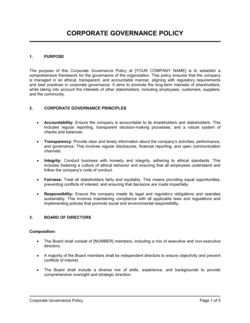
Board adopting a standalone corporate governance charterCorporate Governance Policy
Company codifying anti-corruption and ethical conduct standardsCode of Ethics and Business Conduct
Supplier or vendor ESG compliance requirementSupplier Code of Conduct
Company producing a standalone annual sustainability reportESG / Sustainability Report Template
Investment fund formalizing responsible investment policyResponsible Investment Policy

Common mistakes to avoid

❌ Publishing unquantified environmental commitments

Why it matters: Regulators in the US, EU, and UK are actively prosecuting greenwashing claims — vague language like 'we care about the planet' without measurable targets creates legal and reputational exposure.

Fix: Attach specific emission reduction percentages, a baseline year, and a target year to every environmental claim in the policy.

❌ Assigning ESG oversight to 'leadership' without a named committee

Why it matters: Diffuse governance accountability means no one is actually responsible — investors and rating agencies penalize this in ESG scores and it creates D&O liability when targets are missed.

Fix: Name the specific board committee (e.g., Audit and Risk Committee, standalone ESG Committee) and a C-suite officer with explicit ESG accountability.

❌ Excluding subsidiaries and supply chain from scope

Why it matters: Scope 3 emissions and supply chain labor violations are increasingly the focus of regulatory enforcement — a policy that only covers headquarters leaves the company's largest risk exposures unaddressed.

Fix: Explicitly extend policy scope to all subsidiaries, controlled entities, and Tier 1 suppliers, with a timeline to extend to Tier 2.

❌ Committing to a reporting framework the company cannot yet support with data

Why it matters: Committing to GRI or CSRD disclosures without confirming data collection systems are in place leads to incomplete first reports, material restatements, and loss of creditor or investor confidence.

Fix: Conduct a data readiness gap analysis before finalizing the reporting framework commitment, and phase in disclosure obligations over a stated 2–3 year transition period.

❌ Omitting a formal review trigger for regulatory changes

Why it matters: ESG regulation is evolving rapidly — a policy with only an annual review cycle can become materially non-compliant months before the scheduled review.

Fix: Add an off-cycle review trigger clause that activates when a material regulatory change, ESG incident, or new investor requirement occurs.

❌ No whistleblower or ESG reporting channel

Why it matters: Without a safe reporting mechanism, ESG violations surface externally through media or regulators rather than internally — dramatically increasing reputational and legal damage.

Fix: Include a named reporting channel (hotline, email address, or third-party platform), a non-retaliation commitment, and a defined escalation process in the enforcement clause.

The 9 key clauses, explained

Purpose, Scope, and Definitions

In plain language: States the policy's objectives, identifies which entities and personnel it applies to, and defines key terms used throughout the document.

Sample language
This ESG Policy ('Policy') applies to [COMPANY NAME] and all its subsidiaries, directors, officers, employees, contractors, and agents. The Policy establishes [COMPANY NAME]'s commitments with respect to environmental stewardship, social responsibility, and corporate governance.

Common mistake: Limiting scope to headquarters only and excluding subsidiaries or contractors — this creates enforcement gaps and exposes the company to supply chain liability claims.

Environmental Commitments

In plain language: Documents specific, measurable environmental targets — emission reductions, energy use, waste management, and water consumption — with a defined baseline year and timeline.

Sample language
[COMPANY NAME] commits to reducing Scope 1 and Scope 2 GHG emissions by [X]% from a [BASELINE YEAR] baseline by [TARGET YEAR], and to achieving net-zero across Scope 1, 2, and 3 emissions by [YEAR].

Common mistake: Stating vague aspirations like 'we are committed to the environment' without quantified targets and a baseline — regulators and investors treat unquantified commitments as potential greenwashing.

Social Responsibility Commitments

In plain language: Covers labor standards, health and safety, DEI targets, community investment, supply chain labor rights, and human rights due diligence.

Sample language
[COMPANY NAME] commits to maintaining a workplace free from discrimination and harassment, achieving [X]% gender representation at the senior leadership level by [YEAR], and conducting human rights due diligence across its Tier 1 supplier base annually.

Common mistake: Copying DEI language from a template without setting measurable targets. A policy that mandates 'fostering diversity' with no KPIs cannot be enforced or reported against.

Governance Framework

In plain language: Defines the board and executive structure responsible for ESG oversight, including committee mandates, reporting lines, and accountability mechanisms.

Sample language
The Board of Directors, through its [ESG / Audit / Risk] Committee, is responsible for overseeing [COMPANY NAME]'s ESG strategy and performance. The Chief [Sustainability / ESG] Officer reports to the [CEO / Board Committee] and is accountable for policy implementation.

Common mistake: Assigning ESG governance to a general 'leadership team' without naming a specific committee or officer. Diffuse accountability means no accountability — and signals weak governance to investors.

Anti-Corruption and Ethical Conduct

In plain language: Prohibits bribery, fraud, facilitation payments, and conflicts of interest, and requires compliance with applicable anti-corruption laws in every jurisdiction of operation.

Sample language
[COMPANY NAME] prohibits all forms of bribery, kickbacks, and facilitation payments in connection with its business activities, consistent with the U.S. Foreign Corrupt Practices Act, the UK Bribery Act 2010, and applicable local anti-corruption laws.

Common mistake: Referencing only one jurisdiction's anti-corruption law in a company that operates internationally — gaps in jurisdictional coverage leave the company exposed to enforcement in markets not named.

ESG Reporting and Disclosure

In plain language: Commits to producing regular ESG disclosures at a defined frequency, aligned to a recognized framework (GRI, SASB, TCFD, or CSRD), and specifies the assurance level required.

Sample language
[COMPANY NAME] will publish an annual ESG Report aligned to the [GRI Standards / SASB Standards / TCFD Recommendations] no later than [MONTH] each year. ESG data will be subject to [limited / reasonable] third-party assurance by a qualified independent auditor.

Common mistake: Committing to a reporting framework in the policy without confirming the company has the data infrastructure to actually collect the required metrics — this leads to incomplete or restated disclosures.

Stakeholder Engagement

In plain language: Describes how the company identifies, prioritizes, and engages with material stakeholders — investors, employees, communities, regulators, and customers — on ESG matters.

Sample language
[COMPANY NAME] conducts a formal materiality assessment with input from key stakeholders at least every [2] years to identify ESG topics of greatest significance. Engagement channels include [ANNUAL SURVEY / INVESTOR ROADSHOW / COMMUNITY CONSULTATION PROCESS].

Common mistake: Treating stakeholder engagement as a one-time exercise during policy drafting rather than an ongoing structured process — which misses emerging risks and undermines the materiality assessment.

Enforcement, Non-Compliance, and Remediation

In plain language: States the consequences of policy violations, the process for reporting non-compliance, and the company's remediation obligations when targets are missed.

Sample language
Violations of this Policy may result in disciplinary action up to and including termination of employment or contract. Employees may report concerns through [REPORTING CHANNEL] without fear of retaliation. Where ESG targets are missed, management must present a remediation plan to the [BOARD COMMITTEE] within [60] days.

Common mistake: Omitting a whistleblower or reporting channel specific to ESG — employees and contractors who witness violations need a clear, safe mechanism to raise concerns, and many jurisdictions now require one.

Review, Amendment, and Approval

In plain language: Specifies how often the policy is reviewed, who has authority to amend it, and what triggers an unscheduled review — such as material regulatory change or a significant ESG incident.

Sample language
This Policy shall be reviewed by the [Board / ESG Committee] at least annually and updated to reflect material changes in regulation, business operations, or stakeholder expectations. Any amendments require approval by the [BOARD OF DIRECTORS].

Common mistake: Setting an annual review with no trigger for off-cycle updates — a major regulatory change (e.g., new CSRD requirements) can make the policy non-compliant before the scheduled review date.

How to fill it out

  1. 1

    Identify applicable frameworks and regulations

    Before drafting, determine which ESG reporting frameworks (GRI, SASB, TCFD, CSRD) and regulations apply based on your company's size, jurisdiction, and exchange listing. This determines which disclosures are mandatory versus voluntary.

    💡 EU-listed companies and large private companies in the EU must align to CSRD from 2025–2027 depending on size — confirm your threshold date before committing to a framework in the policy text.

  2. 2

    Conduct or reference a materiality assessment

    Define which ESG topics are material to your business by surveying key stakeholders and mapping topics against financial impact and stakeholder concern. Document this process so it supports the policy's scope and target-setting.

    💡 A double materiality lens — financial materiality plus impact materiality — is required under CSRD and increasingly expected by institutional investors outside the EU.

  3. 3

    Set quantified environmental targets with a baseline

    Enter specific, measurable targets for GHG emissions, energy consumption, water use, and waste — referenced against a clearly stated baseline year. Vague aspirations are treated as greenwashing by regulators.

    💡 Align emission targets to Science Based Targets initiative (SBTi) methodology to maximize credibility with institutional investors and lenders.

  4. 4

    Define social commitments with measurable KPIs

    Populate the social section with DEI representation targets, health and safety metrics, community investment budgets, and supply chain audit commitments. Each commitment should have a target value and a deadline year.

    💡 Link DEI targets to executive compensation or performance reviews — policies without accountability mechanisms are rarely implemented consistently.

  5. 5

    Assign named governance accountability

    Name the specific board committee responsible for ESG oversight, the executive officer accountable for implementation, and the reporting frequency to the board. Avoid assigning accountability to unnamed 'senior management.'

    💡 Companies that tie ESG performance to executive pay see materially faster progress — include a placeholder reference to compensation linkage even if the incentive plan is not yet finalized.

  6. 6

    Specify the reporting framework and assurance level

    Choose one primary reporting framework and commit to a publication timeline. Specify whether ESG data will receive limited or reasonable third-party assurance — the standard is rising toward reasonable assurance under CSRD.

    💡 Starting with limited assurance in Year 1 is acceptable — but document a roadmap to reasonable assurance within 2–3 years to satisfy sophisticated investors.

  7. 7

    Add whistleblower and enforcement provisions

    Include a specific reporting channel for ESG-related concerns, state the non-retaliation commitment, and define the escalation path and consequences for confirmed violations.

    💡 The EU Whistleblower Protection Directive requires formal reporting channels for companies with 50+ employees in EU member states — confirm your compliance obligation before finalizing this clause.

  8. 8

    Obtain board approval and execute

    Submit the final policy to the full board or designated ESG committee for approval. Record the resolution, obtain signatures from authorized directors, and publish the policy on the company's investor relations or sustainability page.

    💡 Date the policy consistently across the header, signature block, and board resolution — mismatched dates raise questions during regulatory audits and investor due diligence.

Frequently asked questions

What is an ESG policy?

An ESG policy is a formal company document that codifies commitments across three pillars — environmental stewardship, social responsibility, and corporate governance. It translates broad sustainability goals into specific, measurable obligations with defined accountability structures, reporting frameworks, and enforcement mechanisms. Unlike a general mission statement, a well-drafted ESG policy creates binding internal obligations that can be reported against and audited.

Who needs an ESG policy?

Any company subject to ESG reporting regulations, institutional investor scrutiny, or ESG-linked financing covenants needs a formal policy. In the EU, the CSRD requires large companies and listed SMEs to publish detailed sustainability reports from 2025 onward. In the US, SEC climate disclosure rules affect public companies. Beyond legal mandates, procurement teams at large corporations increasingly require ESG policies from suppliers before awarding contracts.

Is an ESG policy legally binding?

An internally adopted ESG policy is binding on the company and its personnel to the extent the company's governance documents and employment contracts incorporate it. Externally, published ESG commitments can create legal exposure under securities law (material misstatements), consumer protection law (greenwashing), and contractual representations in financing agreements. Board approval and formal adoption significantly strengthen enforceability and signal good faith to regulators.

What is the difference between an ESG policy and an ESG report?

An ESG policy is the governing document that establishes a company's commitments, targets, governance structures, and accountability mechanisms. An ESG report is the periodic disclosure — typically annual — that measures actual performance against those commitments. The policy comes first; the report demonstrates whether the policy is working. Many companies publish both as linked documents on their investor relations pages.

Which ESG reporting framework should I use?

The right framework depends on your jurisdiction, audience, and industry. GRI (Global Reporting Initiative) is the most widely used globally and suits multi-stakeholder reporting. SASB standards are industry-specific and investor-focused. TCFD is the standard for climate-related financial risk disclosure. EU companies must align to CSRD and the European Sustainability Reporting Standards (ESRS). Many companies use a primary framework and cross-reference others — confirm what your key investors and regulators require before committing in the policy text.

What is greenwashing and how does an ESG policy help prevent it?

Greenwashing is making misleading or unsubstantiated environmental claims — either through false statements or omission of material information. Regulators in the US (FTC Green Guides), EU (Green Claims Directive), and UK (CMA Green Claims Code) are actively enforcing against it. A well-drafted ESG policy reduces greenwashing risk by tying every public commitment to a quantified target, a baseline year, and a third-party assurance process that independently validates reported data.

Does an ESG policy need to be signed by the board?

Board approval and signature is strongly recommended and in some jurisdictions effectively required. Under the EU CSRD, sustainability reporting must be approved by the board and is subject to director liability for material misstatements. Even where not mandated, board sign-off signals governance maturity to investors, lenders, and rating agencies. The policy should reference the board resolution approving it and be dated consistently with that resolution.

How often should an ESG policy be updated?

At minimum, annually — aligned to the company's ESG reporting cycle so commitments and disclosures remain synchronized. In practice, the policy should also be updated off-cycle when a material regulatory change occurs (such as new CSRD requirements), when the company's business activities change materially, or following a significant ESG incident. Include an explicit off-cycle review trigger clause in the policy itself.

How does an ESG policy affect financing?

ESG-linked loans and green bonds typically include ESG key performance indicators as covenant conditions — the loan agreement references the company's ESG policy as the governing document for those KPIs. Missing ESG targets can trigger margin ratchets (interest rate increases) or technical covenant breaches. A formally adopted, board-approved ESG policy with auditable targets is a prerequisite for accessing most ESG-linked debt markets as of 2024.

How this compares to alternatives

vs Code of Ethics

A Code of Ethics governs individual employee conduct — prohibiting conflicts of interest, fraud, and unethical behavior. An ESG policy operates at the organizational level, setting company-wide environmental, social, and governance commitments reported to external stakeholders. Most companies need both: the Code governs internal behavior; the ESG policy governs external impact and accountability.

vs Corporate Governance Policy

A Corporate Governance Policy addresses board structure, director duties, voting rights, and shareholder relations. An ESG policy is broader, incorporating governance as only one of three pillars alongside environmental and social commitments. A standalone governance policy is typically more detailed on board mechanics; an ESG policy integrates governance into a wider sustainability framework.

vs Sustainability Report

An ESG policy is the prospective governing document — it establishes what the company commits to achieving. A sustainability report is the retrospective disclosure — it measures actual performance against those commitments over the prior period. The policy is adopted once and updated periodically; the report is produced annually. Publishing a report without an underlying policy creates a governance credibility gap.

vs Supplier Code of Conduct

A Supplier Code of Conduct extends specific ESG and ethical requirements to third-party vendors and supply chain partners. An ESG policy governs the company itself. Most robust ESG frameworks reference a Supplier Code of Conduct as the mechanism for managing Scope 3 supply chain risks — the two documents work together rather than as alternatives.

Industry-specific considerations

Financial Services

ESG policies in financial services must address investment screening criteria, climate risk in loan portfolios, and alignment with SFDR (Sustainable Finance Disclosure Regulation) fund classification requirements in the EU.

Manufacturing

Manufacturing ESG policies center on Scope 1 and Scope 2 emission reductions, supply chain labor standards, waste and effluent management, and product lifecycle assessments.

Technology / SaaS

Tech companies focus on data center energy consumption and renewable energy sourcing, workforce DEI representation targets, and responsible AI governance as a social pillar commitment.

Real Estate and Construction

Real estate ESG policies address building energy efficiency ratings, embodied carbon in construction materials, tenant engagement programs, and alignment with GRESB (Global Real Estate Sustainability Benchmark) standards.

Healthcare

Healthcare ESG policies incorporate pharmaceutical waste and medical supply chain sustainability, equitable access to care commitments, and governance structures addressing patient data privacy alongside standard GHG targets.

Retail / Consumer Goods

Retailers focus ESG policies on supply chain labor rights and traceability, packaging reduction and recyclability targets, and scope 3 emissions which typically represent over 80% of total footprint.

Jurisdictional notes

United States

SEC climate disclosure rules finalized in 2024 require large accelerated filers to disclose Scope 1 and 2 emissions and material climate risks in annual reports — though implementation has faced legal challenges. The FTC's Green Guides govern environmental marketing claims and are under revision. California's SB 253 and SB 261 impose separate GHG and climate financial risk disclosure requirements on large companies doing business in California, regardless of state of incorporation.

Canada

Canada's Office of the Superintendent of Financial Institutions (OSFI) requires federally regulated financial institutions to align climate disclosures to TCFD. The Canadian Securities Administrators (CSA) have proposed mandatory climate-related disclosure rules for reporting issuers. Federally incorporated companies should also note that Bill S-211 (Fighting Against Forced Labour and Child Labour in Supply Chains Act) requires annual supply chain due diligence reports — a direct intersection with the social pillar of any ESG policy.

United Kingdom

UK-listed companies and large private companies are subject to mandatory TCFD-aligned climate disclosure under the Companies Act and FCA Listing Rules. The UK Modern Slavery Act requires an annual transparency statement for companies with annual turnover above £36 million. The FCA's SDR (Sustainability Disclosure Requirements) regime introduces anti-greenwashing rules and product labeling requirements for financial services firms. Companies must ensure ESG policy language is consistent with SDR obligations.

European Union

The EU's Corporate Sustainability Reporting Directive (CSRD) requires large companies and listed SMEs to report under the European Sustainability Reporting Standards (ESRS) — with phased implementation from 2025 for large public-interest entities. The SFDR applies to financial market participants, requiring ESG disclosures at entity and product level. Double materiality is mandatory under CSRD, and reported data must be subject to limited assurance from 2025, rising to reasonable assurance by 2028. The EU Green Claims Directive, once finalized, will impose strict substantiation requirements on all environmental marketing claims.

Template vs lawyer — what fits your deal?

PathBest forCostTime
Use the templatePrivate SMEs establishing a first ESG policy for lender or procurement requirementsFree1–3 days
Template + legal reviewMid-market companies seeking ESG-linked financing or responding to institutional investor requests$800–$2,500 (sustainability consultant or legal review)1–2 weeks
Custom draftedPublic companies, CSRD-regulated entities, or businesses with complex multi-jurisdiction ESG obligations$5,000–$25,000+4–10 weeks

Glossary

ESG
Environmental, Social, and Governance — the three pillars used to evaluate a company's non-financial performance and ethical impact.
GHG Emissions (Scope 1, 2, 3)
Greenhouse gas emissions classified by source: Scope 1 is direct emissions, Scope 2 is purchased energy, and Scope 3 covers the full value chain including suppliers and customers.
Materiality Assessment
A structured process to identify which ESG topics are most significant to a company's business operations and stakeholder expectations.
TCFD
Task Force on Climate-related Financial Disclosures — an internationally recognized framework for reporting climate risks and opportunities in financial filings.
Double Materiality
A reporting approach, required under the EU CSRD, that considers both how ESG factors affect the company financially and how the company's activities affect people and the environment.
KPI (Key Performance Indicator)
A measurable metric used to track progress toward a specific ESG target, such as tons of CO2 reduced or percentage of women in leadership roles.
Net Zero
A state in which greenhouse gas emissions produced are balanced by an equivalent amount removed from the atmosphere, typically achieved by a defined target year.
CSRD
Corporate Sustainability Reporting Directive — an EU regulation requiring large companies and listed SMEs to report sustainability information under the European Sustainability Reporting Standards (ESRS).
DEI (Diversity, Equity, and Inclusion)
A set of organizational practices and commitments ensuring fair representation and treatment of employees across gender, race, ethnicity, disability, and other dimensions.
Fiduciary Duty
A board director's legal obligation to act in the best interests of the company and its shareholders, which in many jurisdictions now encompasses material ESG risks.
Greenwashing
Making misleading or unsubstantiated claims about environmental practices or sustainability performance — a regulatory and reputational risk for companies publishing ESG commitments.

Part of your Business Operating System

This document is one of 3,000+ business & legal templates included in Business in a Box.

  • Fill-in-the-blanks — ready in minutes
  • 100% customizable Word document
  • Compatible with all office suites
  • Export to PDF and share electronically

Create your document in 3 simple steps.

From template to signed document — all inside one Business Operating System.
1
Download or open template

Access over 3,000+ business and legal templates for any business task, project or initiative.

2
Edit and fill in the blanks with AI

Customize your ready-made business document template and save it in the cloud.

3
Save, Share, Send, Sign

Share your files and folders with your team. Create a space of seamless collaboration.

Save time, save money, and create top-quality documents.

★★★★★

"Fantastic value! I'm not sure how I'd do without it. It's worth its weight in gold and paid back for itself many times."

Managing Director · Mall Farm
Robert Whalley
Managing Director, Mall Farm Proprietary Limited
★★★★★

"I have been using Business in a Box for years. It has been the most useful source of templates I have encountered. I recommend it to anyone."

Business Owner · 4+ years
Dr Michael John Freestone
Business Owner
★★★★★

"It has been a life saver so many times I have lost count. Business in a Box has saved me so much time and as you know, time is money."

Owner · Upstate Web
David G. Moore Jr.
Owner, Upstate Web

Run your business with a system — not scattered tools

Stop downloading documents. Start operating with clarity. Business in a Box gives you the Business Operating System used by over 250,000 companies worldwide to structure, run, and grow their business.

Start free · No credit card required