1
Enter the corporation's full legal name and jurisdiction
Use the exact name as it appears on your articles of incorporation or certificate of formation — not a trade name, abbreviation, or DBA. Include the state, province, or country of incorporation.
💡 Pull the exact legal name from your most recent state or provincial filing to eliminate any discrepancy that could trigger a bank rejection.
2
Record the meeting type, date, time, and location
Specify whether the meeting was a regular, special, or annual meeting of the board or shareholders. Include the date, time, and location — or note if it was held via videoconference or written consent.
💡 If action was taken by written consent in lieu of a formal meeting, use the Written Consent of the Board of Directors template and reference it in this certificate rather than fabricating a meeting date.
3
Confirm quorum with the actual vote threshold
State how many directors or shares were represented and what fraction constitutes quorum under your bylaws. Cross-reference your current bylaws — do not estimate or use a generic majority statement.
💡 Some bylaw amendments require a supermajority quorum. Confirm the applicable threshold for the specific type of resolution before completing this field.
4
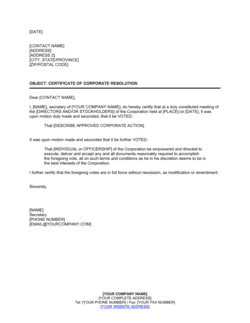
Draft the resolution text precisely
Write the RESOLVED clause with the specific action, counterparty name, dollar amounts, account numbers, or contract names involved. Vague language causes third-party rejections and forces you to reissue the certificate.
💡 For banking resolutions, call your bank's commercial banking team and ask for their specific required resolution language — many institutions have a prescribed format.
5
Record the vote tally
Enter the exact number of votes cast in favor, against, and abstaining. Confirm the tally meets the threshold required by your bylaws for the resolution type.
💡 Keep the original meeting minutes showing the same vote count on file — the certificate is a certified extract of those minutes, and auditors may request both documents.
6
Name each authorized signatory with full legal name and title
List every individual authorized to act pursuant to the resolution, their exact title, and include a specimen signature line where required by the counterparty.
💡 Include successor language — 'and any person succeeding to the title of [TITLE]' — if you want the authorization to survive officer turnover without issuing a new certificate.
7
Complete the certification and incumbency statement
The certifying officer must confirm their own title, that the resolution was duly adopted, and that it remains in full force. Ensure the certifying officer is not the same person whose authority is being established by the resolution.
💡 Many banks require the Secretary or Assistant Secretary to certify — not the CEO or authorized signatory named in the resolution itself.
8
Execute with the required number of signatures and date
Sign and date the certificate. Confirm whether your bylaws, the counterparty's requirements, or applicable law require one or two officer signatures, and ensure both sign if required.
💡 Use Business in a Box eSign to timestamp execution and store the fully executed certificate alongside the underlying meeting minutes in a single document package.