Corporate Social Media Use Policy Template

Free Word download β€’ Edit online β€’ Save & share with Drive β€’ Export to PDF

3 pagesβ€’20–25 min to fillβ€’Difficulty: Standard
Learn more ↓
FreeCorporate Social Media Use Policy Template

At a glance

What it is
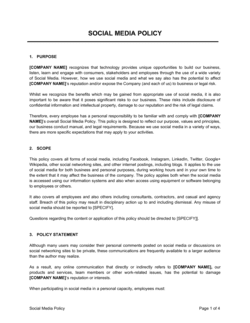
A Corporate Social Media Use Policy is an internal governance document that defines how employees may use social media platforms β€” both on company time and in personal capacities where the company could be implicated. This free Word download gives you a structured, editable template covering approved use, prohibited conduct, brand voice guidelines, confidentiality obligations, and disciplinary consequences.
When you need it
Use it when onboarding new employees, after a social media incident involving staff, or when formalizing HR and communications policies for a growing team. It is also required by many enterprise clients and regulated-industry partners as a vendor compliance document.
What's inside
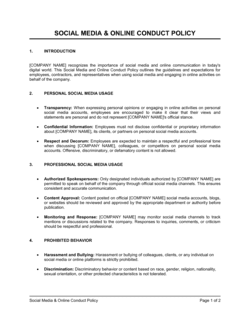
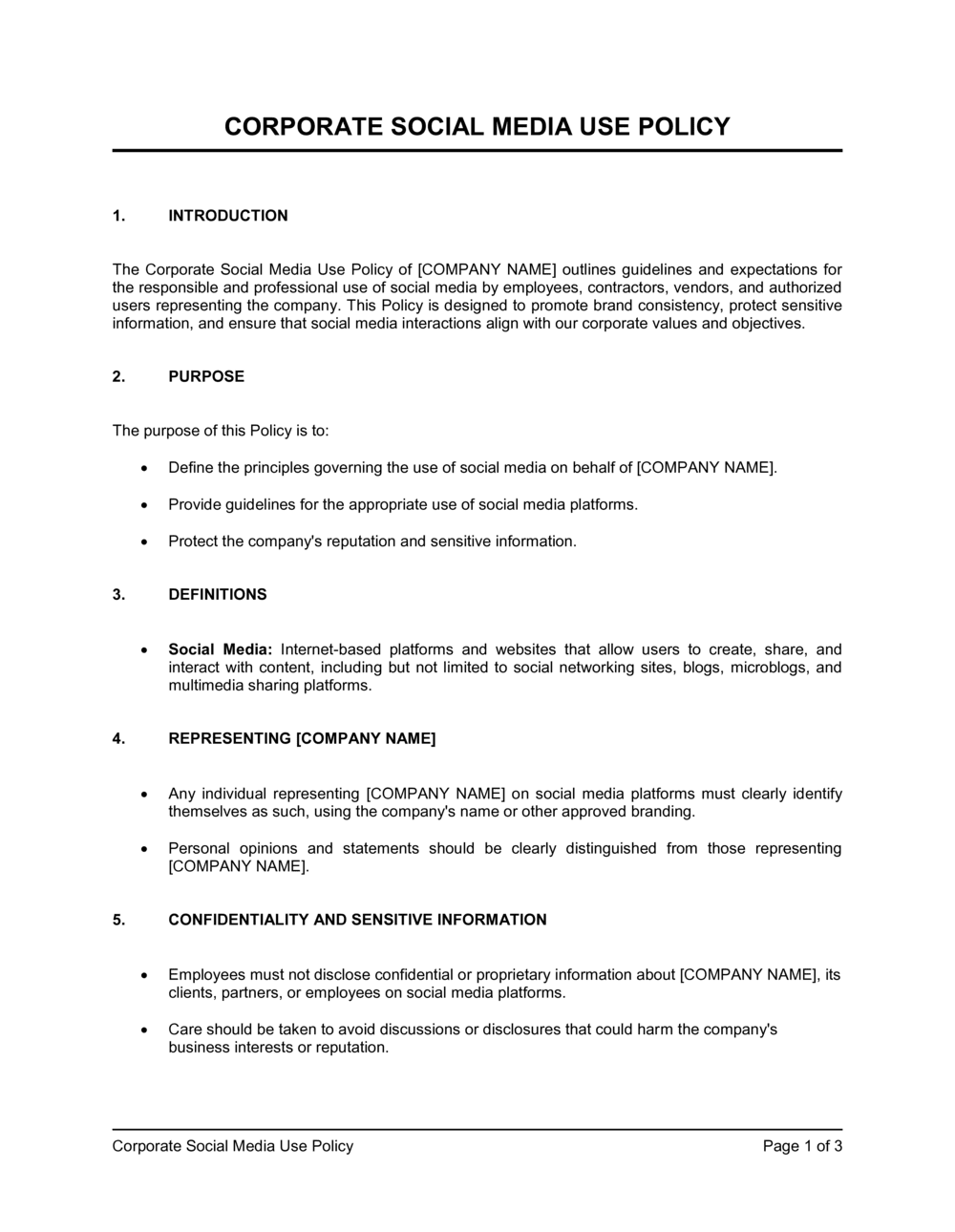
Purpose and scope, definitions of personal versus official use, approved conduct and brand voice guidelines, prohibited behaviors, confidentiality and disclosure rules, monitoring and enforcement procedures, and an employee acknowledgement section.

What is a Corporate Social Media Use Policy?

A Corporate Social Media Use Policy is an internal governance document that defines the rules governing how employees use social media β€” across official company accounts, personal accounts that reference the employer, and any activity conducted on company devices or networks. It sets the boundaries of acceptable conduct, specifies what constitutes a prohibited disclosure, establishes the brand voice standards employees must follow when posting on behalf of the company, and outlines the monitoring practices and disciplinary consequences that apply when the policy is violated. Unlike a general code of conduct, it is focused specifically on the reputational, legal, and operational risks that arise from social media activity.

Why You Need This Document

Every employee with a LinkedIn profile, a personal X account, or access to your company's Instagram is a potential vector for reputational damage, confidential data leakage, or regulatory liability β€” whether they intend harm or not. Without a written policy in place before an incident occurs, disciplinary action is difficult to defend, wrongful dismissal claims are harder to contest, and employees cannot be held to a standard they were never told existed. In regulated industries, the absence of a documented social media policy can itself constitute a compliance failure β€” FINRA, for example, expects firms to supervise employees' business-related social media communications. This template gives you a complete, customizable starting point that covers every material risk area, integrates with your existing HR documentation, and can be put in front of employees for acknowledgement the same day you download it.

Which variant fits your situation?

If your situation is…Use this template
General employee personal and professional social media useCorporate Social Media Use Policy
Governing official company social media accounts onlySocial Media Marketing Policy
Managing a brand ambassador or employee advocacy programEmployee Advocacy Guidelines
Addressing social media use during a specific crisis or PR eventCrisis Communications Plan
Setting rules for all technology and internet use, not just social mediaAcceptable Use Policy
Protecting sensitive data shared across all digital channelsInformation Security Policy

Common mistakes to avoid

❌ Overly broad personal account restrictions

Why it matters: In the US, the National Labor Relations Act protects employees' rights to discuss wages, working conditions, and organize collectively β€” even on personal social media. Policies that restrict all work-related personal posts can constitute an unfair labor practice.

Fix: Review the NLRA and equivalent statutes in your jurisdiction before finalizing restrictions on personal account content. Include a carve-out for protected concerted activity and have HR counsel review the prohibited conduct section.

❌ No platform-specific guidance

Why it matters: A policy written around Facebook and LinkedIn in 2019 gives employees no guidance on TikTok, Threads, or emerging platforms where professional and personal personas increasingly overlap.

Fix: Include a catch-all definition of 'social media' that covers any current or future platform and review the platform list annually as part of your policy update cycle.

❌ Collecting acknowledgements informally

Why it matters: An email reply or verbal confirmation is nearly impossible to produce as evidence if a disciplinary dispute reaches an employment tribunal or litigation. The company cannot prove the employee was on notice of the rules.

Fix: Require a dated signature on a physical or PDF form, or record acknowledgement through your HRIS system with a timestamp. Store records for the duration of employment plus at least two years.

❌ No update or review schedule

Why it matters: A social media policy that hasn't been revised in three or more years is likely to reference defunct platforms, miss new legal obligations (e.g., FTC influencer disclosure rules updated in 2023), and fail to address behaviors that didn't exist when the policy was written.

Fix: Assign a named policy owner and a fixed annual review date. Trigger an off-cycle review any time a major platform changes its functionality or a regulatory update affects disclosure obligations.

The 9 key sections, explained

Purpose and scope

Definitions

Approved conduct and personal use guidelines

Brand voice and official posting standards

Prohibited conduct

Confidentiality and disclosure obligations

Monitoring and privacy

Disciplinary procedures

Employee acknowledgement

How to fill it out

  1. 1

    Define your scope and covered parties

    Identify every category of worker the policy covers β€” full-time employees, part-time staff, contractors, and agency workers. Specify which platforms are addressed and whether the policy applies to personal use outside work hours.

    πŸ’‘ Err toward broader scope definitions. A contractor who posts a damaging statement about a client creates the same liability as a full-time employee.

  2. 2

    Customize the definitions section

    Replace placeholder terms with your actual account names, approved hashtags, and confidential information categories specific to your industry. Add a definition for any platform your workforce uses that is not listed in the template.

    πŸ’‘ Name your actual official accounts (e.g., '@[CompanyHandle] on LinkedIn') so employees have no ambiguity about what constitutes an Official Account.

  3. 3

    Set permitted personal use boundaries

    Decide whether personal social media is permitted during work hours and under what conditions β€” e.g., during breaks only, or unrestricted if job duties are met. Document your decision explicitly rather than leaving it implied.

    πŸ’‘ If your workforce is remote or hybrid, be specific about 'work hours' β€” a blanket 'no personal use during work hours' rule is nearly unenforceable for employees without fixed schedules.

  4. 4

    Write the prohibited conduct list with specific examples

    Replace generic prohibitions with conduct examples tailored to your industry and risk profile. A financial services firm needs explicit securities law references; a healthcare employer needs HIPAA-specific examples.

    πŸ’‘ Adding three to five real-world examples of prohibited posts (anonymized) is more effective at changing behavior than a list of abstract rules.

  5. 5

    Attach or link your brand voice guidelines

    Either paste a summary of your brand voice standards into Appendix A or include a live link to the current version in your internal knowledge base. Do not leave the appendix blank.

    πŸ’‘ Include at least two 'do' and two 'don't' examples of tone and phrasing β€” this is more actionable than a style description alone.

  6. 6

    Configure the acknowledgement mechanism

    Decide whether you will collect signatures on paper, via PDF, or through your HRIS. Update the acknowledgement section to name the specific platform and record-keeping process you will use.

    πŸ’‘ Integrate acknowledgement collection into your onboarding workflow so new employees sign the policy before their first day, not weeks later.

  7. 7

    Set a review date and assign an owner

    Add a 'Policy Owner' field (typically HR or Legal) and a review date no more than 12 months from the effective date. Social media platforms and relevant laws change frequently enough to warrant annual updates.

    πŸ’‘ Calendar the review 30 days before the review date, not on the day β€” last-minute reviews produce careless updates.

Frequently asked questions

What is a corporate social media use policy?

A corporate social media use policy is an internal document that sets rules for how employees may use social media β€” both on official company channels and in personal capacities where the employer could be implicated. It covers approved conduct, prohibited behaviors, confidentiality obligations, brand voice standards, monitoring rights, and the consequences of violations. It is typically part of the employee handbook and acknowledged at onboarding.

Why does my company need a social media policy?

Without a written policy, employees have no clear guidance on what disclosures are prohibited, what tone is appropriate when identifying their employer online, or what constitutes a disciplinable offense. Employers who attempt to discipline employees for social media conduct without a pre-existing written policy frequently lose wrongful dismissal claims. A policy also reduces the risk of confidential information leaks, securities law violations, and reputational damage from unauthorized or off-brand posts.

Can a company restrict what employees post on personal social media accounts?

Yes, within limits. Employers can prohibit employees from disclosing confidential information, making defamatory statements, or posting content that creates legal liability β€” on personal accounts as well as official ones. However, in the US the NLRA protects employees' rights to discuss wages and working conditions online, and many state laws restrict employer monitoring of personal accounts. The policy should be reviewed against applicable labor law before it is finalized.

Should the social media policy be part of the employee handbook?

Yes, and it should also be distributed as a standalone document that employees sign separately. Embedding it in a handbook is useful for reference, but a separate signed acknowledgement creates a cleaner evidence trail if a disciplinary matter arises. Both approaches together provide the strongest documentation position.

Does this policy apply to contractors and freelancers?

It should, and the policy should say so explicitly. A contractor who discloses confidential client information on LinkedIn creates the same legal and reputational risk as a full-time employee. Include contractors, agency workers, and any third party who accesses company information in your scope definition, and require acknowledgement as part of onboarding or contract execution.

How often should a social media policy be updated?

At minimum once per year, and immediately following any major regulatory change (such as updated FTC influencer disclosure guidelines), a significant platform change, or a social media incident involving staff. Assign a named policy owner β€” typically HR or Legal β€” and calendar the review 30 days before the annual renewal date so the update is not rushed.

What happens if an employee violates the social media policy?

Consequences should be proportionate to the severity of the violation and consistent with the company's overall disciplinary framework. Minor infractions β€” an off-brand personal post that causes no material harm β€” typically warrant a verbal or written warning and retraining. Serious violations such as disclosing confidential client information, posting discriminatory content, or making statements that create securities law exposure may justify immediate termination. The policy should preserve management's discretion to escalate the response based on circumstances.

Does a social media policy need to address personal use during work hours?

Yes. Leaving personal use during work hours unaddressed creates ambiguity that is hard to enforce. The policy should state whether personal social media is permitted during work hours, under what conditions (e.g., breaks only), and whether productivity impact is a factor. For remote or hybrid teams, define 'work hours' explicitly rather than relying on a generic prohibition.

Can the company monitor employees' social media activity?

Companies can monitor activity on official company accounts and on company-owned devices and networks. Monitoring personal accounts is more restricted β€” in most jurisdictions, employers may only review publicly accessible content, and some states (including California and New York) have specific statutes limiting employer access to personal accounts. The policy should describe monitoring practices accurately and avoid overstating the employer's rights.

How this compares to alternatives

vs Acceptable Use Policy

An acceptable use policy governs all company technology and internet access β€” email, file sharing, browsing, and devices β€” not just social media. A social media policy focuses specifically on social platforms and the unique conduct risks they present, including brand voice, employee advocacy, and public-facing disclosures. Large organizations typically need both; smaller teams may combine them.

vs Employee Handbook

An employee handbook is a comprehensive reference covering all workplace policies β€” conduct, compensation, leave, and benefits. A social media use policy is a discrete standalone document focused on one risk area. The social media policy should be embedded in the handbook as a chapter and also distributed separately to generate a specific signed acknowledgement.

vs Non-Disclosure Agreement

An NDA is a legally binding contract that prohibits disclosure of confidential information in all contexts. A social media policy applies the confidentiality obligation specifically to online platforms and adds conduct rules that go beyond disclosure β€” brand voice, prohibited posts, monitoring, and discipline. Both documents are typically used together; the social media policy reinforces and operationalizes the NDA.

vs Crisis Communications Plan

A crisis communications plan governs how the company responds to a reputation-threatening event β€” who speaks, what is said, and how quickly. A social media use policy is preventive, setting day-to-day conduct rules before any incident occurs. The two documents should cross-reference each other: the social media policy should direct employees to the crisis plan when an incident is developing.

Industry-specific considerations

Financial Services

Must address FINRA and SEC regulations on financial promotions, prohibit disclosure of material non-public information, and require compliance pre-approval for posts discussing markets or products.

Healthcare

HIPAA prohibits sharing any patient information β€” even anonymized cases that could identify an individual β€” on social media, requiring explicit examples of prohibited disclosures in the policy.

Retail / E-commerce

Large frontline workforces and high turnover demand a short, plain-language policy with strong acknowledgement workflows integrated into store or warehouse onboarding.

Professional Services

Client confidentiality is paramount β€” the policy must prohibit naming clients, describing engagements, or sharing work product on personal profiles, even in general terms.

Template vs pro β€” what fits your needs?

PathBest forCostTime
Use the templateSmall to mid-sized businesses establishing a social media policy for the first timeFree2–4 hours to customize and finalize
Template + professional reviewCompanies in regulated industries (financial services, healthcare) or with a workforce in multiple states or countries$300–$800 for an HR or employment counsel review3–5 business days
Custom draftedEnterprise employers with complex brand ambassador programs, union workforces, or operations across multiple jurisdictions with conflicting privacy laws$1,500–$4,000+2–4 weeks

Glossary

Social Media
Any web-based or mobile platform that enables users to create, share, or exchange content publicly or within a network β€” including LinkedIn, X, Facebook, Instagram, TikTok, Reddit, and YouTube.
Official Use
Posting or engaging on social media on behalf of the company using a company-owned or company-authorized account.
Personal Use
An employee's activity on personal social media accounts, even when it references the employer, colleagues, clients, or company matters.
Confidential Information
Any non-public information about the company's finances, clients, products, strategies, or personnel that an employee accesses in the course of their work.
Endorsement
A post that could be interpreted as an official company position or recommendation β€” regulated by the FTC in the US when undisclosed.
Disclosure Obligation
An employee's duty to identify their employer affiliation when posting about the company, industry, or related topics in a professional context.
Monitoring
The company's review of activity on company-owned accounts or on company devices and networks, within the limits permitted by applicable privacy law.
Disciplinary Action
The range of employer responses to a policy violation β€” from a written warning to termination β€” depending on severity and recurrence.
Brand Voice
The consistent tone, vocabulary, and values the company uses in all external communications, including social media.
Safe Harbor Statement
A disclaimer β€” such as 'views are my own' β€” that employees may include on personal profiles to indicate that personal posts do not represent the company.

Part of your Business Operating System

This document is one of 3,000+ business & legal templates included in Business in a Box.

  • Fill-in-the-blanks β€” ready in minutes
  • 100% customizable Word document
  • Compatible with all office suites
  • Export to PDF and share electronically

Create your document in 3 simple steps.

From template to signed document β€” all inside one Business Operating System.
1
Download or open template

Access over 3,000+ business and legal templates for any business task, project or initiative.

2
Edit and fill in the blanks with AI

Customize your ready-made business document template and save it in the cloud.

3
Save, Share, Send, Sign

Share your files and folders with your team. Create a space of seamless collaboration.

Save time, save money, and create top-quality documents.

β˜…β˜…β˜…β˜…β˜…

"Fantastic value! I'm not sure how I'd do without it. It's worth its weight in gold and paid back for itself many times."

Managing Director Β· Mall Farm
Robert Whalley
Managing Director, Mall Farm Proprietary Limited
β˜…β˜…β˜…β˜…β˜…

"I have been using Business in a Box for years. It has been the most useful source of templates I have encountered. I recommend it to anyone."

Business Owner Β· 4+ years
Dr Michael John Freestone
Business Owner
β˜…β˜…β˜…β˜…β˜…

"It has been a life saver so many times I have lost count. Business in a Box has saved me so much time and as you know, time is money."

Owner Β· Upstate Web
David G. Moore Jr.
Owner, Upstate Web

Run your business with a system β€” not scattered tools

Stop downloading documents. Start operating with clarity. Business in a Box gives you the Business Operating System used by over 250,000 companies worldwide to structure, run, and grow their business.

Start freeΒ Β·Β No credit card required