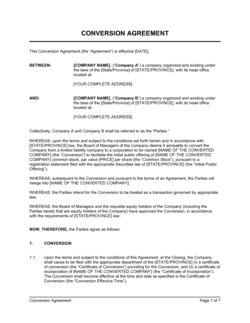
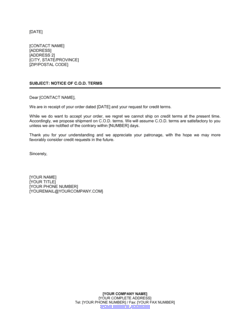
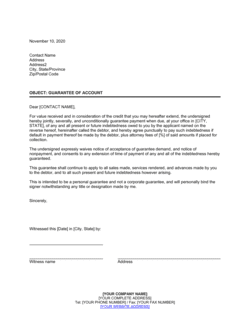
Conversion of Account to COD Template

Free Word download β€’ Edit online β€’ Save & share with Drive β€’ Export to PDF

1 pageβ€’20–30 min to fillβ€’Difficulty: Standardβ€’Signature requiredβ€’Legal review recommended
Learn more ↓
FreeConversion of Account to COD Template

At a glance

What it is
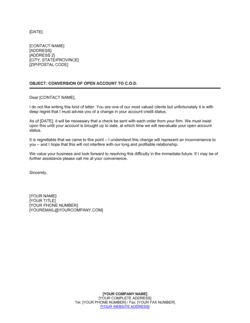
A Conversion of Account to COD is a formal written notice a seller sends to a customer to formally revoke previously granted open credit terms and require that all future orders be paid on a cash-on-delivery basis. This free Word download gives you a legally structured letter you can edit online and export as PDF in minutes.
When you need it
Use it when a customer has a pattern of late payments, has defaulted on invoices, has exceeded their credit limit, or when your credit review process reveals deteriorating financial health. It documents the change in terms before the next shipment is made.
What's inside
The notice identifies both parties and the account, states the effective date of the COD conversion, references the payment history or reason for the change, sets out the new COD payment requirement, and includes outstanding balance instructions and an acknowledgment block for the customer to sign.

What is a Conversion of Account to COD?

A Conversion of Account to COD is a formal written notice a seller issues to a customer to revoke previously granted open credit terms β€” such as Net 30 or Net 60 β€” and require that all future orders be paid on a cash-on-delivery basis. It identifies the account, documents the reason for the change, states the effective date, addresses any outstanding balance, and includes an acknowledgment block for the customer to sign. The notice operates as a binding modification to the payment terms of the supply relationship and creates a dated paper trail that supports enforcement, collection action, and credit management decisions.

Why You Need This Document

Continuing to ship goods to a customer on open credit after they have missed payment deadlines exposes your business to compounding accounts receivable losses. Each new shipment increases your unsecured exposure on an account that has already demonstrated it cannot or will not pay on time. A formal COD conversion notice stops that exposure from growing while keeping the supply relationship intact under terms your business can actually sustain. Without a written, signed notice, customers can dispute when the new terms took effect, claim they were unaware of the change, or argue that continued shipments constituted acceptance of the old terms. This template gives you a legally structured, plain-language notice you can complete in under 20 minutes β€” protecting your cash flow, your legal position, and the clarity of your customer relationships.

Which variant fits your situation?

If your situation is…Use this template
Customer has unpaid invoices and ongoing credit exposureConversion of Account to COD
Issuing a formal final demand before collections or legal actionDemand for Payment Letter
Suspending the account entirely rather than switching to CODAccount Suspension Notice
Offering a payment plan for the outstanding balancePayment Plan Agreement
Notifying a customer of an overdue balance before any term changePast Due Collection Letter
Terminating the customer relationship entirelyContract Termination Letter
Establishing initial credit terms with a new customerCredit Application

Common mistakes to avoid

❌ Using vague or inflammatory language in the reason clause

Why it matters: Phrases like 'refusal to pay' or 'bad faith' can expose the seller to defamation or trade libel claims if the characterization is disputed. They also inflame the customer relationship unnecessarily.

Fix: State only objective facts β€” invoice numbers, dollar amounts, and days past due. Neutral, specific language is both legally safer and harder to contest.

❌ Not addressing the existing outstanding balance separately

Why it matters: Customers sometimes interpret a COD conversion as a fresh start, assuming prior invoices are no longer enforceable or will be resolved through the new arrangement.

Fix: Include a dedicated clause listing open invoices, the total amount owed, and the deadline for payment under the original terms β€” separate from and in addition to the COD requirement.

❌ Setting the effective date to 'immediately' without a calendar date

Why it matters: Disputes arise over when the customer actually received the notice and when their COD obligation began. 'Immediately' is not an enforceable date in most jurisdictions.

Fix: Always specify a calendar date β€” at minimum 3–5 business days after the expected delivery of the notice β€” to create a clear, provable timeline.

❌ Omitting the reservation of rights clause

Why it matters: Without it, a court could interpret the COD conversion notice as a modification of the original agreement that implicitly waives prior claims or late fees.

Fix: Include an express reservation of rights stating that the notice does not waive any existing remedies, claims, or rights to collect outstanding amounts.

❌ Sending the notice only verbally or by untracked email

Why it matters: An undelivered or unacknowledged notice gives the customer grounds to claim they were unaware of the COD requirement when the next shipment arrives β€” exposing the seller to a dispute over payment terms at the point of delivery.

Fix: Send by certified mail, registered courier, or a tracked email platform that timestamps delivery. Retain the delivery confirmation in the customer's file.

❌ Promising automatic credit reinstatement after a fixed period

Why it matters: A specific, unconditional reinstatement promise creates a contractual obligation to restore credit terms even if the customer's financial condition has not improved.

Fix: Frame reinstatement as 'at Seller's sole discretion upon satisfactory review' β€” giving the customer a clear pathway while keeping the decision firmly within the seller's control.

The 10 key clauses, explained

Parties and Account Identification

In plain language: Identifies the seller and the customer by full legal name, account number, and contact information to ensure there is no ambiguity about which account is being converted.

Sample language
This notice is issued by [SELLER LEGAL NAME] ('Seller') to [CUSTOMER LEGAL NAME] ('Customer'), account number [ACCOUNT NUMBER], located at [CUSTOMER ADDRESS].

Common mistake: Using a trade name instead of the customer's registered legal entity β€” if the account is disputed or sent to collections, enforcement against the correct legal entity becomes complicated.

Statement of Prior Credit Terms

In plain language: Documents the credit terms that were previously in place, including the credit limit and payment period, to establish a clear baseline before the change.

Sample language
Customer's account has been maintained on [NET 30 / NET 60] open credit terms with a credit limit of $[AMOUNT] since [DATE].

Common mistake: Omitting the prior terms entirely. Without this, the customer can dispute that any credit arrangement existed, weakening the seller's position in a collection or dispute.

Reason for Conversion

In plain language: States the specific basis for converting the account β€” late payments, outstanding balance, credit limit breach, or deteriorating financial condition β€” without making accusations that could expose the seller to defamation claims.

Sample language
Due to [invoices totaling $[AMOUNT] remaining unpaid beyond [X] days past due / Customer's account balance of $[AMOUNT] exceeding the approved credit limit / a review of Customer's credit and payment history], Seller has determined that continued open-account terms are no longer appropriate.

Common mistake: Using inflammatory language such as 'refusal to pay' or 'dishonest conduct.' Factual, neutral language β€” referencing dates and dollar amounts β€” is enforceable and avoids defamation exposure.

Effective Date of COD Conversion

In plain language: States the precise date on which COD terms take effect. Orders placed on or after this date will not ship until payment is received in full.

Sample language
Effective [DATE], all orders placed with Seller shall be payable on a cash-on-delivery basis. No shipments will be processed or released until full payment for each order is received prior to or at the time of delivery.

Common mistake: Setting the effective date to 'immediately' without a calendar date. Disputes arise over when the notice was received and when COD obligations actually began.

Outstanding Balance and Settlement Terms

In plain language: Addresses any existing unpaid invoices, states the total amount owed, and sets a deadline for settling the outstanding balance under the prior terms.

Sample language
Customer's outstanding balance as of [DATE] is $[AMOUNT], comprising invoices [INVOICE NUMBERS]. This balance remains due and payable in accordance with the original invoice terms. Full payment is requested by [DATE].

Common mistake: Converting to COD without separately addressing the existing balance. Customers sometimes assume COD conversion resets or forgives old invoices β€” the clause eliminates that ambiguity.

COD Payment Method and Process

In plain language: Specifies which forms of payment are accepted on delivery β€” bank transfer, certified check, money order, or electronic payment β€” and how advance confirmation of payment will work logistically.

Sample language
Acceptable COD payment methods include [certified check / money order / bank wire transfer / electronic payment via [PLATFORM]]. Payment must be confirmed prior to dispatch for orders exceeding $[AMOUNT].

Common mistake: Not specifying accepted payment methods. Drivers and warehouse staff receive goods without guidance on what constitutes valid COD payment, creating operational disputes.

Reservation of Rights

In plain language: Preserves the seller's right to pursue collection of the outstanding balance, charge contractual late fees, or take further credit action without waiving any existing remedies.

Sample language
This notice does not waive Seller's right to collect any outstanding amounts owed, to charge applicable late fees, or to pursue any other remedies available at law or in equity. All existing rights are expressly reserved.

Common mistake: Omitting a reservation of rights. Without it, issuing a conversion notice could be argued to constitute a settlement or release of prior claims, particularly if the customer makes a partial payment.

Reinstatement of Credit Terms

In plain language: States the conditions β€” if any β€” under which the seller may agree to restore open credit terms, giving the customer a clear path to rehabilitation while keeping the decision firmly in the seller's discretion.

Sample language
Seller may, at its sole discretion, consider reinstatement of open credit terms upon receipt of payment in full of all outstanding balances and demonstration of [X consecutive on-time COD payments / satisfactory credit review].

Common mistake: Promising reinstatement after a fixed number of payments without a discretionary qualifier. This can create an enforceable obligation to restore credit terms even if the customer's financial position has not genuinely improved.

Governing Law and Dispute Resolution

In plain language: Specifies the jurisdiction whose law governs the notice and how any disputes arising from the conversion or the outstanding balance will be resolved.

Sample language
This notice and any disputes arising from it shall be governed by the laws of [STATE / PROVINCE / COUNTRY]. Any dispute not resolved by good-faith negotiation shall be submitted to [binding arbitration / the courts of [JURISDICTION]].

Common mistake: Choosing a governing law that has no connection to the customer's location. Enforcing a judgment in a different jurisdiction adds cost and complexity that a properly chosen forum clause avoids.

Customer Acknowledgment and Signature

In plain language: A signature block where the customer's authorized representative acknowledges receipt of the notice and acceptance of the new COD terms, creating a dated written record.

Sample language
By signing below, Customer acknowledges receipt of this notice, understands that open credit terms have been revoked effective [DATE], and agrees to pay all future orders on a cash-on-delivery basis. Customer: [NAME], [TITLE], [SIGNATURE], [DATE].

Common mistake: Sending the notice without an acknowledgment block and treating a verbal confirmation as sufficient. Unsigned notices are harder to enforce and leave the seller exposed if the customer later claims they never agreed to the change.

How to fill it out

  1. 1

    Enter both parties' legal names and the account number

    Use the seller's registered legal entity name and the customer's exact legal name as it appears in your accounting system. Include the customer's account number for unambiguous identification.

    πŸ’‘ Cross-check the customer's legal name against their original credit application or the contract that established the account β€” mismatches create enforcement complications.

  2. 2

    Document the prior credit terms

    State the credit limit, payment period (e.g., Net 30), and the date the terms were originally established. This creates a clear baseline for the conversion.

    πŸ’‘ Pull this information directly from your credit agreement or account setup records β€” paraphrasing from memory introduces errors that the customer may dispute.

  3. 3

    State the reason for conversion factually

    List specific unpaid invoices by number, date, and dollar amount, or reference the outstanding balance total. Avoid characterizations of intent β€” stick to amounts and dates.

    πŸ’‘ A factual, dollar-specific reason is harder to dispute than a vague reference to 'unsatisfactory payment history.' Numbers close arguments.

  4. 4

    Set a specific effective date

    Choose a calendar date that gives the customer at least 3–5 business days' notice before COD takes effect. Record this date clearly in the body of the letter.

    πŸ’‘ Do not backdate the effective date to a date before the notice is sent β€” this is unenforceable and creates bad faith exposure.

  5. 5

    List the outstanding balance and a settlement deadline

    Itemize open invoices by invoice number, date, and amount. Set a specific date by which the existing balance must be paid under the original terms.

    πŸ’‘ Attaching a copy of the aging report or invoice list as an exhibit removes any ambiguity about what is owed and speeds up resolution.

  6. 6

    Specify accepted COD payment methods

    List every payment form you will accept on delivery β€” certified check, money order, ACH, or payment link β€” so your operations team and the customer's accounts payable team are aligned before the first COD shipment.

    πŸ’‘ If you use a payment platform (e.g., Stripe, Bill.com), include the direct payment link so the customer can pay electronically before dispatch.

  7. 7

    Have the customer's authorized representative sign

    Send the notice with a signature block and request return of the signed copy within 5 business days. Keep the executed original in the customer's account file.

    πŸ’‘ If the customer refuses to sign, send the notice by certified mail or tracked email and retain the delivery confirmation β€” this establishes receipt even without a signature.

  8. 8

    Distribute to internal teams before the effective date

    Send a copy of the executed notice to your order processing, warehouse, and AR teams so they can flag the account and enforce COD on the first order after the effective date.

    πŸ’‘ Set a hard block in your order management system on the effective date so no COD-exempt order slips through by mistake.

Frequently asked questions

What is a Conversion of Account to COD?

A Conversion of Account to COD is a formal written notice from a seller to a customer that revokes existing open credit terms and requires all future orders to be paid in full at the time of delivery. It is used when a customer's payment history β€” late payments, unpaid invoices, or exceeded credit limits β€” makes continued extension of credit a financial risk. The document creates a dated, signed record of the change in payment terms.

When should a business convert a customer account to COD?

Common triggers include two or more consecutive late payments, invoices more than 60 days past due, a balance that has exceeded the approved credit limit, a significant deterioration in the customer's credit score, or a customer entering insolvency proceedings. Acting proactively before the exposure grows larger is generally preferable to waiting until the account requires collection action.

Does a Conversion of Account to COD need to be signed by the customer?

A customer signature is not strictly required for the notice to be legally effective in most jurisdictions β€” as long as the seller can demonstrate the notice was received. However, an acknowledgment signature is strongly recommended because it eliminates disputes about whether the customer was aware of the new terms when the next shipment arrived. If the customer refuses to sign, send the notice by certified mail and retain proof of delivery.

What happens to existing unpaid invoices when an account is converted to COD?

The COD conversion governs future orders only. Existing unpaid invoices remain due and payable under their original terms and due dates. The conversion notice should include a separate clause listing open invoices and a deadline for their settlement. Converting to COD does not forgive, defer, or modify the customer's obligation to pay amounts already owed.

Can a seller convert an account to COD without prior notice?

In most jurisdictions, if the original credit agreement includes a clause permitting the seller to change terms upon default, an immediate conversion is permissible. Without such a clause, converting without reasonable notice may be challenged as a breach of the implied covenant of good faith. Providing at least 3–5 business days' notice is standard practice and reduces dispute risk significantly.

Can credit terms be reinstated after a COD conversion?

Yes β€” reinstatement is at the seller's discretion and is typically considered after the outstanding balance is paid in full and the customer demonstrates a pattern of on-time COD payments, usually over 3–6 months. The conversion notice should frame reinstatement as discretionary rather than automatic to preserve the seller's control over the decision.

Is a Conversion of Account to COD the same as a demand letter?

No. A demand letter formally demands payment of a specific sum and typically precedes legal action if the demand is not met. A COD conversion notice changes the terms for future orders while addressing existing outstanding balances β€” it is a prospective credit management tool, not a collection instrument. Both documents may be used together: a COD conversion for ongoing orders and a separate demand letter for the outstanding balance.

Does a COD conversion affect the underlying supply contract?

A COD conversion notice modifies the payment terms of the supply relationship but does not typically terminate the underlying contract or change pricing, delivery obligations, or warranty terms. If the original supply agreement specifies how payment terms can be changed, the conversion notice should conform to that process. Consider having a lawyer review the original contract before issuing the notice if the relationship involves significant ongoing volume.

How this compares to alternatives

vs Past Due Collection Letter

A past due collection letter demands payment of a specific overdue amount and warns of escalation β€” it is a collection instrument focused on recovering money already owed. A COD conversion notice changes the terms for future orders and addresses the outstanding balance as a secondary matter. Use a collection letter when the primary goal is recovery; use a COD conversion when you intend to continue supplying the customer under stricter terms.

vs Credit Application

A credit application establishes open credit terms with a new customer at the start of the relationship. A COD conversion notice revokes those terms after the relationship has deteriorated. The credit application is the document that creates the credit exposure; the COD conversion notice is the mechanism for closing it.

vs Payment Plan Agreement

A payment plan agreement restructures an existing outstanding balance into scheduled installments β€” it is a cooperative arrangement the customer agrees to. A COD conversion notice is a unilateral action by the seller requiring all future orders be prepaid or paid on delivery. Both can be issued simultaneously: COD for new orders and a payment plan for the existing balance.

vs Contract Termination Letter

A contract termination letter ends the supply or service relationship entirely. A COD conversion notice preserves the relationship but changes its financial terms. Choose termination when the customer relationship is not worth continuing; choose a COD conversion when the customer has genuine value but poses unacceptable credit risk under current terms.

Industry-specific considerations

Wholesale and Distribution

High-volume distributors use COD conversions to protect against large outstanding balances when a retail or commercial buyer misses consecutive payment cycles.

Manufacturing

Manufacturers converting a distributor or OEM customer to COD after repeated late payments protect against exposure on raw-material and production costs already incurred.

Professional Services

Service firms convert clients to advance-payment or COD terms when retainer invoices go unpaid, ensuring work-in-progress is not delivered without compensation.

Construction and Trades

Suppliers of materials to general contractors require COD when a contractor's payment history deteriorates, particularly in long project cycles where payment disputes are common.

Jurisdictional notes

United States

In the US, UCC Article 2 governs the sale of goods and permits sellers to demand adequate assurance of payment when a buyer's ability to pay is in doubt. Most states allow unilateral conversion to COD if the original credit agreement includes a default clause. State-specific usury laws may cap late fees on outstanding balances, so confirm your rate is compliant before including it in the notice.

Canada

Canadian courts require that any modification to payment terms be communicated with reasonable notice and in good faith, particularly in established supply relationships. Provincial consumer protection legislation may impose additional notice requirements if the customer is a consumer rather than a business. Quebec's Civil Code requires that any amendment to an existing contract be clear and documented β€” an acknowledgment signature is especially important for Quebec customers.

United Kingdom

Under the Late Payment of Commercial Debts (Interest) Act 1998, UK businesses are entitled to statutory interest at 8% above the Bank of England base rate on overdue B2B invoices β€” reference this right in the outstanding balance clause to reinforce the urgency of settlement. UK contract law requires adequate notice before changing agreed terms; 5–10 business days' notice is standard practice for a COD conversion.

European Union

The EU Late Payment Directive (2011/7/EU) entitles creditors to statutory interest and recovery costs on overdue B2B invoices, and member states have implemented it with varying specifics. GDPR considerations apply if the reason clause references credit bureau data or financial information obtained about the customer β€” ensure the basis for processing that data is documented. France, Germany, and the Netherlands each impose their own notice periods for unilateral changes to commercial payment terms.

Template vs lawyer β€” what fits your deal?

PathBest forCostTime
Use the templateBusinesses converting a standard trade account to COD after routine late payment in a single jurisdictionFree15–20 minutes
Template + legal reviewAccounts with balances over $25,000, customers in a different jurisdiction, or where the original supply contract contains specific amendment procedures$150–$400 for a lawyer review1–2 business days
Custom draftedHigh-value accounts, international customers, or situations where the conversion is likely to be contested and may lead to litigation$500–$2,000+3–7 business days

Glossary

Cash on Delivery (COD)
A payment arrangement requiring the buyer to pay in full at the time goods are delivered, with no extension of credit.
Open Account / Net Terms
A credit arrangement allowing a buyer to receive goods now and pay the invoice within an agreed period β€” commonly Net 15, Net 30, or Net 60.
Credit Revocation
The formal act of withdrawing previously granted credit terms, requiring the customer to pay under stricter conditions going forward.
Effective Date
The specific calendar date on which the new COD payment terms take effect, after which no orders will ship on credit.
Outstanding Balance
The total amount owed by the customer for goods or services already delivered under the prior credit terms.
Payment Default
A customer's failure to pay one or more invoices by the contractual due date, triggering remedies such as COD conversion, late fees, or collections.
Accounts Receivable (AR)
The total amount of money a business is owed by customers for goods or services already delivered but not yet paid.
Credit Limit
The maximum outstanding balance a seller permits a customer to carry at any one time under open-account terms.
Advance Payment
A payment made by the buyer before goods are shipped or services are rendered β€” sometimes used as an alternative to COD for established customers losing credit.
Acknowledgment of Terms
A signed confirmation from the customer accepting the new COD requirement, creating a documented record of mutual agreement to the change.

Part of your Business Operating System

This document is one of 3,000+ business & legal templates included in Business in a Box.

  • Fill-in-the-blanks β€” ready in minutes
  • 100% customizable Word document
  • Compatible with all office suites
  • Export to PDF and share electronically

Create your document in 3 simple steps.

From template to signed document β€” all inside one Business Operating System.
1
Download or open template

Access over 3,000+ business and legal templates for any business task, project or initiative.

2
Edit and fill in the blanks with AI

Customize your ready-made business document template and save it in the cloud.

3
Save, Share, Send, Sign

Share your files and folders with your team. Create a space of seamless collaboration.

Save time, save money, and create top-quality documents.

β˜…β˜…β˜…β˜…β˜…

"Fantastic value! I'm not sure how I'd do without it. It's worth its weight in gold and paid back for itself many times."

Managing Director Β· Mall Farm
Robert Whalley
Managing Director, Mall Farm Proprietary Limited
β˜…β˜…β˜…β˜…β˜…

"I have been using Business in a Box for years. It has been the most useful source of templates I have encountered. I recommend it to anyone."

Business Owner Β· 4+ years
Dr Michael John Freestone
Business Owner
β˜…β˜…β˜…β˜…β˜…

"It has been a life saver so many times I have lost count. Business in a Box has saved me so much time and as you know, time is money."

Owner Β· Upstate Web
David G. Moore Jr.
Owner, Upstate Web

Run your business with a system β€” not scattered tools

Stop downloading documents. Start operating with clarity. Business in a Box gives you the Business Operating System used by over 250,000 companies worldwide to structure, run, and grow their business.

Free Forever PlanΒ Β·Β No credit card required