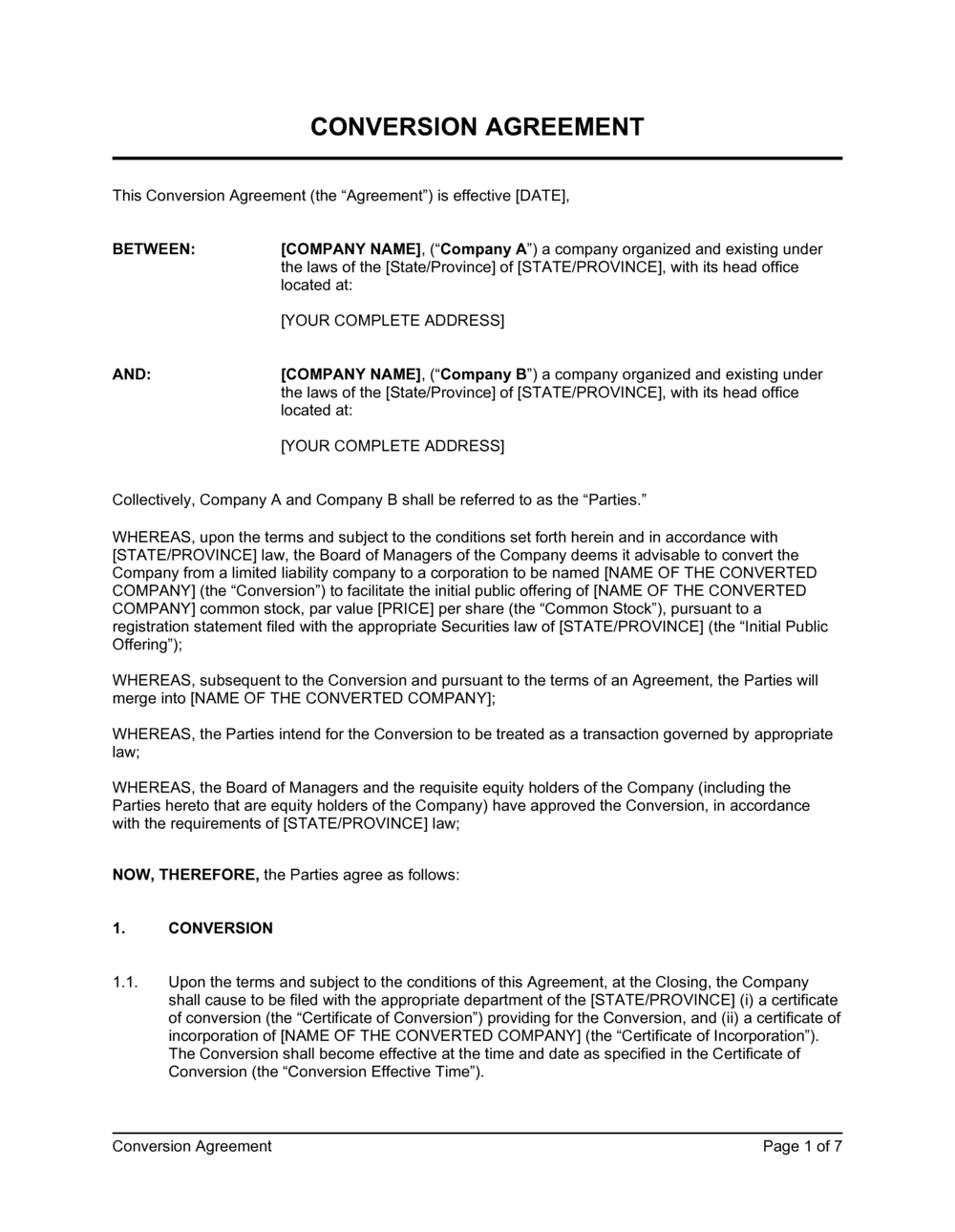
Conversion Agreement Template

Free Word download • Edit online • Save & share with Drive • Export to PDF

7 pages30–40 min to fillDifficulty: ComplexSignature requiredLegal review recommended
Learn more ↓
FreeConversion Agreement Template

At a glance

What it is
A Conversion Agreement is a legally binding contract that governs the transformation of one financial instrument or legal interest into another — most commonly converting a debt obligation (such as a loan or promissory note) into equity ownership in a company. This free Word download gives you a structured, attorney-reviewed starting point you can edit online and export as PDF to share with investors, lenders, or business partners.
When you need it
Use it when a creditor and debtor agree to convert an outstanding loan balance into shares, when converting one class of equity to another, or when restructuring a financial obligation to avoid default. It is also used when converting a business entity type — such as an LLC to a corporation — and the parties need to document the treatment of existing interests.
What's inside
Identification of parties and the instrument being converted, conversion terms and the conversion rate or price, conditions precedent to closing, representations and warranties from both parties, anti-dilution and pre-emptive rights provisions, closing mechanics, and governing law.

What is a Conversion Agreement?

A Conversion Agreement is a legally binding contract that formally governs the transformation of one financial instrument or legal interest into another — most commonly the exchange of an outstanding debt obligation for equity ownership in a company. When a startup's convertible note reaches its trigger event, when a shareholder loan is restructured into shares, or when preferred equity converts to common stock on an exit, the conversion agreement is the closing document that records the terms, extinguishes the original instrument, and establishes the new ownership relationship. Without it, the transaction exists only in informal communications and unenforceable oral understandings, leaving both parties exposed to disputes over the number of shares issued, the applicable conversion price, and whether the original debt was truly satisfied.

Why You Need This Document

The consequences of converting a financial instrument without a properly executed conversion agreement are concrete and serious. A creditor who converts a loan without formal documentation retains the legal ability to argue the debt was never satisfied — potentially asserting both a shareholder and a creditor claim simultaneously, particularly in an insolvency. Without a signed agreement specifying the conversion price and share class, the company may face cap table disputes that block future financing rounds, since investors and their counsel will find unexplained discrepancies in the equity register. Tax authorities in every major jurisdiction treat accrued interest as income in the year of conversion regardless of whether cash changed hands — an undocumented transaction leaves both parties without the records needed to support their respective tax filings. A well-prepared conversion agreement closes all of these gaps in a single closing package: it cancels the original instrument, issues shares on agreed terms, and creates the audit trail that future lenders, investors, and regulators will require.

Which variant fits your situation?

If your situation is…Use this template
Converting a short-term bridge loan into equity at the next priced roundConvertible Note Agreement
Converting one class of shares (e.g., preferred to common) upon an exit eventShare Conversion Agreement
Converting an LLC membership interest into corporate stock during entity conversionEntity Conversion Agreement
Converting an outstanding shareholder loan to equity on agreed termsDebt to Equity Conversion Agreement
Issuing simple future equity without a valuation cap or discountSAFE Agreement (Simple Agreement for Future Equity)
Restructuring multiple creditor debts into a combined equity stakeDebt Restructuring Agreement
Granting an option to convert debt at a future date if conditions are metConvertible Loan Agreement

Common mistakes to avoid

❌ Forgetting to include accrued interest in the conversion amount

Why it matters: If only the principal converts, the Holder retains an outstanding unsatisfied claim for accrued interest, creating a lingering creditor relationship alongside a new equity stake — a structurally problematic combination.

Fix: Calculate all accrued but unpaid interest to the conversion date using the original note's rate and formula, add it to the principal balance, and state the combined Outstanding Balance in the instrument description clause.

❌ Failing to formally cancel the original instrument at closing

Why it matters: Without documented cancellation, the Holder may later assert that both the debt and the equity coexist — essentially claiming double recovery — especially in an insolvency or dispute.

Fix: Include an explicit cancellation step in the closing mechanics clause, have the Holder surrender the original note marked 'Cancelled and Satisfied in Full,' and retain the cancelled instrument in your corporate records.

❌ Leaving the class of shares issued on conversion undefined

Why it matters: Ambiguity over whether the Holder receives common or preferred stock, and which series, creates disputes over liquidation preferences, voting rights, and dividend entitlements that are difficult and expensive to unwind.

Fix: Name the exact class and series of shares in the conversion terms clause and attach the relevant provisions of the certificate of incorporation or shareholders' agreement as a schedule.

❌ Using vague or subjective conditions precedent

Why it matters: A condition framed as 'subject to the Company's satisfaction' or 'at the Company's reasonable discretion' effectively gives one party a unilateral veto over conversion, making the agreement unenforceable against that party.

Fix: State all conditions as objective, verifiable facts — a specific dollar threshold for the qualifying financing, a board resolution by a fixed date, or a named regulatory approval — so neither party can unilaterally block conversion.

❌ Omitting the investment-purpose representation from the Holder

Why it matters: Without a representation that the Holder is acquiring shares for investment and not resale, the company cannot rely on common private placement exemptions, potentially making the share issuance an unregistered securities offering.

Fix: Include a standard accredited-investor and investment-purpose representation in the Holder's warranties section, and confirm the Holder's accredited status with appropriate documentation before closing.

❌ Not including a long-stop date on conditions precedent

Why it matters: Without a termination date, both parties can be bound to an open-ended obligation to convert if conditions are never satisfied — creating strategic leverage for whichever party benefits from delay.

Fix: Add a long-stop date clause: if all conditions precedent are not satisfied by [SPECIFIC DATE], either party may terminate the agreement by written notice, with no further obligation to convert.

The 10 key clauses, explained

Parties and Recitals

In plain language: Identifies the converting party (creditor or holder) and the issuing party (company or debtor) by their full legal names and describes the background and purpose of the conversion.

Sample language
This Conversion Agreement (the 'Agreement') is entered into as of [DATE] by and between [COMPANY LEGAL NAME], a [STATE/PROVINCE] [ENTITY TYPE] (the 'Company'), and [HOLDER FULL NAME / ENTITY NAME] (the 'Holder'). The parties wish to convert the outstanding [INSTRUMENT TYPE] described herein into equity of the Company on the terms set out below.

Common mistake: Using a trade name instead of the registered legal entity name for either party. If the entity name does not match the cap table or corporate registry, the shares issued may be attributed to the wrong legal person.

Description of the Instrument Being Converted

In plain language: Precisely identifies the debt, note, or other instrument subject to conversion — including the original principal amount, any accrued interest, the issue date, and the outstanding balance at conversion.

Sample language
The Holder holds that certain Promissory Note dated [ORIGINAL DATE] in the original principal amount of $[AMOUNT], of which $[OUTSTANDING PRINCIPAL] in principal and $[ACCRUED INTEREST] in accrued interest remains outstanding as of the Conversion Date (the 'Outstanding Balance').

Common mistake: Failing to account for accrued interest in the Outstanding Balance. Omitting accrued interest means the Holder may have a residual unsatisfied claim after conversion, creating a future dispute.

Conversion Terms and Conversion Price

In plain language: States the price per share (or unit) at which the outstanding balance converts, whether a discount or valuation cap applies, and the resulting number of shares to be issued.

Sample language
The Outstanding Balance shall convert into [X] shares of [CLASS OF STOCK] of the Company at a Conversion Price of $[PRICE] per share, calculated as the lesser of (a) $[CAP PRICE] and (b) [DISCOUNT]% of the price per share paid by investors in the Qualified Financing.

Common mistake: Not specifying which class of shares is issued on conversion. Leaving the class open creates ambiguity about voting rights, liquidation preferences, and dividend entitlements at the point of conversion.

Conditions Precedent to Conversion

In plain language: Lists the events or approvals that must occur before the conversion becomes effective — such as completion of a qualifying financing round, board approval, or regulatory clearance.

Sample language
The conversion of the Outstanding Balance shall be conditioned upon: (a) the closing of a Qualified Financing of at least $[MINIMUM AMOUNT] in aggregate gross proceeds; (b) approval by the Company's Board of Directors; and (c) execution of all required investor documentation for such Qualified Financing.

Common mistake: Setting conditions that are vague or within a single party's complete control. A condition like 'subject to Company's satisfaction' gives one party unilateral power to block conversion indefinitely.

Issuance of Shares and Closing Mechanics

In plain language: Describes what happens at closing — the cancellation of the converted instrument, the delivery of share certificates or electronic book-entry, and the timeline for completing these steps.

Sample language
Upon satisfaction of the Conditions Precedent, the Company shall: (a) cancel the [INSTRUMENT NAME] and mark it as satisfied in full; (b) issue to the Holder a certificate (or book-entry notation) representing [NUMBER] shares of [CLASS]; and (c) update the Company's capitalization table within [5] business days of the Conversion Date.

Common mistake: Failing to document the cancellation of the original instrument at closing. If the note is not formally cancelled, the Holder may later assert that the debt still exists independently of the shares received.

Representations and Warranties of the Company

In plain language: Statements by the company confirming it has authority to issue shares, that the shares will be validly issued and fully paid, that the capitalization table is accurate, and that there are no undisclosed encumbrances.

Sample language
The Company represents and warrants that: (a) it is duly organized and in good standing under the laws of [JURISDICTION]; (b) the shares to be issued upon conversion are duly authorized and, when issued, will be validly issued, fully paid, and non-assessable; and (c) the capitalization table attached as Schedule A is true and complete as of the date hereof.

Common mistake: Giving reps that are accurate at signing but not at closing. If the cap table changes between signature and the conversion closing date, the stale representation can expose the company to misrepresentation claims.

Representations and Warranties of the Holder

In plain language: Statements by the converting party confirming they own the instrument free of liens, have authority to convert, and are acquiring shares for their own account (satisfying securities law exemptions).

Sample language
The Holder represents and warrants that: (a) the Holder owns the [INSTRUMENT] free and clear of all liens, claims, and encumbrances; (b) the Holder has full power and authority to enter into this Agreement; and (c) the Holder is acquiring the shares for the Holder's own account, for investment purposes only, and not with a view to resale or distribution.

Common mistake: Omitting the investment-purpose representation. Without it, the share issuance may not qualify for a private placement exemption under applicable securities law, exposing the company to unregistered offering liability.

Anti-Dilution and Pre-Emptive Rights

In plain language: Specifies any price adjustment protections if the company later issues shares at a lower price, and any right of the Holder to participate in future rounds to maintain their ownership percentage.

Sample language
In the event the Company issues additional shares of [CLASS] at a price per share less than the Conversion Price, the Conversion Price shall be adjusted on a [broad-based weighted average / full-ratchet] basis. The Holder shall have pro rata rights to participate in future equity financings up to the Holder's post-conversion ownership percentage.

Common mistake: Including a full-ratchet anti-dilution clause without understanding its punitive effect. Full-ratchet resets the conversion price to the new lower price regardless of how few shares are issued at the lower price — this can dramatically dilute founders and other investors.

Tax Treatment and Acknowledgments

In plain language: Addresses the tax characterization of the conversion (e.g., whether accrued interest is treated as ordinary income), and each party's acknowledgment that they have sought independent tax and legal advice.

Sample language
Each party acknowledges that the tax consequences of this conversion may vary depending on individual circumstances. The Holder acknowledges that any accrued interest included in the Outstanding Balance may be treated as ordinary income in the year of conversion under applicable tax law. Each party has had the opportunity to consult with independent tax and legal counsel prior to execution.

Common mistake: Omitting any tax acknowledgment language and treating conversion as a purely mechanical financial event. Accrued interest converted to equity is typically taxable income to the Holder even though no cash is received — failing to flag this creates surprise tax liability.

Governing Law, Entire Agreement, and Miscellaneous

In plain language: States the jurisdiction whose law governs the agreement, confirms the document supersedes all prior understandings, and includes standard boilerplate on amendments, counterparts, and notices.

Sample language
This Agreement shall be governed by the laws of [STATE / PROVINCE / COUNTRY], without regard to its conflict-of-law principles. This Agreement constitutes the entire agreement between the parties with respect to its subject matter and supersedes all prior discussions, representations, and agreements. Amendments must be in writing and signed by both parties.

Common mistake: Selecting a governing law that has no connection to either party or the transaction. Courts in several jurisdictions will apply local law regardless of a contractual choice-of-law clause that lacks a reasonable relationship to the parties.

How to fill it out

  1. 1

    Identify the parties with their full legal names

    Enter the company's registered legal entity name — not a trade name — and the Holder's full legal name or registered entity name. Confirm both match the relevant corporate registry and cap table.

    💡 Pull the exact entity name from the certificate of incorporation or articles of organization to avoid mismatches that can void the share issuance.

  2. 2

    Describe the instrument being converted in full

    Reference the original instrument by its title, date, and original principal amount. Calculate the outstanding principal and accrued interest as of the intended conversion date and record both figures separately.

    💡 Use the actual accrual formula from the original note — simple vs. compound interest at the stated rate — to calculate accrued interest precisely, and attach the original instrument as an exhibit.

  3. 3

    Set the conversion price and resulting share count

    Determine whether the conversion price is a fixed negotiated price, the lower of a valuation cap and a discounted round price, or another formula. Calculate the exact number of shares the Outstanding Balance yields at that price.

    💡 Round down to the nearest whole share and state how any fractional share will be handled — cash payment at conversion price, or simply forfeited — to avoid ambiguity.

  4. 4

    Specify the class of shares to be issued

    State clearly whether the Holder receives common stock, preferred stock, or a specific series of preferred (e.g., Series A Preferred). Attach or cross-reference the certificate of incorporation and any applicable investors' rights agreement.

    💡 If the shares carry special rights (liquidation preference, dividends, anti-dilution), reference the governing documents rather than restating all terms in the body of this agreement.

  5. 5

    Define the conditions precedent with objective criteria

    List every event that must occur before conversion is effective. Use objective, measurable thresholds — a minimum financing amount in dollars, a board resolution date, a specific regulatory approval — rather than subjective satisfaction standards.

    💡 Include a long-stop date: if conditions are not satisfied by [DATE], either party may terminate the agreement. Without a long-stop, the obligation to convert can hang open indefinitely.

  6. 6

    Complete the representations and warranties sections

    Have each party confirm their authority to execute, the accuracy of their stated facts, and — for the Holder — the investment-purpose representation required for private placement exemptions under securities law.

    💡 Date the representations as of both the signing date and the conversion closing date using a bring-down mechanism, so that material changes between signing and closing are captured.

  7. 7

    Address anti-dilution, pro rata rights, and tax acknowledgments

    Decide whether to include anti-dilution protection and which formula applies. Add a tax acknowledgment confirming each party has had the opportunity to consult counsel. Insert the governing law and entire agreement clauses.

    💡 Broad-based weighted average anti-dilution is standard for most transactions — full-ratchet is investor-friendly but can severely harm founders and should only be accepted with full understanding of the downside scenario.

  8. 8

    Execute, cancel the original instrument, and update the cap table

    Both parties must sign before the conversion closing date. At closing, mark the original instrument cancelled, deliver shares or a book-entry confirmation, and update the capitalization table immediately.

    💡 Retain a fully executed copy with wet or electronic signatures, the cancelled original instrument, and the updated cap table as a single closing package — this is the evidence trail you will need for any future financing or audit.

Frequently asked questions

What is a conversion agreement?

A conversion agreement is a legally binding contract that governs the transformation of one financial instrument or legal interest into another. The most common use is converting outstanding debt — such as a loan or promissory note — into equity shares in the issuing company. It sets out the conversion price, the number of shares to be issued, any conditions that must be met, and the mechanics of closing the transaction.

When is a conversion agreement used?

Conversion agreements are most frequently used when a convertible note or bridge loan matures or reaches a qualifying financing trigger and the holder elects or is required to take equity rather than repayment. They are also used when a company restructures its balance sheet by converting shareholder loans to equity, when preferred shares convert to common upon an IPO or acquisition, and when an LLC converts to a corporation and existing interests must be formally redesignated.

What is the difference between a convertible note and a conversion agreement?

A convertible note is the original instrument — a loan document that contains built-in conversion rights from the outset. A conversion agreement is the separate document executed at the moment of actual conversion to formally effect the exchange of debt for equity. Think of the convertible note as the contract that creates the right, and the conversion agreement as the closing document that exercises it and records the transaction.

Does a conversion agreement need to be signed by both parties?

Yes. A conversion agreement is a bilateral contract and requires execution by both the company (or debtor) and the holder (or creditor). Both signatures should be obtained before or on the conversion closing date. Conversion mechanics that occur automatically under a note's terms still benefit from a signed confirmation agreement to create a clear audit trail for the cap table, future investors, and tax authorities.

What is a valuation cap and how does it affect the conversion price?

A valuation cap is a ceiling on the company valuation used to calculate the holder's conversion price, regardless of how high the next round actually values the company. If a note has a $5M valuation cap and the company raises a round at a $10M valuation, the holder converts at the $5M-implied price — receiving twice as many shares as investors in the new round. The cap rewards early investors for taking risk before the company's value was established.

Are conversion agreements enforceable if there is no original written instrument to convert?

In most jurisdictions, a conversion agreement converting an oral or undocumented loan into equity faces significant enforceability risk. Courts generally require the underlying obligation to be sufficiently certain in amount and terms before a conversion can be given legal effect. If the original loan was not documented in writing, both parties should first execute a promissory note formalizing the debt, then enter the conversion agreement referencing that note. Consider consulting a lawyer in this situation.

What are the tax implications of converting debt to equity?

Tax treatment typically depends on jurisdiction, but in most cases the holder must recognize accrued interest as ordinary income in the year of conversion even though no cash is received. For the company, cancellation of debt in exchange for equity can in some circumstances give rise to cancellation of indebtedness income under US tax rules, though specific exemptions may apply. Both parties should consult a tax advisor before executing a conversion agreement, as the consequences vary meaningfully by structure and jurisdiction.

Can a conversion agreement include anti-dilution protection?

Yes. It is common to include anti-dilution provisions that adjust the conversion price downward if the company later issues shares at a lower price. The two main formulas are broad-based weighted average (industry standard, moderate protection) and full-ratchet (aggressive, resets the price to the new lower price regardless of the number of shares issued). Most startup investors and company counsel prefer broad-based weighted average because full-ratchet can severely dilute founders and later investors in a down round.

Do I need a lawyer to prepare a conversion agreement?

For straightforward debt-to-equity conversions between known parties with a clearly documented original instrument, a high-quality template is a sound starting point. Engage a lawyer when the conversion involves a material amount, complex securities law considerations, multiple creditors, regulatory approvals, cross-border parties, or when the capitalization structure is already complex. A 2–4 hour legal review typically costs $400–$1,000 and is worthwhile for any conversion that will materially affect the company's cap table.

How this compares to alternatives

vs Convertible Note Agreement

A convertible note agreement is the original lending document that creates the debt and embeds future conversion rights from the outset. A conversion agreement is the closing document executed when those rights are actually exercised, formally extinguishing the debt and issuing shares. You need both: the note creates the right; the conversion agreement exercises it.

vs SAFE Agreement

A SAFE (Simple Agreement for Future Equity) is not debt — it carries no interest or maturity date and converts automatically on a triggering event without requiring a separate conversion agreement. A conversion agreement is used with instruments that are structured as debt or have more complex conversion conditions. SAFEs are simpler to execute but offer less flexibility in negotiating conversion mechanics.

vs Share Purchase Agreement

A share purchase agreement involves a new cash investment in exchange for shares. A conversion agreement involves no new cash — it exchanges an existing financial claim (debt or another instrument) for equity. The economics and legal mechanics differ materially: a share purchase increases the company's cash, while a conversion improves its balance sheet by reducing liabilities.

vs Debt Restructuring Agreement

A debt restructuring agreement modifies the terms of existing debt — extending maturity, reducing interest, or deferring payments — without necessarily converting it to equity. A conversion agreement terminates the debt relationship entirely by exchanging the outstanding balance for ownership. Restructuring preserves the creditor relationship; conversion ends it.

Industry-specific considerations

Technology / SaaS

Bridge loans and SAFE agreements converting at series priced rounds, often with valuation caps and discount rates that must be precisely modeled against the round's pre-money valuation.

Real estate

Mezzanine debt or preferred equity instruments converting to full equity ownership upon a development milestone or refinancing event, with conversion prices tied to appraised asset valuations.

Financial services

Regulated convertible instruments subject to additional securities and banking regulatory requirements, including potential approval from financial regulators before conversion can close.

Manufacturing

Shareholder or related-party loans converted to equity to improve debt-to-equity ratios ahead of acquisition, refinancing, or a strategic partnership requiring a cleaner balance sheet.

Jurisdictional notes

United States

Debt-to-equity conversions must comply with federal and state securities laws — share issuances typically rely on Regulation D exemptions, requiring the holder to be an accredited investor. Delaware corporate law governs most startup conversions and imposes specific requirements on board authorization for share issuances. Cancellation of indebtedness rules under the Internal Revenue Code may create taxable income for the company in certain conversion structures; consult a tax attorney before closing.

Canada

Share issuances on conversion must comply with applicable provincial securities legislation, typically relying on the accredited investor or private issuer exemptions. In Ontario and British Columbia, board resolutions authorizing the specific share issuance are required. Quebec-based transactions may require French-language documentation for provincially regulated entities. The Canada Revenue Agency treats accrued interest as income to the holder in the taxation year of conversion regardless of cash receipt.

United Kingdom

Conversions of debt to equity are generally exempt from the UK's financial promotion restrictions when conducted between sophisticated parties, but compliance with the Companies Act 2006 requirements for share allotment — including directors' authority and pre-emption rights waivers — is mandatory. HMRC treats accrued interest as income in the period it arises regardless of conversion. Enterprise Investment Scheme or Seed EIS tax reliefs may be affected by the terms of the convertible instrument, and early specialist advice is recommended.

European Union

Securities law requirements vary significantly by member state, but the EU Prospectus Regulation exempts most private conversion transactions from prospectus requirements when offered to fewer than 150 persons per member state. GDPR considerations apply when personal data of the holder is processed as part of the transaction. Several member states — including Germany and France — require notarization of share transfer documents; confirm local requirements before closing. Tax treatment of converted accrued interest varies by member state and should be confirmed with local counsel.

Template vs lawyer — what fits your deal?

PathBest forCostTime
Use the templateSimple debt-to-equity conversions between two known parties with a clearly documented original instrument and a straightforward cap tableFree30–60 minutes
Template + legal reviewConversions involving material amounts, valuation caps and discounts, anti-dilution provisions, or parties in different jurisdictions$400–$1,0002–5 days
Custom draftedComplex multi-creditor conversions, regulated industries, cross-border transactions, or any conversion that materially restructures the company's cap table ahead of a significant financing event$2,000–$8,000+1–3 weeks

Glossary

Conversion
The contractual process by which one financial instrument or legal interest is exchanged for another, such as debt being exchanged for equity shares.
Conversion Price
The price per share at which outstanding debt or a convertible instrument is exchanged for equity, usually set at a discount to the next round's share price.
Conversion Rate
The ratio at which the existing instrument converts into the new one — for example, $1,000 of debt converting at $1.00 per share yields 1,000 shares.
Convertible Note
A short-term debt instrument that automatically or optionally converts into equity — typically preferred shares — when a triggering event occurs, such as a qualified financing round.
Valuation Cap
A ceiling on the company's valuation used to calculate the conversion price, ensuring early investors receive shares at no worse than the capped price regardless of how high the round values the company.
Discount Rate
A percentage reduction applied to the per-share price of the conversion round, rewarding early investors with cheaper shares than later-round participants.
Conditions Precedent
Specific requirements that must be satisfied before the conversion is legally effective — such as completion of a qualified financing or board approval.
Anti-Dilution Protection
A clause that adjusts the conversion price downward if the company later issues shares at a lower price, protecting the converting party from value erosion.
Representations and Warranties
Statements of fact made by each party at the time of signing, confirming matters such as authority to execute, accuracy of capitalization, and absence of undisclosed liabilities.
Capitalization Table (Cap Table)
A spreadsheet or schedule listing all equity holders and their respective ownership percentages, updated to reflect post-conversion ownership.
Qualified Financing
A funding round that meets defined minimum criteria — typically a minimum aggregate amount raised — that automatically triggers conversion of outstanding instruments.
Pro Rata Rights
The right of a converting investor to participate in future financing rounds in proportion to their post-conversion ownership stake, preserving their percentage.

Part of your Business Operating System

This document is one of 3,000+ business & legal templates included in Business in a Box.

  • Fill-in-the-blanks — ready in minutes
  • 100% customizable Word document
  • Compatible with all office suites
  • Export to PDF and share electronically

Create your document in 3 simple steps.

From template to signed document — all inside one Business Operating System.
1
Download or open template

Access over 3,000+ business and legal templates for any business task, project or initiative.

2
Edit and fill in the blanks with AI

Customize your ready-made business document template and save it in the cloud.

3
Save, Share, Send, Sign

Share your files and folders with your team. Create a space of seamless collaboration.

Save time, save money, and create top-quality documents.

★★★★★

"Fantastic value! I'm not sure how I'd do without it. It's worth its weight in gold and paid back for itself many times."

Managing Director · Mall Farm
Robert Whalley
Managing Director, Mall Farm Proprietary Limited
★★★★★

"I have been using Business in a Box for years. It has been the most useful source of templates I have encountered. I recommend it to anyone."

Business Owner · 4+ years
Dr Michael John Freestone
Business Owner
★★★★★

"It has been a life saver so many times I have lost count. Business in a Box has saved me so much time and as you know, time is money."

Owner · Upstate Web
David G. Moore Jr.
Owner, Upstate Web

Run your business with a system — not scattered tools

Stop downloading documents. Start operating with clarity. Business in a Box gives you the Business Operating System used by over 250,000 companies worldwide to structure, run, and grow their business.

Free Forever Plan · No credit card required