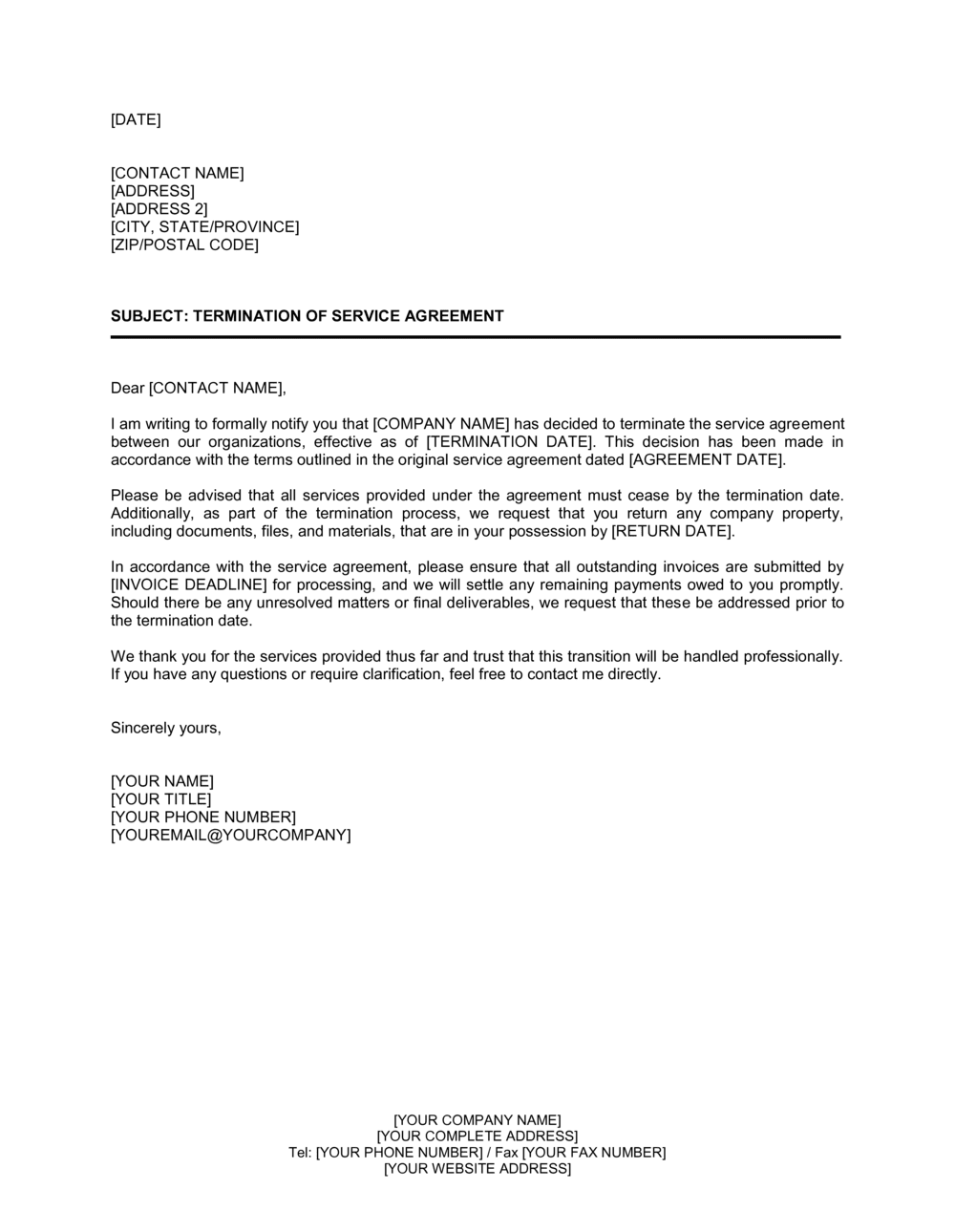
Service Agreement Termination Letter Template

Free Word download β€’ Edit online β€’ Save & share with Drive β€’ Export to PDF

1 pageβ€’20–25 min to fillβ€’Difficulty: Standard
Learn more ↓
FreeService Agreement Termination Letter Template

At a glance

What it is
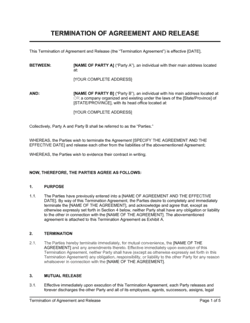
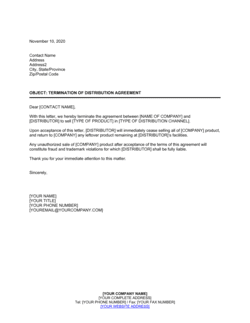
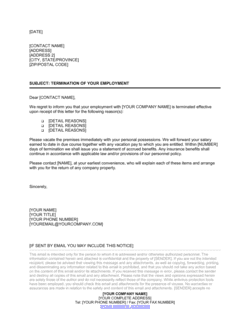
A Service Agreement Termination Letter is a formal written notice that one party sends to the other to end an existing service agreement. This free Word download gives you a ready-to-edit letter that references the underlying contract, states the basis for termination, sets an effective date, and documents any wind-down or transition arrangements β€” all in a single, professionally formatted page.
When you need it
Use it when you need to formally end a service relationship β€” whether exercising a contractual notice period, responding to a breach, or recording a mutual decision to part ways. Sending a written letter creates a dated paper trail that protects both sides.
What's inside
Opening identification of the agreement being terminated, the legal basis for termination, the effective termination date, outstanding payment and deliverable obligations, transition or hand-off instructions, and a closing statement confirming the end of the relationship.

What is a Service Agreement Termination Letter?

A Service Agreement Termination Letter is a formal written notice that one party sends to the other to end an existing service contract. It references the underlying agreement by title and date, states the contractual or factual basis for ending the relationship β€” exercising a notice clause, responding to a material breach, or recording a mutual decision β€” calculates the effective termination date, and documents any outstanding obligations on either side. Unlike a verbal cancellation, a properly drafted letter creates a timestamped paper trail that establishes exactly when notice was given and what each party is responsible for completing before the relationship ends.

Why You Need This Document

Ending a service relationship without a written letter leaves you exposed in ways that become obvious only after a dispute starts. Without a dated notice tied to the contract's termination clause, the other party can argue the agreement is still active and continue billing β€” or claim wrongful termination damages if your effective date fell short of the required notice period. Clear wind-down instructions in the letter are equally important: service providers who receive no explicit guidance on data return, credential revocation, or outstanding deliverables routinely retain access to client systems and files long after the relationship ends. This template gives you a structured, professionally formatted letter that covers every component β€” from the opening contract reference to the closing transition instructions β€” so you can exit any service arrangement cleanly, on your terms, and with full documentation in hand.

Which variant fits your situation?

If your situation is…Use this template
Ending a contract by exercising the standard notice clauseService Agreement Termination Letter (Notice)
Terminating due to the other party's material breachContract Breach Termination Letter
Recording a mutual agreement to end the relationshipMutual Termination Agreement
Ending an independent contractor engagementIndependent Contractor Termination Letter
Terminating a vendor supply or purchase agreementVendor Termination Letter
Cancelling a subscription or software serviceService Cancellation Letter
Notifying a client that you are ending a retainer arrangementRetainer Termination Letter

Common mistakes to avoid

❌ Not referencing the agreement's termination clause

Why it matters: A letter that gives notice without citing a contractual right to terminate can be treated as a repudiation of the contract, exposing the sender to a damages claim rather than a clean exit.

Fix: Always cite the specific section of the agreement that permits termination, and quote the notice requirement it imposes.
❌ Setting an effective date that violates the notice period

Why it matters: Cutting the notice period short β€” even by a few days β€” gives the other party grounds to reject the termination or claim damages for the shortfall.

Fix: Calculate the effective date carefully from the letter date, using the exact day count in the contract, and state the calculation explicitly in the letter.

❌ Omitting data return or credential transfer instructions

Why it matters: Without explicit instructions, service providers may retain client login credentials, proprietary data, or work files indefinitely β€” creating ongoing security exposure.

Fix: Include a specific clause listing every asset held by the provider and a deadline β€” typically 5 to 10 business days after the effective date β€” for return or certified deletion.

❌ Leaving transition assistance open-ended

Why it matters: An unlimited transition obligation becomes a source of ongoing disputes over what is owed and by when, often delaying the clean end both parties want.

Fix: Cap transition assistance by hours, days, or a specific list of tasks. State that any assistance beyond that scope is subject to a separate written agreement.

The 9 key clauses, explained

Opening and agreement identification

In plain language: Identifies both parties by legal name, references the service agreement by title and date, and states plainly that the letter constitutes formal notice of termination.

Sample language
This letter serves as formal notice of termination of the Service Agreement dated [AGREEMENT DATE] between [CLIENT LEGAL NAME] ('Client') and [SERVICE PROVIDER LEGAL NAME] ('Provider').

Common mistake: Referencing the agreement by a casual description rather than its exact title and date. Ambiguity about which contract is being terminated can allow the other party to dispute the notice's validity.

Basis for termination

In plain language: States the contractual or factual grounds for ending the agreement β€” notice clause exercise, material breach, mutual consent, or change in circumstances.

Sample language
Client hereby exercises its right to terminate under Section [X] of the Agreement, which permits either party to terminate upon [X] days' written notice. / This termination is issued in response to Provider's material breach of Section [X], specifically [DESCRIBE BREACH].

Common mistake: Citing the wrong section number or omitting any contractual reference. An unsupported termination claim can expose the sender to a wrongful termination counterclaim.

Effective termination date

In plain language: States the exact calendar date on which the agreement ends, calculated to satisfy any contractual notice requirement.

Sample language
The termination shall be effective as of [EFFECTIVE DATE], which represents [X] days' notice from the date of this letter dated [LETTER DATE].

Common mistake: Setting an effective date that falls short of the contractual notice period. Undercutting the required notice period can invalidate the termination or create a damages claim for the shortfall.

Outstanding payments

In plain language: Confirms the amounts owed to the service provider for work completed through the effective date and sets a deadline for payment.

Sample language
Client agrees to remit payment of $[AMOUNT] for services rendered through [DATE], no later than [PAYMENT DUE DATE]. Provider shall issue a final invoice within [X] business days of the effective date.

Common mistake: Leaving payment terms vague or omitting a deadline entirely. Without a specific due date, disputes over the final invoice frequently delay closure of the relationship.

Outstanding deliverables

In plain language: Lists any work product, reports, or outputs the provider is still required to deliver before or on the effective date.

Sample language
Prior to the effective date, Provider shall deliver: (a) [DELIVERABLE 1]; (b) [DELIVERABLE 2]; and (c) all project files and documentation in [FORMAT] to [RECIPIENT EMAIL / LOCATION].

Common mistake: Failing to list specific deliverables and instead writing 'all remaining work.' Vague language leads to disagreements about what was owed and what was actually handed over.

Return or transfer of materials and data

In plain language: Instructs the service provider to return, transfer, or destroy confidential information, credentials, files, and any property belonging to the client.

Sample language
Upon termination, Provider shall return or permanently delete all Confidential Information belonging to Client, including login credentials, data files, and physical property, within [X] business days of the effective date.

Common mistake: Omitting this clause entirely. Without an explicit instruction, service providers sometimes retain client data or access credentials indefinitely, creating security and confidentiality risks.

Transition assistance

In plain language: Specifies any hand-off activities the provider agrees to perform to help the client transition to a new provider or in-house operation.

Sample language
Provider agrees to make reasonable efforts to assist with the transition for a period of [X] days following the effective date, including briefing [CLIENT CONTACT / SUCCESSOR PROVIDER] and providing a written handover summary.

Common mistake: Requesting unlimited transition assistance without defining scope or duration. Open-ended transition obligations can become a source of ongoing disputes and unpaid work.

Survival of obligations

In plain language: Confirms which contractual obligations β€” typically confidentiality, IP ownership, and dispute resolution β€” continue after the agreement ends.

Sample language
Notwithstanding termination, Sections [X, Y, Z] of the Agreement β€” including confidentiality, intellectual property assignment, and governing law β€” shall survive and remain in full force.

Common mistake: Skipping the survival clause on the assumption that the original contract covers it. The termination letter itself can inadvertently supersede the original contract if survival terms are not explicitly preserved.

Closing statement and signature block

In plain language: Confirms the finality of the termination, invites the other party to raise questions before the effective date, and provides the sender's contact details and signature.

Sample language
We appreciate the services provided under this Agreement and wish to close out the relationship professionally. Please direct any questions to [NAME] at [EMAIL / PHONE] prior to [EFFECTIVE DATE]. Sincerely, [SENDER NAME], [TITLE], [COMPANY NAME].

Common mistake: Ending with a hostile or ambiguous tone when a neutral, professional close is available. Unnecessarily confrontational language increases the risk of the other party disputing the termination or withholding cooperation on wind-down tasks.

How to fill it out

  1. 1

    Locate and review the original service agreement

    Find the signed agreement and note the exact title, date, and the termination clause section number. Confirm the required notice period before calculating your effective date.

    πŸ’‘ If the agreement has been amended, reference both the original agreement and all amendments by date in your opening paragraph.

  2. 2

    Identify the basis for termination

    Determine whether you are exercising a standard notice clause, responding to a breach, or recording a mutual decision. Choose the corresponding sample language in the template and delete the alternatives.

    πŸ’‘ For breach-based terminations, state the breach specifically and document it β€” a vague allegation of 'non-performance' is harder to defend than citing a specific missed deadline or deliverable.

  3. 3

    Calculate and enter the effective date

    Count forward from today's date by the number of notice days required under the agreement. Enter the resulting calendar date as the effective termination date.

    πŸ’‘ When the notice period is expressed in business days, exclude weekends and public holidays from your count.

  4. 4

    List outstanding deliverables and payments

    Review the agreement's scope of work and note anything owed by either side as of the effective date β€” final deliverables, approved expenses, or a pro-rated monthly fee. Enter each item specifically.

    πŸ’‘ Confirming the final payment amount in the letter reduces back-and-forth over the last invoice and typically accelerates payment.

  5. 5

    Specify data return or transfer instructions

    List the specific assets the provider holds β€” files, credentials, hardware, data β€” and state the format and deadline for returning or deleting them.

    πŸ’‘ For cloud-based services, include a request for account transfer or export in a usable format (e.g., CSV, JSON) rather than simply asking for deletion.

  6. 6

    Define any transition assistance required

    If you need the provider to brief a successor or produce a handover document, state the scope and time limit clearly. Keep transition requests proportionate to the relationship's complexity.

    πŸ’‘ Capping transition assistance at a fixed number of hours or days prevents scope creep and keeps the wind-down clean.

  7. 7

    Send by a trackable method and retain a copy

    Deliver the letter by email with read receipt, certified mail, or the delivery method specified in the agreement's notice clause. Save the sent confirmation and a copy of the signed letter.

    πŸ’‘ Check the notice clause for a required delivery method β€” some agreements specify that notice must be sent to a particular address or contact to be valid.

Frequently asked questions

What is a service agreement termination letter?

A service agreement termination letter is a formal written notice that one party sends to the other to end an existing service contract. It identifies the agreement being terminated, states the legal basis for ending it, sets the effective date, and documents any final obligations β€” such as outstanding payments, deliverables, and data return. It creates a dated paper trail that protects both sides if a dispute arises later.

When should I send a termination letter for a service agreement?

Send it as soon as you decide to end the relationship β€” ideally before your contractual notice window closes. Waiting too long can result in automatic renewal of the contract or a shorter effective notice period than you intended. For breach-based terminations, send the letter promptly after the breach and any required cure period has expired.

Does a service agreement termination letter need to be signed?

A physical signature is not strictly required for the letter to be effective in most cases, but including a typed name, title, and company name β€” along with a scanned or electronic signature β€” reinforces its formal character and reduces the chance the recipient claims not to recognize it. Always follow the delivery method specified in the agreement's notice clause.

Can I terminate a service agreement without a reason?

If the agreement includes a termination-for-convenience clause, yes β€” you can end the contract by giving the required notice without stating a reason. If the agreement only permits termination for cause, you must identify a specific breach or default. Always check the termination section of your contract before sending the letter to confirm which basis applies.

What happens if the other party ignores the termination letter?

If the other party continues performing or billing after the effective date, document everything and respond in writing confirming that the agreement has ended. Do not accept or pay invoices dated after the effective termination date without protest. If the dispute escalates, the dated termination letter β€” delivered via a trackable method β€” is your primary evidence that proper notice was given.

How much notice do I need to give to terminate a service agreement?

The required notice period is set by the service agreement itself β€” commonly 14, 30, or 60 days. If the agreement is silent on notice, the general standard in most jurisdictions is reasonable notice, which courts assess based on the length and nature of the relationship. Always check the contract before calculating your effective date.

Should I use a termination letter or a mutual termination agreement?

Use a termination letter when one party is exercising a unilateral right to end the agreement β€” under a notice clause or for cause. Use a mutual termination agreement when both parties have agreed to end the relationship and want to record that consent, settle final amounts, and release each other from further claims. The mutual agreement is a stronger document for disputed or high-value terminations.

What should I do with confidential information after terminating a service agreement?

Your termination letter should instruct the service provider to return or permanently delete all confidential information β€” including files, credentials, and proprietary data β€” within a specified deadline. If you hold confidential information belonging to the provider, your obligations under the original agreement's confidentiality clause typically survive termination and continue to apply.

How this compares to alternatives

vs Mutual Termination Agreement

A mutual termination agreement is a bilateral document both parties sign to record their joint decision to end the relationship, settle final amounts, and release each other from future claims. A termination letter is a unilateral notice exercising a contractual right. Use the letter for standard notice-period or breach-based exits; use the mutual agreement when both sides want a clean, signed release.

vs Breach of Contract Notice Letter

A breach of contract notice informs the other party of a default and triggers a cure period before any termination takes effect. A termination letter ends the agreement β€” either after the cure period has expired without remedy or under a no-fault notice clause. Send the breach notice first if the contract requires it; follow with the termination letter if the breach is not cured.

vs Service Agreement

A service agreement is the underlying contract that creates the obligations being ended. The termination letter closes that contract by exercising rights already written into it. The termination letter should always reference the service agreement by title and date so the two documents are clearly linked in any subsequent dispute.

vs Contract Amendment

A contract amendment modifies specific terms of the service agreement β€” scope, pricing, or timeline β€” while keeping the relationship intact. A termination letter ends the relationship entirely. If the goal is to renegotiate rather than exit, an amendment is the right document; if the goal is a clean break, the termination letter is the correct choice.

Industry-specific considerations

Professional Services

Terminating consulting retainers requires specifying the final billing period and confirming which deliverables β€” reports, recommendations, strategy documents β€” are owed through the effective date.

Technology / SaaS

Ending a software development or managed IT services agreement involves explicit data export instructions, credential revocation timelines, and code or repository transfer steps.

Marketing and Creative Agencies

Agency terminations typically require return of brand assets, ad account access, and campaign performance data, along with confirmation of IP ownership for work already paid for.

Construction and Facilities

Terminating a facilities management or subcontractor service agreement often requires documenting work completed to date, outstanding punch-list items, and return of site access credentials or keys.

Template vs pro β€” what fits your needs?

PathBest forCostTime
Use the templateStandard notice-period terminations and low-value service contractsFree15–30 minutes
Template + professional reviewBreach-based terminations, contracts with complex wind-down obligations, or relationships where a dispute is likely$150–$400 for a one-hour lawyer review1–2 days
Custom draftedHigh-value contracts, terminations involving IP disputes, or situations where the other party has already threatened legal action$500–$2,000+3–7 days

Glossary

Notice Period
The number of days or weeks one party must give the other before a termination becomes effective, as defined in the service agreement.
Effective Date
The specific calendar date on which the termination takes legal effect and all obligations under the agreement cease.
Material Breach
A failure by one party to perform a core obligation under the agreement β€” serious enough to justify immediate termination without a notice period.
Cure Period
A contractually defined window β€” typically 14 to 30 days β€” during which a breaching party can remedy the default before termination takes effect.
Wind-Down Period
A transitional interval after notice is given during which the parties complete outstanding work, transfer data, and settle final payments.
Mutual Termination
An agreed ending to the service relationship where both parties consent to terminate, typically documented in a termination letter or short agreement.
Outstanding Deliverables
Work product, reports, data, or other outputs that the service provider owes the client as of the termination effective date.
Confidentiality Survival Clause
A provision stating that confidentiality and non-disclosure obligations continue to apply even after the service agreement is terminated.
Transition Assistance
Steps the departing service provider agrees to take β€” such as transferring files, briefing a successor, or providing a handover document β€” to help the client continue operations.
Final Invoice
The last billing document issued by the service provider covering work completed up to the effective termination date, including any contractually agreed wind-down fees.

Part of your Business Operating System

This document is one of 3,000+ business & legal templates included in Business in a Box.

  • Fill-in-the-blanks β€” ready in minutes
  • 100% customizable Word document
  • Compatible with all office suites
  • Export to PDF and share electronically

Create your document in 3 simple steps.

From template to signed document β€” all inside one Business Operating System.
1
Download or open template

Access over 3,000+ business and legal templates for any business task, project or initiative.

2
Edit and fill in the blanks with AI

Customize your ready-made business document template and save it in the cloud.

3
Save, Share, Send, Sign

Share your files and folders with your team. Create a space of seamless collaboration.

Save time, save money, and create top-quality documents.

β˜…β˜…β˜…β˜…β˜…

"Fantastic value! I'm not sure how I'd do without it. It's worth its weight in gold and paid back for itself many times."

Managing Director Β· Mall Farm
Robert Whalley
Managing Director, Mall Farm Proprietary Limited
β˜…β˜…β˜…β˜…β˜…

"I have been using Business in a Box for years. It has been the most useful source of templates I have encountered. I recommend it to anyone."

Business Owner Β· 4+ years
Dr Michael John Freestone
Business Owner
β˜…β˜…β˜…β˜…β˜…

"It has been a life saver so many times I have lost count. Business in a Box has saved me so much time and as you know, time is money."

Owner Β· Upstate Web
David G. Moore Jr.
Owner, Upstate Web

Run your business with a system β€” not scattered tools

Stop downloading documents. Start operating with clarity. Business in a Box gives you the Business Operating System used by over 250,000 companies worldwide to structure, run, and grow their business.

Start freeΒ Β·Β No credit card required