- Debtor
- The party who owes money under an existing payment obligation and is requesting the extension.
- Creditor
- The party to whom money is owed and who has the authority to grant or deny the extension request.
- Original Due Date
- The payment deadline established in the underlying contract, invoice, or agreement that the debtor is seeking to postpone.
- Extended Due Date
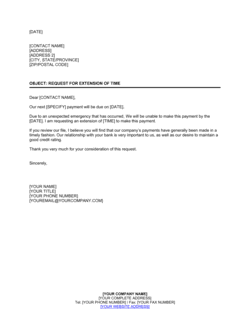
- The specific new calendar date on which full payment will be made if the creditor approves the extension request.
- Consideration
- Something of value exchanged between parties to make a contract modification binding — may include an interest payment, a partial upfront payment, or a written acknowledgment of the debt.
- Forbearance
- The creditor's agreement to refrain from enforcing a debt or taking legal action during the extension period.
- Default
- Failure to meet a payment obligation by the agreed date, which may trigger penalties, acceleration clauses, or legal remedies.
- Acceleration Clause
- A provision in a loan or contract that makes the entire outstanding balance immediately due upon a default event, such as a missed payment.
- Novation
- A formal agreement that replaces an original obligation with a new one — distinct from a simple extension, which preserves the original terms and only changes the due date.
- Waiver
- The voluntary relinquishment of a known right — in this context, the creditor waiving the right to demand payment on the original due date.
- Late Payment Penalty
- A fee or interest charge contractually triggered when payment is not received by the original due date, which may be suspended or waived as part of the extension agreement.