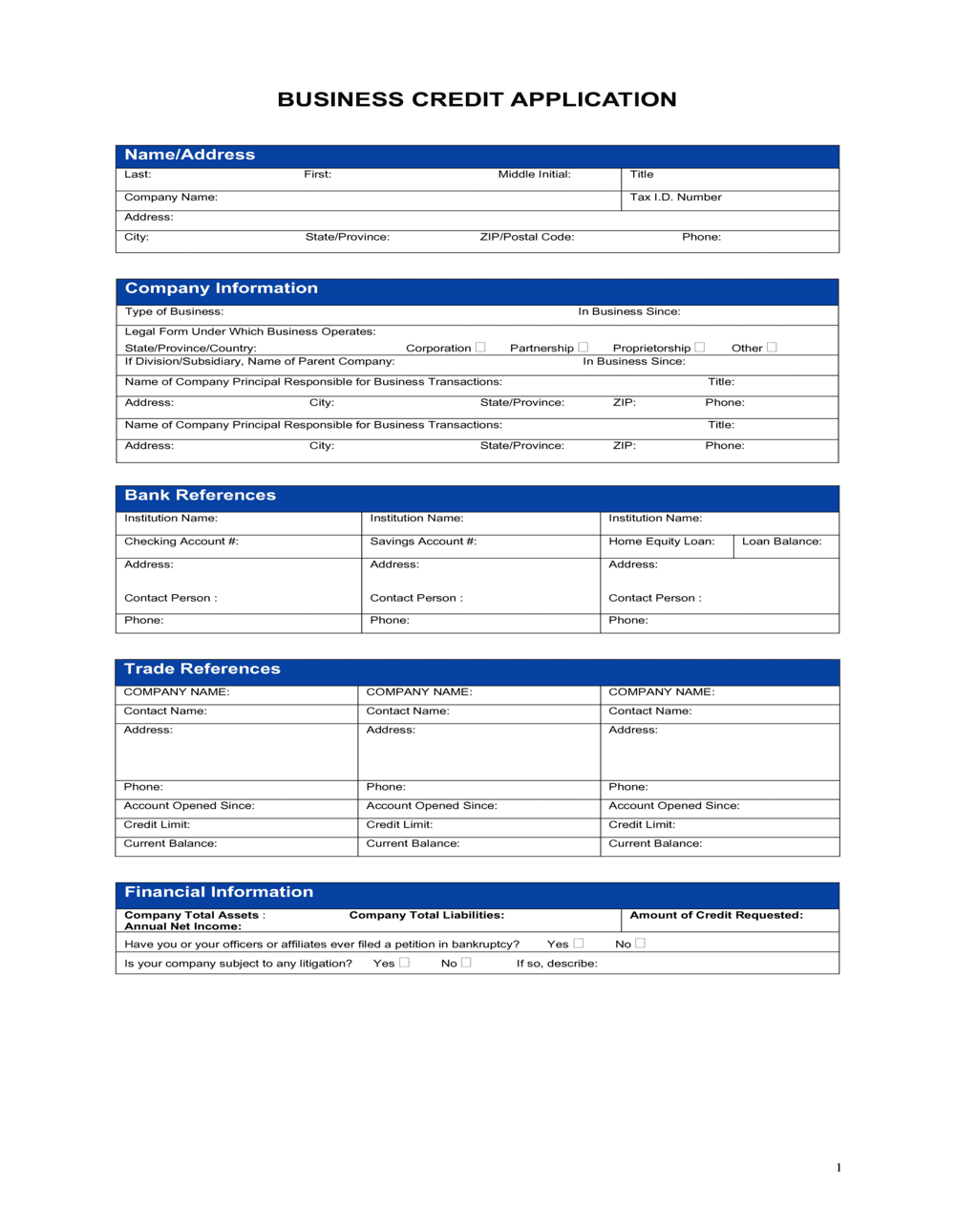
Business Credit Application Template

Free Word download β€’ Edit online β€’ Save & share with Drive β€’ Export to PDF

1 pageβ€’15–25 min to fillβ€’Difficulty: Standard
Learn more ↓
FreeBusiness Credit Application Template

At a glance

What it is
A Business Credit Application is a standardized form a business completes when requesting trade credit, a line of credit, or net payment terms from a supplier or vendor. This free Word download captures legal entity details, ownership structure, banking references, trade references, and a signed authorization for credit checks β€” giving the supplier everything needed to make a credit decision in a single document.
When you need it
Use it when applying for net-30, net-60, or net-90 terms with a new supplier, opening a vendor account that requires credit approval, or responding to a supplier's request for a completed credit application before they extend an open account.
What's inside
Legal entity and contact information, ownership details, years in business, bank account and financial institution references, trade references with contact details, requested credit limit, and a credit check authorization signed by an authorized officer.

What is a Business Credit Application?

A Business Credit Application is a standardized form a company completes when requesting trade credit, an open account, or net payment terms from a supplier or vendor. It collects the applicant's legal entity information, ownership structure, banking relationship, and trade references, and includes a signed authorization allowing the supplier to verify that information and pull a business credit report. Suppliers use the completed form to evaluate creditworthiness and decide whether to extend an open account, at what credit limit, and under what payment terms β€” Net 30, Net 60, or Net 90.

Why You Need This Document

Without a completed, professional credit application, suppliers have no basis to approve an open account and will require cash in advance or cash on delivery for every order β€” tying up working capital and slowing your procurement cycle. A well-prepared application with strong trade references and a supported credit limit request signals financial stability and speeds up approval decisions. It also protects the applicant by creating a clear record of the terms requested and the authorization given, preventing disputes about what was disclosed during the credit review. Using this template ensures every required field is present so the application moves through the supplier's review process without delays caused by missing information.

Which variant fits your situation?

If your situation is…Use this template
Applying for a revolving line of credit from a bank or lenderBusiness Loan Application
Requesting net-30 or net-60 payment terms from a new supplierBusiness Credit Application
Supplier collecting and evaluating multiple applicant formsCredit Evaluation Form
Providing a personal guarantee alongside the business applicationPersonal Guarantee Agreement
Formally establishing the approved credit terms in writingCredit Agreement
Purchasing goods on account under established trade termsPurchase Order

Common mistakes to avoid

❌ Using a trade name instead of the legal entity name

Why it matters: The supplier's credit team runs checks against the legal entity name and EIN. A DBA or brand name returns no matching record and stalls the application indefinitely.

Fix: Confirm the exact registered name from your EIN filing or state business registration before completing the form.
❌ Listing references who cannot verify credit terms

Why it matters: Suppliers call every reference. If a reference reports cash-only transactions or cannot confirm payment terms, it signals the applicant has no real trade credit history.

Fix: Only list suppliers with whom you have an active open account and at least six months of documented on-time payments.

❌ Requesting a credit limit unsupported by purchase history

Why it matters: A $50,000 credit request from a business with $3,000 in average monthly purchases triggers immediate suspicion and often results in a much lower approved limit or outright denial.

Fix: Calculate your expected monthly purchase volume with the supplier and request a limit equal to 1.5–2 months of projected spend.

❌ Having an unauthorized employee sign the credit authorization

Why it matters: An authorization signed by someone without binding authority is invalid. The supplier's legal team may reject the application or, if fraud is involved, void any extended credit.

Fix: Ensure the signatory is a listed owner, officer, or holds a documented power of attorney. Include their title on the signature line.

The 9 key fields, explained

Legal business name and entity type

Business address and contact information

Federal Tax ID (EIN)

Years in business and annual revenue

Ownership and principal information

Banking reference

Trade references

Requested credit limit and payment terms

Credit check authorization and signature

How to fill it out

  1. 1

    Enter the legal entity name and structure

    Use the exact registered business name as it appears on your EIN filing or state incorporation documents. Select the correct entity type and state of registration.

    πŸ’‘ Pull your EIN confirmation letter (IRS CP 575) before you start β€” it confirms both the legal name and the nine-digit EIN in one document.

  2. 2

    Complete business address and AP contact details

    Provide a physical street address and a dedicated accounts-payable email. If your AP team uses a shared inbox (e.g., ap@company.com), use that rather than an individual's address.

    πŸ’‘ Ensure the address matches your business registration records β€” suppliers may cross-check it against public filings.

  3. 3

    Enter the EIN and DUNS number

    Input your nine-digit EIN in XX-XXXXXXX format. If you have a Dun & Bradstreet DUNS number, include it β€” it allows suppliers to pull your Paydex score instantly.

    πŸ’‘ Register for a free DUNS number at dnb.com if you don't have one. It typically takes 30 days to receive and significantly speeds up credit approvals.

  4. 4

    List all owners above 20% equity

    Enter each principal's full legal name, title, ownership percentage, and home address. Include this information even for owners who are not involved in day-to-day operations.

    πŸ’‘ Check your operating agreement or shareholders' register to confirm ownership percentages before completing this section.

  5. 5

    Provide banking reference details

    Enter your primary business bank, account type, and the contact information for your banker or relationship manager. Avoid listing a personal account.

    πŸ’‘ Call your banker before submitting and let them know a reference call may be coming β€” banks respond faster when they expect the inquiry.

  6. 6

    Select three strong trade references

    Choose suppliers with whom you have at least 6–12 months of on-time payment history and active open accounts. Contact each reference in advance to confirm they will respond to verification calls.

    πŸ’‘ Prioritize references whose average monthly purchase volume is close to the credit limit you are requesting β€” it makes the requested amount look proportionate.

  7. 7

    State the credit limit and payment terms

    Enter a specific dollar amount and your preferred net terms. Base the requested limit on your anticipated monthly purchase volume with this supplier, not on your maximum possible need.

    πŸ’‘ Starting with a modest limit (e.g., $5,000–$10,000) and requesting an increase after 90 days of on-time payments is more likely to be approved than opening with an aggressive ask.

  8. 8

    Have an authorized officer sign and date

    The credit authorization must be signed by a business owner, officer, or someone with documented authority to bind the company. Print, sign, and scan or use an e-signature tool.

    πŸ’‘ Date the signature on the day you submit the application β€” some suppliers reject forms signed more than 30 days before receipt.

Frequently asked questions

What is a business credit application?

A business credit application is a standardized form a company submits to a supplier or vendor when requesting trade credit, net payment terms, or an open account. It captures the applicant's legal entity details, ownership, banking relationship, and trade references, and includes a signed authorization for the supplier to conduct a credit check. The supplier uses this information to decide whether to extend credit and at what limit and terms.

What information is required on a business credit application?

Most applications require the legal business name and entity type, EIN, physical address, years in business, estimated annual revenue, ownership details, the name and contact of the applicant's primary business bank, at least three trade references with contact information and approximate monthly purchase volumes, the requested credit limit, desired payment terms, and a signed credit check authorization.

What is a trade reference on a credit application?

A trade reference is an existing supplier or vendor with whom the applicant currently does business on credit terms. The new supplier contacts these references to verify that the applicant pays on time and within the agreed terms. Strong references β€” ones with active accounts and 6–12 months of consistent on-time payment history β€” are the single most important factor in a supplier's credit decision.

How long does it take to get approved for trade credit?

Approval timelines vary by supplier, but most decisions take 3–10 business days once a complete application is submitted. Delays almost always trace back to missing information β€” a blank EIN field, trade references that don't respond, or a bank that takes several days to verify the account. Submitting a fully complete application and alerting your references in advance typically keeps approvals within 5 business days.

Does applying for trade credit affect my business credit score?

It depends on the supplier. Many trade credit applications trigger a soft inquiry on your business credit file (Dun & Bradstreet, Experian Business, or Equifax Business), which does not affect your score. Some suppliers run a hard inquiry, which can have a minor temporary impact. The authorization field on the application will typically indicate what type of check the supplier intends to perform.

Can a startup apply for trade credit?

Yes, though approval is harder without an established credit history. Suppliers often approve startups for smaller initial limits β€” $1,000 to $5,000 β€” and require a personal guarantee from the business owner. Building a track record with a modest limit and paying consistently before requesting an increase is the most reliable path to meaningful trade credit for a new business.

What is the difference between a business credit application and a business loan application?

A business credit application requests trade credit from a supplier β€” essentially the ability to buy goods now and pay later, with no interest if paid within terms. A business loan application requests cash from a lender that must be repaid with interest over a defined term. Trade credit is the simpler, faster, and less formal of the two, and approval relies primarily on trade references and payment history rather than full financial statements.

Is a personal guarantee required on a business credit application?

Not always, but many suppliers require one for new businesses, small businesses, or applicants without an established credit profile. A personal guarantee makes the owner personally liable for the company's outstanding balance if the business fails to pay. If the application includes a personal guarantee section, review it carefully before signing β€” it is a binding commitment separate from the business's liability.

How this compares to alternatives

vs Business Loan Application

A business loan application requests cash from a bank or lender, requires full financial statements, and results in an interest-bearing debt obligation. A business credit application requests trade credit from a supplier, relies on trade references and payment history, and carries no interest if paid within terms. The two serve different purposes and are evaluated by very different criteria.

vs Purchase Order

A purchase order is issued by the buyer to authorize a specific transaction once credit has already been established. A business credit application is completed before any purchases are made to set up the open account. The credit application comes first; purchase orders flow through the account afterward.

vs Credit Agreement

A credit agreement is a formal binding contract between a lender and borrower detailing loan amount, interest rate, repayment schedule, and default terms. A business credit application is a form the applicant submits to request credit β€” it is not itself a binding agreement. The supplier issues a separate approval letter or credit agreement once the application is reviewed.

vs Personal Guarantee Agreement

A personal guarantee is a separate document in which a business owner personally commits to repaying the company's credit obligations if the business defaults. A business credit application may include a personal guarantee section, but the two are distinct documents. Larger credit lines often require both a completed application and a standalone personal guarantee.

Industry-specific considerations

Retail and wholesale

Retailers apply for trade credit to purchase inventory on net terms, preserving cash flow between the purchase date and the point of sale.

Construction and trades

Contractors open trade accounts with materials suppliers to purchase lumber, fixtures, and hardware on account and bill clients upon project completion.

Manufacturing

Manufacturers apply for net terms with raw-material and component suppliers to align payment obligations with production and delivery cycles.

Professional services

Service firms use trade credit accounts with office supply vendors, software resellers, and equipment leasing companies to manage operating expenses.

Template vs pro β€” what fits your needs?

PathBest forCostTime
Use the templateAny business applying for trade credit or net terms with a supplierFree15–30 minutes to complete
Template + professional reviewBusinesses applying for large credit limits or accounts requiring a personal guarantee$0–$100 (accountant or attorney quick review)1–2 hours
Custom draftedSuppliers who need a branded, custom credit application for their own vendor onboarding process$200–$500 (legal or admin setup)1–3 days

Glossary

Trade Credit
An arrangement where a supplier allows a buyer to receive goods or services immediately and pay the invoice within an agreed period β€” typically 30, 60, or 90 days.
Net Terms
Payment terms specifying the number of days after the invoice date by which full payment is due β€” e.g., Net 30 means payment is due within 30 days.
Credit Limit
The maximum outstanding balance a supplier will allow a buyer to carry on an open account at any one time.
Trade Reference
A supplier or creditor the applicant has previously done business with on credit terms, listed so the new supplier can verify payment history.
Bank Reference
The applicant's financial institution and account information, provided so the supplier can verify the business's banking relationship and average balance.
Credit Authorization
A signed consent allowing the supplier to pull the applicant's business credit report and contact listed references as part of the credit review.
Personal Guarantee
A clause making a business owner personally liable for the company's trade credit balance if the business fails to pay β€” sometimes required for new or small businesses.
DUNS Number
A unique nine-digit identifier assigned by Dun & Bradstreet to a business entity, commonly used to look up a company's commercial credit profile.
Accounts Payable
Money a business owes to suppliers for goods or services received on credit that have not yet been paid.
Open Account
A credit arrangement where the buyer receives goods and is billed periodically, with no formal promissory note β€” the most common form of trade credit.

Part of your Business Operating System

This document is one of 3,000+ business & legal templates included in Business in a Box.

  • Fill-in-the-blanks β€” ready in minutes
  • 100% customizable Word document
  • Compatible with all office suites
  • Export to PDF and share electronically

Create your document in 3 simple steps.

From template to signed document β€” all inside one Business Operating System.
1
Download or open template

Access over 3,000+ business and legal templates for any business task, project or initiative.

2
Edit and fill in the blanks with AI

Customize your ready-made business document template and save it in the cloud.

3
Save, Share, Send, Sign

Share your files and folders with your team. Create a space of seamless collaboration.

Save time, save money, and create top-quality documents.

β˜…β˜…β˜…β˜…β˜…

"Fantastic value! I'm not sure how I'd do without it. It's worth its weight in gold and paid back for itself many times."

Managing Director Β· Mall Farm
Robert Whalley
Managing Director, Mall Farm Proprietary Limited
β˜…β˜…β˜…β˜…β˜…

"I have been using Business in a Box for years. It has been the most useful source of templates I have encountered. I recommend it to anyone."

Business Owner Β· 4+ years
Dr Michael John Freestone
Business Owner
β˜…β˜…β˜…β˜…β˜…

"It has been a life saver so many times I have lost count. Business in a Box has saved me so much time and as you know, time is money."

Owner Β· Upstate Web
David G. Moore Jr.
Owner, Upstate Web

Run your business with a system β€” not scattered tools

Stop downloading documents. Start operating with clarity. Business in a Box gives you the Business Operating System used by over 250,000 companies worldwide to structure, run, and grow their business.

Start freeΒ Β·Β No credit card required