Guarantee of Account Template

Free Word download β€’ Edit online β€’ Save & share with Drive β€’ Export to PDF

1 pageβ€’20–30 min to fillβ€’Difficulty: Standardβ€’Signature requiredβ€’Legal review recommended
Learn more ↓
FreeGuarantee of Account Template

At a glance

What it is
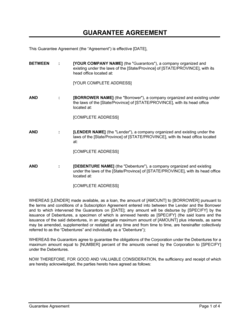
A Guarantee of Account is a legally binding agreement in which an individual or entity (the guarantor) promises to pay any outstanding balance owed to a creditor if the primary account holder (the debtor) fails to do so. This free Word download gives suppliers, wholesalers, and trade creditors a signed, enforceable backstop they can edit online and export as PDF before extending credit to a new business customer.
When you need it
Use it when opening a trade credit account for a new business customer whose creditworthiness is unproven, when a small or newly formed company lacks sufficient credit history, or when a lender or supplier requires a personal guarantee from a business owner before approving a line of credit.
What's inside
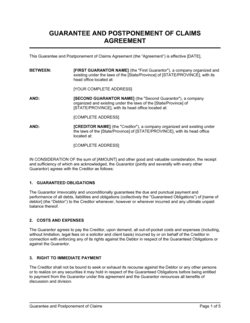
Identification of the guarantor, debtor, and creditor; a clear statement of unconditional guaranty; scope and cap of liability; default and notice provisions; waiver of defenses; and governing law and signature blocks for all required parties.

What is a Guarantee of Account?

A Guarantee of Account is a legally binding agreement in which a guarantor β€” typically the owner or principal of a business β€” personally promises to pay any outstanding balance owed on a commercial credit account if the primary account holder fails to do so. Unlike a one-time loan guarantee, a guarantee of account is typically a continuing instrument: it covers not just the balance at the time of signing but all future purchases and invoices generated on the account until the guarantor formally revokes it in writing. Suppliers, wholesalers, and trade creditors use this document as a standard condition of extending net-30 or net-60 payment terms to new business customers whose creditworthiness has not yet been established.

Why You Need This Document

Extending trade credit without a signed guarantee of account leaves the creditor with a single point of recovery β€” a business entity that may have minimal assets, no credit history, and the ability to dissolve overnight. When a small or newly formed company defaults on an open account, the creditor often has no practical avenue to recover. A properly executed guarantee of account changes the equation entirely: the creditor gains direct, enforceable access to the guarantor's personal assets without first exhausting litigation against the business. Accounts that go unpaid for 90 or more days typically recover at much higher rates when a personal guarantee is on file compared to unsecured trade accounts. For businesses that extend significant credit to new customers regularly, collecting guarantees at account opening is one of the lowest-cost credit risk controls available β€” and this template gives you a ready-to-sign document that covers the core provisions every enforceable guarantee requires.

Which variant fits your situation?

If your situation is…Use this template
Individual owner guaranteeing a business's trade accountPersonal Guarantee of Account
Parent company guaranteeing a subsidiary's obligationsCorporate Guarantee Agreement
Guarantor securing a specific dollar amount onlyLimited Guarantee Agreement
Multiple owners jointly guaranteeing a single accountJoint and Several Guarantee of Account
Guarantee provided as part of a broader loan packagePersonal Guarantee (Loan)
Guarantee required alongside a lease agreementCommercial Lease Personal Guarantee
Guarantee for a construction or contractor supply accountContractor Account Guarantee

Common mistakes to avoid

❌ Using 'guarantee of collection' instead of 'guarantee of payment'

Why it matters: A guarantee of collection requires the creditor to exhaust all legal remedies against the debtor before demanding payment from the guarantor β€” adding months of delay and litigation costs before any recovery.

Fix: Use 'unconditional guarantee of payment' language explicitly and confirm the waiver-of-defenses clause removes any requirement to pursue the debtor first.

❌ Signing the guarantee after credit has already been extended

Why it matters: A guarantee signed after the credit account is already open lacks fresh consideration in most common-law jurisdictions β€” making the entire document potentially unenforceable.

Fix: Make execution of the guarantee a condition precedent to opening the account, and document the sequence: guarantee signed, then account activated.

❌ Failing to include a liability cap on high-volume accounts

Why it matters: Without a cap, the guarantor's personal exposure grows indefinitely as the account balance increases β€” making it harder to obtain the guarantee from creditworthy individuals and creating disproportionate risk.

Fix: Set the cap at 120–150% of the agreed credit limit to cover principal, accrued interest, and reasonable collection costs.

❌ Not updating the guarantee when ownership of the debtor changes

Why it matters: A guarantee signed by the previous business owner does not automatically bind the incoming owner β€” leaving the creditor with an unenforceable guarantee against a new principal they never vetted.

Fix: Include a clause requiring the debtor to notify the creditor of any change in ownership and making the guarantee callable on such an event, triggering a new guarantee from the incoming owner.

❌ Omitting attorney's fees and collection costs from the remedies clause

Why it matters: Without an express fee-shifting provision, the creditor must absorb legal costs even after winning a collection action β€” substantially reducing the net recovery and the practical deterrent effect of the guarantee.

Fix: Add an explicit clause: 'Guarantor shall reimburse Creditor for all reasonable attorney's fees, court costs, and collection expenses incurred in enforcing this Guarantee.'

❌ Allowing the guarantor to sign as a corporate officer rather than in their personal capacity

Why it matters: If the guarantor signs with a title (e.g., 'John Smith, President') rather than their personal name alone, courts may interpret the signature as a corporate act β€” eliminating personal liability entirely.

Fix: Include a statement that the guarantor is signing in their individual personal capacity, and have them sign twice if needed: once as the corporate officer executing on behalf of the debtor, and once individually as guarantor.

The 10 key clauses, explained

Parties identification

In plain language: Names and identifies the three parties: the guarantor, the debtor (account holder), and the creditor (supplier or lender) with their full legal names and addresses.

Sample language
This Guarantee of Account is entered into as of [DATE] by [GUARANTOR FULL NAME], residing at [ADDRESS] ('Guarantor'), in favor of [CREDITOR LEGAL NAME], a [STATE] [ENTITY TYPE] ('Creditor'), with respect to the account of [DEBTOR LEGAL NAME] ('Debtor').

Common mistake: Using a trade name instead of the guarantor's legal name. If the guarantor's name does not match government ID, enforcing the guarantee in court becomes significantly more difficult.

Guarantee of payment

In plain language: The core promise β€” the guarantor unconditionally agrees to pay all amounts owed by the debtor on the account if the debtor fails to pay when due.

Sample language
Guarantor unconditionally and irrevocably guarantees to Creditor the full and prompt payment of any and all amounts owed by Debtor on Account No. [ACCOUNT NUMBER], including principal, interest, and any fees or collection costs.

Common mistake: Using 'guarantee of collection' language instead of 'guarantee of payment.' A collection guarantee requires the creditor to exhaust remedies against the debtor first β€” defeating most of the protective value of the document.

Scope and continuing nature

In plain language: Confirms that the guarantee covers all present and future balances on the account β€” not just the amount outstanding at signing β€” and remains in force until formally revoked in writing.

Sample language
This is a continuing guarantee and shall apply to all indebtedness of Debtor to Creditor arising at any time, including amounts incurred after the date of this Agreement, until Guarantor delivers written notice of revocation to Creditor.

Common mistake: Failing to specify that the guarantee is 'continuing.' Without this language, a court may limit the guarantee to the balance outstanding at the time of signing, leaving future credit extensions unprotected.

Liability cap (optional)

In plain language: Sets the maximum dollar amount the guarantor can be required to pay β€” used when parties agree to limit exposure rather than guaranteeing the full account balance.

Sample language
Notwithstanding any other provision, Guarantor's total liability under this Agreement shall not exceed [MAXIMUM AMOUNT] in the aggregate.

Common mistake: Omitting a liability cap when the account has no credit limit. Without a cap, a guarantor can face unlimited personal exposure as the account balance grows.

Waiver of defenses and notice

In plain language: The guarantor waives standard legal defenses β€” such as requiring the creditor to first sue the debtor, requiring notice of default, or any change in the debtor's financial condition β€” that would otherwise delay or reduce enforcement.

Sample language
Guarantor waives: (a) notice of Debtor's default; (b) notice of acceptance of this Guarantee; (c) demand for payment; (d) protest; and (e) any right to require Creditor to proceed against Debtor before enforcing this Guarantee.

Common mistake: Leaving out a waiver of the 'suretyship defense.' Without it, a guarantor may successfully argue that any modification to the credit terms β€” such as an extended payment period β€” released them from liability.

Representations and warranties

In plain language: The guarantor confirms they have read the agreement, have authority to sign, are not signing under duress, and that the information provided about them is accurate.

Sample language
Guarantor represents and warrants that: (a) Guarantor has the legal capacity to enter into this Agreement; (b) this Agreement constitutes a valid and binding obligation of Guarantor; and (c) no consent or approval of any third party is required for Guarantor to perform hereunder.

Common mistake: No representations clause at all. Without it, a guarantor who later claims they lacked capacity or were misled has an easier path to voiding the agreement.

Default and remedies

In plain language: Defines what constitutes a default (missed payment, insolvency, breach of the account terms) and what actions the creditor may take β€” immediate demand for full payment, collection costs, and legal fees.

Sample language
Upon Debtor's failure to pay any amount when due, Creditor may, without prior notice or demand, require Guarantor to pay the full outstanding balance immediately. Guarantor shall also be liable for Creditor's reasonable attorney's fees and collection costs.

Common mistake: Not including attorney's fees in the remedies clause. Without an express fee-shifting provision, the creditor must absorb legal costs even on a successful collection β€” reducing the practical value of the guarantee.

Subrogation and indemnification

In plain language: After paying the creditor, the guarantor inherits the creditor's rights against the debtor and may seek reimbursement from the debtor for amounts paid.

Sample language
Upon payment of all amounts due hereunder, Guarantor shall be subrogated to the rights of Creditor against Debtor to the extent of such payment and shall be entitled to indemnification from Debtor for all amounts paid by Guarantor.

Common mistake: Waiving subrogation rights entirely. A guarantor who waives subrogation gives up their right to recover from the debtor after paying the creditor β€” turning the guarantee into a gift rather than a secured backstop.

Governing law and jurisdiction

In plain language: Specifies which state or country's law governs the agreement and which courts have jurisdiction to resolve disputes.

Sample language
This Agreement shall be governed by and construed in accordance with the laws of the State of [STATE], without regard to conflict-of-law principles. Any legal action shall be brought exclusively in the courts of [COUNTY], [STATE].

Common mistake: Choosing a governing law with no connection to where either party operates. Courts in the debtor's or guarantor's home state may apply local consumer protection laws regardless of what the contract specifies.

Signature and acknowledgment

In plain language: The signature block where the guarantor, and optionally a witness or notary, signs and dates the agreement β€” confirming they have read, understood, and voluntarily executed it.

Sample language
IN WITNESS WHEREOF, Guarantor has executed this Guarantee of Account as of the date first written above. GUARANTOR: [GUARANTOR SIGNATURE], [PRINTED NAME], Date: [DATE]. ACCEPTED BY CREDITOR: [CREDITOR SIGNATURE], [TITLE], Date: [DATE].

Common mistake: Having only the guarantor sign without a creditor acceptance signature. Some jurisdictions require evidence of the creditor's acceptance for the guarantee to be enforceable as a bilateral agreement.

How to fill it out

  1. 1

    Identify all three parties with full legal names

    Enter the guarantor's full legal name and home address, the debtor's full registered business name and address, and the creditor's full legal entity name and business address. Do not use trade names or abbreviations.

    πŸ’‘ Ask the guarantor to provide a copy of government-issued ID to confirm the name match before execution β€” a mismatch can void enforcement.

  2. 2

    Reference the specific account being guaranteed

    Insert the account number, credit limit, and any existing balance at the time of signing. This ties the guarantee to a specific credit relationship rather than all obligations the debtor may have with the creditor.

    πŸ’‘ If no account number has been assigned yet, describe the account by type and date opened so the reference is unambiguous.

  3. 3

    Decide on continuing versus limited guarantee

    Choose whether the guarantee covers only the current balance (limited) or all future transactions on the account (continuing). A continuing guarantee is standard for trade credit accounts where new purchases will occur regularly.

    πŸ’‘ If the debtor is a startup with unpredictable growth, include a liability cap to limit the guarantor's maximum exposure to a defined dollar amount.

  4. 4

    Set or confirm the liability cap

    Enter the maximum amount the guarantor can be required to pay, or explicitly state that the guarantee is unlimited. If you include a cap, set it at 120–150% of the credit limit to cover interest and collection costs.

    πŸ’‘ Courts in some jurisdictions will not enforce an unlimited personal guarantee against a consumer guarantor β€” confirm the applicable rule before removing the cap.

  5. 5

    Review and retain the waiver-of-defenses clause

    Confirm that the waiver of defenses, notice, and demand language is present and unaltered. This clause is the most operationally critical for the creditor β€” without it, collection requires additional procedural steps.

    πŸ’‘ If the guarantor pushes back on the waiver clause, the minimum acceptable compromise is a waiver of the requirement to pursue the debtor first β€” preserve that even if you concede on notice.

  6. 6

    Execute before the credit account is opened

    Both the guarantor and an authorized representative of the creditor must sign and date the agreement before any credit is extended. Post-execution guarantees β€” signed after credit has already been granted β€” may lack consideration and be unenforceable.

    πŸ’‘ Collect the signed guarantee before entering the account into your ERP or accounting system β€” this enforces the process discipline that prevents unsigned accounts slipping through.

  7. 7

    Store and track executed guarantees

    Retain the original signed guarantee in the customer's credit file. Note the execution date, guarantor identity, and any liability cap in your accounts-receivable system so collectors can reference it immediately on default.

    πŸ’‘ Set a calendar reminder to request an updated guarantee if the debtor's ownership structure changes β€” a guarantee signed by a prior owner does not automatically bind a new owner.

  8. 8

    Notify the guarantor on default before pursuing legal action

    Even where notice is waived, send written notice to the guarantor when the debtor defaults β€” by email and certified mail. This establishes a clear timeline, reduces dispute risk, and is required in some jurisdictions regardless of the waiver.

    πŸ’‘ Document every communication with the guarantor after default in a dated log. Courts weigh the creditor's conduct heavily in guarantee enforcement disputes.

Frequently asked questions

What is a guarantee of account?

A guarantee of account is a legally binding agreement in which an individual or entity β€” typically a business owner β€” promises to personally pay any outstanding balance owed on a commercial credit account if the primary account holder defaults. It gives suppliers and creditors a second source of repayment beyond the business itself. The guarantee remains in force for future transactions on the account until formally revoked in writing, making it a standard condition for opening trade credit with a new or unproven business customer.

What is the difference between a guarantee of account and a personal guarantee?

A guarantee of account is a specific form of personal guarantee tied to a trade credit account β€” covering all purchases, invoices, and balances generated on that account. A personal guarantee is a broader term that can apply to any debt obligation, including loans, leases, and contracts. Both documents create personal liability for the guarantor, but a guarantee of account is typically scoped to a defined credit relationship with a specific supplier or creditor rather than a single lump-sum loan.

Is a guarantee of account enforceable?

A guarantee of account is generally enforceable when properly executed β€” meaning it is signed before credit is extended, identifies all three parties clearly, includes consideration (the creditor's agreement to open or continue the account), and meets any applicable formality requirements in the governing jurisdiction. Courts scrutinize the timing of execution and the clarity of the guarantor's personal capacity. Consider consulting a lawyer for guarantees involving significant credit limits or guarantors in consumer-protection-heavy jurisdictions.

Can a guarantee of account be revoked?

A continuing guarantee of account can typically be revoked by the guarantor for future transactions by delivering written notice of revocation to the creditor. However, revocation does not extinguish liability for balances already outstanding at the time of revocation β€” the guarantor remains responsible for those amounts. The guarantee agreement should specify the notice method and timing required for revocation to be effective.

What happens if the guarantor dies or becomes insolvent?

Death or insolvency of the guarantor does not automatically terminate the guarantee. In most jurisdictions, the guarantee becomes a claim against the guarantor's estate (in the case of death) or is treated as a debt in the insolvency proceedings. Creditors should monitor the financial status of guarantors on large accounts and consider requiring replacement guarantees when a guarantor's financial position deteriorates materially.

Does a guarantee of account cover interest and fees, not just the principal balance?

Yes β€” if the guarantee is drafted correctly, it covers the full amount owed under the account, including accrued interest, late fees, and reasonable collection costs. This scope should be stated explicitly in the guarantee of payment clause. A guarantee that covers only the 'principal balance' or 'invoiced amounts' may be interpreted narrowly to exclude fees and interest, reducing the creditor's recovery.

Do I need a notary for a guarantee of account?

Notarization is not required for a guarantee of account to be legally valid in most US states, Canadian provinces, or UK jurisdictions. However, notarization adds an evidentiary layer that makes it harder for a guarantor to claim they did not sign or did not understand the document. For guarantees securing large credit limits, notarization is worth the minor additional cost. Some US states require notarization for guarantees securing real property β€” confirm the requirement in the governing jurisdiction.

Can a spouse be required to co-sign a guarantee of account?

Requiring a non-owner spouse to co-sign a commercial guarantee is restricted or prohibited under the Equal Credit Opportunity Act (ECOA) in the United States β€” creditors generally cannot require a spousal signature unless the spouse is a co-owner of the business. Requiring a co-signature in violation of ECOA can void the entire guarantee. In Canada and the UK, similar protections exist β€” consider consulting a lawyer before adding a co-signer requirement.

What should a creditor do when a guarantor defaults?

Send formal written demand to the guarantor β€” by certified mail and email β€” immediately after the debtor misses payment and a grace period has expired. Document all communication. If the guarantee includes a waiver of the requirement to pursue the debtor first, you can proceed directly against the guarantor without litigation against the debtor. Engage a collections attorney early if the balance exceeds your small-claims threshold, as guarantee enforcement actions often move faster with counsel.

How this compares to alternatives

vs Personal Guarantee (Loan)

A personal guarantee for a loan backs a specific, fixed debt obligation β€” a lump-sum loan with a defined repayment schedule. A guarantee of account backs a revolving trade credit relationship where the balance fluctuates with each purchase and payment. The loan guarantee is typically a one-time instrument; the account guarantee is continuing and covers future transactions until revoked.

vs Promissory Note

A promissory note is a direct promise by the debtor to repay a specific sum on defined terms β€” it creates the primary debt obligation. A guarantee of account is a secondary promise by a third party to pay if the primary debtor does not. A note stands alone; a guarantee is always derivative of an underlying credit relationship.

vs Credit Application

A credit application collects financial information and consent to a credit check β€” it is the intake form that determines whether credit will be extended. A guarantee of account is the enforceable security instrument that protects the creditor once the decision to extend credit has been made. Both documents are typically executed together when onboarding a new commercial account.

vs Surety Bond

A surety bond is a three-party instrument in which an insurance company (the surety) guarantees performance or payment to the obligee on behalf of the principal β€” typically used in construction and government contracts. A guarantee of account is a direct personal obligation by the guarantor, not backed by an insurer. Surety bonds involve underwriting and premiums; a guarantee of account requires only a signature.

Industry-specific considerations

Wholesale and Distribution

Suppliers routinely require a personal guarantee before opening net-30 or net-60 trade accounts for new retail or reseller customers with limited credit history.

Construction and Building Materials

Lumber yards, electrical suppliers, and plumbing wholesalers use guarantees of account to secure open accounts for contractors whose cash flow is project-dependent and highly variable.

Retail and Franchise

Franchisors and branded product suppliers require franchisee principals to personally guarantee supply accounts to ensure payment regardless of the franchisee entity's financial performance.

Financial Services and Lending

Commercial lenders and asset-based lenders pair a guarantee of account with a revolving credit facility, requiring the principal owners to personally guarantee the business line of credit.

Jurisdictional notes

United States

Guarantees of account are governed by state contract law and, in some cases, the Uniform Commercial Code. The Equal Credit Opportunity Act prohibits creditors from requiring a spousal co-signature unless the spouse is a co-owner. California, New York, and Texas have specific statutes affecting guarantee enforceability β€” particularly for consumer guarantors and guarantees lacking a defined maximum amount. Some states require the guarantee to be in writing under the Statute of Frauds to be enforceable.

Canada

Guarantees must be in writing and signed by the guarantor to be enforceable under provincial Statute of Frauds equivalents. Ontario's Mercantile Law Amendment Act gives courts discretion to reduce a guarantor's liability if the creditor's conduct prejudiced the guarantor. Quebec civil law treats guarantees (surety contracts) differently from common-law provinces β€” specific Quebec-compliant language is required for guarantors domiciled in Quebec.

United Kingdom

Under the Statute of Frauds 1677, a guarantee must be in writing and signed by the guarantor (or their agent) to be enforceable. The Consumer Credit Act 1974 imposes additional formality requirements for guarantees supporting consumer credit agreements. Courts apply the principle that guarantee terms are construed strictly against the creditor β€” ambiguous language is interpreted in the guarantor's favor, making precise drafting especially important.

European Union

Guarantee requirements vary significantly by member state β€” France, Germany, and Spain each have distinct formality rules. In France, the guarantor must handwrite a specific acknowledgment statement for the guarantee to be valid against a non-commercial guarantor. EU consumer protection directives limit enforcement against individual guarantors in some cross-border credit arrangements. GDPR considerations apply when processing guarantor personal data as part of the credit onboarding process.

Template vs lawyer β€” what fits your deal?

PathBest forCostTime
Use the templateTrade creditors, suppliers, and wholesalers opening standard credit accounts with credit limits below $50,000Free15 minutes
Template + legal reviewCredit accounts above $50,000, guarantors in California or other consumer-protection-heavy jurisdictions, or multi-guarantor arrangements$200–$5001–3 days
Custom draftedComplex commercial lending arrangements, cross-border credit accounts, or guarantees tied to equity or real property security$800–$2,500+1–2 weeks

Glossary

Guarantor
The individual or entity that promises to pay the debtor's obligations to the creditor if the debtor defaults.
Debtor (Principal)
The business or individual that owes money on the account β€” the party whose performance the guarantor is backing.
Creditor (Obligee)
The party extending credit β€” typically a supplier, lender, or service provider β€” who benefits from the guarantee.
Unconditional Guaranty
A guarantee that can be enforced by the creditor without first pursuing the debtor or exhausting other remedies.
Continuing Guarantee
A guarantee that covers not just the current balance but all future transactions on the account until formally revoked in writing.
Joint and Several Liability
When multiple guarantors each bear full responsibility for the entire debt β€” the creditor can collect the total from any one of them.
Waiver of Defenses
A clause in which the guarantor gives up the right to raise certain legal defenses β€” such as notice of default or creditor's failure to pursue the debtor first β€” that would otherwise reduce their obligation.
Subrogation
The guarantor's right, after paying the creditor, to step into the creditor's shoes and pursue the debtor for reimbursement.
Indemnification
A contractual obligation by the debtor to reimburse the guarantor for any amounts the guarantor pays out under the guarantee.
Revocation
The process by which a continuing guarantor formally terminates their guarantee for future transactions, typically by written notice β€” prior balances already incurred usually remain covered.
Consideration
The benefit the guarantor receives in exchange for signing β€” typically the creditor's agreement to extend or continue credit to the debtor.
Default
The triggering event β€” usually a missed payment or insolvency β€” that allows the creditor to demand payment directly from the guarantor.

Part of your Business Operating System

This document is one of 3,000+ business & legal templates included in Business in a Box.

  • Fill-in-the-blanks β€” ready in minutes
  • 100% customizable Word document
  • Compatible with all office suites
  • Export to PDF and share electronically

Create your document in 3 simple steps.

From template to signed document β€” all inside one Business Operating System.
1
Download or open template

Access over 3,000+ business and legal templates for any business task, project or initiative.

2
Edit and fill in the blanks with AI

Customize your ready-made business document template and save it in the cloud.

3
Save, Share, Send, Sign

Share your files and folders with your team. Create a space of seamless collaboration.

Save time, save money, and create top-quality documents.

β˜…β˜…β˜…β˜…β˜…

"Fantastic value! I'm not sure how I'd do without it. It's worth its weight in gold and paid back for itself many times."

Managing Director Β· Mall Farm
Robert Whalley
Managing Director, Mall Farm Proprietary Limited
β˜…β˜…β˜…β˜…β˜…

"I have been using Business in a Box for years. It has been the most useful source of templates I have encountered. I recommend it to anyone."

Business Owner Β· 4+ years
Dr Michael John Freestone
Business Owner
β˜…β˜…β˜…β˜…β˜…

"It has been a life saver so many times I have lost count. Business in a Box has saved me so much time and as you know, time is money."

Owner Β· Upstate Web
David G. Moore Jr.
Owner, Upstate Web

Run your business with a system β€” not scattered tools

Stop downloading documents. Start operating with clarity. Business in a Box gives you the Business Operating System used by over 250,000 companies worldwide to structure, run, and grow their business.

Start freeΒ Β·Β No credit card required