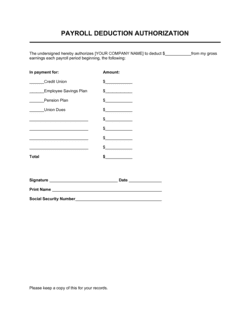
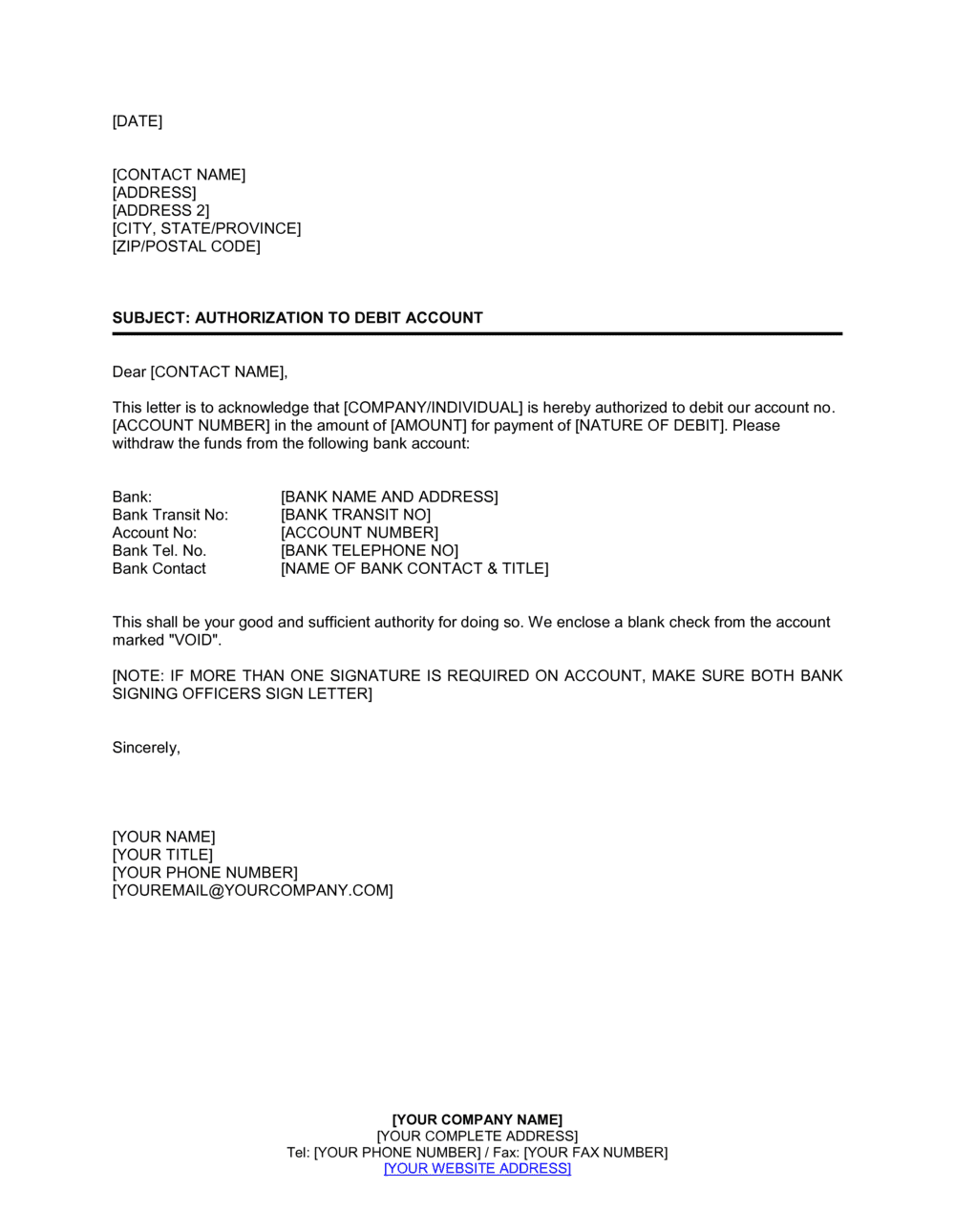
Authorization to Debit Account Template

Free Word download • Edit online • Save & share with Drive • Export to PDF

1 page20–30 min to fillDifficulty: StandardSignature requiredLegal review recommended
Learn more ↓
FreeAuthorization to Debit Account Template

At a glance

What it is
An Authorization to Debit Account is a signed instruction from a bank account holder granting a third party — typically a business or creditor — the right to withdraw funds from that account on a one-time or recurring basis. This free Word download covers all required fields under NACHA ACH rules, Canadian PAD standards, the UK Direct Debit Guarantee, and SEPA Direct Debit, and can be exported as PDF and presented to account holders for signature before any draw is processed.
When you need it
Use it whenever you collect recurring payments — subscription fees, loan installments, rent, or membership dues — or need a documented one-time draw authorization from a customer, tenant, or debtor. It is also required when a payment processor or acquiring bank asks for proof of account-holder consent before activating ACH or direct debit on a merchant account.
What's inside
Account holder and payee identification, account and routing numbers, authorization scope (one-time or recurring), debit amount and schedule, revocation rights and notice period, return and dispute procedures, and a signature block with date. The template includes an optional pre-notification clause and a section for processing reference numbers required by NACHA and SEPA.

What is an Authorization to Debit Account?

An Authorization to Debit Account is a signed legal document in which a bank account holder grants a named third party — typically a business, lender, or service provider — the right to withdraw funds directly from their bank account on a one-time or recurring basis. It functions as the documented proof of consent that payment networks require before any direct bank draw can be legally initiated. In the United States, these authorizations are governed by NACHA ACH Operating Rules; in Canada by Payments Canada Rule H1 for pre-authorized debits; in the United Kingdom by the Bacs Direct Debit Scheme and the Direct Debit Guarantee; and across the European Union by the SEPA Direct Debit Core and B2B rulebooks. A properly executed authorization records the account details, the scope and schedule of permitted draws, the account holder's revocation rights, and the dispute procedures — creating an enforceable paper trail that protects both parties.

Why You Need This Document

Initiating a bank debit without a valid, signed authorization on file is not a procedural technicality — it is an unauthorized transaction under every major payment scheme, and the consequences are concrete. The account holder's bank can return the entry as unauthorized within 60 days of settlement for US consumer accounts, triggering a full refund, a return fee passed back to you by your payment processor, and a mark against your unauthorized return rate. Exceed NACHA's 0.5% unauthorized return threshold and your originating bank can suspend your ACH access entirely, taking down every recurring billing relationship you have built. In the UK, the Direct Debit Guarantee means the account holder's bank refunds an unauthorized draw immediately and without investigation — leaving you to recover the funds through other means. A signed, scheme-compliant authorization eliminates all of this exposure, gives your payment processor the documentation it needs, and gives the account holder a clear record of what they agreed to, reducing disputes at the source.

Which variant fits your situation?

If your situation is…Use this template
One-time single draw for a specific transactionOne-Time ACH Debit Authorization
Recurring fixed-amount draws on a regular scheduleRecurring Pre-Authorized Debit Agreement
Variable-amount draws tied to monthly usage or billingVariable Amount Direct Debit Authorization
Authorizing a credit card charge rather than a bank drawCredit Card Authorization Form
Landlord collecting rent via automatic bank transferPre-Authorized Rent Payment Form
Cross-border euro-denominated recurring payment within the EUSEPA Direct Debit Mandate
Loan repayment schedule with variable and fixed installmentsLoan Repayment Authorization

Common mistakes to avoid

❌ Using a typed email reply as the authorization

Why it matters: An email without a compliant electronic-signature mechanism does not satisfy NACHA's requirement for a signed authorization, leaving every draw under it vulnerable to an unauthorized-debit dispute.

Fix: Collect signatures through an E-SIGN-compliant platform that timestamps consent and stores an audit log, or require a wet signature on the printed form.

❌ Setting the revocation notice period above 3 business days for consumer accounts

Why it matters: NACHA mandates a maximum 3-business-day revocation notice period for consumer ACH entries — any longer contractual requirement is unenforceable and exposes the originator to unauthorized-return liability.

Fix: Set the revocation notice period at exactly 3 business days and train your billing team to honor same-day revocation requests that arrive more than 3 days before the next draw.

❌ Not retaining the signed authorization for 2 years post-last-draw

Why it matters: NACHA requires originators to retain authorization records for 2 years from the last entry date. An ODFI that receives a return and cannot produce the authorization within 10 business days can face rule violations and pass the loss back to you.

Fix: Store executed authorizations in a document management system tagged to the account holder record, with an automated retention alert at 2 years after the final draw.

❌ Omitting advance notice before changing a recurring debit amount

Why it matters: Drawing a different amount than authorized — even by a small variance — gives the account holder valid grounds to return the item as unauthorized and can push your ODFI's return rate toward NACHA's 0.5% threshold for unauthorized returns.

Fix: Build a 10-business-day advance notice step into your billing workflow for any amount change and document that notice was sent before initiating the modified draw.

❌ Using a single authorization form for multiple countries

Why it matters: ACH, PAD, UK Direct Debit, and SEPA mandates each have distinct mandatory disclosure language, notice periods, and revocation rights — a multi-jurisdiction form that omits scheme-specific language is non-compliant in every jurisdiction it covers.

Fix: Maintain separate authorization templates for each jurisdiction where you collect payments, reviewed against the current scheme rules at least annually.

❌ Failing to include a mandate reference number for SEPA debits

Why it matters: Every SEPA Direct Debit transaction must reference the unique mandate reference number assigned at authorization — without it, the creditor bank will reject the entry and the account holder's bank cannot trace a dispute.

Fix: Generate a unique mandate reference number at the time of authorization, print it on the mandate form, and store it in your payment records linked to every transaction initiated under that mandate.

The 10 key clauses, explained

Parties and Account Identification

In plain language: Identifies the account holder authorizing the draw and the payee (company) receiving it, along with the account and routing numbers of the account to be debited.

Sample language
I, [ACCOUNT HOLDER FULL NAME], authorize [COMPANY NAME] ('Company') to initiate debit entries to my account at [BANK NAME], ABA Routing Number [ROUTING NUMBER], Account Number [ACCOUNT NUMBER] ('Account').

Common mistake: Collecting only the last four digits of the account number for privacy, then being unable to process the transaction. The full account number is required by the ODFI to originate an ACH entry.

Authorization Scope — One-Time or Recurring

In plain language: States clearly whether the authorization covers a single draw or an ongoing series of debits, and specifies the frequency (weekly, monthly, quarterly) for recurring authorizations.

Sample language
This authorization applies to: [ ] a one-time debit of $[AMOUNT] on [DATE]; OR [ ] recurring debits of $[AMOUNT] on the [DAY] of each [WEEK / MONTH] beginning [START DATE].

Common mistake: Leaving the scope ambiguous by checking neither box or failing to specify the recurrence frequency. A processor that initiates additional draws beyond what the account holder intended will face R10 returns and possible NACHA violation findings.

Debit Amount and Schedule

In plain language: Specifies the exact dollar amount of each draw, or for variable-amount authorizations, the method by which the amount will be calculated, along with the processing date.

Sample language
Each debit shall be in the amount of $[FIXED AMOUNT], OR in the amount shown on the invoice issued by Company on or before [X DAYS] prior to each debit date. Company will debit the Account on the [DAY] of each month, or the next business day if that date falls on a weekend or holiday.

Common mistake: Omitting the advance-notice requirement for variable-amount debits. NACHA requires at least 10 days' advance notice when the debit amount changes, and failure to provide it gives the account holder grounds to dispute the draw.

Pre-Notification

In plain language: Gives the account holder the option to receive a zero-dollar test entry or written notice before the first live draw, allowing them to confirm account details are correct.

Sample language
Company will [ ] send a pre-notification entry to the Account at least 3 banking days before the first debit; OR [ ] provide written notice of the first debit amount and date at least [X] days in advance.

Common mistake: Skipping pre-notification entirely for new account enrollments. A failed first draw due to incorrect account details generates a return fee, delays payment, and may trigger a NACHA reportable return-rate threshold.

Revocation Rights and Notice Period

In plain language: Tells the account holder how to cancel the authorization and how much advance notice is required before the next scheduled draw to stop it from processing.

Sample language
Account Holder may revoke this authorization at any time by providing written notice to Company at [EMAIL / MAILING ADDRESS] at least 3 business days before the next scheduled debit date. Revocation does not release Account Holder from any outstanding payment obligations.

Common mistake: Setting the revocation notice period to more than 3 business days for consumer ACH entries. NACHA Subsection 2.3.2 mandates a maximum of 3 business days for consumer accounts — a longer contractual requirement is unenforceable.

Return and Dispute Procedure

In plain language: Explains the account holder's right to dispute an unauthorized or incorrect draw and the timeframe within which the bank will process a return.

Sample language
If an error or unauthorized debit is posted to the Account, Account Holder must notify Company at [CONTACT] and their bank within [60] days of the transaction date. Company will investigate and correct any confirmed errors within [5] business days of written notice.

Common mistake: Stating a dispute window shorter than the NACHA standard of 60 calendar days from the settlement date for consumer accounts. Shortening this window in the authorization does not override the bank's obligation to honor a timely return request.

Representations and Warranties

In plain language: The account holder confirms they are an authorized signer on the account, the account is in good standing, and they have the authority to grant this debit permission.

Sample language
Account Holder represents and warrants that: (a) they are an authorized signer on the Account; (b) the Account is open and in good standing; (c) they have full authority to execute this Authorization; and (d) all information provided herein is accurate.

Common mistake: Omitting this clause and later being unable to recover funds from a draw disputed on the grounds that the signatory was not an authorized account signer — a defense that succeeds when the ODFI cannot show a valid authorization was in place.

Modification of Terms

In plain language: Sets out how changes to the debit amount, frequency, or schedule will be communicated to the account holder before taking effect.

Sample language
Company will provide Account Holder with at least [10] days' written notice of any change to the debit amount or schedule. Continued maintenance of the Account following such notice constitutes acceptance of the modified terms.

Common mistake: Providing no modification clause at all and then changing the debit amount without notice. This generates R10 unauthorized-return codes, puts the ODFI's return rate at risk, and exposes the company to NACHA sanctions.

Governing Law and NACHA / Scheme Rules

In plain language: States which jurisdiction's law governs the authorization and confirms that all draws will be processed in compliance with the applicable payment scheme rules.

Sample language
This Authorization is governed by the laws of [STATE / PROVINCE / COUNTRY]. All ACH entries initiated hereunder are subject to NACHA Operating Rules and Guidelines [OR applicable payment scheme rules], as amended from time to time.

Common mistake: Omitting the NACHA or scheme-rules reference entirely. Without it, the payee cannot invoke the scheme's dispute and return procedures if the account holder's bank challenges the authorization.

Signature Block and Date

In plain language: Records the account holder's wet or electronic signature, printed name, and the date the authorization was executed — required by NACHA and all major direct debit schemes as proof of consent.

Sample language
By signing below, Account Holder agrees to the terms of this Authorization. Signature: _______________________ Printed Name: [ACCOUNT HOLDER NAME] Date: [DATE]

Common mistake: Accepting a typed name in an email as the authorization signature without an explicit agreement that electronic signatures are valid under E-SIGN or the applicable jurisdiction's electronic-signature law. A challenged draw with no valid signature record is effectively an unauthorized debit.

How to fill it out

  1. 1

    Identify both parties and the account

    Enter the account holder's full legal name as it appears on the bank account, the company's full registered name, and the bank name, ABA routing number, and full account number.

    💡 For business accounts, confirm whether the signatory is an authorized signer on the account — the bank's records, not just the company's say-so, determine validity.

  2. 2

    Select and define the authorization scope

    Check one-time or recurring. For recurring, specify the exact frequency (monthly, weekly, quarterly) and the start date. Do not leave this section blank or ambiguous.

    💡 If the payment amount will vary month to month, use the variable-amount language and specify how the amount will be calculated or communicated — for example, 'per invoice issued at least 10 days prior.'

  3. 3

    Set the debit amount and processing date

    Enter the fixed dollar amount per draw, or describe the variable-amount calculation method. Specify the calendar day of the month the draw will process and the business-day fallback rule.

    💡 Avoid 'on or about' language for the processing date — account holders plan around a specific date, and vague scheduling increases dispute rates.

  4. 4

    Complete the pre-notification election

    Decide whether to send a pre-notification test entry or a written advance notice before the first draw. Select the applicable option and enter the notice lead time.

    💡 For high-value first draws over $5,000, send both a pre-note and a written notice — the small processing delay is worth eliminating the risk of a failed first debit.

  5. 5

    Enter revocation and dispute contact details

    Fill in the company's revocation contact — a dedicated email address and mailing address. Confirm the dispute window matches the applicable scheme minimum (60 days for US consumer ACH).

    💡 Use a monitored shared inbox (e.g., payments@yourcompany.com) rather than an individual employee's email — staff turnover should not break the revocation process.

  6. 6

    Add governing law and payment scheme reference

    Select the governing jurisdiction and confirm which payment scheme rules apply — NACHA for US ACH, Payments Canada Rule H1 for Canadian PAD, FCA rules and the Direct Debit Guarantee for UK, or SEPA EPC rules for EU.

    💡 If you collect from account holders in more than one country, use a separate authorization form tailored to each jurisdiction's scheme rules rather than a single catch-all document.

  7. 7

    Obtain a dated signature before processing

    Collect the account holder's wet signature on the printed form, or an electronic signature via a compliant e-signature platform. Record the exact date of execution.

    💡 For NACHA compliance, retain the signed authorization for 2 years after the last draw processed under it — longer than many businesses expect.

  8. 8

    File the authorization and link it to your payment records

    Store the executed authorization in a searchable file linked to the account holder's payment profile in your billing or accounting system. Your ODFI can request to see it within 10 business days of a return.

    💡 Attach the authorization as a PDF to the account record in your CRM or billing platform on the same day it is signed — tracking down a paper file 18 months later after an R10 return is a common and avoidable problem.

Frequently asked questions

What is an authorization to debit account?

An authorization to debit account is a signed document in which a bank account holder gives a third party — typically a business — permission to withdraw funds directly from their bank account. It specifies whether the draw is one-time or recurring, the amount and schedule, and the account holder's rights to revoke the authorization. Without a valid, signed authorization on file, any debit initiated is considered unauthorized under NACHA rules, SEPA regulations, and most national payment scheme rules.

Is a signed debit authorization legally required?

Yes, in virtually all major payment schemes. NACHA requires originators to obtain a signed or electronically authenticated authorization before initiating any ACH debit entry. SEPA mandates a signed mandate document before any SEPA Direct Debit can be processed. The UK Direct Debit scheme requires an Instruction to your bank before draws begin. In Canada, Payments Canada Rule H1 requires a written PAD agreement. Operating without one exposes the payee to unauthorized-return claims, ODFI sanctions, and potential liability for the full debited amount.

What is the difference between an ACH debit authorization and a SEPA mandate?

Both documents accomplish the same goal — written account-holder consent for direct bank draws — but under different rules. ACH authorizations are governed by NACHA and apply to US dollar transactions between US bank accounts. SEPA mandates are governed by the European Payments Council, apply to euro-denominated transactions across 36 countries, and require a unique mandate reference number on every draw. Disclosure language, notice periods, and revocation rights differ between the two schemes, so a single form cannot satisfy both.

Can the account holder revoke a debit authorization?

Yes. Under NACHA rules, an account holder may revoke a consumer ACH authorization at any time by providing written notice to the payee at least 3 business days before the next scheduled draw. SEPA mandates can also be cancelled, typically with notice to both the creditor and the account holder's bank. Revocation does not, however, cancel any underlying payment obligation — it only removes the bank-draw mechanism. The payee must then seek payment through other means.

What happens if a debit is processed without a valid authorization?

The account holder's bank can return the entry using return code R10 (customer advises not authorized) within 60 calendar days of the settlement date for consumer accounts. The ODFI is required to pass the return back to the originator, who must refund the amount. Repeated unauthorized returns above NACHA's 0.5% threshold can result in the ODFI suspending the originator's ACH access. In severe cases, the payee may also face regulatory action and civil liability.

How long must a signed authorization be retained?

NACHA requires originators to retain authorization records for 2 years from the date of the last entry processed under that authorization. SEPA mandates must be retained for 14 months after the last transaction under most national scheme implementations, though some creditor banks require longer. Best practice is to retain all signed authorizations for at least 3 years to cover audit cycles and any delayed dispute windows.

Does an electronic signature satisfy the authorization requirement?

Generally yes, provided the signature was obtained through a method that meets the requirements of the applicable electronic-signature law — E-SIGN and UETA in the US, the Electronic Commerce Act in Canada, eIDAS in the EU, and the Electronic Communications Act in the UK. A typed name in an email, without an audit trail and explicit consent to electronic authorization, typically does not satisfy NACHA or SEPA requirements. Use a compliant e-signature platform that generates a timestamped audit log.

What is the notice period for changing a recurring debit amount?

Under NACHA rules, an originator must provide at least 10 business days' advance notice to the account holder before drawing an amount that differs from the authorized amount. In Canada, Payments Canada Rule H1 requires at least 30 days' notice for changes to a personal PAD. SEPA requires advance notice of at least 14 calendar days before the due date of a modified draw under the Core scheme. Building this notice step into billing workflows before modifying any recurring draw is essential to avoiding unauthorized-return codes.

Can a business use one authorization form for customers in multiple countries?

Not reliably. Each major payment scheme — NACHA, Payments Canada PAD, UK Direct Debit, and SEPA — requires specific disclosure language, revocation rights, and notice periods that differ from one another. A single form written to satisfy all four will almost certainly omit mandatory language for at least one jurisdiction, making it non-compliant. Businesses collecting from account holders in more than one country should maintain jurisdiction-specific authorization templates reviewed annually against current scheme rules.

How this compares to alternatives

vs Credit Card Authorization Form

A credit card authorization permits charges to a card network (Visa, Mastercard) rather than a bank account. Credit card draws are governed by card network chargeback rules, not NACHA or direct debit scheme rules, and carry higher processing fees. ACH debit authorizations cost less per transaction but take 1–3 business days to settle, while card charges settle faster. Use a credit card authorization when speed matters; use an ACH debit authorization when cost matters.

vs Direct Deposit Authorization Form

A direct deposit authorization is issued by an employee to their employer authorizing a credit (push) into their account, not a debit (pull) from it. The flow of funds is opposite: direct deposit sends money to the account holder; a debit authorization allows funds to be taken from it. Both use the ACH network but serve entirely different purposes and require different authorization language.

vs Payment Agreement

A payment agreement defines the terms under which a debtor will repay an outstanding balance — installment amounts, due dates, and consequences for default. An authorization to debit account is the mechanism that executes those draws. The two documents are complementary: the payment agreement establishes the obligation; the debit authorization activates the collection method. Using a payment agreement alone, without a debit authorization, does not give the payee the right to pull funds from the bank account.

vs Wire Transfer Authorization

A wire transfer authorization is a one-time instruction to a bank to push a specific amount to a named beneficiary — it cannot be used for recurring draws and is typically irrevocable once the bank executes it. An ACH debit authorization is a standing permission for a third party to pull funds, is revocable by the account holder, and carries consumer return rights. Wire transfers settle same-day and are used for large, time-sensitive payments; ACH debits settle in 1–3 business days and are used for recurring, lower-cost collections.

Industry-specific considerations

Financial Services and Lending

Loan repayment schedules with fixed or variable installments, missed-payment retry logic, and NACHA unauthorized-return threshold monitoring are all standard compliance concerns for lenders using ACH debits.

SaaS and Software

Monthly subscription billing via ACH carries lower processing fees than credit card but requires a valid signed authorization and a compliant dunning process for failed draws due to insufficient funds.

Property Management

Landlords collecting rent via pre-authorized debit need authorizations that cover variable move-in amounts, regular monthly rent, and one-off draws for damages — each requiring separate scope language.

Nonprofit and Fundraising

Recurring donor bank-transfer programs rely entirely on valid signed authorizations; a revoked authorization that is not honored promptly can generate R10 returns that damage the organization's ODFI relationship.

Jurisdictional notes

United States

All ACH debit entries are governed by NACHA Operating Rules. Originators must obtain a signed or electronically authenticated authorization before initiating any debit, retain it for 2 years after the last entry, and produce it within 10 business days upon ODFI request. Consumer accounts carry a 60-calendar-day unauthorized-return window (R10); business accounts have a shorter 2-business-day window (R29). Unauthorized return rates above 0.5% can trigger ODFI suspension of ACH origination privileges.

Canada

Canadian pre-authorized debits are governed by Payments Canada Rule H1. The rule distinguishes personal PADs (consumer accounts) from business PADs, with personal PADs carrying a 90-day right to dispute a draw at the account holder's bank for any reason. Originators must provide at least 30 days' advance notice before changing the amount, frequency, or timing of a personal PAD. French-language authorization forms are required for customers in Quebec under the Consumer Protection Act.

United Kingdom

UK direct debits operate under the Bacs Direct Debit Scheme, and every originator must be sponsored by an approved bank or building society. The Direct Debit Guarantee entitles account holders to an immediate refund from their bank of any unauthorized or incorrect direct debit — no advance investigation required. Originators must give advance notice of the amount and collection date (typically 10 working days) before the first draw and before any change to the amount.

European Union

SEPA Direct Debit is governed by the European Payments Council rulebooks — the Core scheme for consumer accounts and the B2B scheme for business accounts. Every mandate must include a unique mandate reference number generated by the creditor and must be retained for 14 months after the final transaction. Under the Core scheme, consumers may request a refund of any authorized SEPA debit within 8 weeks of the debit date, and an unauthorized debit within 13 months. Under PSD2, creditors must give at least 14 calendar days' advance notice before each draw unless a shorter period is agreed.

Template vs lawyer — what fits your deal?

PathBest forCostTime
Use the templateBusinesses collecting consumer or business payments via ACH, PAD, or direct debit with standard fixed-amount recurring schedulesFree15–30 minutes
Template + legal reviewMulti-jurisdiction collection, variable-amount billing, or high-volume programs where ODFI return thresholds are a compliance concern$300–$8002–5 business days
Custom draftedRegulated financial institutions, lenders with complex repayment structures, or businesses operating under SEPA and NACHA simultaneously$1,000–$3,500+1–2 weeks

Glossary

ACH (Automated Clearing House)
A US electronic funds-transfer network operated under NACHA rules that processes direct deposits and direct debits between bank accounts.
NACHA
The governing body that sets the rules for ACH transactions in the United States, including required authorization language, return codes, and record-keeping obligations.
Pre-Authorized Debit (PAD)
The Canadian equivalent of an ACH debit, governed by Payments Canada Rule H1, which requires written authorization and specific revocation notice periods.
SEPA Direct Debit
A euro-denominated direct debit scheme operated by the European Payments Council, covering 36 countries, that requires a signed mandate before any draw can be initiated.
Direct Debit Guarantee
A UK consumer protection rule requiring banks to refund any unauthorized or incorrect direct debit immediately upon request, with no questions asked.
Originating Depository Financial Institution (ODFI)
The bank or payment processor that initiates an ACH debit entry on behalf of the payee — it bears responsibility for ensuring a valid authorization exists.
Return Code
A standardized code issued by the receiving bank when an ACH debit cannot be processed — for example, R01 (insufficient funds) or R10 (customer advises not authorized).
Pre-Notification (Pre-Note)
A zero-dollar test entry sent to the receiving bank before the first live ACH debit to verify that the account and routing numbers are valid.
Revocation
The account holder's right to cancel a debit authorization, typically requiring written notice to the payee at least 3 business days before the next scheduled draw under NACHA rules.
Mandate Reference Number
A unique identifier assigned to a SEPA Direct Debit mandate by the creditor, required on every transaction initiated under that mandate.
Net Settlement
The process by which a bank aggregates ACH credits and debits across a business day and settles the net position rather than processing each item individually.

Part of your Business Operating System

This document is one of 3,000+ business & legal templates included in Business in a Box.

  • Fill-in-the-blanks — ready in minutes
  • 100% customizable Word document
  • Compatible with all office suites
  • Export to PDF and share electronically

Create your document in 3 simple steps.

From template to signed document — all inside one Business Operating System.
1
Download or open template

Access over 3,000+ business and legal templates for any business task, project or initiative.

2
Edit and fill in the blanks with AI

Customize your ready-made business document template and save it in the cloud.

3
Save, Share, Send, Sign

Share your files and folders with your team. Create a space of seamless collaboration.

Save time, save money, and create top-quality documents.

★★★★★

"Fantastic value! I'm not sure how I'd do without it. It's worth its weight in gold and paid back for itself many times."

Managing Director · Mall Farm
Robert Whalley
Managing Director, Mall Farm Proprietary Limited
★★★★★

"I have been using Business in a Box for years. It has been the most useful source of templates I have encountered. I recommend it to anyone."

Business Owner · 4+ years
Dr Michael John Freestone
Business Owner
★★★★★

"It has been a life saver so many times I have lost count. Business in a Box has saved me so much time and as you know, time is money."

Owner · Upstate Web
David G. Moore Jr.
Owner, Upstate Web

Run your business with a system — not scattered tools

Stop downloading documents. Start operating with clarity. Business in a Box gives you the Business Operating System used by over 250,000 companies worldwide to structure, run, and grow their business.

Start free · No credit card required