Conversion of Account to COD 2 Template

Free Word download β€’ Edit online β€’ Save & share with Drive β€’ Export to PDF

1 pageβ€’20–30 min to fillβ€’Difficulty: Standardβ€’Signature requiredβ€’Legal review recommended
Learn more ↓
FreeConversion of Account to COD 2 Template

At a glance

What it is
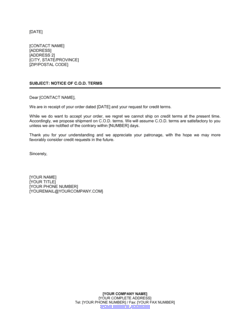
A Conversion of Account to COD is a formal legal notice and binding agreement that a seller or creditor sends to a buyer to revoke existing open-account or net-terms credit and require all future orders to be paid cash-on-delivery. This free Word download can be edited online, tailored to your specific account details, and exported as PDF for immediate delivery to the customer.
When you need it
Use it when a customer has missed payments, exceeded their credit limit, had a material change in financial condition, or when your credit policy requires you to formally document the revocation of credit terms in writing. It is also appropriate when a buyer's check has been returned or when a payment arrangement has broken down.
What's inside
Identification of both parties and the account number, a statement of the outstanding balance and payment history triggering the conversion, the effective date of the COD requirement, conditions under which credit terms may be reinstated, and signature blocks for both parties to acknowledge the new terms.

What is a Conversion of Account to COD?

A Conversion of Account to COD is a formal legal notice and binding written agreement by which a seller formally revokes a buyer's existing open-account or net-terms credit and requires all future orders to be paid cash-on-delivery. It documents the specific payment failures, returned checks, or credit events that triggered the change, sets an effective date for the new terms, establishes a repayment schedule for any outstanding past-due balance, and defines measurable conditions under which credit may be reinstated. Unlike a simple collection letter, this document restructures the ongoing commercial relationship β€” allowing trade to continue on terms that protect the seller's cash flow while giving the buyer a clear path back to credit standing.

Why You Need This Document

Continuing to ship goods on open-account terms to a buyer with a pattern of late payments or returned checks exposes your business to compounding losses β€” each new delivery adds to an already impaired receivable. Without a formal COD conversion agreement, you have no written record of the changed terms, no binding repayment schedule for the outstanding balance, and no enforceable conditions for credit reinstatement, leaving both parties in a legal gray zone. A signed agreement closes each of those gaps: it creates a documented audit trail that supports collection proceedings if the buyer defaults again, binds the buyer to a repayment plan they cannot easily dispute, and preserves your ability to continue the commercial relationship on sustainable terms. This template gives you a professionally structured starting point you can complete in under 30 minutes and execute immediately.

Which variant fits your situation?

If your situation is…Use this template
Customer has missed multiple payments and you want a mutual agreementConversion of Account to COD (Mutual Agreement Version)
Sending a unilateral notice of credit revocation without requiring signatureCredit Revocation Notice Letter
Customer owes a past-due balance and you need a repayment schedulePayment Plan Agreement
Escalating to formal debt collection after COD conversion failsDemand Letter for Payment
Customer is disputing the outstanding balance before agreeing to CODAccount Statement and Balance Dispute Letter
Reinstating credit after the customer has met COD conditionsCredit Application and Agreement
Placing an account on full credit hold pending financial reviewCredit Hold Notice

Common mistakes to avoid

❌ Obtaining only the seller's signature

Why it matters: A document signed only by the seller is a unilateral notice, not a mutual agreement. The buyer is not bound by the repayment schedule or reinstatement conditions, making both far harder to enforce in court.

Fix: Require the buyer's authorized representative to sign and date the agreement before processing any new orders. Use email confirmation or a signed-receipt request if obtaining a wet signature is difficult.

❌ Setting an immediate effective date with no notice period

Why it matters: Courts in several jurisdictions have found that abrupt revocation of credit β€” particularly where the buyer had reliance interest in ongoing credit β€” constitutes commercially unreasonable conduct, exposing the seller to counterclaims.

Fix: Allow at least 5 business days' notice before COD terms take effect, and complete any acknowledged open purchase orders under the prior terms before switching to COD.

❌ Accepting personal checks as COD payment

Why it matters: A personal check is not guaranteed funds. Accepting one at delivery defeats the entire purpose of requiring COD β€” a returned check after delivery leaves you in the same position as a missed invoice, but now the goods are gone.

Fix: Specify in the delivery mechanics clause that COD payment must be made by certified check, money order, wire transfer, or approved electronic payment only. Train delivery staff accordingly.

❌ Leaving reinstatement conditions undefined or automatic

Why it matters: If the agreement states the buyer 'may' have credit reinstated without specifying measurable conditions, the buyer may assert entitlement to reinstatement after only one or two on-time COD payments, triggering a dispute.

Fix: Define reinstatement as requiring full balance payment plus a minimum consecutive period of on-time COD orders β€” typically 3 to 6 months β€” and phrase it as subject to the seller's sole discretion.

❌ Failing to document the specific invoices triggering the conversion

Why it matters: A generic reference to 'unpaid balances' gives the buyer room to dispute the factual trigger for the conversion and may weaken your position in subsequent collection litigation.

Fix: List every past-due invoice by number, amount, and days overdue in the payment history clause, and attach your accounts receivable aging report as an exhibit.

❌ Using the buyer's trade name instead of their registered legal entity

Why it matters: If the buyer is incorporated, a judgment against their trade name may not be enforceable against the legal entity, requiring a separate step to identify and pierce the corporate structure.

Fix: Verify the buyer's registered legal name through your state or provincial business registry before executing the agreement, and use the exact registered name throughout the document.

The 10 key clauses, explained

Parties and Account Identification

In plain language: Names the seller and buyer as legal entities, references the specific account number, and establishes the prior credit relationship being modified.

Sample language
This Agreement is entered into between [SELLER LEGAL NAME] ('Seller') and [BUYER LEGAL NAME] ('Buyer'), concerning Account No. [ACCOUNT NUMBER] ('Account'), previously maintained under [NET-30 / NET-60 / OPEN ACCOUNT] credit terms.

Common mistake: Using a trade name or DBA instead of the buyer's registered legal entity name. If the buyer is a corporation, naming only an individual contact makes the agreement difficult to enforce against the entity.

Statement of Payment History and Default

In plain language: Documents the specific payment failures, returned checks, or missed invoices that are triggering the conversion, creating a factual record for the file.

Sample language
As of [DATE], Buyer has the following past-due invoices on the Account: Invoice [NUMBER] dated [DATE] in the amount of $[X], overdue by [DAYS] days; Invoice [NUMBER] dated [DATE] in the amount of $[X], overdue by [DAYS] days. Total outstanding balance: $[AMOUNT].

Common mistake: Omitting specific invoice numbers and dollar amounts. A vague reference to 'unpaid balances' is harder to rely on in subsequent collection proceedings and gives the buyer room to dispute the factual basis.

Effective Date of COD Conversion

In plain language: Sets the specific date from which all future orders must be paid cash-on-delivery, giving the buyer clear notice of when the new terms take effect.

Sample language
Effective [DATE], all orders placed by Buyer shall be subject to cash-on-delivery payment terms. No goods or services will be shipped or rendered until payment in full is received by Seller at or before the time of delivery.

Common mistake: Setting an immediate effective date without providing reasonable notice. In several jurisdictions, courts have found abrupt credit revocations to be commercially unreasonable, particularly where the buyer had open purchase orders in transit.

Outstanding Balance Payment Obligation

In plain language: Addresses how the existing past-due balance will be handled β€” whether it must be paid in full immediately or on an agreed schedule β€” separate from the COD requirement on future orders.

Sample language
Buyer agrees to pay the outstanding balance of $[AMOUNT] as follows: [FULL PAYMENT BY DATE / INSTALLMENTS OF $[X] ON THE [DAY] OF EACH MONTH, COMMENCING [DATE]]. Late payments on the outstanding balance shall accrue interest at [X]% per month.

Common mistake: Failing to separate the repayment of the existing balance from the COD requirement on new orders. Blending both creates ambiguity about whether a partial payment clears the COD restriction.

Delivery and Acceptance Mechanics

In plain language: Specifies how COD payment must be made at delivery β€” acceptable payment methods, who collects, and what happens if the buyer refuses to pay upon delivery.

Sample language
COD payment shall be made by [CASH / CERTIFIED CHECK / BANK TRANSFER] at the time of delivery. If Buyer refuses or fails to pay at delivery, Seller may retain the goods and Buyer shall remain liable for [RESTOCKING FEE / RETURN SHIPPING COSTS] of $[AMOUNT] or [X]% of the order value.

Common mistake: Not specifying accepted payment methods for COD. If the buyer tenders a personal check and the seller's driver accepts it, the COD protection is undermined β€” specify certified funds or electronic payment.

Reinstatement of Credit Terms

In plain language: Sets out the specific, measurable conditions the buyer must satisfy to have their original credit terms reinstated, giving both parties a defined path forward.

Sample language
Seller may, at its sole discretion, reinstate credit terms upon Buyer's satisfaction of all of the following conditions: (a) full payment of the outstanding balance of $[AMOUNT]; (b) timely COD payment on all orders for a consecutive period of [X] months; and (c) submission of a current financial statement satisfactory to Seller.

Common mistake: Leaving reinstatement conditions vague or omitting them entirely. Without defined criteria, a buyer may argue entitlement to credit reinstatement after a single on-time payment, triggering a dispute.

Seller's Right to Refuse Orders

In plain language: Preserves the seller's right to decline new orders at their discretion during the COD period, protecting against a buyer who continues to place large orders under the new terms but then disputes delivery.

Sample language
Seller reserves the right to accept or decline any order from Buyer at its sole discretion during the COD period and shall incur no liability for declining orders where Buyer is not current on all payment obligations, including the outstanding balance.

Common mistake: No reservation of rights clause. Without it, refusing a large order during the COD period could expose the seller to a breach-of-contract claim if the parties have an ongoing supply arrangement.

Confidentiality of Account Status

In plain language: Optionally restricts either party from disclosing the account status change to third parties, protecting the buyer's business reputation and reducing the risk of defamation claims against the seller.

Sample language
The parties agree to keep the terms of this Agreement and the circumstances of the Account conversion confidential, except as required by law or as necessary to enforce this Agreement.

Common mistake: Omitting this clause and then disclosing the credit revocation to the buyer's other suppliers or customers. Even an inadvertent disclosure can give rise to a defamation or tortious interference claim.

Governing Law and Dispute Resolution

In plain language: Specifies which jurisdiction's law governs the agreement and how disputes will be resolved β€” court, arbitration, or mediation β€” and who bears legal costs.

Sample language
This Agreement is governed by the laws of [STATE / PROVINCE / COUNTRY]. Any dispute arising hereunder shall be resolved in the courts of [JURISDICTION]. The prevailing party shall be entitled to recover reasonable attorneys' fees and costs.

Common mistake: Choosing a governing jurisdiction that has no connection to either party's place of business. Some jurisdictions will decline to enforce a choice-of-law clause that is purely opportunistic and disadvantages a local buyer.

Acknowledgment and Signatures

In plain language: Both parties sign and date the agreement, confirming they have read, understood, and accepted the new payment terms, creating an enforceable written record.

Sample language
By signing below, each party acknowledges that it has read and understands this Agreement and agrees to be bound by its terms. SELLER: [AUTHORIZED REPRESENTATIVE NAME], [TITLE], Date: [DATE]. BUYER: [AUTHORIZED REPRESENTATIVE NAME], [TITLE], Date: [DATE].

Common mistake: Having only one party sign. A conversion agreement signed only by the seller is treated as a unilateral notice, not a binding mutual agreement. Both signatures are required for maximum enforceability of the reinstatement conditions and the repayment schedule.

How to fill it out

  1. 1

    Insert both parties' legal entity names and the account number

    Enter the seller's and buyer's full registered legal names β€” not trade names or DBA names β€” along with the specific account number tied to the credit relationship being converted.

    πŸ’‘ Cross-check the buyer's legal name against their original credit application or the registered business name in your state's corporate registry before inserting it.

  2. 2

    Document the specific payment failures triggering the conversion

    List each past-due invoice by number, date, and dollar amount in the payment history clause. Include any returned checks, NSF events, or broken payment arrangements by date.

    πŸ’‘ Pull the data directly from your accounts receivable aging report so the figures are audit-ready. Screenshots of the aging report attached as an exhibit strengthen your position significantly.

  3. 3

    Set a reasonable effective date for the COD requirement

    Choose an effective date that gives the buyer enough notice to arrange alternative payment methods β€” typically 5 to 15 business days from the date you deliver the agreement, depending on your jurisdiction and any existing purchase orders in process.

    πŸ’‘ If the buyer has open purchase orders already acknowledged by you, complete those under the old terms and apply COD only to new orders placed after the effective date to avoid a breach-of-contract exposure.

  4. 4

    State the outstanding balance and repayment schedule

    Enter the exact outstanding balance as of a specific date and choose between immediate full payment or an installment schedule. If installments, specify the amount, due date, and applicable interest rate.

    πŸ’‘ Keep the repayment schedule realistic β€” an installment amount the buyer cannot meet defeats the purpose. Confirm verbally with the buyer before inserting numbers, then document the agreed figures here.

  5. 5

    Specify acceptable COD payment methods

    List which payment types you will accept at delivery β€” certified check, ACH, wire transfer, or credit card. Explicitly exclude personal checks and unpaid purchase orders.

    πŸ’‘ If you use a third-party delivery service, confirm with the carrier whether they can collect and remit COD payments before committing to a COD delivery mechanic.

  6. 6

    Define the reinstatement conditions clearly

    Set measurable, specific criteria for credit reinstatement: full balance paid, a minimum number of consecutive on-time COD payments (e.g., 6 months), and any financial disclosure requirements.

    πŸ’‘ Phrase reinstatement as 'at Seller's sole discretion upon satisfaction of conditions' β€” not as an automatic right β€” to preserve your flexibility.

  7. 7

    Select the governing law and dispute resolution mechanism

    Enter the state, province, or country whose law will govern the agreement and specify whether disputes go to court or binding arbitration. Add a prevailing-party attorney's fees clause if permitted in your jurisdiction.

    πŸ’‘ If you are a seller in one state and the buyer is in another, choose your own state as governing jurisdiction β€” this often gives you home-court advantage in collection proceedings.

  8. 8

    Obtain signatures from authorized representatives of both parties

    Have an officer, director, or authorized signatory of the buyer sign and date the agreement before any new orders are processed. Retain an executed copy in the buyer's account file.

    πŸ’‘ Send the agreement via certified mail or a tracked delivery channel and request email confirmation of receipt. Documented delivery is critical if the buyer later claims they never received the notice.

Frequently asked questions

What is a conversion of account to COD agreement?

A conversion of account to COD agreement is a formal legal document that revokes a buyer's existing open-account or net-terms credit and requires all future orders to be paid cash-on-delivery. It documents the payment failures triggering the change, sets the effective date of the new terms, establishes a repayment schedule for any outstanding balance, and defines the conditions under which credit may be reinstated. The signed agreement creates a binding written record that supports subsequent collection action if the buyer defaults again.

When should I convert a customer account to COD?

Common triggers include two or more consecutive missed invoices, a returned or NSF check, the buyer exceeding their approved credit limit, a material adverse change in the buyer's financial condition, or a broken payment arrangement. Many credit policies also require a COD conversion when a customer's accounts receivable aging reaches 60 or 90 days overdue. Acting at 60 days rather than 90 days typically results in better collection outcomes.

Does the buyer have to sign the COD conversion agreement?

To create a binding mutual agreement β€” particularly for the repayment schedule and reinstatement conditions β€” the buyer's authorized representative should sign. A seller-only signature creates a unilateral notice of changed terms, which has legal effect in most jurisdictions for future orders but does not bind the buyer to a repayment plan for the outstanding balance. For maximum enforceability, obtain both signatures before processing new orders.

Can I refuse to ship orders if the buyer won't sign the COD agreement?

In most jurisdictions, a seller may decline to extend further credit or ship on credit terms without legal liability, as long as there is no binding supply contract requiring delivery regardless of payment status. If you have an ongoing supply agreement with volume commitments, review it carefully before withholding shipment β€” unilateral refusal to ship may constitute breach if the existing contract does not include a credit-revocation right. Consider consulting a lawyer before withholding delivery under a long-term supply contract.

What payment methods should I accept for COD deliveries?

Specify only guaranteed or near-guaranteed funds: certified checks, money orders, wire transfers confirmed before dispatch, or approved electronic payment via a payment portal. Avoid accepting personal checks, company checks from a buyer with a history of NSF events, or promises to pay by purchase order β€” these reintroduce the same credit risk the COD conversion was designed to eliminate.

How is this different from a demand letter for payment?

A demand letter for payment requests the buyer settle an existing overdue balance and is typically a precursor to legal action. A COD conversion agreement addresses both the outstanding balance and the ongoing commercial relationship β€” it modifies the payment terms for future orders and provides a structured path to continue trading rather than immediately escalating to collections. Use a demand letter when you intend to stop supplying the customer; use a COD agreement when you want to continue the relationship on safer terms.

What happens if the buyer refuses to pay at delivery?

If the buyer refuses to pay at the time of delivery, the seller should retain the goods and not leave them with the buyer. The agreement should specify that refusal to pay at delivery constitutes a breach, entitling the seller to recover return shipping and restocking costs. Repeated refusals may also constitute grounds for terminating the commercial relationship and commencing collection proceedings for the outstanding balance. Document each refused delivery with a written record dated and signed by your delivery representative.

Can credit terms be reinstated after a COD conversion?

Yes β€” reinstatement is possible and common where the buyer pays off the outstanding balance and demonstrates reliable COD payment over a defined period, typically 3 to 6 consecutive months. The agreement should phrase reinstatement as subject to the seller's sole discretion and conditioned on specific measurable criteria, not as an automatic right triggered by partial payment. Sellers may also require an updated credit application and financial statement before reinstating terms.

Is a COD conversion agreement enforceable in court?

A COD conversion agreement signed by both parties is generally enforceable as a binding contract modification in most jurisdictions, provided it identifies the parties, states adequate consideration (such as the seller's agreement to continue supplying), and does not conflict with any existing supply contract or statutory requirement. The enforceability of the repayment schedule and interest provisions depends on the applicable jurisdiction's usury and commercial credit laws. Consider having a lawyer review the agreement if the outstanding balance is material or if the buyer is likely to contest the conversion.

How this compares to alternatives

vs Demand Letter for Payment

A demand letter for payment is a formal notice requiring settlement of an existing overdue balance, typically as a final step before legal action. A COD conversion agreement modifies the ongoing commercial relationship β€” it handles the outstanding balance and establishes new terms for future orders. Use a demand letter when you are terminating the relationship; use a COD agreement when you want to continue supplying on safer terms.

vs Credit Application and Agreement

A credit application and agreement establishes an open-account credit relationship at the outset β€” setting credit limits, net terms, and the buyer's obligations. A COD conversion agreement modifies or revokes that existing relationship after a payment failure. The credit application comes first; the COD conversion is a downstream document triggered by default.

vs Payment Plan Agreement

A payment plan agreement addresses only the repayment of an existing past-due balance in installments. A COD conversion agreement covers both the outstanding balance and all future orders β€” it restructures the entire commercial relationship, not just the arrears. Where the buyer needs to continue purchasing, a standalone payment plan without COD terms leaves the seller exposed to further credit losses.

vs Account Suspension Notice

An account suspension notice places the buyer's account on full hold, stopping all shipments until the balance is resolved. A COD conversion agreement allows the commercial relationship to continue β€” goods can still be ordered and delivered, but payment is required upfront. Use a suspension notice when you are unwilling to ship further; use a COD conversion when you are willing to supply but only on guaranteed payment terms.

Industry-specific considerations

Wholesale and Distribution

High-volume, low-margin distributors use COD conversions to protect cash flow when a reseller account ages past 60 days, particularly for consumable or perishable goods that cannot be returned.

Manufacturing

Manufacturers with long production lead times use COD agreements to protect against buyers canceling or refusing large custom orders after production is complete and delivery is imminent.

Construction and Building Materials

Suppliers to contractors frequently convert accounts to COD after a project payment delay, where the contractor's cash flow depends on owner draws that may not materialize on schedule.

Food and Beverage

Perishable goods make credit risk particularly acute β€” food distributors often have COD conversion policies triggered at 30 days overdue because returned goods have negligible recovery value.

Jurisdictional notes

United States

Commercial credit relationships between businesses are generally governed by Article 2 of the Uniform Commercial Code in most states, which permits sellers to demand adequate assurance of payment and modify credit terms on reasonable notice. State usury laws cap interest rates on overdue balances β€” rates vary significantly, from 6% to 24% annually. California, New York, and Texas have specific commercial credit regulations that may affect the enforceability of certain fee and interest provisions.

Canada

Canadian trade credit is governed provincially under each province's Sale of Goods Act and Judicature Act interest provisions. Interest on overdue commercial accounts is enforceable if clearly stated in the original credit agreement or in the conversion document, but the rate must not exceed the Criminal Code's criminal interest rate of 60% per annum. Quebec civil law applies different default rules than common-law provinces and requires all commercial agreements to comply with the Civil Code of Quebec.

United Kingdom

UK sellers converting trade accounts to COD may rely on the Late Payment of Commercial Debts (Interest) Act 1998, which entitles creditors to statutory interest at 8% over base rate on overdue business-to-business debts. The COD conversion agreement should reference the specific invoices and comply with the Unfair Contract Terms Act 1977 and the Consumer Rights Act 2015 if the buyer is a sole trader. Written notice of changed payment terms is advisable and best practice under standard commercial practice.

European Union

EU Directive 2011/7/EU on combating late payment in commercial transactions entitles sellers to statutory interest and recovery costs when buyers exceed agreed payment terms. Member states implement the directive differently β€” Germany, France, and Italy each have national rules on maximum payment terms and creditor remedies. GDPR considerations arise if the conversion agreement includes financial data about the buyer that may be shared with credit insurers or collection agencies.

Template vs lawyer β€” what fits your deal?

PathBest forCostTime
Use the templateSmall and mid-sized businesses converting a standard trade account to COD where the outstanding balance is under $10,000 and no long-term supply contract is in placeFree15–30 minutes
Template + legal reviewAccounts with outstanding balances of $10,000–$50,000, buyers in a different jurisdiction, or situations where an existing supply contract governs the relationship$200–$5001–2 days
Custom draftedLarge trade accounts over $50,000, strategic supplier relationships, multi-jurisdiction arrangements, or accounts where litigation is already anticipated$500–$2,000+3–7 days

Glossary

Cash on Delivery (COD)
A payment arrangement requiring the buyer to pay the full invoice amount at the time goods or services are delivered, with no credit period extended.
Open Account
A credit arrangement where the seller ships goods and invoices the buyer, who is expected to pay within an agreed period such as net 30 or net 60.
Credit Revocation
The formal act of withdrawing a previously granted credit facility, requiring the account to be settled under new, typically stricter, payment terms.
Net Terms
Payment terms specifying the number of days β€” commonly 15, 30, or 60 β€” within which a buyer must remit payment after receiving an invoice.
NSF (Non-Sufficient Funds)
A bank's rejection of a check or electronic payment because the payer's account lacks sufficient funds to cover the amount, commonly triggering credit review.
Outstanding Balance
The total amount currently owed by the buyer on the account, including any past-due invoices, accrued interest, and applicable fees.
Reinstatement Conditions
Specific, documented criteria β€” such as paying the outstanding balance in full or maintaining timely COD payments for a defined period β€” that a buyer must meet to regain credit terms.
Material Adverse Change
A significant deterioration in a buyer's financial condition, creditworthiness, or business operations that gives the seller grounds to revise or revoke credit terms.
Accounts Receivable Aging
A report categorizing outstanding invoices by how long they have been unpaid β€” typically 0–30, 31–60, 61–90, and 90+ days β€” used to identify accounts requiring credit action.
Credit Limit
The maximum total outstanding balance a seller will carry for a given buyer at any one time under their open-account arrangement.

Part of your Business Operating System

This document is one of 3,000+ business & legal templates included in Business in a Box.

  • Fill-in-the-blanks β€” ready in minutes
  • 100% customizable Word document
  • Compatible with all office suites
  • Export to PDF and share electronically

Create your document in 3 simple steps.

From template to signed document β€” all inside one Business Operating System.
1
Download or open template

Access over 3,000+ business and legal templates for any business task, project or initiative.

2
Edit and fill in the blanks with AI

Customize your ready-made business document template and save it in the cloud.

3
Save, Share, Send, Sign

Share your files and folders with your team. Create a space of seamless collaboration.

Save time, save money, and create top-quality documents.

β˜…β˜…β˜…β˜…β˜…

"Fantastic value! I'm not sure how I'd do without it. It's worth its weight in gold and paid back for itself many times."

Managing Director Β· Mall Farm
Robert Whalley
Managing Director, Mall Farm Proprietary Limited
β˜…β˜…β˜…β˜…β˜…

"I have been using Business in a Box for years. It has been the most useful source of templates I have encountered. I recommend it to anyone."

Business Owner Β· 4+ years
Dr Michael John Freestone
Business Owner
β˜…β˜…β˜…β˜…β˜…

"It has been a life saver so many times I have lost count. Business in a Box has saved me so much time and as you know, time is money."

Owner Β· Upstate Web
David G. Moore Jr.
Owner, Upstate Web

Run your business with a system β€” not scattered tools

Stop downloading documents. Start operating with clarity. Business in a Box gives you the Business Operating System used by over 250,000 companies worldwide to structure, run, and grow their business.

Free Forever PlanΒ Β·Β No credit card required