1
Enter the account holder's full legal details
Fill in the account holder's registered legal name exactly as it appears on the account, along with their current address, date of birth or tax identification number, and contact information.
💡 Cross-check the name against the account statement before signing — a single character discrepancy between the authorization and the account record is enough for most institutions to reject the request.
2
Identify the account precisely
Enter the full account number, account type, and the institution's full legal name and branch address. If authorizing the release of multiple accounts at the same institution, list each account on a separate line.
💡 Use the account number from an official statement rather than a card number — these often differ and only the account number uniquely identifies the record.
3
Name the authorized recipient with full contact details
Enter the recipient's full legal name or company name, mailing address, phone number, and email. Avoid department-level references — the institution needs a specific point of contact to verify identity before releasing data.
💡 Ask the recipient for their preferred contact details in writing before completing this field so they match the institution's records.
4
Define the scope of information to be released
Check only the categories of information the recipient actually needs — balance, transaction history within a specific date range, account status, or loan payoff amount. Leave everything else unchecked or explicitly excluded.
💡 Limiting the scope to the minimum necessary is not just good privacy practice — it reduces the risk that the recipient misuses data for purposes beyond the stated one.
5
State the specific purpose
Write a concrete, one-sentence description of why the information is being released — for example, 'mortgage underwriting for application #12345 with First National Bank' rather than 'financial review.'
💡 A precise purpose statement creates a contractual restriction on how the recipient may use the data — vague purposes provide no such protection.
6
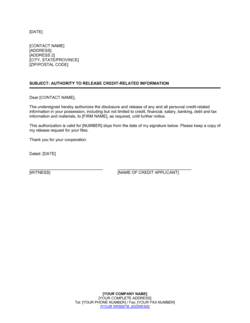
Set the validity period and expiry date
Enter a start date and a specific calendar expiry date. For most routine purposes, 60–90 days is sufficient. For ongoing legal proceedings, extend to 180 days and note that a fresh authorization will be required for any disclosure after that date.
💡 Never leave the expiry field blank. Most institutions will either reject a form without an expiry or apply their own internal default — which may be far longer than intended.
7
Sign and date the form
The account holder signs and dates in the designated block. If someone is signing on behalf of the account holder — as trustee, attorney-in-fact, or authorized corporate officer — attach the relevant supporting document (power of attorney, corporate resolution) to the form.
💡 For mortgage applications and legal proceedings, some institutions require a wet signature or a notarized copy — confirm the institution's specific requirements before submitting.
8
Submit to the institution and retain a copy
Send the signed form directly to the releasing institution's compliance, legal, or customer service department — not just to your branch contact. Request a written confirmation of receipt and retain a copy for your records.
💡 Follow up within 3 business days if no confirmation is received. Unanswered authorization requests are a common source of delay in time-sensitive transactions like loan closings.