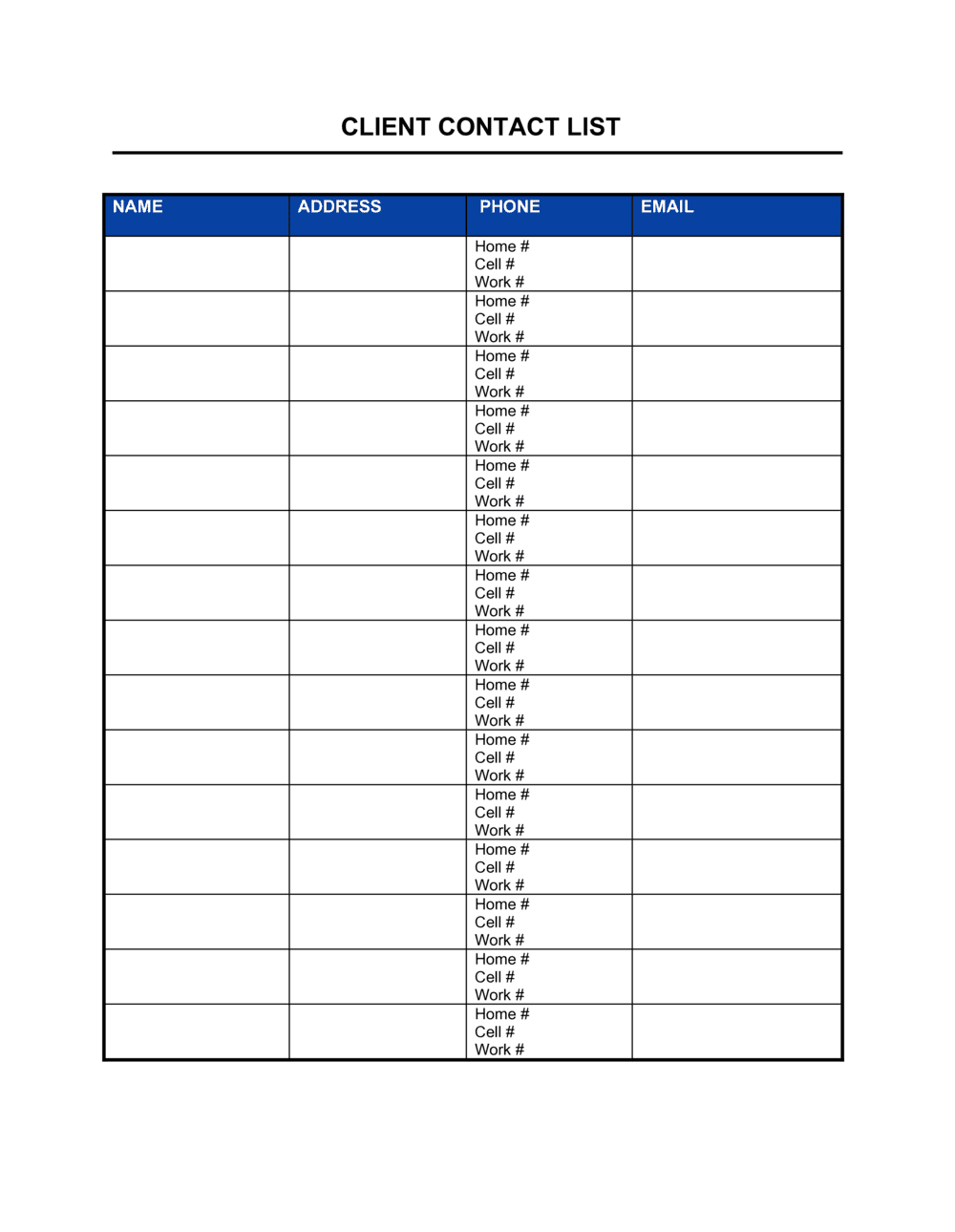
Client Contact List Template

Free Word download β€’ Edit online β€’ Save & share with Drive β€’ Export to PDF

1 pageβ€’20–30 min to fillβ€’Difficulty: Standardβ€’Signature requiredβ€’Legal review recommended
Learn more ↓
FreeClient Contact List Template

At a glance

What it is
A Client Contact List is a structured document that records and organizes essential identifying and communication information for each client or customer a business maintains a relationship with. This free Word download gives you a ready-to-use template you can edit online, populate with client data, and export as PDF for internal use, compliance audits, or secure storage β€” covering contact details, communication preferences, and data handling consent in a single organized record.
When you need it
Use it when onboarding new clients, when your business is subject to data protection regulations that require documented consent for storing personal information, or when your team needs a centralized and compliant reference for client communication across projects and accounts.
What's inside
Client identification fields, primary and secondary contact details, preferred communication channels, relationship owner assignment, data consent and privacy acknowledgment, and notes on engagement history or account status. Together these fields ensure your team can reach the right person through the right channel with proper authorization at every stage of the client relationship.

What is a Client Contact List?

A Client Contact List is a structured business and compliance document that records the identifying information, communication details, data consent, and account status for every client or customer a business maintains a relationship with. Beyond functioning as a simple address book, a properly constructed client contact list documents the lawful basis on which personal data is stored, who within the organization may access it, how long it will be retained, and how updates to the record are logged over time. In jurisdictions with active data protection frameworks β€” including the EU, UK, Canada, and an increasing number of US states β€” maintaining this kind of documented, consent-backed record is not optional. It is the baseline evidence a business needs to demonstrate compliance when regulators, clients, or auditors ask how personal information is handled.

Why You Need This Document

Without a documented client contact list that includes a signed consent and privacy acknowledgment, your business is simultaneously exposed to operational failure and regulatory risk. On the operational side, undocumented or inconsistently formatted contact records mean the wrong person gets called at the wrong time, renewal notices go to a departed employee, and escalations have nowhere to go when your primary contact is unavailable. On the compliance side, storing personal contact information β€” even something as routine as an email address and phone number β€” without a recorded lawful basis is a violation under GDPR, PIPEDA, and the CCPA. A single data breach involving records with no documented consent basis removes your ability to demonstrate you met the standard of care, and supervisory authorities treat the absence of records as evidence of systemic non-compliance rather than an isolated oversight. This template gives you a single document that closes both gaps: an organized, access-controlled contact record your team can rely on day-to-day, and a signed consent and retention clause that satisfies the documentation requirements of every major privacy framework. For the 15 to 30 minutes it takes to complete a record per client, the protection it provides against a regulatory inquiry or a client dispute is disproportionately large.

Which variant fits your situation?

If your situation is…Use this template
Tracking contact details for active paying clients onlyClient Contact List
Managing prospects and leads through a sales pipelineSales Lead Tracker
Recording vendor and supplier contact informationVendor Contact List
Maintaining employee emergency and internal contact recordsEmployee Contact List
Documenting client onboarding details alongside contact dataClient Onboarding Form
Capturing detailed client intake information for a professional services firmClient Information Sheet
Storing client data as part of a broader CRM or account planAccount Management Plan

Common mistakes to avoid

❌ Storing personal data without a documented consent basis

Why it matters: Under GDPR, PIPEDA, and similar frameworks, processing personal data without a recorded lawful basis is a regulatory violation regardless of whether the client was harmed. Fines can reach €20 million or 4% of global annual turnover under GDPR.

Fix: Add a data consent clause to every client contact record and obtain a dated signature or verifiable digital acknowledgment before storing any personal information.

❌ Recording only a generic company email as the contact

Why it matters: When the client relationship requires urgent attention β€” a missed payment, a scope dispute, or a contract renewal β€” a generic inbox like info@ or accounts@ can sit unmonitored for days.

Fix: Always record a named individual with a direct email and phone number. Supplement with a generic inbox only as a secondary field.

❌ Setting no retention period and keeping client data indefinitely

Why it matters: Indefinite retention violates the storage limitation principle in GDPR and similar laws, and substantially increases liability exposure if the data is compromised in a breach years after the client relationship ended.

Fix: Define a specific retention period β€” typically the duration of the contract plus 2–7 years depending on jurisdiction and record type β€” and schedule a documented review at expiry.

❌ Granting unrestricted internal access to client contact records

Why it matters: Privacy laws require that personal data be accessed only by personnel who need it to perform their role. Broad access increases breach risk and will fail a regulatory audit under the minimum-necessary standard.

Fix: Restrict access to the relationship owner, their backup, and any team members with an active role on the account. Document who has access and review the list at least annually.

❌ Overwriting contact details without logging the previous values

Why it matters: When a client raises a privacy complaint or disputes a communication, an unlogged record provides no evidence of what data was held, when it changed, or who changed it.

Fix: Use the amendment and update record section to log every change with the employee name, date, old value, and new value before overwriting any field.

❌ Failing to update the relationship owner when staff changes occur

Why it matters: An outdated relationship owner assignment means the client has no active internal point of contact, and critical communications β€” renewal notices, invoices, escalations β€” go unmanaged.

Fix: Build a staff-offboarding checklist that includes a mandatory step to reassign all client contact records before an employee's departure date.

The 10 key clauses, explained

Client identification

In plain language: Records the client's full legal name or trading name, registered address, and any unique account or client identifier assigned by the business.

Sample language
Client Legal Name: [CLIENT FULL LEGAL NAME] | Trading Name (if different): [TRADING NAME] | Client ID: [ACCOUNT NUMBER] | Registered Address: [ADDRESS LINE 1], [CITY], [STATE/PROVINCE], [POSTAL CODE], [COUNTRY]

Common mistake: Using a contact person's name instead of the client's legal entity name. This creates mismatches with invoices and contracts, making records hard to reconcile during audits or disputes.

Primary contact details

In plain language: Captures the name, title, direct phone number, and email address of the person who handles day-to-day communication on behalf of the client.

Sample language
Primary Contact Name: [FIRST NAME] [LAST NAME] | Title: [JOB TITLE] | Direct Phone: [+X (XXX) XXX-XXXX] | Email: [EMAIL ADDRESS] | LinkedIn (optional): [PROFILE URL]

Common mistake: Recording only a generic company email (e.g., info@client.com) without a named individual. When the relationship needs urgent attention, there is no specific person to contact.

Secondary and escalation contacts

In plain language: Lists one or two backup contacts β€” such as a finance manager or operations lead β€” who should be reached when the primary contact is unavailable or when escalation is required.

Sample language
Secondary Contact Name: [FIRST NAME] [LAST NAME] | Title: [JOB TITLE] | Phone: [NUMBER] | Email: [EMAIL ADDRESS] | Escalation Contact: [NAME], [TITLE], [EMAIL]

Common mistake: Leaving the escalation contact field blank. When a primary contact leaves the client organization unexpectedly, there is no documented fallback and the business relationship stalls.

Communication preferences

In plain language: Documents the client's preferred method of contact (email, phone, video call, in-person), preferred days and times, and any communication restrictions or requirements.

Sample language
Preferred Contact Method: [EMAIL / PHONE / VIDEO CALL / IN-PERSON] | Preferred Contact Times: [TIME WINDOW, TIMEZONE] | Communication Restrictions: [E.G., NO CALLS BEFORE 9AM ET] | Language Preference: [LANGUAGE]

Common mistake: Omitting the time zone alongside preferred contact hours. Calling a client two hours outside their stated window because of a time zone error damages trust and can violate contractual service commitments.

Relationship owner and account team

In plain language: Identifies the internal employee responsible for the client relationship and lists any other team members with active access to the account.

Sample language
Relationship Owner: [EMPLOYEE FULL NAME], [TITLE] | Backup Owner: [EMPLOYEE FULL NAME] | Account Team Members: [NAME, ROLE]; [NAME, ROLE] | Date Assigned: [DATE]

Common mistake: Assigning a single relationship owner with no backup. If that employee is out of office or leaves the company, the client has no documented internal point of contact.

Data consent and privacy acknowledgment

In plain language: Records the client's agreement to the storage and use of their personal information, the stated purpose of processing, and the date and method of consent collection.

Sample language
The client acknowledges that [COMPANY NAME] will collect and store personal contact information for the purpose of [SERVICE DELIVERY / INVOICING / COMMUNICATIONS]. Consent provided by: [NAME], [TITLE], on [DATE] via [METHOD β€” email confirmation / signed form / online portal].

Common mistake: Storing client personal data without any documented consent basis. Under GDPR and similar laws, processing personal data without a recorded lawful basis can result in regulatory fines regardless of whether harm occurred.

Data retention and deletion terms

In plain language: States how long the client's contact information will be retained, what triggers a review or deletion, and how the data will be securely disposed of at the end of the retention period.

Sample language
Client contact data will be retained for [X] years from the date of last active engagement or until the client submits a written deletion request. Upon expiry, data will be [DELETED / ANONYMIZED] in accordance with [COMPANY NAME]'s data retention policy dated [DATE].

Common mistake: Setting no retention period at all and keeping client data indefinitely. Unlimited retention is a compliance violation in most privacy jurisdictions and increases liability exposure in the event of a data breach.

Access control and confidentiality

In plain language: Restricts who within the business may access the client contact record and obligates those with access to treat the information as confidential.

Sample language
Access to this record is restricted to [ROLE / DEPARTMENT / NAMED INDIVIDUALS]. All personnel with access agree to maintain the confidentiality of the client's personal information and may not share it with third parties without prior written consent from [CLIENT NAME] or as required by law.

Common mistake: Granting blanket company-wide access to client contact records. Wide access increases the risk of unauthorized disclosure and typically fails the 'minimum necessary' standard required by privacy regulations.

Client status and engagement notes

In plain language: Tracks the current status of the client relationship β€” active, on hold, churned, or prospect β€” and records key dates and notes relevant to the account.

Sample language
Client Status: [ACTIVE / ON HOLD / CHURNED / PROSPECT] | Relationship Start Date: [DATE] | Last Contact Date: [DATE] | Contract Renewal Date: [DATE] | Notes: [FREE TEXT]

Common mistake: Treating the notes field as a substitute for a formal CRM or contract management system. Informal free-text notes are not auditable and create compliance gaps when status changes are not timestamped.

Amendment and update record

In plain language: Logs each update made to the contact record β€” who made the change, what was changed, and when β€” to maintain an auditable history of the data.

Sample language
Record Last Updated By: [EMPLOYEE NAME] | Date of Update: [DATE] | Changes Made: [DESCRIPTION OF CHANGE] | Previous Value: [OLD DATA] | Updated Value: [NEW DATA]

Common mistake: Overwriting old contact details without logging the previous values. When a client disputes communications or raises a privacy complaint, an unlogged record offers no evidence of what data was held or when it changed.

How to fill it out

  1. 1

    Enter the client's legal entity name and account ID

    Record the client's full registered legal name β€” not a nickname or trading name unless the trading name is also noted separately. Assign a unique client ID that matches your invoicing and contract management system.

    πŸ’‘ Cross-check the legal name against the signed service agreement or invoice before entering it to avoid mismatches in your accounting records.

  2. 2

    Capture primary contact details with a named individual

    Enter the full name, job title, direct phone number, and business email of the person who handles day-to-day communication. Avoid generic inboxes as the sole contact.

    πŸ’‘ Ask the client to confirm the primary contact at the start of each engagement β€” organizational changes are common and outdated contacts are one of the most frequent sources of communication failures.

  3. 3

    Add secondary and escalation contacts

    Record at least one backup contact and one escalation contact with their names, titles, and direct communication details. These should be real people, not departments.

    πŸ’‘ For enterprise clients, the escalation contact is often a VP or C-suite executive β€” confirm they have agreed to be listed before adding them.

  4. 4

    Document communication preferences and restrictions

    Ask the client directly about preferred contact methods, best times to reach them, and any communication restrictions. Record the client's time zone explicitly alongside any time-based preferences.

    πŸ’‘ Some clients β€” particularly in regulated industries like healthcare or finance β€” have specific instructions about which channels may be used for sensitive information. Capture these restrictions in this field.

  5. 5

    Assign a relationship owner and list account team members

    Name the internal employee responsible for the account and list any others with active access. Include a backup owner so the record is always actionable.

    πŸ’‘ Review and update the relationship owner field any time there is a staff change β€” an outdated owner assignment is one of the most common causes of dropped client communication.

  6. 6

    Record data consent with the method and date

    Document when and how the client consented to their data being stored β€” whether via a signed form, email confirmation, or online checkbox. Include the stated purpose of processing at the time consent was given.

    πŸ’‘ Keep the original consent artifact (email, signed document, or portal log) linked to or filed alongside this record. The record alone is not sufficient evidence of consent if the method cannot be verified.

  7. 7

    Set a data retention period and review date

    Enter the retention period based on your company's data retention policy and applicable privacy law. Set a calendar reminder for the review date so the record is assessed or deleted on schedule.

    πŸ’‘ For clients in the EU or UK, the retention period should align with the minimum necessary to fulfill the stated purpose β€” keeping data 'just in case' is not a valid basis under GDPR.

  8. 8

    Obtain the client's signature and file the completed record

    Have the client sign the data consent and privacy acknowledgment section before storing their information. File the completed record in a secure, access-controlled location and log the creation date.

    πŸ’‘ Use Business in a Box eSign to timestamp execution and store the signed copy with the client file so it is retrievable during a privacy audit without delay.

Frequently asked questions

What is a client contact list?

A client contact list is a structured document that records the identifying and communication information for every client or customer a business maintains a relationship with. It typically includes the client's legal name, primary and secondary contact details, communication preferences, data consent acknowledgment, and account status. In a legal and compliance context, it also documents the basis on which personal data is stored and the retention period that applies.

How long should I keep client contact records?

Retention periods depend on the applicable privacy law and the purpose of the data. A common approach for service businesses is to retain client contact records for the duration of the contract plus 3–7 years to satisfy potential legal claims, tax requirements, and contract dispute windows. Under GDPR, data should be kept only as long as necessary for the stated purpose. Set a specific expiry date in the record and review it when the client relationship ends.

What is the difference between a client contact list and a CRM?

A client contact list is a structured document β€” typically a Word or Excel file β€” that records core contact and consent information in a portable, auditable format. A CRM (Customer Relationship Management) system is software that stores the same data alongside interaction history, pipeline stages, and automated workflows. A contact list is suitable for small businesses and compliance documentation; a CRM is more appropriate for teams managing large volumes of accounts. Both should reflect the same underlying data standards for consent and retention.

Who should have access to our client contact list?

Access should be limited to employees who need the information to perform their role β€” typically the relationship owner, their backup, and active account team members. Privacy laws including GDPR require a minimum-necessary approach to data access. Granting company-wide access to a list containing personal contact details is both a compliance risk and a security risk. Access rights should be reviewed whenever team membership changes.

What happens if client contact data is breached?

A data breach involving personal contact information triggers notification obligations in most jurisdictions. Under GDPR, you must notify the relevant supervisory authority within 72 hours if the breach is likely to result in risk to individuals, and notify affected data subjects without undue delay if the risk is high. In Canada, PIPEDA requires breach notification when there is a real risk of significant harm. US obligations vary by state. Having documented consent records and an access log substantially reduces regulatory liability after a breach.

Should clients sign the contact list?

Clients should sign or provide a verifiable acknowledgment of the data consent and privacy section, which documents their agreement to the storage and use of their personal information for the stated purpose. A signature on the full contact list is not always required, but a signed or timestamped consent record is strongly recommended for compliance in regulated jurisdictions. Use a consistent method β€” signed form, email confirmation, or digital acknowledgment β€” and retain the evidence alongside the record.

Can I use a spreadsheet instead of this template?

A spreadsheet can hold the same data fields, but it typically lacks the consent acknowledgment, privacy terms, access control notation, and amendment log that make a client contact list legally defensible. A structured Word template with a signature block provides a cleaner audit trail and is easier to share with a single client for their review and consent. For large volumes of clients, a spreadsheet or CRM populated using this template's field structure is a practical hybrid approach.

How this compares to alternatives

vs Client Onboarding Form

A client onboarding form captures information during the initial intake process β€” scope, service preferences, billing details, and background β€” to set up a new engagement. A client contact list is an ongoing record of communication details and data consent maintained throughout the relationship. The onboarding form feeds the contact list; they serve different phases of the client lifecycle.

vs Non-Disclosure Agreement (NDA)

An NDA governs the confidentiality of business information exchanged between parties and creates legal obligations around non-disclosure. A client contact list governs the storage and use of the client's personal contact data by the business. Both protect sensitive information, but an NDA is a bilateral contract while a contact list is primarily an internal compliance record with a client-signed consent section.

vs Service Agreement

A service agreement defines the scope, fees, deliverables, and terms of a business engagement between provider and client. A client contact list is not a commercial agreement β€” it is an operational and compliance record. The service agreement may reference the client's data processing terms, but it does not substitute for a separate contact record with documented consent.

vs Client Information Sheet

A client information sheet is a single-client intake form capturing background, preferences, and business details at the start of a relationship. A client contact list is a multi-client master record designed for ongoing management, access control, and compliance auditing across the full client portfolio. Use an information sheet for individual onboarding and a contact list for portfolio-level management and privacy compliance.

Industry-specific considerations

Professional Services

Law firms, accountants, and consultancies store client PII under strict professional confidentiality obligations, making documented consent and restricted access critical to bar association and regulatory compliance.

Healthcare

Patient and client contact records intersect with HIPAA in the US and equivalent health-data regulations elsewhere, requiring explicit consent for each communication purpose and strict retention and deletion schedules.

Financial Services

FCA, SEC, and FINRA-regulated firms must maintain auditable client records and document communication preferences to satisfy know-your-client (KYC) and suitability requirements alongside privacy law.

Marketing and Advertising Agencies

Agencies managing client contact data for campaign purposes must document consent for each communication channel β€” email, SMS, paid retargeting β€” separately to comply with CAN-SPAM, CASL, and GDPR requirements.

Real Estate

Agents and brokers handle buyer, seller, and tenant contact information across long transaction timelines, requiring clear retention periods and client-by-client consent records that survive agent turnover.

Retail and E-commerce

Customer contact records underpin loyalty programs, post-purchase follow-up, and marketing automation, all of which require a documented lawful basis under GDPR and CCPA to avoid regulatory action.

Jurisdictional notes

United States

There is no single federal privacy law governing client contact data in the US. The California Consumer Privacy Act (CCPA) and its amendment, the CPRA, impose consent, disclosure, and deletion rights for California residents. Several other states β€” including Virginia, Colorado, and Connecticut β€” have enacted similar laws. Businesses operating nationally should use a consent clause that meets California's standard as the practical baseline.

Canada

PIPEDA (Personal Information Protection and Electronic Documents Act) requires meaningful consent for the collection, use, and disclosure of personal information in commercial activities. Quebec's Law 25 (Bill 64) imposes additional requirements, including privacy impact assessments and stricter consent standards that took effect in 2023. Clients must be informed of the purpose of data collection at or before the time of collection.

United Kingdom

The UK GDPR and Data Protection Act 2018 govern personal data processing in the UK following Brexit. The lawful basis for processing must be documented, and data subjects have rights including access, rectification, and erasure. The ICO (Information Commissioner's Office) can impose fines of up to Β£17.5 million or 4% of global annual turnover for serious violations. Retention periods must be defined and justifiable.

European Union

GDPR imposes strict requirements on recording, processing, and retaining personal contact data. Consent must be freely given, specific, informed, and unambiguous, and data subjects have the right to withdraw consent at any time. Fines reach €20 million or 4% of global annual turnover. Member states may layer additional requirements β€” Germany and France, for example, impose sector-specific rules for certain professional relationships. Data transfers outside the EU require adequate safeguards.

Template vs lawyer β€” what fits your deal?

PathBest forCostTime
Use the templateSmall businesses and freelancers managing a limited client base in a single jurisdictionFree15–30 minutes per client record
Template + legal reviewBusinesses handling EU, UK, or Canadian client data, or operating in regulated industries such as healthcare or financial services$300–$800 for a privacy counsel review of the consent and retention clauses3–5 business days
Custom draftedEnterprises processing high volumes of personal data across multiple jurisdictions, or businesses subject to sector-specific data regulations requiring a bespoke data processing agreement$1,500–$5,000+2–4 weeks

Glossary

Data Subject
An identified or identifiable natural person whose personal data is recorded and processed β€” in this context, the client whose contact information is stored.
Data Controller
The business or individual that determines the purposes and means of processing personal data, and bears primary compliance responsibility under privacy law.
Lawful Basis for Processing
The legal justification under data protection law β€” such as consent, contract performance, or legitimate interest β€” that permits a business to collect and store personal data.
Consent
A freely given, specific, informed, and unambiguous indication by the data subject that they agree to their personal data being processed for a stated purpose.
Data Retention Policy
A documented rule specifying how long personal data is kept and the process for securely deleting or anonymizing it once that period expires.
Personal Identifiable Information (PII)
Any information that can be used alone or in combination with other data to identify a specific individual, such as name, email address, phone number, or physical address.
Primary Contact
The individual at a client organization who is the designated first point of contact for day-to-day communication with the service provider.
Relationship Owner
The internal employee or account manager responsible for managing the client relationship and keeping the contact record current.
Opt-Out
A mechanism allowing the data subject to withdraw consent for specific types of communication or data processing at any time without penalty.
Data Breach Notification
The legal obligation to inform affected individuals and, in many jurisdictions, the relevant supervisory authority within a defined timeframe when personal data is compromised.
Right to Erasure
A data subject's right β€” codified in GDPR and similar laws β€” to request that their personal information be permanently deleted from a business's records.

Part of your Business Operating System

This document is one of 3,000+ business & legal templates included in Business in a Box.

  • Fill-in-the-blanks β€” ready in minutes
  • 100% customizable Word document
  • Compatible with all office suites
  • Export to PDF and share electronically

Create your document in 3 simple steps.

From template to signed document β€” all inside one Business Operating System.
1
Download or open template

Access over 3,000+ business and legal templates for any business task, project or initiative.

2
Edit and fill in the blanks with AI

Customize your ready-made business document template and save it in the cloud.

3
Save, Share, Send, Sign

Share your files and folders with your team. Create a space of seamless collaboration.

Save time, save money, and create top-quality documents.

β˜…β˜…β˜…β˜…β˜…

"Fantastic value! I'm not sure how I'd do without it. It's worth its weight in gold and paid back for itself many times."

Managing Director Β· Mall Farm
Robert Whalley
Managing Director, Mall Farm Proprietary Limited
β˜…β˜…β˜…β˜…β˜…

"I have been using Business in a Box for years. It has been the most useful source of templates I have encountered. I recommend it to anyone."

Business Owner Β· 4+ years
Dr Michael John Freestone
Business Owner
β˜…β˜…β˜…β˜…β˜…

"It has been a life saver so many times I have lost count. Business in a Box has saved me so much time and as you know, time is money."

Owner Β· Upstate Web
David G. Moore Jr.
Owner, Upstate Web

Run your business with a system β€” not scattered tools

Stop downloading documents. Start operating with clarity. Business in a Box gives you the Business Operating System used by over 250,000 companies worldwide to structure, run, and grow their business.

Free Forever PlanΒ Β·Β No credit card required