Commission List Template

Free Word download • Edit online • Save & share with Drive • Export to PDF

1 page20–30 min to fillDifficulty: StandardSignature requiredLegal review recommended
Learn more ↓
FreeCommission List Template

At a glance

What it is
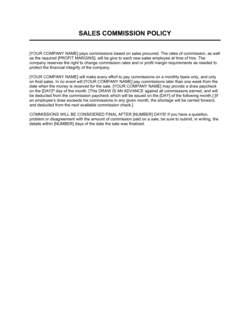
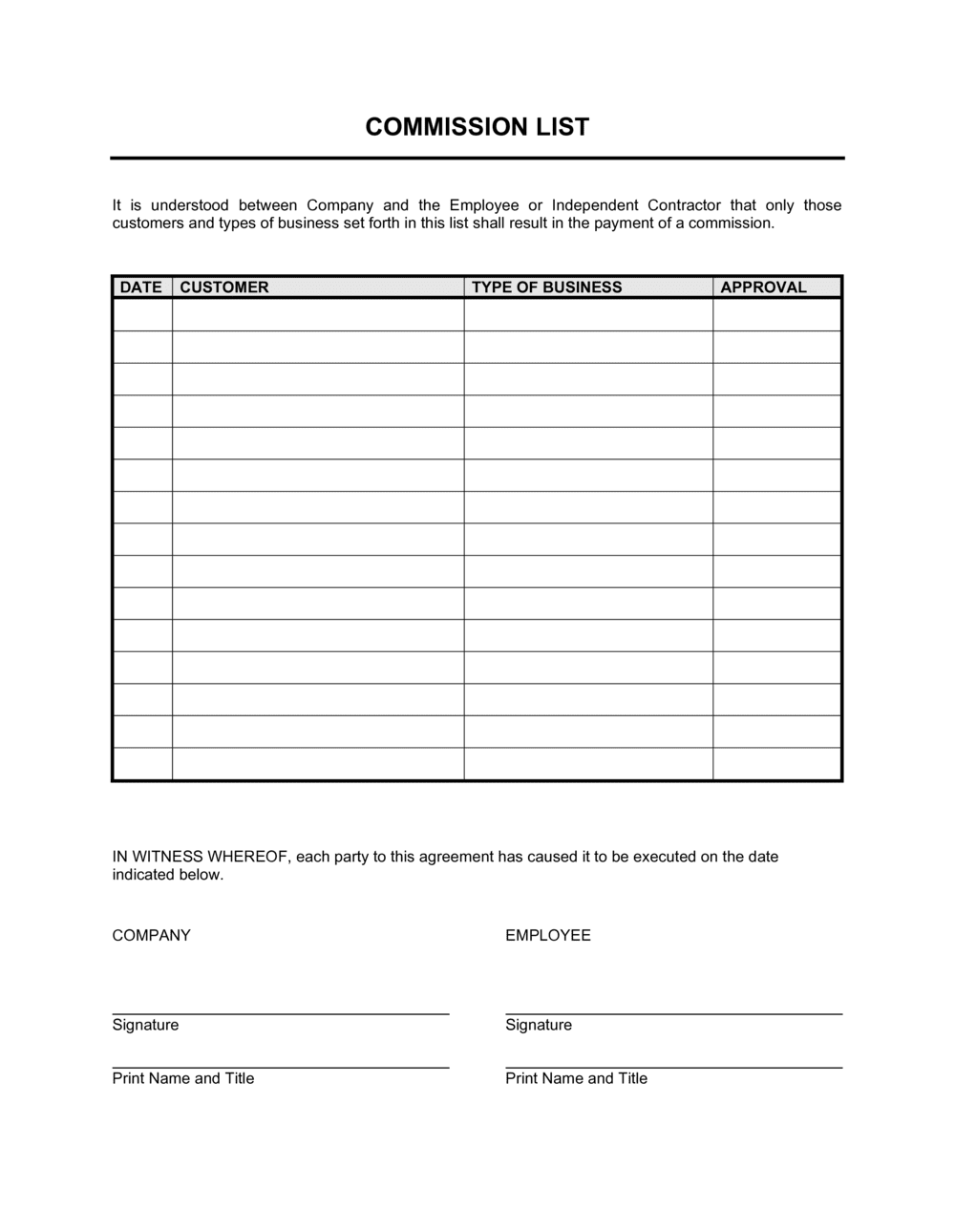
A Commission List is a legally binding schedule that defines the exact commission rates, calculation methods, payment timing, and qualifying conditions applied to each salesperson, agent, or broker in a compensation arrangement. This free Word download lets you define tiered or flat rates by product line or territory, attach it to an employment or agency agreement, and export as PDF for signature in minutes.
When you need it
Use it when onboarding a new sales representative, updating commission structures at the start of a fiscal year, or formalizing verbal pay arrangements before a dispute arises. Any business that compensates people based on revenue they generate needs a signed commission list on file.
What's inside
Parties and effective date, defined product or service categories, per-unit or percentage commission rates, tiered volume thresholds, payment calculation basis (gross vs. net revenue), payment schedule and trigger events, clawback and chargeback conditions, cap provisions, and governing law.

What is a Commission List?

A Commission List is a legally binding schedule that defines the exact commission rates, calculation basis, payment triggers, and qualifying conditions applied to each salesperson, agent, or broker in a variable-compensation arrangement. It functions as the authoritative written record of how variable pay is calculated — specifying whether rates apply to gross or net revenue, how tiered thresholds work, when commissions become earned, and under what circumstances they can be recovered. Commission lists are typically executed as standalone documents or attached as exhibits to employment agreements, independent contractor agreements, or agency contracts, allowing rates to be updated without redrafting the underlying relationship document.

Why You Need This Document

Without a signed commission list, every variable-pay arrangement runs on undocumented assumptions — and assumptions become disputes the moment a deal cancels, a representative leaves, or a rate change is communicated verbally. In most US states and Canadian provinces, earned commissions are classified as wages, meaning a company that fails to pay them on time or retroactively reduces them faces the same legal exposure as withholding salary. A salesperson who claims they were promised a higher rate, or that their post-termination deals should still be paid, has significant legal leverage in the absence of clear written terms. A properly executed commission list eliminates this exposure by documenting every material term before the first qualifying sale — protecting the company from wage claims, protecting the representative from unilateral changes, and giving both sides a single source of truth when disputes arise. This template gives you a structured, editable starting point that covers every standard provision, so you spend your time on the numbers, not the legal framework.

Which variant fits your situation?

If your situation is…Use this template
Compensating a W-2 employee with a base salary plus commissionSales Commission Agreement (Employee)
Engaging an independent contractor on a commission-only basisIndependent Sales Representative Agreement
Setting commission rates for a real estate agent or brokerReal Estate Commission Agreement
Paying referral fees to partners or affiliates for leadsReferral Fee Agreement
Compensating insurance agents on policy premiums writtenInsurance Agent Commission Schedule
Defining multi-level override commissions for a sales managerSales Manager Compensation Plan
Attaching a commission schedule to an existing distribution agreementDistribution Agreement with Commission Schedule

Common mistakes to avoid

❌ Omitting the commission calculation basis

Why it matters: Without specifying gross vs. net revenue, both parties apply different denominators — a disagreement of 20–40% per deal is common and routinely ends in litigation or a departing rep.

Fix: Define the exact revenue figure used and list every deduction that converts gross to net in the same clause. Leave no term undefined.

❌ No exclusions list

Why it matters: A commission list that only enumerates qualifying deals leaves every edge case open to interpretation. Salespeople will claim commission on renewals, cross-sells, and deals they were only tangentially involved in.

Fix: Add an explicit exclusions section listing all deal types, product lines, or channels that do not generate commission, regardless of who was involved.

❌ Unlimited clawback period

Why it matters: An open-ended clawback creates indefinite financial liability for the representative. Courts in California, New York, and Illinois have found uncapped clawbacks unconscionable and unenforceable.

Fix: Cap clawback lookback at 12 months and limit recovery to offset against future commissions rather than demanding cash repayment.

❌ No post-termination commission clause

Why it matters: Without it, departing representatives argue they are owed commission on every deal they ever introduced, including deals that close years later — a common-law quantum meruit claim that is expensive to defend.

Fix: Include a defined post-termination window of 30–90 days, limited to transactions where the customer invoice was already issued before the termination date.

❌ Retroactive amendments with no notice period

Why it matters: Changing commission rates without notice and applying them to deals already in progress is treated as an illegal wage reduction in many US states, exposing the company to back-pay claims and penalties.

Fix: Require 30 days' written notice for any rate change and specify that amendments apply only to transactions occurring after the notice period expires.

❌ Signing after the first qualifying sale

Why it matters: In common-law jurisdictions, a commission schedule signed retroactively may not be enforceable on prior deals without documented fresh consideration — the representative gave nothing new in exchange for agreeing to the terms.

Fix: Always execute the commission list before any transaction that could generate a commission. If timing is unavoidable, provide a documented additional benefit — a signing bonus or rate increase — as consideration.

The 10 key clauses, explained

Parties and effective date

In plain language: Identifies the company paying commission and the salesperson or agent receiving it, and states the date from which the schedule applies.

Sample language
This Commission List is entered into as of [EFFECTIVE DATE] between [COMPANY LEGAL NAME], a [STATE] [ENTITY TYPE] ('Company'), and [SALESPERSON / AGENT FULL NAME] ('Representative').

Common mistake: Using a trade name instead of the registered legal entity. Enforcement actions and tax filings require the exact corporate name, and a mismatch can complicate wage claims or 1099 filings.

Defined product and service categories

In plain language: Lists every product line, service tier, or deal type that qualifies for commission and explicitly excludes anything that does not.

Sample language
Commission applies to sales of the following products and services: [PRODUCT/SERVICE CATEGORY A], [PRODUCT/SERVICE CATEGORY B]. The following are excluded: [EXCLUDED ITEM], renewals negotiated by the Company's customer success team, and government procurement contracts.

Common mistake: Failing to list exclusions. If the document only enumerates what qualifies, salespeople will argue commissions on every unlisted item, creating disputes on edge cases.

Commission rates and calculation basis

In plain language: States the specific percentage or flat rate for each product or service category and defines the revenue figure (gross, net, or gross profit) on which it is calculated.

Sample language
Representative shall earn commission at the rates set out below, calculated on Net Revenue (defined as gross invoice value less returns, chargebacks, and applicable sales taxes): [PRODUCT A]: [X]% | [PRODUCT B]: [Y]% | [PRODUCT C]: $[Z] per unit sold.

Common mistake: Defining rates without specifying the calculation basis. Whether commission is on gross or net revenue can shift earnings by 20–40% and is the single most litigated term in commission disputes.

Tiered volume thresholds and accelerators

In plain language: Defines the sales volume levels at which the commission rate increases, and the higher accelerated rate that applies once each threshold is crossed.

Sample language
Monthly Net Revenue Threshold: $0–$[AMOUNT A]: [X]% | $[AMOUNT A+1]–$[AMOUNT B]: [Y]% | Above $[AMOUNT B]: [Z]%. Accelerator rates apply prospectively from the month in which the threshold is reached.

Common mistake: Not specifying whether accelerator rates apply retroactively to all sales in the period or only prospectively to sales above the threshold. This distinction can mean thousands of dollars of difference per month.

Commission payment trigger and schedule

In plain language: States what event causes commission to become earned (e.g., invoice paid, contract signed, or goods shipped) and when the company will remit payment.

Sample language
Commission becomes earned when full payment of the corresponding invoice is received by Company. Earned commissions shall be paid on the [15th] day of the calendar month following the month in which payment was received, via [ACH / check / wire].

Common mistake: Defining the trigger as 'when the sale closes' rather than 'when payment is received.' Booking a deal that later cancels or defaults can leave the company paying commission on revenue it never collected.

Clawback and chargeback conditions

In plain language: Specifies the circumstances under which the company may recover previously paid commission, including customer cancellations, returns, and credit defaults.

Sample language
If a customer cancels an order, returns goods, or fails to pay within [90] days of invoice, any commission paid on that transaction shall be recouped by Company from the Representative's next commission payment or invoiced as a debt. Clawbacks are limited to commissions paid within [12] months of the triggering event.

Common mistake: No time limit on clawbacks. An uncapped clawback period creates indefinite liability for the salesperson and has been challenged successfully as unconscionable in several US states.

Draw against commission

In plain language: Sets out any advance payment made to the representative before commissions are earned, and the repayment terms if earned commissions do not cover the draw.

Sample language
Company shall advance Representative a draw of $[AMOUNT] per [week / month] ('Draw'). If total earned commissions in any [period] are less than the Draw paid, the deficit shall carry forward as a recoverable advance and be offset against future commission payments.

Common mistake: Guaranteeing the draw without a clear offset mechanism. Courts in some jurisdictions treat an unrecouped draw as wages owed, making recovery difficult without explicit contractual language.

Commission cap

In plain language: States the maximum commission a representative can earn in a given period, and whether any earnings above the cap are forfeited, deferred, or converted to a bonus.

Sample language
Total commission earned by Representative shall not exceed $[MAXIMUM AMOUNT] per [calendar quarter]. Amounts above the cap are forfeited unless Company, at its sole discretion, elects to pay a supplemental bonus.

Common mistake: Including a cap without explaining what happens to above-cap earnings. Ambiguity creates legal exposure — in several jurisdictions, earned commissions are treated as wages that cannot simply be forfeited.

Termination and post-termination commissions

In plain language: Defines whether commissions on pending deals continue to be paid after the representative's employment or agency relationship ends, and for how long.

Sample language
Upon termination of Representative's engagement for any reason, commissions on sales where the customer invoice was issued prior to the termination date and payment is received within [60] days of termination shall be paid at the applicable rate. No commissions are payable on deals closed after the termination date.

Common mistake: No post-termination provision at all. Without it, representatives argue entitlement to commissions on any deal they 'introduced' — even years after departure — citing common-law quantum meruit claims.

Governing law and amendment process

In plain language: Specifies which jurisdiction's law governs the document and how the commission schedule can be changed, including required notice periods.

Sample language
This Commission List is governed by the laws of [STATE / PROVINCE / COUNTRY]. Company may amend the commission rates in Schedule A with [30] days' written notice to Representative. Amendments do not affect commissions already earned on closed transactions.

Common mistake: Allowing immediate unilateral amendments with no notice period. Several states treat a commission schedule change applied retroactively to existing deals as an illegal wage reduction.

How to fill it out

  1. 1

    Identify parties and set the effective date

    Enter the company's full registered legal name, entity type, and state of formation. Enter the representative's full legal name and whether they are an employee or independent contractor. Set the effective date — the date from which these rates apply.

    💡 The employee vs. contractor distinction is not just a label here — it affects tax withholding, benefits entitlement, and which wage-and-hour laws govern the commission.

  2. 2

    Define the qualifying product and service categories

    List every product, service tier, or deal type that earns commission. Then add an explicit exclusions list for items that do not qualify — renewals handled by customer success, internal transfers, or government contracts, for example.

    💡 Be more specific than 'all products sold.' Sales teams are creative — if you haven't named an exclusion, expect a commission claim on it.

  3. 3

    Set commission rates and specify the calculation basis

    Enter the percentage or flat rate for each category and state clearly whether it is calculated on gross revenue, net revenue after returns, or gross profit. Use a table format for readability.

    💡 If you use net revenue, define every deduction that reduces gross to net in the same clause — shipping, taxes, discounts, chargebacks. Ambiguity here is the most common source of disputes.

  4. 4

    Add tiered thresholds and accelerators if applicable

    Define each volume tier by dollar amount or unit count and the corresponding rate. Specify explicitly whether accelerated rates apply to all sales in the period (retroactive) or only to sales above the threshold (prospective).

    💡 Retroactive tiers are a stronger motivator but cost more. Model both approaches in a spreadsheet before committing — the difference can be material at high performance levels.

  5. 5

    Define the payment trigger and schedule

    State the event that makes a commission 'earned' (typically full customer payment received) and the remittance date — for example, the 15th of the following month. Include the payment method.

    💡 Aligning the trigger to customer payment receipt protects cash flow. If your sales cycle is long, consider a partial advance at signing with the balance on payment.

  6. 6

    Draft clawback and draw terms carefully

    Set the conditions for clawback (cancellations, returns, non-payment), the recovery mechanism (offset from future commissions), and the lookback period. If you offer a draw, specify the offset mechanics and what happens to an unrecovered balance at termination.

    💡 Cap the clawback lookback at 12 months. Longer periods are difficult to enforce and create morale problems that hurt retention.

  7. 7

    Address post-termination commission rights

    State clearly how long after termination the representative is entitled to commissions on deals that were in progress. Typical windows are 30–90 days from the termination date, limited to invoices already issued.

    💡 A 60-day post-termination window on invoiced deals is widely accepted and reduces the risk of quantum meruit claims for deals the departing rep introduced.

  8. 8

    Execute before the first qualifying sale

    Both parties must sign before any sale that generates a commission occurs. Have the representative sign and return a dated copy, and store the executed document alongside their employment or agency agreement.

    💡 In common-law jurisdictions, a commission schedule signed after qualifying sales have already occurred may not be enforceable on those prior transactions without separate consideration.

Frequently asked questions

What is a commission list?

A commission list is a formal schedule — typically attached to or incorporated into an employment or agency agreement — that defines the exact rates, calculation methods, payment triggers, and qualifying conditions under which a salesperson, agent, or broker earns compensation. It creates a binding, written record of variable pay terms that both the company and the representative can reference and enforce.

Is a commission list legally binding?

Yes, when properly executed by both parties, a commission list is generally enforceable as a contract in most jurisdictions. It must meet standard contract requirements: offer, acceptance, and consideration (the commission itself). Courts in most US states, Canada, the UK, and the EU treat signed commission schedules as enforceable wage agreements, and many jurisdictions have specific statutes protecting earned commissions as wages.

What should a commission list include?

At minimum: the parties and effective date, a defined list of qualifying products or services, the commission rate and calculation basis (gross or net revenue), the payment trigger event, the payment schedule and method, clawback conditions with a defined lookback period, any cap or accelerator provisions, post-termination commission rights, and governing law. Missing any of these creates gaps that courts fill with defaults typically favorable to the representative.

What is the difference between a commission list and a commission agreement?

A commission agreement is the broader legal document governing the overall relationship — duties, exclusivity, territory, IP ownership, and termination. A commission list is the specific schedule of rates and payment terms, often attached as an exhibit to the agreement. Either document can stand alone, but attaching the list as a schedule to a full agreement gives you the strongest legal foundation and allows you to update rates without redrafting the entire agreement.

How should commission rates be calculated — on gross or net revenue?

Net revenue after deducting returns, chargebacks, discounts, and taxes is the most common basis and the most defensible, because it ties commission to actual revenue the company retains. Gross revenue is simpler but can result in commissions on deals that are ultimately unprofitable. Whichever you choose, define every deduction explicitly in the document — ambiguity about the calculation basis is the leading cause of commission disputes.

Can a company change commission rates mid-year?

In most US states and Canadian provinces, a company can amend commission rates prospectively with adequate written notice — typically 30 days — but cannot retroactively reduce commissions already earned on closed deals. Several states, including California and Illinois, treat earned commissions as wages; reducing them after the fact can constitute illegal wage theft. Always include an amendment clause specifying the notice period and confirming that changes do not affect already-earned amounts.

What is a clawback provision and when is it enforceable?

A clawback provision allows a company to recover commission already paid if the underlying sale is cancelled, the customer returns the goods, or payment is never received. Clawbacks are generally enforceable when they are clearly disclosed in the signed schedule, limited to a defined lookback period (typically 12 months or less), and recovered by offset against future commissions rather than demanded as a cash repayment. Unlimited or retroactive clawbacks have been voided in several jurisdictions as unconscionable.

Are commissions considered wages under employment law?

In most US states, earned commissions are classified as wages under state wage payment statutes, meaning they are subject to the same payment timing and recordkeeping requirements as base salary. California, New York, Illinois, and several other states have specific commission protection statutes. In Canada, commissions are generally treated as earnings under provincial employment standards legislation. In the UK and EU, earned commissions are protected under general wage and commercial agency laws.

Do I need a lawyer to create a commission list?

For straightforward domestic arrangements with a small number of salespeople, a well-structured template is usually sufficient. Consider engaging a lawyer when the representative is a senior executive with material earnings potential, when the arrangement crosses state or national borders, when the role involves regulated industries like real estate, insurance, or securities, or when you are implementing a clawback or draw-against-commission structure that needs to withstand wage-law scrutiny.

How this compares to alternatives

vs Sales commission agreement

A sales commission agreement is the full governing contract covering duties, territory, exclusivity, IP, and termination in addition to rates. A commission list is the rate schedule that plugs into that agreement as an exhibit. Use the full agreement when establishing a new relationship; use a standalone commission list to update rates within an existing arrangement without redrafting the whole contract.

vs Independent contractor agreement

An independent contractor agreement governs the overall engagement terms for a self-employed representative — scope, IP, confidentiality, and termination — but does not detail compensation rates. A commission list defines those rates precisely and should be attached as a schedule to the contractor agreement. Both documents together create a complete, enforceable arrangement.

vs Referral fee agreement

A referral fee agreement pays a one-time or per-lead fee for introducing a prospect, with no expectation of ongoing involvement in the sales process. A commission list compensates a representative who actively sells and closes deals. If your arrangement involves only introductions with no sales role, a referral agreement is the correct document.

vs Distribution agreement

A distribution agreement governs a reseller who buys and resells your product at a margin — the distributor earns their spread on the resale price, not a commission paid by you. A commission list is appropriate when the representative sells on your behalf and you pay them a percentage of the revenue you collect. The distinction matters for tax treatment, pricing control, and legal classification.

Industry-specific considerations

Real estate

Split commissions between listing and buyer's agents, broker override rates, and referral fee schedules tied to transaction close rather than listing.

Insurance

First-year vs. renewal commission rates on policies, chargeback provisions tied to early policy lapse, and state-specific licensing requirements that affect rate structures.

Technology / SaaS

ARR-based commission rates, accelerators above quota, clawback windows tied to customer churn within the first 90 days, and spiff structures for specific product lines.

Wholesale and distribution

Per-unit or percentage-of-invoice commission on product categories, freight and discount exclusions from the calculation basis, and territory-based rate differences.

Jurisdictional notes

United States

Most US states treat earned commissions as wages under state wage payment statutes, meaning they must be paid on time and cannot be retroactively reduced. California (Labor Code §204), Illinois (Sales Representative Act), and New York (Labor Law §191-c) have specific commission protection statutes that impose additional requirements. Non-payment of earned commissions can trigger double-damages and attorney-fee liability in several states. At-will employees may still be entitled to commissions earned before termination even if the schedule is silent.

Canada

Commissions are treated as earnings under provincial Employment Standards Acts and must be paid within the prescribed timeframes — typically within the regular pay period following earning. Ontario and British Columbia require written commission agreements for employees whose pay includes commission. Constructive dismissal claims can arise if commission plan changes materially reduce total compensation without consent. Quebec-based representatives may require French-language versions of all compensation documents.

United Kingdom

The Commercial Agents (Council Directive) Regulations 1993 grant self-employed commercial agents significant statutory rights, including entitlement to commission on transactions procured during the agency and — in some cases — after termination. These rights cannot be contractually waived below the statutory minimum. Employee commission is protected as wages under the Employment Rights Act 1996, and unlawful deductions from wages apply equally to commissions as to base pay.

European Union

EU Directive 86/653/EEC on self-employed commercial agents sets minimum commission entitlements that member states cannot allow parties to contract out of, including post-termination commission rights and indemnity or compensation on termination. Germany, France, and Spain have implemented the Directive with additional national requirements. Employees' commission rights are further protected under national wage legislation. GDPR applies to any personal data processed in managing commission calculations and payments.

Template vs lawyer — what fits your deal?

PathBest forCostTime
Use the templateSmall businesses formalizing standard flat-rate or tiered commission structures for domestic sales employees or agentsFree30 minutes
Template + legal reviewArrangements involving draws against commission, multi-tier overrides, or representatives in states with specific commission protection statutes$300–$6001–3 days
Custom draftedSenior executives with material earnings, regulated industries (real estate, insurance, securities), or cross-border agency relationships$1,000–$3,500+1–2 weeks

Glossary

Commission Rate
The percentage or fixed dollar amount paid to a salesperson for each qualifying sale or transaction.
Commission Basis
The revenue figure on which commission is calculated — typically gross revenue, net revenue after returns, or gross profit.
Tiered Commission
A structure where the commission percentage increases once a salesperson reaches defined revenue or unit thresholds within a period.
Clawback
A provision requiring a salesperson to return previously paid commission if the underlying sale is later cancelled, reversed, or the customer defaults.
Draw Against Commission
An advance payment made to a salesperson before commissions are earned, which must be repaid if actual commissions fall short.
Override Commission
A commission paid to a sales manager or team leader based on the sales volume generated by their direct reports.
Accelerator
An increased commission rate that applies after a salesperson exceeds their quota, designed to reward over-performance.
Commission Cap
A maximum commission amount a salesperson can earn in a given period, regardless of total sales volume.
Qualifying Sale
A transaction that meets all defined conditions to generate a commission — such as full payment received, minimum deal size, or approved product category.
Residual Commission
Ongoing commission paid to a salesperson for the life of a recurring contract or subscription, beyond the initial closing period.
Split Commission
A commission divided between two or more salespeople who both contributed to closing the same deal.

Part of your Business Operating System

This document is one of 3,000+ business & legal templates included in Business in a Box.

  • Fill-in-the-blanks — ready in minutes
  • 100% customizable Word document
  • Compatible with all office suites
  • Export to PDF and share electronically

Create your document in 3 simple steps.

From template to signed document — all inside one Business Operating System.
1
Download or open template

Access over 3,000+ business and legal templates for any business task, project or initiative.

2
Edit and fill in the blanks with AI

Customize your ready-made business document template and save it in the cloud.

3
Save, Share, Send, Sign

Share your files and folders with your team. Create a space of seamless collaboration.

Save time, save money, and create top-quality documents.

★★★★★

"Fantastic value! I'm not sure how I'd do without it. It's worth its weight in gold and paid back for itself many times."

Managing Director · Mall Farm
Robert Whalley
Managing Director, Mall Farm Proprietary Limited
★★★★★

"I have been using Business in a Box for years. It has been the most useful source of templates I have encountered. I recommend it to anyone."

Business Owner · 4+ years
Dr Michael John Freestone
Business Owner
★★★★★

"It has been a life saver so many times I have lost count. Business in a Box has saved me so much time and as you know, time is money."

Owner · Upstate Web
David G. Moore Jr.
Owner, Upstate Web

Run your business with a system — not scattered tools

Stop downloading documents. Start operating with clarity. Business in a Box gives you the Business Operating System used by over 250,000 companies worldwide to structure, run, and grow their business.

Free Forever Plan · No credit card required