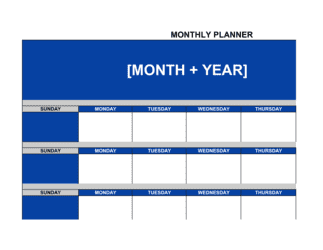
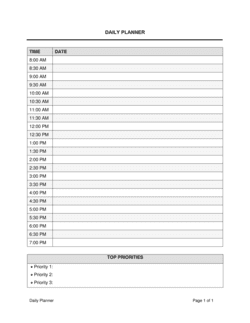
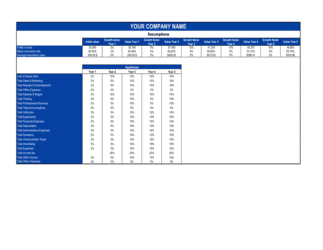
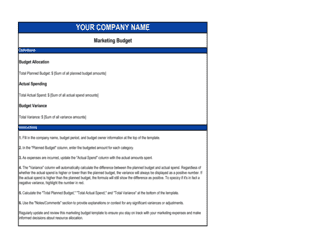
Budget Planner Template

Free Excel download • Use online • Print or share

3 pages25–30 min to useDifficulty: ComplexSignature requiredLegal review recommended
Learn more ↓
FreeXLSBudget Planner Template

At a glance

What it is
A Budget Planner is a structured financial document that records projected income and expenditures across defined categories for a set period, typically a fiscal year or project lifecycle. This free Word download gives you a ready-to-edit framework for capturing revenue assumptions, allocating costs by department or function, tracking variances against actuals, and obtaining formal sign-off from authorized stakeholders. Export as PDF to share with boards, lenders, or department heads.
When you need it
Use it at the start of a fiscal year, before a project kicks off, or whenever a business needs a documented spending authority that all stakeholders have formally approved. It is also required when applying for grant funding, presenting to a board of directors, or establishing spending limits across departments.
What's inside
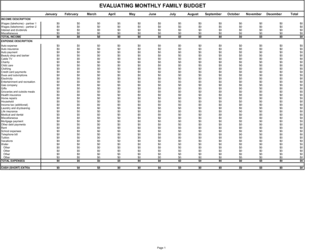
Income projections, fixed and variable expense categories, departmental or cost-center allocations, variance columns for tracking actuals against budget, an approval and authorization block, and notes sections for assumptions and contingency provisions.

What is a Budget Planner?

A Budget Planner is a structured financial governance document that records projected income and expenditures across defined categories for a set period — typically a fiscal year or project lifecycle — and formally authorizes spending up to the limits set within it. Unlike a casual spreadsheet, a properly structured budget planner captures the assumptions behind every figure, assigns accountability to specific cost centers, establishes the variance thresholds that trigger a management review, and collects dated signatures from all authorized approvers to make the plan binding within the organization's governance framework. It functions simultaneously as a financial roadmap and a formal record of delegated spending authority.

Why You Need This Document

Operating without a signed, formal budget planner exposes a business to four compounding risks. First, without defined spending authority, employees and managers make commitments the business cannot track or contain — overruns accumulate silently until a cash crisis makes them visible. Second, banks, grant bodies, and investors routinely require a board-approved budget before releasing funds; an informal spreadsheet will not satisfy that requirement. Third, in the absence of documented variance thresholds, minor overruns go unreported while significant ones fail to trigger the escalation they warrant, eroding financial discipline across every department. Fourth, when disputes arise — with auditors, shareholders, or regulators — a signed budget planner with a clear amendment trail is your primary evidence of what was authorized, by whom, and when. This template gives you the structure to meet governance requirements, satisfy external stakeholders, and maintain real financial control from the first day of the budget period.

Which variant fits your situation?

If your situation is…Use this template
Planning annual income and expenses for a small businessAnnual Business Budget Planner
Tracking costs and spend for a defined project or initiativeProject Budget Template
Allocating spend across multiple departments with separate cost centersDepartmental Budget Plan
Presenting a budget to a board or investors for formal approvalOperating Budget Report
Managing personal or household finances alongside a businessPersonal Budget Planner
Forecasting cash inflows and outflows on a monthly basisCash Flow Forecast Template
Budgeting for a product launch or go-to-market campaignMarketing Budget Template

Common mistakes to avoid

❌ Consolidating all revenue into a single line

Why it matters: A single revenue line makes it impossible to identify which product, service, or channel caused a shortfall when actuals come in below projection.

Fix: Break revenue into at least three to five sources with individual projections and documented assumptions for each.

❌ Setting no variance escalation threshold

Why it matters: Without a defined trigger point, minor overruns accumulate unreported while significant ones fail to prompt timely action, eroding budget discipline across the organization.

Fix: Specify a dollar amount and a percentage — whichever is reached first — that requires a written variance explanation and, if necessary, a formal budget amendment.

❌ Omitting the contingency reserve clause

Why it matters: Every budget encounters unforeseen costs. A budget with no contingency requires a formal amendment for every unexpected expense, slowing operations and signaling poor planning to auditors and boards.

Fix: Allocate a contingency of at least 5% of total projected expenditure and document the conditions under which it can be released.

❌ Mixing capital and operating expenditures in the same category

Why it matters: Misclassifying a CapEx item as OpEx (or vice versa) distorts the income statement, the balance sheet, and the organization's tax position for the full fiscal year.

Fix: Apply your jurisdiction's capitalization threshold consistently. Items above the threshold with a useful life exceeding one year belong on the CapEx schedule, not the operating expense lines.

❌ Collecting only one signature when dual authorization is required

Why it matters: A budget approved outside your governance rules is procedurally invalid. Auditors, boards, and lenders may reject it, requiring a re-approval cycle that delays operations.

Fix: Review your articles of incorporation, bylaws, or board resolutions to confirm the number and seniority of required approvers before routing the document.

❌ Distributing the budget to vendors or external parties without a confidentiality clause

Why it matters: Vendors who see your cost-center allocations know exactly how much you have budgeted for their category — and will price contract renewals accordingly.

Fix: Include an internal-use-only clause and confirm the budget is marked confidential before any distribution outside the organization.

The 10 key clauses, explained

Budget period and scope

In plain language: States the exact start and end dates the budget covers, the legal entity or project it applies to, and any geographical or divisional scope limitations.

Sample language
This Budget Planner covers the fiscal period from [START DATE] to [END DATE] for [ENTITY / DEPARTMENT NAME], operating under [LEGAL ENTITY NAME], a [STATE / PROVINCE / COUNTRY] [ENTITY TYPE].

Common mistake: Omitting the exact end date and writing 'fiscal year 2026' without specifying whether that runs January–December or April–March. The ambiguity creates disputes when budget authority expires mid-year.

Revenue and income projections

In plain language: Records expected income from each source — product sales, service fees, grants, investment income — with the assumptions underpinning each figure.

Sample language
Projected Revenue: [REVENUE SOURCE 1]: $[X]; [REVENUE SOURCE 2]: $[X]. Total Projected Income: $[X]. Assumptions: [DESCRIPTION OF KEY ASSUMPTIONS, e.g., unit volume, average price, conversion rate].

Common mistake: Listing a single consolidated revenue line with no source breakdown. Without itemization, variance analysis is impossible — you cannot identify which revenue stream missed its target.

Fixed expense allocations

In plain language: Lists all non-variable costs committed for the budget period, organized by category, with the annual and monthly amounts and the cost center responsible.

Sample language
Fixed Expenses: Rent — $[X]/month ($[X] annual) — Cost Center: [NAME]; Insurance — $[X]/year — Cost Center: [NAME]; Salaries — $[X]/year — Cost Center: [NAME]. Total Fixed Costs: $[X].

Common mistake: Omitting multi-year contracts that have been signed but not yet billed in the current period. These are committed costs and must appear in the budget even if the invoice has not arrived.

Variable expense allocations

In plain language: Records costs that fluctuate with activity levels, linked to a volume driver so projections can be scaled when the driver changes.

Sample language
Variable Expenses: [CATEGORY] — estimated $[X] at [VOLUME DRIVER, e.g., 500 units/month]; [CATEGORY 2] — estimated $[X] based on [DRIVER]. Total Variable Costs (projected): $[X].

Common mistake: Treating all variable costs as fixed for simplicity. When revenue comes in below projection, the budget shows false overspend in variable lines rather than the proportional reduction that should accompany lower activity.

Capital expenditure schedule

In plain language: Lists planned investments in long-term assets — equipment, technology, vehicles, property improvements — with the expected acquisition date, cost, and funding source.

Sample language
Capital Expenditures: [ASSET DESCRIPTION] — Planned acquisition [MONTH/YEAR], cost $[X], funded by [INTERNAL CASH / FINANCING / GRANT]. Total CapEx: $[X].

Common mistake: Mixing CapEx and OpEx in the same expense category. Capitalizing an asset that should be expensed (or vice versa) distorts both the budget and the tax position.

Contingency reserve

In plain language: Sets aside a defined percentage of the total budget for unforeseen costs, and specifies who has authority to release contingency funds and under what conditions.

Sample language
A contingency reserve of [X]% of total budgeted expenditure ($[X]) is allocated. Release of contingency funds requires written approval from [ROLE / NAME] and documentation of the unforeseen expense.

Common mistake: Setting a contingency of 0% or omitting the clause entirely. A budget with no contingency forces every overrun through a formal amendment process, slowing operations and creating the appearance that the original plan was poorly constructed.

Variance tracking and reporting obligations

In plain language: Defines how frequently actuals are compared to budget, who prepares the variance report, and what threshold of variance triggers a formal review or escalation.

Sample language
Variance reports shall be prepared [monthly / quarterly] by [ROLE] and distributed to [STAKEHOLDERS] by the [X]th day following period close. Variances exceeding [X]% or $[X] on any line item require written explanation and, where applicable, a reforecast.

Common mistake: No escalation threshold defined. Without a specific variance trigger, every overrun — large or small — either gets ignored or escalated unnecessarily, removing any meaningful oversight.

Budget authorization and amendment procedure

In plain language: Establishes who holds spending authority at each level, the maximum commitment any role can make without additional sign-off, and the formal process for amending the budget mid-period.

Sample language
Budget authority is delegated as follows: [ROLE 1] up to $[X] per transaction; [ROLE 2] up to $[X]; amounts above $[X] require approval by [SENIOR ROLE / BOARD]. Budget amendments require a written request, revised schedule, and signature of [AUTHORIZED APPROVER].

Common mistake: Granting blanket budget authority to a title rather than specifying a dollar limit. A 'Finance Manager may approve all operating expenses' clause without a ceiling creates unlimited spending authority and can expose the organization to unauthorized commitments.

Confidentiality and internal use restriction

In plain language: Restricts circulation of the budget to authorized personnel and prohibits disclosure to competitors, vendors, or external parties without senior approval.

Sample language
This Budget Planner is confidential and for internal use only. Distribution outside [ENTITY NAME] requires prior written authorization from [ROLE]. Recipients are bound by the confidentiality obligations of their employment or engagement agreement.

Common mistake: Omitting the confidentiality clause entirely. Sharing budget details with vendors — particularly cost-center allocations — gives counterparties negotiating leverage and can inflate contract renewals.

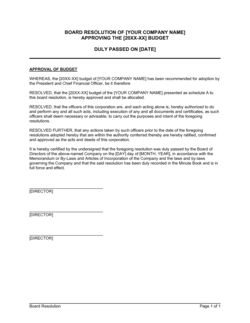
Approval and signature block

In plain language: Captures the dated signatures of all required approvers — CFO, CEO, board chair, or department head — confirming the budget is formally adopted for the period.

Sample language
Approved by: [NAME], [TITLE] — Signature: ____________ — Date: [DATE]. [NAME], [TITLE] — Signature: ____________ — Date: [DATE]. This budget is effective as of the last date signed above.

Common mistake: Collecting only one signature when the organization's governance documents require dual authorization. A budget approved by one signatory when two are required is procedurally invalid and may be challenged by auditors or the board.

How to fill it out

  1. 1

    Define the budget period and scope

    Enter exact start and end dates, the legal entity name, and any divisions or projects covered. Confirm whether the period aligns with your fiscal year or a specific project timeline.

    💡 If your fiscal year differs from the calendar year, note both the fiscal period label (e.g., FY2027) and the corresponding calendar dates to prevent confusion in variance reports.

  2. 2

    Enter all revenue and income projections

    List every income source with its projected amount and the key assumption behind each figure — unit volume, price per unit, expected conversion rate, or confirmed grants.

    💡 Use at least a base-case and a downside-case revenue figure. The spread between them sets the size of your contingency reserve.

  3. 3

    Itemize fixed expenses by category and cost center

    Record every committed, non-variable cost — rent, insurance, salaries, debt service — with the annual total and monthly equivalent. Assign each line to a cost center.

    💡 Pull figures directly from signed contracts and payroll records rather than estimating. Fixed costs with supporting contracts are non-negotiable; accuracy here protects credibility with approvers.

  4. 4

    Project variable expenses linked to a volume driver

    For each variable cost, identify the driver (units produced, customers served, campaigns run) and calculate the cost at your projected activity level. Document the driver assumption.

    💡 Build a secondary column showing variable costs at 70% of projected volume. This downside scenario reveals whether the budget remains solvent if revenue underperforms.

  5. 5

    Add the capital expenditure schedule

    List every planned asset purchase with the planned acquisition date, total cost, and funding source. Confirm CapEx items are separated from OpEx to preserve accurate expense classification.

    💡 Check your jurisdiction's capitalization threshold — items below a set value (often $2,500–$5,000) must be expensed rather than capitalized, regardless of useful life.

  6. 6

    Set the contingency reserve and release conditions

    Calculate the contingency as a percentage of total projected expenditure (5% for stable businesses, 10–15% for early-stage or project-based contexts). Name the person authorized to release it.

    💡 Document the contingency release procedure in writing. An undocumented contingency pool becomes a discretionary slush fund that undermines the budget's authority.

  7. 7

    Define variance thresholds and reporting cadence

    Specify the dollar or percentage variance that triggers a written explanation, the reporting frequency, and the stakeholders who receive variance reports.

    💡 A 10% threshold on any single line item is a practical starting point for most small businesses. Adjust downward for high-risk or tightly controlled cost centers.

  8. 8

    Obtain all required signatures before the period opens

    Route the completed budget to each required approver in the order specified by your governance documents. Collect dated signatures before the budget period begins.

    💡 Use Business in a Box eSign to timestamp each approval and store the fully executed budget alongside the fiscal year's financial records.

Frequently asked questions

What is a budget planner?

A budget planner is a structured financial document that records projected income and expenses for a defined period — typically a fiscal year or project lifecycle — organized by category, cost center, and time interval. It establishes formal spending authority, captures the assumptions behind each figure, and provides a baseline against which actuals are compared to calculate variance. In a business context, a signed budget planner is often a governance requirement before funds can be committed.

What should a business budget planner include?

A complete business budget planner covers revenue projections by source, fixed and variable expense allocations by category and cost center, a capital expenditure schedule, a contingency reserve with release conditions, variance tracking thresholds and reporting obligations, a budget amendment procedure, a confidentiality clause, and a dated authorization block with signatures from all required approvers. Missing any of these creates gaps in financial control that auditors and boards will flag.

Why does a budget planner need to be signed?

A signature transforms a financial projection into a formal commitment. Signed approval confirms that the designated budget authority has reviewed and accepted the spending plan, creating accountability for the period. Banks, grant bodies, boards of directors, and auditors typically require a signed budget before releasing funds or issuing an unqualified audit opinion. Without signatures, the budget has no formal governance standing.

How often should a budget planner be updated?

The underlying document should be formally amended whenever a variance threshold is breached or a material change in scope occurs — not on a fixed calendar. Most organizations prepare a full annual budget before each fiscal year, conduct a mid-year reforecast if actuals diverge by more than 10–15% from plan, and compare actuals to budget monthly or quarterly in variance reports. An annual budget more than six months old without a reforecast is effectively a historical record, not an operating tool.

What is the difference between a budget planner and a financial forecast?

A budget planner is a formal commitment document — approved by designated authorities — that authorizes spending up to specified limits. A financial forecast is a rolling projection of likely outcomes updated as new information becomes available, without the same governance standing. Budgets set limits; forecasts track where you are heading. Both are necessary, but they serve different audiences: the budget satisfies governance requirements, while the forecast informs operational decisions.

Do I need a lawyer to approve a business budget planner?

For most straightforward annual budgets in small and medium-sized businesses, a well-structured template signed by the appropriate internal approvers is sufficient. Legal review is advisable when the budget is attached to a loan covenant, grant agreement, or joint-venture contract; when it includes authorization language that delegates spending authority to specific roles; or when the organization operates in a heavily regulated industry where budget approval procedures are prescribed by statute or regulator.

What contingency percentage should a business budget include?

A contingency of 5% of total projected expenditure is a reasonable baseline for stable businesses with predictable costs. Early-stage businesses, project-based organizations, and any entity operating in a volatile cost environment should allocate 10–15%. Contingency above 15% typically signals that underlying cost estimates are insufficiently developed rather than genuinely uncertain — and may draw scrutiny from boards or funders reviewing the plan.

How is a budget planner different from a cash flow forecast?

A budget planner allocates expected income and expenditure by category across a period and serves as the formal spending authority document. A cash flow forecast translates those figures into expected bank account movements on a week-by-week or month-by-month basis, showing when cash actually arrives and when payments go out. A business needs both: the budget to govern spending decisions and the cash flow forecast to ensure there is money in the account when bills are due.

Can a budget planner be used as evidence in a financial dispute?

Yes. A signed, dated budget planner can be introduced as documentary evidence in contract disputes, shareholder disagreements, audit findings, and regulatory investigations to demonstrate what spending was formally authorized and by whom. The evidential weight increases when the document includes specific amendment procedures and variance reporting records that show the budget was actively managed throughout the period, not simply prepared and filed.

How this compares to alternatives

vs Cash Flow Forecast

A cash flow forecast translates budgeted income and expenditure into week-by-week or month-by-month bank account movements, showing when cash actually arrives and leaves. A budget planner allocates approved spending authority by category across a period. The budget sets the limits; the cash flow forecast reveals whether those limits can be met without running out of money. Both documents are needed to manage a business responsibly.

vs Financial Projections Template

A financial projections template builds a forward-looking income statement, balance sheet, and cash flow model for investor or lender audiences. A budget planner is an internal governance document that formally authorizes spending and assigns accountability. Projections answer the question of what the business expects to earn and spend; the budget planner answers who is authorized to spend how much and under what conditions.

vs Project Budget Template

A project budget is scoped to a single initiative with a defined end date, tracking costs against a project charter or statement of work. A budget planner covers ongoing business operations across a full fiscal period with multiple departments and cost centers. Use a project budget when managing a discrete deliverable; use the budget planner for the overall business or organizational spending authority.

vs Marketing Budget Template

A marketing budget focuses exclusively on the allocation of promotional spend across channels — paid media, events, content, and agency fees — within a single department. A budget planner encompasses the entire business, including revenue, all operating costs, CapEx, and cross-department authorization. The marketing budget is typically one cost-center schedule within the broader budget planner.

Industry-specific considerations

Professional services

Billable hours targets, staff utilization rates, and client project budgets tracked against retainer fees are the primary line items requiring separate cost-center treatment.

Construction and real estate

Phase-by-phase CapEx schedules, subcontractor cost allocations, contingency reserves of 10–15%, and draw schedule alignment with lender requirements distinguish construction budgets.

Nonprofit and public sector

Grant-restricted versus unrestricted funds must be budgeted separately, and board-approval signatures are a governance requirement before any grant funds can be drawn down.

Technology and SaaS

Cloud infrastructure costs modeled as variable expenses tied to customer count, R&D capitalization decisions, and headcount-driven OpEx growth dominate the budget structure.

Retail and e-commerce

Inventory purchasing schedules, seasonal revenue variation requiring quarterly reforecasts, and marketing spend allocation across channels are the key planning variables.

Manufacturing

Raw material cost projections linked to production volume drivers, CapEx for equipment replacement cycles, and overhead absorption rates require separate budget schedules.

Jurisdictional notes

United States

No federal statute mandates a specific budget format for private businesses, but lenders and the SBA require formal signed budgets for loan applications above $150,000. Nonprofits holding 501(c)(3) status must adopt an annual budget approved by the board of directors to maintain governance compliance. State-specific capitalization thresholds for CapEx vary, so confirm your state's de minimis safe harbor amount before classifying expenses.

Canada

Federally incorporated companies under the Canada Business Corporations Act and provincial equivalents are required to present financial plans to shareholders annually. Nonprofits and charities registered with the CRA must maintain board-approved budgets as part of their reporting obligations. Quebec organizations operating under French civil law should ensure budget authorization language aligns with Quebec's distinct civil liability framework.

United Kingdom

Companies House does not prescribe a budget format for private limited companies, but directors have a statutory duty under the Companies Act 2006 to act in the best interests of the company, which courts have interpreted to include maintaining adequate financial planning documentation. Charities registered with the Charity Commission must produce and retain board-approved budgets. Public sector bodies and NHS trusts operate under HM Treasury spending control frameworks that impose specific budget authorization structures.

European Union

EU member states vary in their statutory requirements for formal budget approval, but most impose governance obligations on companies above defined size thresholds — typically more than 50 employees or €10M in turnover. Organizations receiving EU structural funds or Horizon grants must maintain detailed, auditable budget plans meeting European Court of Auditors standards. GDPR considerations apply if the budget document includes personally identifiable information about employees or salary data.

Template vs lawyer — what fits your deal?

PathBest forCostTime
Use the templateSmall businesses and internal teams preparing an annual operating budget for standard governance sign-offFree2–6 hours
Template + legal reviewOrganizations whose budget is attached to a loan covenant, grant agreement, or board resolution with specific procedural requirements$200–$600 for an accountant or financial advisor review1–3 days
Custom draftedRegulated industries, joint ventures, publicly funded bodies, or organizations where budget authorization language carries direct legal liability$1,000–$3,5001–2 weeks

Glossary

Budget Period
The defined timeframe a budget covers, typically a fiscal year, quarter, or project duration.
Cost Center
A business unit or department that incurs costs but does not directly generate revenue, used to allocate and track expenses separately.
Variance
The difference between a budgeted figure and the actual amount spent or earned during the same period.
Fixed Costs
Expenses that remain constant regardless of output or revenue level, such as rent, insurance premiums, or salaried payroll.
Variable Costs
Expenses that change in proportion to business activity, such as raw materials, sales commissions, or shipping costs.
Contingency Reserve
A percentage of the total budget set aside to cover unforeseen costs or scope changes, typically 5–15% of the total.
Budget Authority
The formal, documented permission granted to a person or role to commit funds up to a specified limit.
Actuals
Real expenditures or revenues recorded after they occur, compared against budgeted figures to calculate variance.
Capital Expenditure (CapEx)
Spending on long-term assets such as equipment, property, or software that is capitalized on the balance sheet rather than expensed immediately.
Operating Expenditure (OpEx)
Day-to-day business costs expensed in the period they are incurred, such as salaries, utilities, and subscriptions.
Zero-Based Budgeting
A budgeting method where every expense must be justified from zero each period, rather than adjusting the prior year's figures.

Part of your Business Operating System

This document is one of 3,000+ business & legal templates included in Business in a Box.

  • Fill-in-the-blanks — ready in minutes
  • 100% customizable Word document
  • Compatible with all office suites
  • Export to PDF and share electronically

Create your document in 3 simple steps.

From template to signed document — all inside one Business Operating System.
1
Download or open template

Access over 3,000+ business and legal templates for any business task, project or initiative.

2
Edit and fill in the blanks with AI

Customize your ready-made business document template and save it in the cloud.

3
Save, Share, Send, Sign

Share your files and folders with your team. Create a space of seamless collaboration.

Save time, save money, and create top-quality documents.

★★★★★

"Fantastic value! I'm not sure how I'd do without it. It's worth its weight in gold and paid back for itself many times."

Managing Director · Mall Farm
Robert Whalley
Managing Director, Mall Farm Proprietary Limited
★★★★★

"I have been using Business in a Box for years. It has been the most useful source of templates I have encountered. I recommend it to anyone."

Business Owner · 4+ years
Dr Michael John Freestone
Business Owner
★★★★★

"It has been a life saver so many times I have lost count. Business in a Box has saved me so much time and as you know, time is money."

Owner · Upstate Web
David G. Moore Jr.
Owner, Upstate Web

Run your business with a system — not scattered tools

Stop downloading documents. Start operating with clarity. Business in a Box gives you the Business Operating System used by over 250,000 companies worldwide to structure, run, and grow their business.

Free Forever Plan · No credit card required