Board Resolution Approving Budget Template

Free Word download • Edit online • Save & share with Drive • Export to PDF

1 page20–30 min to fillDifficulty: StandardSignature requiredLegal review recommended
Learn more ↓
FreeBoard Resolution Approving Budget Template

At a glance

What it is
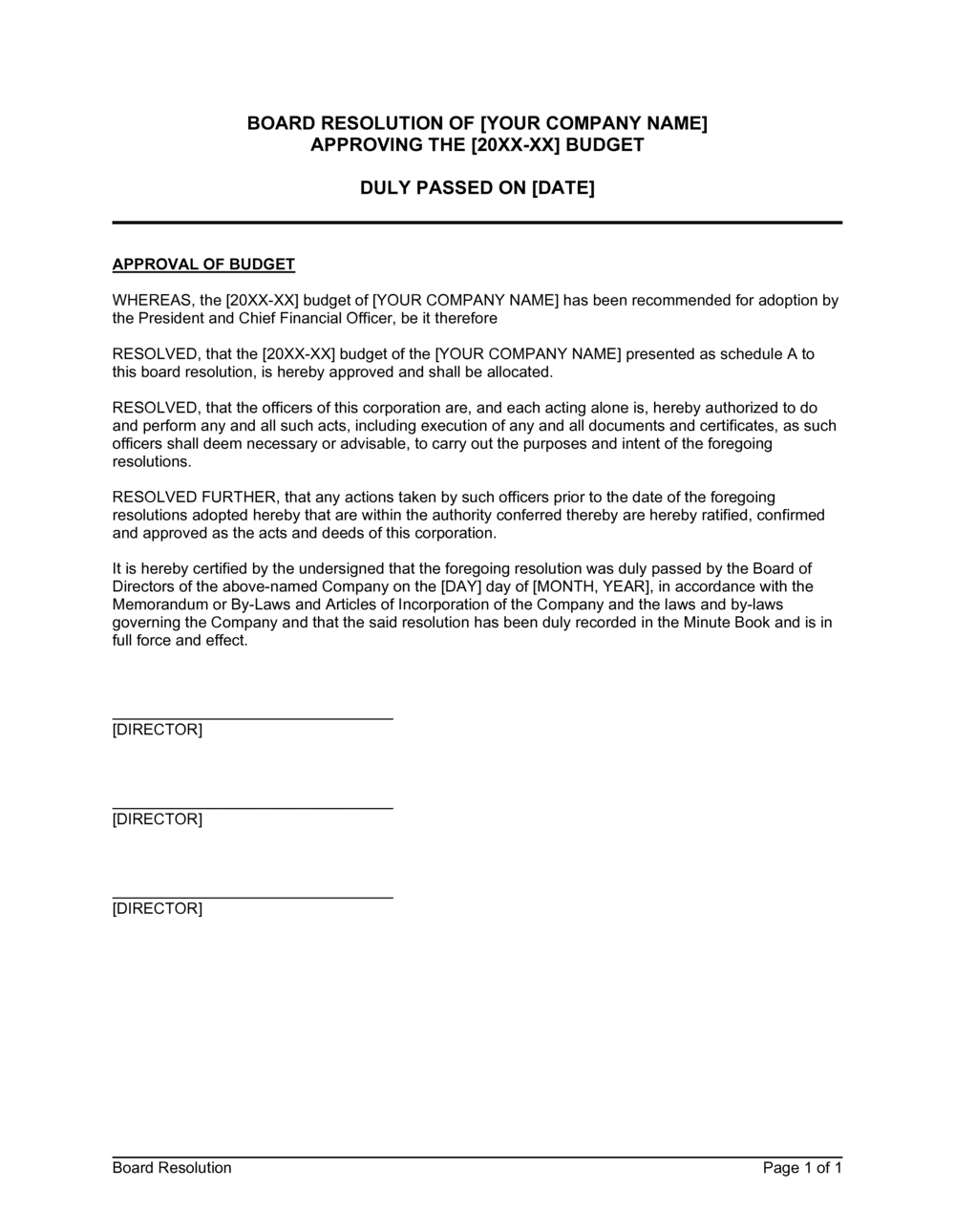
A Board Resolution Approving Budget is a formal corporate governance document adopted by a company's board of directors to officially authorize the annual operating budget and any capital expenditure budget for a defined fiscal period. This free Word download provides a ready-to-edit resolution that records the vote, identifies the approved budget totals, and creates the written record required by corporate bylaws, auditors, and lenders.
When you need it
Use it at the start of each fiscal year when the board reviews and adopts the annual budget, or mid-year when a material budget amendment requires formal board approval. It is also referenced whenever management or finance teams need documented authority to commit expenditures against an approved plan.
What's inside
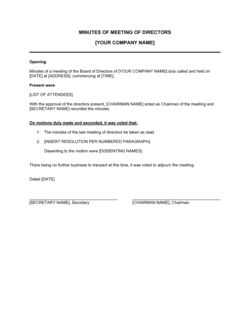
Recitals establishing the meeting date, quorum, and authority; the resolved clauses formally approving operating and capital budget figures; authorization language delegating implementation to named officers; amendment and variance thresholds; and officer certification with signatures and date of adoption.

What is a Board Resolution Approving Budget?

A Board Resolution Approving Budget is a formal corporate governance document in which a company's board of directors officially votes to authorize the annual operating and capital expenditure plan for a defined fiscal period. It records the quorum, the vote, the approved budget totals, the delegation of spending authority to named officers, and the variance thresholds within which management may act without returning to the board. The resolution is signed by directors or adopted by written consent, certified by the corporate secretary, and filed permanently in the corporate minute book — creating the documented authority that management, auditors, lenders, and investors reference whenever they need evidence that spending decisions were made within a board-sanctioned framework.

Why You Need This Document

Operating without a board-approved budget resolution leaves the company in a governance gap that surfaces at the worst possible moments — during a loan covenant review, an audit, an M&A due diligence process, or a dispute between management and the board over spending authority. Without a formal resolution, officers who commit expenditures have no documented authorization to point to, exposing them to personal liability for unauthorized acts. Banks with credit facilities commonly require annual evidence of board-approved budgets as a covenant condition; failing to produce one can trigger a technical default. For nonprofits, the absence of documented budget approval creates IRS reporting exposure and can jeopardize grant funding. This template gives corporate secretaries, CFOs, and founders a ready-to-complete resolution that closes the authorization gap, satisfies third-party requirements, and creates an auditable record of the board's financial oversight — in under 30 minutes.

Which variant fits your situation?

If your situation is…Use this template
Annual budget adoption at the start of the fiscal yearBoard Resolution Approving Budget
Mid-year material budget amendment requiring board sign-offBoard Resolution Amending Budget
Approving a specific capital expenditure above delegated authorityBoard Resolution Approving Capital Expenditure
Authorizing a bank line of credit to fund the approved budgetBoard Resolution Authorizing Bank Account or Credit Facility
Recording the budget vote taken at a written consent instead of a meetingWritten Consent of Board of Directors in Lieu of Meeting
Approving financial statements alongside the budgetBoard Resolution Approving Financial Statements
Nonprofit board approving program and administrative budgets separatelyNonprofit Board Resolution Approving Annual Budget

Common mistakes to avoid

❌ Approving the budget without attaching it as an exhibit

Why it matters: A resolution that references 'the budget presented at the meeting' without a fixed attachment creates an evidentiary gap — if the budget is later revised, there is no record of what was actually approved.

Fix: Attach a version-locked PDF of the final budget as a named exhibit before any director signs, and reference it by exhibit letter and total dollar amount in the resolved clause.

❌ Setting no delegation-of-authority threshold

Why it matters: Open-ended officer delegation allows management to commit to expenditures far above routine levels without board oversight, undermining the purpose of the approval and potentially breaching fiduciary duties.

Fix: Insert a specific per-transaction dollar limit — calibrated to the company's size and risk tolerance — above which a separate board resolution is required.

❌ Adopting the resolution after material spending has already occurred without a ratification clause

Why it matters: Expenditures made before formal board approval technically lack authority. Auditors and investors will flag this gap, and in rare cases it can expose officers to personal liability for unauthorized acts.

Fix: Include the ratification clause whenever the resolution is adopted after the fiscal year start date, and ask the CFO to confirm the exact amount to be ratified.

❌ Using a resolution template that omits variance and amendment procedures

Why it matters: Without a stated variance threshold, management has no clear trigger for when to return to the board — leading either to unnecessary meetings for minor overruns or to material budget deviations that are never escalated.

Fix: Add an explicit variance clause specifying both a line-item tolerance (e.g., 10%) and a hard cap on aggregate expenditures, with a clear procedure for seeking board approval of amendments that exceed those limits.

❌ Having a director rather than the corporate secretary certify the resolution

Why it matters: Banks, auditors, and counterparties expect the corporate secretary — as the official keeper of corporate records — to certify resolutions. A director's certification may be rejected or questioned.

Fix: Designate the corporate secretary to sign the certification block. If there is no appointed secretary, a resolution naming one should be adopted before or concurrently with the budget resolution.

❌ Combining operating and capital budget totals in a single approved figure

Why it matters: Auditors, lenders, and investors typically need to see operating and capital spending authorized separately — a blended total makes it impossible to verify compliance with loan covenants or capital allocation policies.

Fix: Always use two distinct resolved clauses — one for the operating budget and one for the capital budget — each referencing its own exhibit and dollar total.

The 9 key clauses, explained

Recitals — meeting authority and quorum

In plain language: Establishes that a duly noticed meeting was held (or written consent circulated), that a quorum of directors was present, and that the board has authority under the bylaws to adopt this resolution.

Sample language
WHEREAS, a duly noticed [regular / special] meeting of the Board of Directors of [COMPANY LEGAL NAME] (the 'Company') was held on [DATE] at [TIME], at which a quorum of [NUMBER] directors was present; and WHEREAS, the Board has authority under Article [X] of the Company's Bylaws to approve the annual budget;

Common mistake: Omitting the quorum count or meeting notice details — if the resolution is ever challenged, missing procedural facts can make the adoption voidable.

Approval of the operating budget

In plain language: The core resolved clause formally adopting the annual operating budget, identifying it by fiscal year, total revenue, and total expenditure figures.

Sample language
RESOLVED, that the Board hereby approves the Operating Budget for the fiscal year ending [DATE], reflecting projected total revenues of $[AMOUNT] and total operating expenditures of $[AMOUNT], as set out in Exhibit A attached hereto.

Common mistake: Approving the budget by reference to a document not attached to the resolution — if Exhibit A is lost or revised, the resolution lacks a fixed, auditable record of what was actually approved.

Approval of the capital budget

In plain language: A separate resolved clause adopting the capital expenditure plan, specifying total authorized capital spending and any major project line items.

Sample language
RESOLVED FURTHER, that the Board hereby approves the Capital Expenditure Budget for the fiscal year ending [DATE], authorizing aggregate capital expenditures not to exceed $[AMOUNT], including $[AMOUNT] for [PROJECT/ASSET DESCRIPTION] as detailed in Exhibit B.

Common mistake: Combining the operating and capital budgets into a single dollar total — auditors, lenders, and investors routinely need to see capital and operating spend authorized separately.

Delegation of authority to officers

In plain language: Authorizes named officers — typically the CEO and CFO — to execute contracts, make payments, and commit resources within the limits of the approved budget without returning to the board for each transaction.

Sample language
RESOLVED FURTHER, that the CEO and CFO are each hereby authorized to execute agreements, approve expenditures, and take all actions necessary to implement the approved budgets, provided that no single expenditure exceeds $[THRESHOLD] without prior Board approval.

Common mistake: Setting no dollar threshold for delegated authority — leaving the delegation open-ended exposes the company to officers committing to expenditures well outside the spirit of the approved budget.

Variance and amendment procedure

In plain language: Defines how much spending can deviate from the approved budget before management must return to the board, and establishes the process for mid-year budget amendments.

Sample language
RESOLVED FURTHER, that management is authorized to reallocate expenditures between budget line items up to [X]% of the affected line, provided that aggregate operating expenditures do not exceed the approved total; any amendment exceeding this threshold shall require a further Board resolution.

Common mistake: No variance clause at all — without it, management has no clear guidance on when mid-year changes require board re-approval, creating governance gaps that auditors flag.

Reporting obligations

In plain language: Requires management to present periodic budget-vs.-actual reports to the board so directors can monitor performance against the approved plan.

Sample language
RESOLVED FURTHER, that the CFO shall present a budget-versus-actual variance report to the Board on a [monthly / quarterly] basis, identifying any line items where spending is projected to exceed the approved budget by more than [X]%.

Common mistake: Approving the budget with no accompanying reporting requirement — boards that approve budgets without a monitoring obligation lose meaningful oversight and may face fiduciary exposure.

Effective date and fiscal period

In plain language: States the date on which the approved budget takes effect and the exact fiscal period it covers, preventing ambiguity when the resolution is referenced months later.

Sample language
RESOLVED FURTHER, that this Resolution shall be effective as of [EFFECTIVE DATE] and shall govern the Company's financial operations for the fiscal year commencing [START DATE] and ending [END DATE].

Common mistake: Using 'immediately' as the effective date without specifying the fiscal period — if the resolution is adopted after the fiscal year has started, 'immediately' creates an ambiguous gap.

Ratification of prior expenditures

In plain language: Ratifies any expenditures incurred between the start of the fiscal year and the date of the resolution's adoption, where management acted in anticipation of budget approval.

Sample language
RESOLVED FURTHER, that all actions taken by the officers of the Company since [FISCAL YEAR START DATE] in furtherance of the Operating and Capital Budgets, including expenditures not exceeding $[AMOUNT] in aggregate, are hereby ratified and approved.

Common mistake: Skipping ratification when the budget is approved after the fiscal year start — expenditures made before the resolution was adopted technically lacked board authorization until ratified.

Officer certification

In plain language: A signed statement by the corporate secretary or an officer certifying that the resolution was duly adopted, the quorum was met, and the document is a true and accurate record.

Sample language
The undersigned, being the duly appointed Corporate Secretary of [COMPANY LEGAL NAME], hereby certifies that the foregoing resolution was duly adopted by the Board of Directors at a meeting held on [DATE] at which a quorum was present and acted throughout.

Common mistake: Having a director — rather than the corporate secretary — certify the resolution. Third parties such as banks and auditors expect certification from the secretary as the designated keeper of corporate records.

How to fill it out

  1. 1

    Insert the company's full legal name and jurisdiction

    Enter the company's registered legal name — not a trade name — and the state, province, or country of incorporation in the recitals. This anchors the resolution to the correct legal entity and governing corporate statute.

    💡 Confirm the exact registered name against the certificate of incorporation or articles — a mismatch can delay bank and lender processing.

  2. 2

    Record the meeting details and quorum

    Enter the date, time, and location of the board meeting, the number of directors present, and whether the meeting was held in person, by phone, or by video conference. Note whether a written consent procedure is being used instead.

    💡 Check your bylaws for the required notice period before the meeting — typically 10 to 15 days. If proper notice was not given, record that all directors waived notice in writing.

  3. 3

    Attach the approved budget as a named exhibit

    Label the operating budget 'Exhibit A' and the capital budget 'Exhibit B' and physically attach them to the resolution before signing. Reference each exhibit by name and total dollar amount in the resolved clauses.

    💡 Use a version-controlled PDF of the final budget model — not a draft marked 'subject to revision' — so the exhibit is unambiguous.

  4. 4

    Set the delegation-of-authority threshold

    Enter the per-transaction spending limit above which officers must return to the board. Base this on the company's size — a $1,000 threshold is appropriate for a 10-person startup; $50,000–$100,000 is typical for a mid-market company.

    💡 Align this threshold with the signing authority matrix in your financial controls policy so the resolution and internal policy are consistent.

  5. 5

    Define the variance percentage and amendment trigger

    Enter the percentage by which a line item can be exceeded before requiring board notification (commonly 10–15%) and confirm the aggregate total cannot be breached. State explicitly what process management must follow to request a formal amendment.

    💡 A variance clause that applies to individual line items but not the aggregate total can allow material budget overruns to go unnoticed — cap both.

  6. 6

    Complete the ratification clause if the fiscal year has already started

    If the board is adopting the resolution after the fiscal year's commencement date, enter the start date and an estimated dollar amount of expenditures already incurred to be ratified. This closes the authorization gap.

    💡 Ask the CFO for the actual spend figure to date rather than estimating — overstating the ratification amount looks sloppy; understating it leaves expenditures technically unauthorized.

  7. 7

    Obtain director signatures and have the secretary certify

    Have each director sign the resolution or the written consent, then have the corporate secretary sign the certification block. File the original in the minute book and distribute signed copies to the CFO and any external parties who require evidence of approval.

    💡 If your board uses a digital signing tool, ensure each signature is timestamped — banks and auditors increasingly require a time-and-date stamp on electronic signatures.

Frequently asked questions

What is a board resolution approving a budget?

A board resolution approving a budget is a formal corporate governance document in which the board of directors officially votes to authorize the company's annual operating and capital expenditure plan. It records the quorum, the vote, the approved dollar totals, and the delegation of authority to officers to implement the plan. The resolution is filed in the corporate minute book and serves as the documented authority management references when committing company funds throughout the year.

Is a board resolution required to approve the annual budget?

In most jurisdictions, corporate bylaws or governance policies require the board to formally approve the annual budget, making a written resolution the standard mechanism for recording that approval. For companies with bank credit facilities, the loan agreement will typically require evidence of board-approved budgets as a covenant condition. Nonprofits are generally required by IRS guidelines and state nonprofit statutes to have their boards adopt annual budgets. Even where not strictly mandated by law, a resolution creates an auditable record that protects directors and officers.

What is the difference between a board resolution and board meeting minutes?

Board meeting minutes are a narrative record of everything discussed and decided at a meeting — agenda items, presentations, discussion points, and motions. A board resolution is a standalone formal document that records a specific decision or authorization in legally operative language. Resolutions are typically extracted from the minutes or adopted separately and filed as discrete documents because third parties — banks, auditors, investors — need a clean certified copy of the decision without the surrounding narrative.

Who needs to sign a board resolution approving the budget?

The resolution itself is typically signed or acknowledged by the directors who voted in favor, either at the meeting or via written consent. The corporate secretary then signs a certification block confirming the resolution was duly adopted and that the document is a true copy of the record. Some companies require only the secretary's certification; others require director signatures on the face of the resolution. Check your bylaws for the specific execution requirement.

Can a board resolution be adopted without a meeting?

Yes. Most corporate statutes in the US, Canada, and the UK permit the board to act by unanimous written consent — all directors sign a resolution document in lieu of convening a physical or virtual meeting. This is common for routine governance matters like annual budget approvals where the outcome is not in dispute. The written consent must be signed by all directors (not just a majority) in most jurisdictions, and it must be filed in the minute book as if it were adopted at a meeting.

What happens if the company needs to spend more than the approved budget?

Any expenditure that would cause aggregate spending to exceed the board-approved budget typically requires a formal board resolution amending the budget before the expenditure is committed. A well-drafted budget resolution includes a variance clause permitting minor line-item reallocation within defined limits — commonly 10–15% of a line item — without a new resolution, while requiring board approval for material amendments. Proceeding without authorization exposes officers to breach-of-authority claims and can trigger loan covenant violations.

Does a nonprofit need a board resolution to approve its annual budget?

Yes. IRS Form 990 asks whether the board reviews and approves the organization's annual budget, and best-practice governance frameworks such as the BBB Wise Giving Alliance standards require documented board budget approval. Most state nonprofit statutes also impose fiduciary duties on directors that are best discharged through a formal resolution. Funders and grant-makers routinely request a certified copy of the budget resolution as a condition of award.

How long should a board resolution approving a budget be kept?

Corporate resolutions are permanent records that should be retained indefinitely in the corporate minute book. The approved budget exhibit attached to the resolution should be retained for the same period. In practice, financial records supporting tax returns must be kept for at least 7 years in the US and Canada, and 6 years in the UK — but the governance record itself has no statutory expiry and is routinely requested during M&A due diligence for transactions occurring years after adoption.

Do I need a lawyer to prepare a board resolution approving the budget?

For a standard annual budget approval at a private company with a straightforward governance structure, a high-quality template completed by the corporate secretary or CFO is typically sufficient. Engage a lawyer when the resolution needs to satisfy specific loan covenant language, when the company operates in multiple jurisdictions with conflicting governance requirements, when the budget includes material related-party transactions requiring special approval procedures, or when the company is preparing for an audit, financing round, or acquisition where governance records will face outside scrutiny.

Can the same resolution approve both the operating and capital budgets?

Yes — a single resolution can contain separate resolved clauses for the operating budget and the capital budget, each referencing its own exhibit and total dollar amount. This is the most common approach, as it keeps the governance record in one document while maintaining the distinction auditors and lenders need between recurring operating expenditures and long-term capital commitments. Avoid merging the two into a single aggregate figure, as that structure obscures the allocation between operating and capital spend.

How this compares to alternatives

vs Board Meeting Minutes

Board minutes are a narrative record of everything discussed at a meeting — motions, debate, and outcomes. A budget resolution is a standalone operative document recording only the specific authorization decision, in language third parties can act on. Banks and auditors request the resolution, not the minutes, when they need evidence of budget approval. Both documents should exist and cross-reference each other.

vs Written Consent of Directors in Lieu of Meeting

A written consent is the procedural mechanism for adopting a resolution without a physical or virtual meeting — all directors sign the document instead of convening. The budget resolution is the substantive decision; the written consent is the adoption procedure. When a meeting is not held, the budget resolution language is embedded in or attached to the written consent.

vs Annual Operating Budget Template

The annual operating budget is the financial spreadsheet showing projected revenues and expenditures by line item. The board resolution is the governance document that formally authorizes that budget. The budget is typically attached as an exhibit to the resolution — one without the other is incomplete from either a financial planning or a corporate governance standpoint.

vs Board Resolution Authorizing Bank Account

A bank account authorization resolution gives named officers signing authority over specific accounts. A budget resolution authorizes the spending plan those officers will execute. Many lenders require both: the budget resolution confirms management has authority to spend within defined limits, while the bank resolution confirms who can execute individual transactions.

Industry-specific considerations

Technology / SaaS

R&D and headcount-heavy budgets with significant capital allocations for infrastructure; investor board members typically require quarterly budget-vs.-actual reports as a condition of the resolution.

Nonprofit and Associations

IRS Form 990 and funder requirements mandate documented board budget approval; program, administrative, and fundraising budgets are often presented and approved as separate line-item categories within the same resolution.

Real Estate and Construction

Large capital budgets for project development require separate authorization thresholds per project; lenders routinely require a certified copy of the budget resolution as a draw-request condition.

Financial Services

Regulatory capital requirements mean the board's budget approval must align with documented capital adequacy plans; audit committees in regulated entities typically pre-review the budget before the full board resolution is adopted.

Jurisdictional notes

United States

Corporate governance requirements vary by state of incorporation. Delaware General Corporation Law (DGCL) and the Model Business Corporation Act both permit unanimous written consent in lieu of a meeting. Nonprofit corporations in most states must document board budget approval to satisfy state attorney general oversight and IRS Form 990 reporting. Loan agreements governed by New York law commonly include a covenant requiring an annual board-approved budget delivered within 90 days of fiscal year start.

Canada

The Canada Business Corporations Act and provincial equivalents (Ontario OBCA, British Columbia BCA) permit written resolutions signed by all directors. Federal and provincial nonprofit corporations acts require boards to approve annual budgets and maintain records. Bilingual governance requirements apply to federally incorporated entities under the Official Languages Act, and Quebec-based corporations may be subject to French-language documentation obligations under the Charter of the French Language.

United Kingdom

The Companies Act 2006 permits directors' written resolutions for private companies (not public companies). Charity Commission guidance requires trustees of registered charities to formally approve annual budgets and maintain the record for at least 6 years. Companies House does not require budget resolutions to be filed, but they must be retained in the company's statutory books. Board resolutions should reference the specific financial year aligned with the company's accounting reference date registered at Companies House.

European Union

Corporate governance requirements vary significantly by member state — German GmbH and AG governance rules, French SAS and SA structures, and Dutch BV rules each impose different board authority and documentation requirements. Budget resolutions that include processing of employee personal data in financial planning should reference GDPR Article 6 lawful basis. EU-listed entities and regulated financial institutions face additional supervisory board or audit committee review requirements before a management board budget resolution can be adopted.

Template vs lawyer — what fits your deal?

PathBest forCostTime
Use the templatePrivate companies and nonprofits with standard annual budget cycles and no complex lender or investor requirementsFree20–30 minutes
Template + legal reviewCompanies with bank loan covenants requiring specific resolution language, multi-jurisdiction entities, or boards with outside investor directors$200–$5001–2 days
Custom draftedRegulated financial institutions, pre-IPO companies, nonprofits under audit, or transactions where the budget resolution will be reviewed by outside counsel in due diligence$500–$2,000+3–7 days

Glossary

Board Resolution
A formal written decision adopted by a board of directors, recorded in the minute book, that authorizes or directs a specific corporate action.
Quorum
The minimum number of directors who must be present at a meeting for the board's decisions to be legally valid, as specified in the company's bylaws.
Operating Budget
A financial plan projecting revenues and day-to-day expenses — salaries, rent, marketing, and overheads — for a defined fiscal period, typically 12 months.
Capital Budget
A plan authorizing expenditures on long-term assets such as equipment, technology infrastructure, or property that will be capitalized on the balance sheet.
Fiscal Year
The 12-month accounting period a company uses for financial reporting, which may or may not align with the calendar year.
Delegated Authority
The spending limit up to which a named officer or manager may commit company funds without returning to the board for a separate resolution.
Variance Threshold
The maximum percentage or dollar amount by which actual spending may exceed a budget line before requiring board notification or a formal amendment.
Recitals
The introductory 'whereas' clauses in a resolution that provide the factual background — meeting date, attendees, and authority — supporting the decisions that follow.
Minute Book
The official corporate record maintained by the corporate secretary containing all board and shareholder resolutions, meeting minutes, and governance documents.
Unanimous Written Consent
A procedure allowing all directors to adopt a resolution by signing a written document, without holding a formal meeting, when permitted by the jurisdiction's corporate statute.
Certification
A statement signed by the corporate secretary or an officer confirming that the resolution was duly adopted and accurately reflects the board's vote.

Part of your Business Operating System

This document is one of 3,000+ business & legal templates included in Business in a Box.

  • Fill-in-the-blanks — ready in minutes
  • 100% customizable Word document
  • Compatible with all office suites
  • Export to PDF and share electronically

Create your document in 3 simple steps.

From template to signed document — all inside one Business Operating System.
1
Download or open template

Access over 3,000+ business and legal templates for any business task, project or initiative.

2
Edit and fill in the blanks with AI

Customize your ready-made business document template and save it in the cloud.

3
Save, Share, Send, Sign

Share your files and folders with your team. Create a space of seamless collaboration.

Save time, save money, and create top-quality documents.

★★★★★

"Fantastic value! I'm not sure how I'd do without it. It's worth its weight in gold and paid back for itself many times."

Managing Director · Mall Farm
Robert Whalley
Managing Director, Mall Farm Proprietary Limited
★★★★★

"I have been using Business in a Box for years. It has been the most useful source of templates I have encountered. I recommend it to anyone."

Business Owner · 4+ years
Dr Michael John Freestone
Business Owner
★★★★★

"It has been a life saver so many times I have lost count. Business in a Box has saved me so much time and as you know, time is money."

Owner · Upstate Web
David G. Moore Jr.
Owner, Upstate Web

Run your business with a system — not scattered tools

Stop downloading documents. Start operating with clarity. Business in a Box gives you the Business Operating System used by over 250,000 companies worldwide to structure, run, and grow their business.

Start free · No credit card required