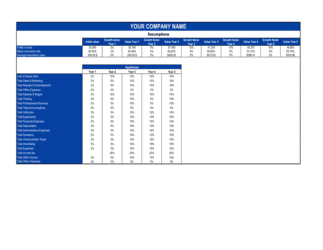
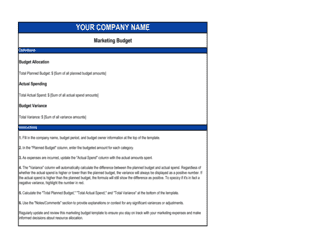
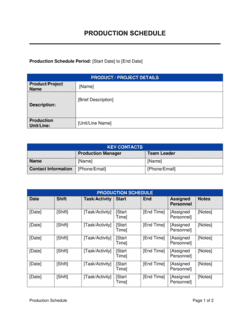
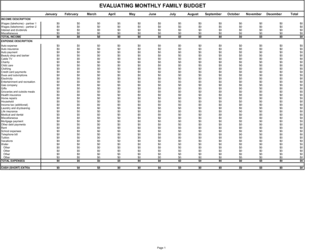
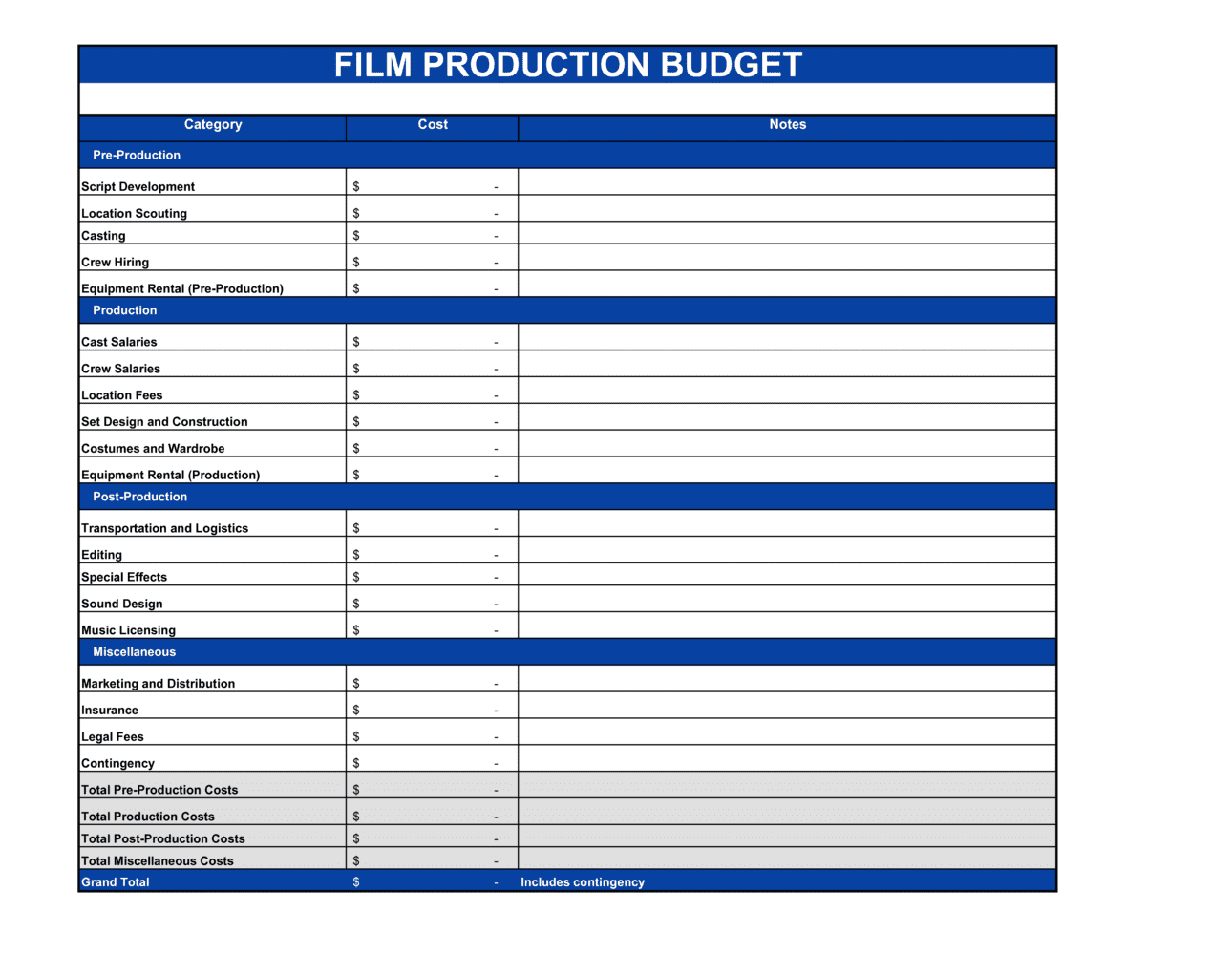
Film Production Budget Template

Free Excel download • Use online • Print or share

1 page20–30 min to useDifficulty: StandardSignature requiredLegal review recommended
Learn more ↓
FreeXLSFilm Production Budget Template

At a glance

What it is
A Film Production Budget is a formal financial and contractual document that itemizes every anticipated cost of a film or video production — from writer fees and director salaries through crew wages, equipment rental, location permits, post-production, and contingency reserves. This free Word download gives producers, directors, and financiers a structured, investor-ready starting point they can edit online and export as PDF for use in financing agreements, co-production deals, and guild-compliance submissions.
When you need it
Use it before production begins whenever you are seeking financing, presenting to a studio, distributor, or private investor, applying for a film tax credit, or entering a co-production agreement that requires a certified budget as an exhibit. It is also required by most completion bond companies before they will issue a guarantee.
What's inside
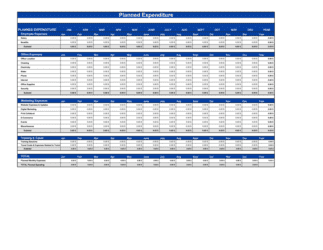
Above-the-line costs (story rights, producer, director, cast), below-the-line costs (crew, equipment, locations, art department, VFX), post-production costs (editing, sound, color grading, deliverables), and fringe benefits, insurance, completion bond fees, and a contingency reserve — organized by account number and category for easy lender and auditor review.

What is a Film Production Budget?

A Film Production Budget is a formal, itemized financial document that accounts for every anticipated cost of a film or video production — organized by industry-standard account categories including above-the-line creative talent, below-the-line crew and equipment, post-production, insurance, completion bond fees, and contingency reserve. When executed as a signed exhibit to a financing agreement or co-production deal, it functions as a binding contractual document that governs how production funds are allocated, drawn, and monitored from the first day of pre-production through final deliverables. Investors, bond companies, distributors, and tax credit administrators all rely on the production budget as the primary financial instrument of a film project.

Why You Need This Document

Without a certified, signed production budget, most film financing transactions cannot close — completion bond companies will not issue a guarantee, entertainment lenders will not fund drawdowns, and film tax credit applications lack the required cost basis documentation. Producers who begin spending without an approved budget have no contractual mechanism to protect themselves when costs overrun, and financiers have no recourse when funds are misapplied. A single missing fringe calculation or an undisclosed deferred payment obligation can invalidate a tax credit audit and create personal liability for the producer. This template gives you the account structure, fringe methodology, tax incentive disclosure framework, and signature block required to turn a working spreadsheet into an enforceable financing exhibit — reducing the risk of budget overages, bond claims, and investor disputes before principal photography begins.

Which variant fits your situation?

If your situation is…Use this template
Feature film with union crew seeking studio or distributor financingFeature Film Production Budget
Short film or student project with a budget under $50,000Short Film Budget Template
Branded video or commercial content productionCommercial Video Production Budget
Documentary with multi-year production timelineDocumentary Film Budget
Television episode or pilot budget for a network or streamerTV Production Budget
Music video with a single shoot day and limited postMusic Video Production Budget
Co-production requiring budget certification for a foreign co-producerCo-Production Budget and Finance Plan

Common mistakes to avoid

❌ Omitting fringe benefits from labor lines

Why it matters: Fringes on union productions typically add 25–35% to gross wages — omitting them causes the budget to understate true labor cost by hundreds of thousands of dollars on a mid-budget feature, triggering a bond call within weeks of production start.

Fix: Apply the correct fringe rate to every labor line before presenting the budget to any investor or bond company, and confirm current rates with your payroll company.

❌ Treating estimated tax credits as confirmed funding

Why it matters: Film tax credits are estimates until the production's final cost report is audited — spending against unconfirmed credits is the leading cause of independent film insolvency and can leave producers personally liable for shortfalls.

Fix: Label all tax credit projections as estimates, disclose the audit timeline to investors, and structure the financing so production can complete without the credit being fully confirmed.

❌ Setting contingency below 10%

Why it matters: Bond companies require a minimum 10% contingency as a condition of issuing a completion guarantee — a budget presented with 5% contingency will be rejected or amended before the bond is issued, delaying production start.

Fix: Build the contingency at 10% of the pre-bond, pre-insurance subtotal from the first draft and resist investor pressure to reduce it — the cost of a bond claim far exceeds the optics of a higher contingency line.

❌ Leaving the budget unsigned and unattached to the financing agreement

Why it matters: An unexecuted budget is a working estimate, not a binding document — if a producer deviates materially from an unsigned budget, the financier has no contractual basis to demand remediation or withhold drawdowns.

Fix: Attach the finalized budget as a signed exhibit to the financing or co-production agreement before the first dollar is drawn from the production account.

❌ Using a single deliverables line without format detail

Why it matters: Streaming platforms, international distributors, and festival programmers each require distinct technical deliverables — a vague single-line estimate routinely understates actual post-production cost by $20,000–$50,000 on a feature.

Fix: Request a written deliverables quote from a post-production house listing every required format and its individual cost before locking the post-production budget.

❌ Forgetting prep and wrap weeks for department heads

Why it matters: Budgeting department heads for shoot days only and ignoring prep and wrap periods understates crew cost and creates cash-flow gaps at the start and end of production when overage risk is highest.

Fix: Add explicit prep and wrap periods for each department head line, cross-referenced to the production schedule, before presenting the budget for financing approval.

The 10 key clauses, explained

Production identification and budget certification

In plain language: States the project title, format, estimated running time, production company, and certifies that the budget reflects the producer's good-faith estimate of total costs.

Sample language
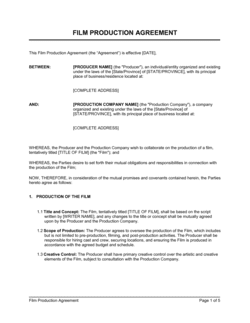
This budget covers the production of '[PROJECT TITLE],' a [RUNTIME]-minute [FORMAT] film produced by [PRODUCTION COMPANY NAME] ('Producer'). The Producer certifies that this budget represents a good-faith estimate of all anticipated costs as of [DATE].

Common mistake: Using a working title that differs from the title in the financing agreement — lenders and bond companies require exact title consistency across all documents or they flag the discrepancy during closing.

Above-the-line costs

In plain language: Itemizes story and rights acquisition, producer fees, director fee, and cast salaries — including deferred compensation and back-end participation points.

Sample language
Story and Rights: $[AMOUNT]. Producer Fee: $[AMOUNT] ([X]% deferred). Director: $[AMOUNT] plus [X]% net profits. Principal Cast: [ACTOR NAME] — $[AMOUNT]/week × [WEEKS] = $[TOTAL]. ATL Total: $[AMOUNT].

Common mistake: Omitting back-end participation points from the budget narrative — investors need to see contingent compensation obligations to accurately assess their recoupment position.

Below-the-line production costs

In plain language: Lists all crew wages by department (camera, sound, grip, electric, art, wardrobe, makeup), equipment rentals, location fees, permits, travel, and living expenses.

Sample language
Director of Photography: $[RATE]/day × [DAYS] = $[TOTAL]. Camera Package Rental: $[AMOUNT]/week × [WEEKS] = $[TOTAL]. Location Fees and Permits: $[AMOUNT]. Travel and Living: $[AMOUNT]. BTL Production Total: $[AMOUNT].

Common mistake: Budgeting crew at flat rates without accounting for fringe benefits — fringes on union crews typically add 25–35% to gross wages, and omitting them routinely causes budget overages in the first week of production.

Post-production costs

In plain language: Covers picture editing, visual effects, sound design, ADR, music licensing or scoring, color grading, and creation of deliverables required by the distributor.

Sample language
Picture Editor: $[RATE]/week × [WEEKS] = $[TOTAL]. VFX: $[AMOUNT] (per approved VFX breakdown). Music Score: $[AMOUNT]. Color Grade: $[AMOUNT]. Deliverables (DCP, IMF, M&E): $[AMOUNT]. Post Total: $[AMOUNT].

Common mistake: Treating deliverables as a single line item without listing each required format — streaming platforms and international distributors each require distinct file specs, and the cost difference between one DCP and a full deliverables package can exceed $20,000.

Fringe benefits and payroll taxes

In plain language: Calculates employer-side payroll taxes (FICA, FUTA, state unemployment) and union fund contributions as a percentage of gross wages for each labor category.

Sample language
ATL Fringes: [X]% × $[ATL LABOR] = $[AMOUNT]. BTL Union Fringes (SAG-AFTRA, IATSE): [X]% × $[BTL LABOR] = $[AMOUNT]. Non-Union Fringes (payroll taxes): [X]% × $[NON-UNION LABOR] = $[AMOUNT]. Total Fringes: $[AMOUNT].

Common mistake: Applying a single blended fringe rate across all labor categories — SAG-AFTRA health and pension rates differ from IATSE rates, and misapplying them creates audit discrepancies that can trigger a bond claim review.

Insurance

In plain language: States the production insurance package required — cast insurance, negative film or media insurance, errors and omissions (E&O), general liability, and workers' compensation.

Sample language
Production Insurance Package (cast, equipment, media, GL): $[AMOUNT]. Workers' Compensation: $[AMOUNT]. Errors and Omissions (E&O): $[AMOUNT]. Total Insurance: $[AMOUNT].

Common mistake: Purchasing E&O insurance too late — most distributors require E&O coverage effective from the first day of principal photography, and retroactive policies are significantly more expensive or unavailable.

Completion bond fee

In plain language: Records the fee payable to the completion guarantor — typically 2–6% of the total budget excluding contingency — and any over-budget escrow or cash-flow guarantee required.

Sample language
Completion Bond Fee: [X]% × $[BUDGET EXCLUDING CONTINGENCY] = $[AMOUNT]. Contingency Escrow (held by bond company): $[AMOUNT]. Total Bond Cost: $[AMOUNT].

Common mistake: Excluding the completion bond fee from the total budget presented to investors — the fee is a real cash cost that reduces funds available for production and must be disclosed.

Contingency reserve

In plain language: A reserve line — typically 10% of combined above-the-line, below-the-line, and post-production costs — available for cost overruns without requiring a budget amendment.

Sample language
Contingency: 10% × $[SUBTOTAL] = $[AMOUNT]. Contingency may be drawn only with written approval of the Executive Producer and, where a completion bond is in place, the bond company's representative.

Common mistake: Setting contingency below 10% to make the total budget appear lower for investors — bond companies will typically require a 10% contingency as a condition of issuing a guarantee, so the saving is illusory.

Tax incentive and rebate projections

In plain language: Estimates the value of applicable state, provincial, or national film tax credits or rebates, states the qualifying expenditure base, and clarifies how the credit will be applied to reduce the net budget.

Sample language
Estimated [STATE/PROVINCE] Film Tax Credit: [X]% × $[QUALIFYING SPEND] = $[ESTIMATED CREDIT]. Net Budget After Tax Incentive: $[TOTAL BUDGET] − $[ESTIMATED CREDIT] = $[NET AMOUNT]. Note: credit is an estimate subject to final audit.

Common mistake: Treating estimated tax credits as confirmed funding in the financing plan — credits are estimates until audited, and spending against unconfirmed credits is a leading cause of independent film insolvency.

Governing terms and authorized signatures

In plain language: Identifies the parties bound by the budget, the governing jurisdiction, and requires signatures from the producer and, where applicable, the financier or bond company representative to make the budget a binding exhibit.

Sample language
This Budget is incorporated by reference into the [FINANCING AGREEMENT / CO-PRODUCTION AGREEMENT] dated [DATE]. Any amendment requires written consent of all signatories. Governing law: [JURISDICTION]. Producer: [NAME / TITLE / DATE]. Financier: [NAME / TITLE / DATE].

Common mistake: Leaving the budget as an unexecuted working document rather than a signed exhibit — an unsigned budget has no contractual force and gives the financier no recourse if the producer deviates materially from the agreed cost plan.

How to fill it out

  1. 1

    Complete the production identification block

    Enter the exact legal project title, format (feature, short, documentary), estimated running time, production company legal name, and the date the budget is being prepared. Confirm these match every other document in the financing package.

    💡 Use the production company's full registered legal name — not a production DBA — to ensure consistency with the financing agreement and tax credit applications.

  2. 2

    Enter above-the-line deal terms

    Pull the agreed fees from executed or draft deal memos for the writer, producer, director, and principal cast. Record any deferred amounts and back-end participation points in a separate column so they are visible to investors.

    💡 If deals are still being negotiated, use placeholder brackets and note 'deal pending' — presenting invented numbers as confirmed deal terms can constitute misrepresentation to a financier.

  3. 3

    Build the below-the-line crew and equipment schedule

    List each crew position with daily or weekly rate, number of days or weeks, and the line total. Add equipment rental lines by department. Cross-reference the shooting schedule to confirm the day count is accurate for each hire.

    💡 Add a prep and wrap period for each department head — forgetting prep weeks is the single most common source of below-the-line budget overages on first features.

  4. 4

    Calculate fringes by labor category

    Apply the correct fringe rate to each labor category — union and non-union rates differ significantly. Confirm current SAG-AFTRA, IATSE, and state payroll tax rates before locking the budget.

    💡 Contact your payroll company for current blended fringe rates before finalizing — rates update annually and an outdated fringe percentage can create a shortfall of tens of thousands of dollars.

  5. 5

    Complete the post-production section

    List every post-production hire and service — editor, VFX supervisor, composer, sound designer, colorist — with rate and weeks. Add a separate deliverables line and request a quote from a post house for the specific formats your distributor requires.

    💡 Get deliverables quotes before locking the budget, not after picture lock — costs vary enormously by platform and format, and a single 4K HDR Netflix deliverables package can cost $15,000–$40,000.

  6. 6

    Add insurance, bond fee, and contingency

    Obtain insurance quotes for cast, equipment, media, general liability, workers' comp, and E&O. Calculate the completion bond fee at the rate quoted by your bond company. Set the contingency at 10% of the pre-bond, pre-insurance subtotal.

    💡 Request insurance and bond quotes simultaneously — bond companies and insurers often have preferred relationships, and bundling can reduce total cost by 5–10%.

  7. 7

    Estimate applicable tax incentives

    Research the film tax credit programs available in your planned shooting jurisdiction. Calculate the estimated credit against qualifying spend and show it as a separate line reducing the net investor budget — clearly labeled as an estimate pending audit.

    💡 Confirm qualifying spend categories with a local entertainment accountant before presenting the credit to investors — many costs that appear to qualify (e.g., foreign crew) are specifically excluded.

  8. 8

    Execute as a signed exhibit to the financing agreement

    Attach the finalized budget to the financing or co-production agreement as a numbered exhibit and obtain signatures from all required parties before the first production expenditure is made.

    💡 Date the signed budget the same day as the financing agreement — a budget signed weeks later raises questions about whether it reflects the terms actually agreed at closing.

Frequently asked questions

What is a film production budget?

A film production budget is a formal, itemized financial document that estimates every cost associated with producing a film — from story rights and creative talent fees through crew wages, equipment, locations, post-production, insurance, and contingency. When signed and attached to a financing or co-production agreement, it becomes a binding exhibit that governs how production funds are allocated and spent.

What is the difference between above-the-line and below-the-line costs?

Above-the-line costs cover the key creative talent whose deals are negotiated before production begins — story and rights acquisition, the producer, director, and principal cast. Below-the-line costs cover everything else required to physically produce the film, including crew wages, camera and lighting equipment, locations, art department, and on-set expenses. The distinction matters because ATL costs are largely fixed before the shoot, while BTL costs are more variable and subject to schedule changes.

Why is a completion bond required and how does it relate to the budget?

A completion bond is an insurance instrument guaranteeing that a film will be delivered to the financier even if the production runs out of money. Bond companies require a detailed, certified budget — typically with a 10% contingency reserve — before they will issue a guarantee. The bond fee, usually 2–6% of the total budget, must be included as a budget line so investors understand the true all-in cost of production.

What percentage of a film budget should be set aside for contingency?

The industry standard for contingency is 10% of the combined above-the-line, below-the-line, and post-production subtotal, calculated before insurance and bond fees are added. Most completion bond companies require this minimum as a condition of issuing a guarantee. Setting contingency lower to make the budget appear smaller to investors is a common mistake that typically delays bond issuance and triggers overages within the first weeks of production.

How do film tax incentives appear in a production budget?

Tax incentives — state, provincial, or national film rebates or credits — are typically shown as a separate line reducing the gross budget to a net investor requirement. Because credits are estimates until the production's final cost report is audited, they should be clearly labeled as projected amounts and not presented as confirmed funding. Entertainment accountants in the applicable jurisdiction can confirm qualifying spend categories and credit percentages before the budget is finalized.

Does a film production budget need to be signed to be enforceable?

A budget used solely as an internal planning tool does not require signatures. However, when a budget is attached as an exhibit to a financing agreement, co-production agreement, or completion bond application, it must be executed by all required parties to be contractually enforceable. An unsigned budget gives neither the financier nor the bond company a legal basis to hold the producer to the agreed cost plan.

What fringes must be included in a union film production budget?

Union productions in the US typically require employer contributions to SAG-AFTRA health and pension funds (currently around 21.5% of applicable wages), IATSE health, pension, and vacation funds (rates vary by local and agreement type), and employer-side payroll taxes including FICA, FUTA, and state unemployment insurance. Blended fringe rates on union features commonly run 28–35% of gross wages. Non-union productions still owe payroll taxes but not union fund contributions. Confirm current rates with a payroll company before locking the budget.

What jurisdictions offer the strongest film tax incentives?

In the US, Georgia, New Mexico, and California offer rebates or credits of 20–30% of qualified in-state spend. In Canada, British Columbia and Ontario provide combined federal and provincial credits that can reach 35–40% of eligible labor. The UK's Audio Content Fund and High-End TV tax relief offer 25% on qualifying UK spend. Most EU member states, including France, Germany, and Belgium, operate national or regional production incentive schemes. Qualifying spend definitions vary significantly by jurisdiction and require local entertainment accountant review before the budget is finalized.

Can a film production budget be amended after it is signed?

Yes, but amendments typically require the written consent of all signatories — the producer, the financier, and the bond company where one is in place. Material budget amendments that increase the total cost may trigger additional equity calls or debt drawdowns and must be disclosed to all financing parties. Minor reallocation between budget accounts below a stated threshold is sometimes permitted without formal amendment under the terms of the financing agreement.

What is the role of a production accountant in the budgeting process?

A production accountant prepares the initial budget from the producer's deal terms and the shooting schedule, tracks actual expenditures against the budget throughout production in periodic cost reports, flags variances and projected overages to the producer and bond company, and prepares the final cost report submitted for tax credit audit. Engaging a qualified production accountant before the budget is finalized reduces the risk of material omissions that cause overages or bond claims.

How this compares to alternatives

vs Film Financing Agreement

A film financing agreement governs the legal relationship between the producer and investor — investment amount, recoupment waterfall, profit participation, and default provisions. The production budget is typically incorporated as a signed exhibit to the financing agreement. The financing agreement without an attached budget lacks the cost controls investors rely on to protect their capital.

vs Co-Production Agreement

A co-production agreement structures the relationship between two or more production companies sharing creative and financial responsibility for a project. The budget appears as an exhibit defining each co-producer's financial contribution. A budget used in a co-production context must also satisfy the treaty requirements of the applicable bilateral co-production treaty, which may impose minimum spend thresholds.

vs Production Services Agreement

A production services agreement engages one company to physically produce a film on behalf of a foreign co-producer or financier, typically to access local tax incentives. The budget in this context must separate qualifying local spend from non-qualifying foreign spend to support the tax credit application. Unlike a full production budget, it may exclude above-the-line costs borne by the commissioning party.

vs Project Budget Template

A general project budget covers income and expenditure for any type of project — construction, software development, or events — without the film-specific account structure, union fringe calculations, tax credit projections, or completion bond provisions that a film production budget requires. Using a generic project budget for a film financing submission will typically be rejected by bond companies and entertainment lenders.

Industry-specific considerations

Independent Film and Television

Private equity waterfall structures, gap financing, and pre-sale recoupment schedules require a certified budget as the primary financial exhibit in every investor agreement.

Advertising and Branded Content

Client-facing cost-plus or fixed-fee production budgets must separate agency markup from hard production costs, with transparent vendor quotes attached as supporting exhibits.

Streaming and Digital Media

Platform commissioning agreements require budgets to include platform-specific deliverables costs and may cap above-the-line fees as a percentage of total budget.

Documentary and Factual Production

Multi-year production timelines require phased budget structures with annual cash-flow plans, and grant-funding bodies require a budget certified by the production company's auditor.

Jurisdictional notes

United States

US productions must account for SAG-AFTRA and IATSE union agreement minimums and fund contribution rates, which vary by agreement type (Low Budget, Modified Low Budget, Basic Agreement). State film tax incentives differ significantly — Georgia offers a 20–30% transferable credit while California caps its credit and uses a competitive application process. Payroll taxes include federal FICA (7.65%), FUTA, and state unemployment insurance, all of which must appear in the fringe benefit calculation.

Canada

Canadian productions can access combined federal Canadian Film or Video Production Tax Credit (CPTC) and provincial credits that together may reach 35–40% of eligible Canadian labor expenditure. Productions must meet Canadian content requirements (Cancon points) to qualify for the CPTC. ACTRA and DGC agreement minimums govern performer and director fees. Quebec productions must comply with French-language requirements for documents submitted to provincial agencies.

United Kingdom

UK film productions with a minimum 10% of core expenditure in the UK can access the Film Tax Relief (FTR) at 25% of qualifying UK spend, administered through the BFI's Cultural Test. From April 2025, the FTR has transitioned to the Audio-Visual Expenditure Credit (AVEC) at 34% of qualifying expenditure. PACT/Equity and BECTU agreement terms govern performer and crew minimums. Completion bonds issued in the UK follow standard international terms but must reflect UK VAT treatment on qualifying services.

European Union

EU member states operate national and regional production incentive schemes with widely varying rates — Belgium's Tax Shelter reaches 40% of qualifying Belgian spend, France's TRIP offers 30–40%, and Germany's DFFF provides grants of up to 25%. Co-productions structured under bilateral treaty arrangements require budgets to demonstrate minimum qualifying spend in each territory. GDPR compliance is relevant where the budget includes personal data of cast and crew. State aid rules limit how EU incentives can be stacked with other public funding.

Template vs lawyer — what fits your deal?

PathBest forCostTime
Use the templateIndependent producers budgeting short films, student projects, or early-stage feature development for internal planningFree4–8 hours for a short film; 2–5 days for a feature
Template + legal reviewFeatures seeking private financing under $2M, branded content with client approvals, or first-time producers applying for a regional film tax credit$500–$2,000 for a production accountant review3–7 days
Custom draftedStudio co-productions, films requiring a completion bond, union productions, or projects with multi-jurisdiction tax incentive structures$3,000–$15,000+ for a qualified production accountant and entertainment attorney2–6 weeks

Glossary

Above-the-Line (ATL)
Budget costs associated with key creative talent — story and rights, producer, director, and principal cast — typically negotiated before production begins.
Below-the-Line (BTL)
All production costs below the creative talent line, including crew wages, equipment, locations, art department, extras, and on-set expenses.
Completion Bond
An insurance instrument issued by a bond company guaranteeing that a film will be completed and delivered to the financier if the production runs over budget or out of money.
Fringes
Employer-paid payroll taxes, union benefit and pension contributions, and health fund payments calculated as a percentage of gross wages — typically 20–40% of labor costs.
Contingency Reserve
A budget line — typically 10% of the total below-the-line cost — held in reserve to cover unforeseen expenses without triggering a bond claim.
Cost Report
A periodic document prepared by the production accountant comparing budgeted amounts to actual expenditures, flagging variances and projected overages.
Deal Memo
A short-form agreement between the production company and a crew member or vendor confirming rate, start date, and key deal terms before a long-form contract is executed.
SAG-AFTRA Scale
The minimum daily, weekly, or project rates set by the Screen Actors Guild-American Federation of Television and Radio Artists for covered performers.
Deferral
Compensation agreed to be paid to a cast or crew member after the film recoups its costs, documented in the budget as a deferred payment obligation.
Post-Production
The phase of filmmaking following principal photography, covering picture editing, VFX, sound design, music, color grading, and deliverable creation.
Tax Incentive / Film Credit
A rebate or transferable credit offered by a state, province, or country equal to a percentage of qualified production expenditures, used to offset budget costs.
Chain of Title
The documented sequence of ownership transfers for the underlying story rights, confirming the production company holds clear title to produce the film.

Part of your Business Operating System

This document is one of 3,000+ business & legal templates included in Business in a Box.

  • Fill-in-the-blanks — ready in minutes
  • 100% customizable Word document
  • Compatible with all office suites
  • Export to PDF and share electronically

Create your document in 3 simple steps.

From template to signed document — all inside one Business Operating System.
1
Download or open template

Access over 3,000+ business and legal templates for any business task, project or initiative.

2
Edit and fill in the blanks with AI

Customize your ready-made business document template and save it in the cloud.

3
Save, Share, Send, Sign

Share your files and folders with your team. Create a space of seamless collaboration.

Save time, save money, and create top-quality documents.

★★★★★

"Fantastic value! I'm not sure how I'd do without it. It's worth its weight in gold and paid back for itself many times."

Managing Director · Mall Farm
Robert Whalley
Managing Director, Mall Farm Proprietary Limited
★★★★★

"I have been using Business in a Box for years. It has been the most useful source of templates I have encountered. I recommend it to anyone."

Business Owner · 4+ years
Dr Michael John Freestone
Business Owner
★★★★★

"It has been a life saver so many times I have lost count. Business in a Box has saved me so much time and as you know, time is money."

Owner · Upstate Web
David G. Moore Jr.
Owner, Upstate Web

Run your business with a system — not scattered tools

Stop downloading documents. Start operating with clarity. Business in a Box gives you the Business Operating System used by over 250,000 companies worldwide to structure, run, and grow their business.

Start free · No credit card required