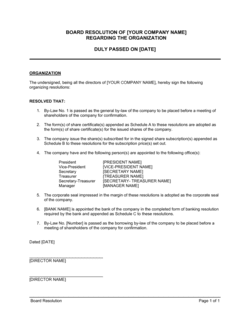
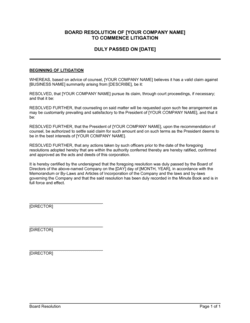
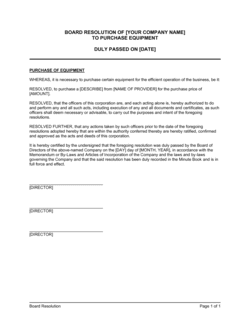
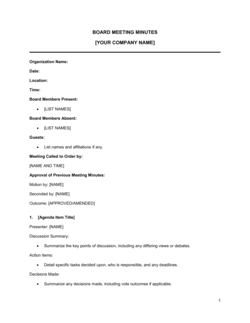
Board Resolution Establishing Performance Committee Template

Free Word download • Edit online • Save & share with Drive • Export to PDF

1 page20–30 min to fillDifficulty: StandardSignature requiredLegal review recommended
Learn more ↓
FreeBoard Resolution Establishing Performance Committee Template

At a glance

What it is
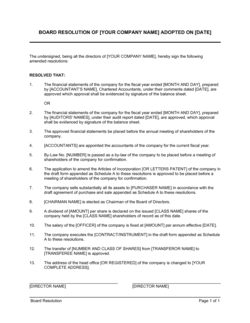
A Board Resolution Establishing a Performance Committee is a formal binding corporate document by which a board of directors officially creates a standing committee tasked with overseeing executive performance, goal-setting, and accountability. This free Word download gives you a complete, attorney-reviewed starting point you can edit online and export as PDF for execution at your next board meeting.
When you need it
Use it when your board decides to delegate executive performance oversight to a dedicated subcommittee — typically at initial governance setup, after a significant leadership change, or when investors or regulators require a formal accountability structure.
What's inside
Recitals establishing authority, committee purpose and scope, membership composition and term limits, quorum and voting requirements, charter of powers and duties, reporting obligations to the full board, and the ratification and signature block needed for the resolution to take legal effect.

What is a Board Resolution Establishing a Performance Committee?

A Board Resolution Establishing a Performance Committee is a formal binding corporate document by which a board of directors officially creates a standing subcommittee with delegated authority to oversee executive performance — including goal-setting, periodic evaluation, and accountability reporting back to the full board. The resolution defines the committee's legal existence, its membership composition and independence requirements, its scope of delegated authority, and its specific duties and reporting obligations. Unlike an ad hoc task force, a performance committee created by board resolution is a permanent governance structure that persists until formally dissolved by another board action, and its decisions carry the legal weight of the board's delegated authority.

Why You Need This Document

Without a formal resolution, a performance committee has no legal standing — its meetings are informal gatherings, its recommendations carry no documented authority, and its evaluations can be challenged or ignored. Investors with board representation increasingly require documented independent performance oversight as a condition of their investment, and a verbal understanding among directors does not satisfy that requirement. For companies in regulated industries or with public reporting obligations, the absence of a formally constituted committee creates a material governance gap that auditors, regulators, and activist shareholders will identify. Conflicts of interest are also far more difficult to manage when performance evaluations happen informally — a properly constituted committee with defined independence standards ensures that the directors setting executive goals are not the same individuals who benefit from those executives' decisions. This template gives you a complete, attorney-reviewed structure that establishes your committee's authority on day one, with the specific duty deadlines and reporting requirements that make governance real rather than nominal.

Which variant fits your situation?

If your situation is…Use this template
Establishing a committee focused on executive pay rather than performance reviewBoard Resolution Establishing Compensation Committee
Creating an audit oversight function at the board levelBoard Resolution Establishing Audit Committee
Forming a nominating or governance committeeBoard Resolution Establishing Nominating Committee
Approving a standalone executive performance review policyExecutive Performance Review Policy
Documenting a one-time board decision rather than creating a standing committeeGeneral Board Resolution
Recording the committee's inaugural meeting and adopted charterCommittee Meeting Minutes
Defining individual director roles and responsibilitiesBoard Director Role Description

Common mistakes to avoid

❌ No bylaw citation in the recitals

Why it matters: A resolution that does not identify its source of authority can be challenged by dissenting directors or in litigation, potentially voiding all actions the committee subsequently takes.

Fix: Locate and cite the specific bylaw article authorizing committee formation before the resolution is drafted. If no such article exists, amend the bylaws first.

❌ Vague or unmeasurable committee duties

Why it matters: A committee whose mandate is described only as 'oversee executive performance' has no clear deliverables, leaving investors and regulators unable to verify that the committee is functioning — and giving directors cover to do nothing.

Fix: Attach specific annual deadlines to each core duty — goal-setting, mid-year review, and year-end evaluation — and require written output from each activity.

❌ Unlimited delegated authority with no board ratification requirement

Why it matters: Giving the committee final authority over all performance-linked decisions, including compensation changes, may exceed the authority your bylaws actually grant to subcommittees and can expose directors to breach-of-fiduciary-duty claims.

Fix: Enumerate the specific decisions the committee can make unilaterally, and explicitly reserve all others — particularly material compensation adjustments — for full board approval.

❌ Fixed quorum number that doesn't adjust for membership changes

Why it matters: If the resolution states 'quorum is two members' and membership later drops to two because a director resigns, the committee can never reach quorum and is effectively paralyzed.

Fix: Define quorum as a fraction of current membership — 'a majority of members then in office' — so it scales automatically with any membership changes.

❌ No written reporting requirement

Why it matters: Verbal-only committee reports leave no documentary record of what was communicated to the full board, creating gaps that are exploited in shareholder litigation and regulatory examinations.

Fix: Require the committee chair to submit a written summary to the full board at each regularly scheduled board meeting, and retain those summaries in the corporate minute book.

❌ Omitting a dissolution or amendment clause

Why it matters: A committee with no mechanism for amendment or dissolution can persist long after its mandate is obsolete, creating ongoing director liability and confusing governance responsibilities.

Fix: Include an explicit clause stating that the committee may be amended or dissolved only by majority vote of the full board, and that any such action must be recorded in the board minutes.

The 10 key clauses, explained

Recitals and authority

In plain language: Establishes the legal basis for the resolution — citing the corporation's bylaws or governing statute that authorizes the board to form standing committees.

Sample language
WHEREAS, the Bylaws of [COMPANY LEGAL NAME] (the 'Company') authorize the Board of Directors to establish standing committees and to delegate authority thereto; and WHEREAS, the Board has determined that it is in the best interests of the Company to establish a Performance Committee;

Common mistake: Failing to cite the specific bylaw article or statutory section that authorizes committee formation. Without this, the resolution's authority can be challenged if a director later contests the committee's actions.

Committee establishment and name

In plain language: Formally declares that the performance committee is created as a standing committee of the board, using the exact name that will appear in all subsequent corporate records.

Sample language
RESOLVED, that the Board of Directors hereby establishes a standing committee of the Board to be known as the 'Performance Committee' (the 'Committee'), effective [EFFECTIVE DATE].

Common mistake: Using an informal or inconsistent name across the resolution, charter, and meeting minutes. Name mismatches create ambiguity about which body took a given action.

Purpose and scope of authority

In plain language: Defines what the committee is responsible for — typically evaluating executive performance against defined goals — and the boundaries of its delegated authority versus what must go to the full board.

Sample language
RESOLVED, that the Committee shall have authority to: (a) establish annual performance objectives for the [CEO / EXECUTIVE OFFICERS]; (b) evaluate performance against such objectives; (c) make recommendations to the full Board regarding [PERFORMANCE-LINKED COMPENSATION / RETENTION / SUCCESSION]; provided that final approval of [SPECIFIC MATTERS] shall remain with the full Board.

Common mistake: Granting the committee unlimited authority to approve compensation changes. Most bylaws and good governance practice require full board ratification for material pay decisions — omitting this restriction creates liability exposure.

Membership composition and qualifications

In plain language: Specifies how many directors serve on the committee, any independence or qualification requirements, and how members are appointed.

Sample language
RESOLVED, that the Committee shall consist of not fewer than [THREE (3)] members of the Board, each of whom shall be an independent director as defined under [APPLICABLE STOCK EXCHANGE RULES / COMPANY POLICY]. Members shall be appointed by the Board Chair and shall serve terms of [ONE (1)] year, renewable for up to [THREE (3)] consecutive terms.

Common mistake: Not defining 'independence' by reference to a specific standard. Courts and regulators apply their own definitions when the document is silent, which may conflict with what the board intended.

Chair appointment and succession

In plain language: Names or describes how the committee chair is selected, the chair's specific responsibilities, and what happens if the chair is unavailable.

Sample language
RESOLVED, that the Board shall designate one member of the Committee as Chair (the 'Committee Chair'). In the absence of the Committee Chair, the members present shall elect a chair pro tempore by majority vote.

Common mistake: Omitting a chair-succession provision. If the designated chair is conflicted or unavailable during a sensitive performance review, the committee can be paralyzed without a clear fallback process.

Quorum and voting requirements

In plain language: States the minimum attendance needed to hold a valid meeting and the vote threshold required to pass a resolution or recommendation.

Sample language
RESOLVED, that a quorum of the Committee shall consist of a majority of its members then in office. Actions of the Committee shall be taken by affirmative vote of a majority of members present at a meeting at which a quorum exists. The Committee may also act by unanimous written consent without a meeting.

Common mistake: Setting quorum at a fixed number rather than a majority fraction. If membership changes and the fixed quorum number exceeds the new membership, the committee becomes inquorate and cannot act.

Duties and responsibilities

In plain language: The core operational mandate — the specific tasks the committee must perform on a scheduled or triggered basis, such as annual goal-setting, mid-year check-ins, and year-end evaluation.

Sample language
RESOLVED, that the duties of the Committee shall include: (a) establishing written performance goals for the [CEO] no later than [JANUARY 31] of each fiscal year; (b) conducting a formal mid-year performance review no later than [JULY 31]; (c) completing an annual performance evaluation no later than [DECEMBER 15]; and (d) presenting findings and recommendations to the full Board at the next regularly scheduled Board meeting.

Common mistake: Defining duties at such a high level of generality that the committee has no clear deliverables. Vague duties lead to committees that meet infrequently, produce no written output, and fail to satisfy investor or regulatory expectations.

Reporting obligations

In plain language: Requires the committee to report its activities, findings, and recommendations to the full board at defined intervals, maintaining board-level accountability.

Sample language
RESOLVED, that the Committee Chair shall present a written report to the full Board of Directors at each regularly scheduled Board meeting summarizing the Committee's activities, decisions, and any recommendations requiring Board action.

Common mistake: Requiring only verbal reports rather than written summaries. Verbal-only reporting leaves no documentary record of what the committee communicated, creating governance gaps in audits or disputes.

Resources and outside advisors

In plain language: Authorizes the committee to engage external consultants, legal counsel, or compensation advisors and to access company resources needed to fulfill its mandate.

Sample language
RESOLVED, that the Committee is authorized to retain independent outside advisors, including legal counsel and performance consultants, at the Company's expense, as the Committee deems necessary to fulfill its responsibilities, subject to a budget not to exceed [$AMOUNT] per fiscal year without full Board approval.

Common mistake: Granting unlimited spending authority for outside advisors with no cap or approval threshold. Without a budget limit, a single committee can commit significant unbudgeted expense without full board visibility.

Ratification, amendment, and dissolution

In plain language: Confirms that all prior actions taken in anticipation of the committee's formation are ratified, and states the process for amending the committee's charter or dissolving the committee.

Sample language
RESOLVED, that all actions taken by directors in anticipation of the establishment of this Committee are hereby ratified and confirmed. The Committee's charter may be amended, and the Committee may be dissolved, only by affirmative vote of a majority of the full Board of Directors.

Common mistake: Omitting a dissolution clause. A committee with no defined dissolution mechanism can persist indefinitely even after its mandate becomes obsolete, creating ongoing liability and governance confusion.

How to fill it out

  1. 1

    Review your bylaws for committee authority

    Before completing the resolution, locate the specific bylaw article that authorizes the board to form standing committees. Cite it verbatim in the recitals section. If your bylaws do not address committees, a bylaw amendment may be required before this resolution is valid.

    💡 Ask your corporate secretary for the most recent restated bylaws — many companies have multiple amendments on file and the operative version is not always obvious.

  2. 2

    Define the committee's name and effective date

    Enter the exact committee name as it will appear in all future corporate records, board minutes, and public disclosures. Set the effective date to the date the board meeting is held, not the date the resolution is drafted.

    💡 Consistency in committee naming across all documents prevents ambiguity in shareholder communications and regulatory filings.

  3. 3

    Specify membership composition and independence standard

    State the number of directors (typically three to five), any independence requirements, and cite the specific standard used to define independence — such as applicable stock exchange listing rules or your company's own governance policy.

    💡 For private companies, even without exchange listing requirements, defining independence by reference to a recognized standard adds credibility with investors and auditors.

  4. 4

    Draft the duties with specific deadlines

    List each substantive duty the committee is expected to perform and attach a calendar deadline to each one — goal-setting by a specific date, mid-year review by another, and year-end evaluation by a third. Avoid generic language like 'periodically' or 'as needed.'

    💡 Tying duties to fiscal-year calendar dates makes it easy to hold the committee accountable and to identify if a required activity was skipped.

  5. 5

    Set the delegated authority boundary clearly

    Distinguish explicitly between what the committee can decide autonomously and what requires full board ratification. List specific categories — such as compensation changes above a dollar threshold — that remain with the full board.

    💡 Investor rights agreements and D&O insurance policies sometimes specify governance requirements; cross-check those documents when defining the committee's authority limits.

  6. 6

    Include the budget for outside advisors

    Set a specific annual dollar cap for the committee's authority to engage external consultants without prior full board approval. This protects the company's budget while giving the committee operational flexibility.

    💡 A $25,000–$50,000 annual cap is common for mid-market companies; adjust based on anticipated complexity of the executive performance review cycle.

  7. 7

    Execute before or at the board meeting

    The resolution must be signed by the requisite number of directors — either at a duly convened board meeting with a quorum present, or by unanimous written consent if permitted by your bylaws. Attach the executed resolution to the official board meeting minutes.

    💡 Have the corporate secretary confirm quorum and attendance in the meeting minutes contemporaneously with execution — reconstructing attendance records after the fact is a common audit finding.

  8. 8

    File and distribute the executed resolution

    Store the executed resolution in the corporate minute book, distribute a copy to each committee member, and note the committee formation in the next shareholder communication or governance disclosure as applicable.

    💡 For companies subject to investor reporting requirements, provide the resolution to your lead investor's general counsel within five business days of execution to satisfy any governance covenants.

Frequently asked questions

What is a board resolution establishing a performance committee?

It is a formal written decision by a corporation's board of directors that creates a standing subcommittee with delegated authority to oversee executive performance evaluation and goal-setting. The resolution defines the committee's purpose, membership, authority, duties, and reporting obligations, and takes legal effect when signed by the requisite directors or approved at a duly convened board meeting.

Why does a board need a separate performance committee?

Separating performance oversight into a dedicated committee allows a smaller group of independent directors to conduct rigorous, confidential evaluations without the full board's involvement at every step. It reduces conflicts of interest — particularly when the CEO or other executives are also board members — and satisfies investor rights agreements and governance frameworks that require independent performance oversight. It also creates a clear documentary trail demonstrating that executive accountability is taken seriously.

What is the difference between a performance committee and a compensation committee?

A performance committee focuses on setting executive goals, evaluating results, and recommending retention or succession actions based on performance. A compensation committee focuses on structuring pay — salary, bonuses, equity grants, and benefits. In many organizations the two functions are combined into a single compensation and performance committee, but separating them is a governance best practice for companies with complex executive structures or significant investor scrutiny.

Does a board resolution require a shareholder vote to establish a committee?

In most jurisdictions, establishing a standing committee is a board-level action that does not require a shareholder vote, provided the corporation's bylaws authorize the board to form committees. Shareholders generally only have authority over matters expressly reserved to them by statute or the governing documents — committee formation is typically not one of them. However, major governance changes that affect shareholder rights may require shareholder approval depending on the jurisdiction and the company's charter.

How many directors should serve on a performance committee?

Three to five independent directors is the most common composition for a performance committee. Three is the practical minimum to maintain a functional quorum; larger committees can become unwieldy for the confidential discussions performance evaluations require. All members should meet the applicable independence standard to prevent the evaluation process from being compromised by directors who report to or have financial relationships with the executives being evaluated.

What happens if the resolution is signed after the committee has already started meeting?

Actions taken by a committee before the formal resolution is executed may lack binding authority, since the committee did not yet legally exist. Including a ratification clause in the resolution — confirming that all prior actions taken in anticipation of the committee's formation are hereby ratified — is the standard fix, but it may not cure defects in jurisdictions where ratification of ultra vires acts is restricted. The safest approach is to execute the resolution before the committee holds its first formal meeting.

Can the performance committee approve executive pay changes?

This depends entirely on what authority the board has expressly delegated in the resolution and what the bylaws permit. Most governance frameworks treat the committee's role as advisory on compensation matters, with final approval reserved for the full board. Granting a committee final authority over material compensation changes without full board ratification can expose the corporation to breach-of-fiduciary-duty claims, particularly if those decisions are later challenged by shareholders or in regulatory proceedings.

Does a performance committee resolution need to be filed with any government authority?

For most private corporations, the resolution is an internal corporate record and does not require filing with a government authority. Publicly traded companies may need to disclose the existence and charter of their performance or compensation committees in proxy statements, annual reports, or governance disclosures required by their stock exchange listing rules. Nonprofit organizations subject to state charity registration may need to reflect governance committee structures in annual filings.

How often should the performance committee charter be reviewed?

An annual review aligned to the start of each fiscal year is standard practice. The review should confirm that the committee's membership meets current independence requirements, that its duties remain aligned with the company's strategic priorities, and that any changes in applicable law, exchange rules, or investor requirements are reflected. Material changes to the charter require a new or amended board resolution.

How this compares to alternatives

vs General Board Resolution

A general board resolution records a one-time decision — approving a contract, authorizing a bank account, or ratifying a prior action. A resolution establishing a performance committee creates a permanent governance structure with ongoing duties, authority, and reporting obligations. Use the general resolution for discrete decisions and this template when creating a standing body.

vs Board Resolution Establishing Compensation Committee

A compensation committee resolution delegates authority over pay structure, equity grants, and benefits. A performance committee resolution focuses on goal-setting, evaluation, and accountability for results. Many companies have both; others combine them into a single compensation and performance committee, which requires a resolution that addresses both mandates.

vs Committee Meeting Minutes

Committee meeting minutes record what a committee discussed and decided at a specific meeting after it is formed. The board resolution is the founding document that gives the committee legal existence and authority in the first place. The resolution must exist before any minutes can be valid records of committee action.

vs Corporate Bylaws Amendment

A bylaws amendment changes the corporation's foundational governance rules and typically requires shareholder approval or a supermajority board vote. A board resolution establishing a performance committee operates within the existing bylaws by exercising the board's existing authority to form committees — no bylaw amendment is needed unless the bylaws do not already authorize standing committees.

Industry-specific considerations

Technology / SaaS

Performance committees at growth-stage technology companies typically focus on OKR achievement, product milestones, and ARR growth targets, with investor board members requiring formal documentation of the evaluation process.

Financial Services

Regulatory frameworks such as the Basel Committee's corporate governance guidelines and SEC rules for public financial institutions often require documented board-level performance oversight, making the resolution a compliance necessity.

Healthcare

Hospital boards and healthcare system governance frameworks frequently mandate a formal performance committee to evaluate the CEO against quality, patient safety, and financial metrics under accreditation standards.

Nonprofit Organizations

Charity regulators in multiple jurisdictions expect nonprofit boards to demonstrate independent evaluation of executive directors; a formal performance committee resolution satisfies this requirement and supports grant compliance documentation.

Jurisdictional notes

United States

Under the Model Business Corporation Act and most state corporation statutes, boards may delegate authority to committees unless the bylaws or articles prohibit it. Delaware General Corporation Law §141(c) is the most commonly cited authority for committee formation. Public companies listed on the NYSE or Nasdaq must comply with exchange governance standards that specify independence requirements for compensation and related committees. State-by-state variations in what committees can and cannot be delegated authority to decide — for example, committees generally cannot authorize dividends or approve mergers — should be confirmed with local counsel.

Canada

The Canada Business Corporations Act and provincial equivalents (such as the Ontario Business Corporations Act) permit boards to delegate to committees but restrict delegation of certain fundamental actions such as filling board vacancies or approving shareholder distributions. Quebec-incorporated corporations must also comply with the Business Corporations Act (Quebec). TSX-listed companies face additional governance requirements under TSX Company Manual Section 461, which addresses committee independence. French-language governance documentation may be required for Quebec-incorporated entities.

United Kingdom

The UK Corporate Governance Code — applicable to premium-listed companies — recommends a remuneration committee that also addresses performance evaluation, but does not mandate a separate performance committee. For private companies incorporated under the Companies Act 2006, committee formation is governed by the articles of association. Directors retain their fiduciary duties when acting through committees; a committee decision does not insulate individual directors from personal liability for decisions that breach their duties to the company.

European Union

EU member states implement corporate governance requirements through national law, with significant variation. The EU Shareholder Rights Directive II (2017/828) requires certain listed companies to adopt remuneration policies subject to shareholder approval, indirectly shaping the authority a performance committee may exercise. GDPR considerations apply when the committee processes personal data related to executive performance evaluations, including setting appropriate data retention and access controls. German co-determination law (Mitbestimmung) requires employee representation on supervisory boards, which affects committee composition requirements for larger German entities.

Template vs lawyer — what fits your deal?

PathBest forCostTime
Use the templatePrivate companies with straightforward governance needs and existing bylaws that clearly authorize committee formationFree30–60 minutes
Template + legal reviewCompanies with investor board seats, complex bylaws, or performance-linked compensation that could trigger securities or employment law issues$300–$8002–5 business days
Custom draftedPublicly traded companies, regulated financial institutions, or organizations whose governance documents are subject to exchange listing standards or regulatory examination$1,500–$5,000+1–3 weeks

Glossary

Board Resolution
A formal written decision made by a board of directors that carries the legal authority of the full board and is entered into the corporate record.
Standing Committee
A permanent subcommittee of the board with ongoing delegated authority, as distinguished from an ad hoc committee created for a single task.
Charter (Committee)
A written document that defines a committee's purpose, authority, composition, and procedures — often adopted as an exhibit to the forming resolution.
Quorum
The minimum number of committee members who must be present for the committee to conduct business and take binding votes.
Recitals
The introductory 'WHEREAS' clauses of a resolution that establish the factual background and legal authority supporting the board's action.
Operative Clauses
The 'RESOLVED' clauses that state the specific decisions and actions the board is formally authorizing.
Delegated Authority
The scope of powers a board formally transfers to a committee — defining what the committee can decide independently versus what requires full board approval.
Term Limit (Committee)
The maximum consecutive period a director may serve on a specific committee before rotation is required, designed to prevent entrenchment.
Ratification
Formal board approval of a prior action, confirming it is valid and binding as if originally authorized — used when a committee acts between board meetings.
Fiduciary Duty
The legal obligation of board members to act in the best interests of the corporation and its stakeholders, which extends to committee members acting within their delegated authority.
Executive Session
A closed portion of a meeting from which management is excluded, used by the committee to discuss sensitive performance matters candidly.

Part of your Business Operating System

This document is one of 3,000+ business & legal templates included in Business in a Box.

  • Fill-in-the-blanks — ready in minutes
  • 100% customizable Word document
  • Compatible with all office suites
  • Export to PDF and share electronically

Create your document in 3 simple steps.

From template to signed document — all inside one Business Operating System.
1
Download or open template

Access over 3,000+ business and legal templates for any business task, project or initiative.

2
Edit and fill in the blanks with AI

Customize your ready-made business document template and save it in the cloud.

3
Save, Share, Send, Sign

Share your files and folders with your team. Create a space of seamless collaboration.

Save time, save money, and create top-quality documents.

★★★★★

"Fantastic value! I'm not sure how I'd do without it. It's worth its weight in gold and paid back for itself many times."

Managing Director · Mall Farm
Robert Whalley
Managing Director, Mall Farm Proprietary Limited
★★★★★

"I have been using Business in a Box for years. It has been the most useful source of templates I have encountered. I recommend it to anyone."

Business Owner · 4+ years
Dr Michael John Freestone
Business Owner
★★★★★

"It has been a life saver so many times I have lost count. Business in a Box has saved me so much time and as you know, time is money."

Owner · Upstate Web
David G. Moore Jr.
Owner, Upstate Web

Run your business with a system — not scattered tools

Stop downloading documents. Start operating with clarity. Business in a Box gives you the Business Operating System used by over 250,000 companies worldwide to structure, run, and grow their business.

Free Forever Plan · No credit card required