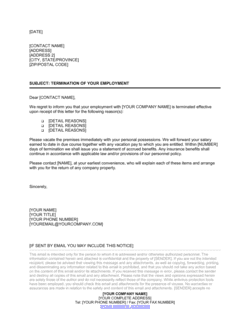
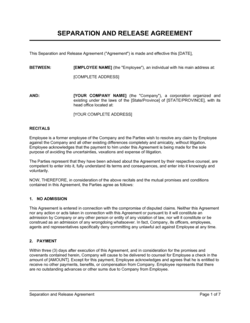
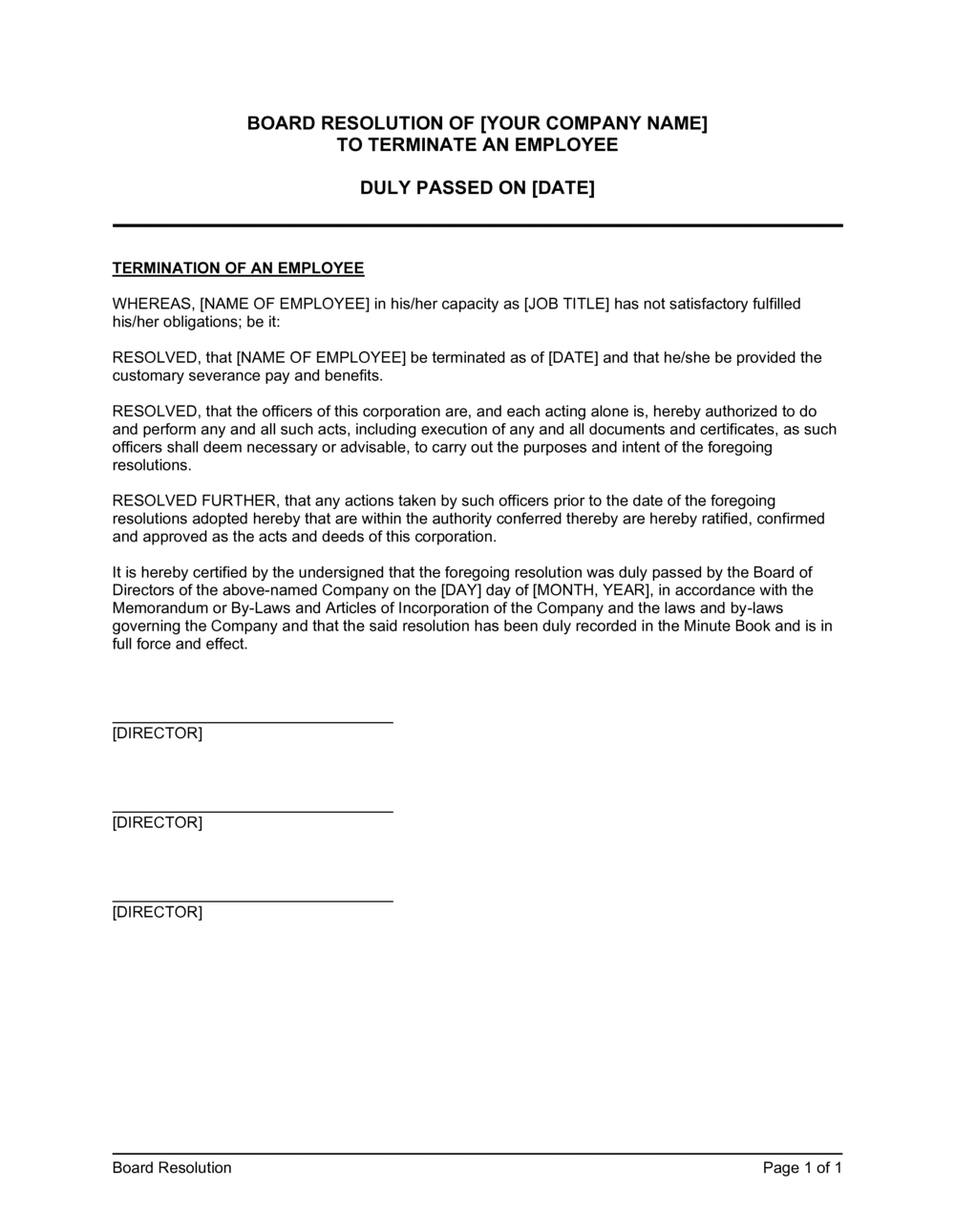
Board Resolution to Terminate an Employee Template

Free Word download • Edit online • Save & share with Drive • Export to PDF

1 page20–30 min to fillDifficulty: StandardSignature requiredLegal review recommended
Learn more ↓
FreeBoard Resolution to Terminate an Employee Template

At a glance

What it is
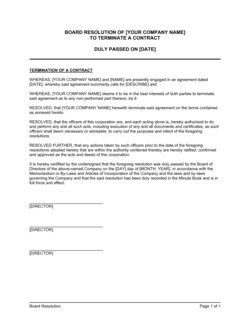
A Board Resolution to Terminate an Employee is a formal corporate document that records the board of directors' official decision to end an individual's employment. It functions as binding internal corporate authority — establishing that the termination was approved at the board level, documenting the vote, and creating an auditable record for legal, regulatory, and HR purposes. This free Word download can be edited online and exported as PDF for execution and filing in your corporate minute book.
When you need it
Use it when terminating a senior employee, officer, or executive whose appointment was originally authorized by the board, or whenever your corporate bylaws, employment agreement, or shareholder agreement requires board-level approval before termination can proceed. It is also essential when the termination carries significant legal or financial exposure — such as a wrongful dismissal risk, severance above a defined threshold, or involvement of a shareholder-employee.
What's inside
Corporate identification, recitals establishing the basis for the resolution, the board vote and quorum confirmation, the termination decision with effective date, any authorized severance or compensation terms, instructions to officers to execute the decision, and the signatures of all directors who participated in the vote.

What is a Board Resolution to Terminate an Employee?

A Board Resolution to Terminate an Employee is a formal corporate governance document that records the board of directors' binding decision to end a specific individual's employment. It identifies the company and the affected employee, confirms that the board convened with valid quorum and conducted a proper vote, states whether the termination is for cause or without cause, authorizes any severance or final compensation to be paid, and delegates implementation authority to a named officer. Unlike the termination letter delivered to the employee, the resolution is an internal corporate record filed in the minute book — it establishes that the company had proper authority to act and that the decision was made at the right governance level before any action was taken.

Why You Need This Document

Without a board resolution, an officer or executive termination lacks the corporate authority that bylaws, employment agreements, and corporate statutes typically require — and that gap becomes the first line of attack in any wrongful dismissal or breach of contract claim. Courts and arbitrators scrutinize whether the correct decision-making body approved the action, whether quorum was met, and whether the resolution predated the employee's notification. A missing or retroactively signed resolution signals procedural failure, weakens the company's legal position, and can expose individual directors and officers to personal liability for acting without authority. For terminations involving material severance, cause grounds, or employees who hold equity, the resolution also creates the paper trail that auditors, insurers, and future investors will expect to find in the corporate minute book. This template gives you a complete, board-ready document that covers every required element — from recitals through signature blocks — so you can execute the decision with the governance formality it demands.

Which variant fits your situation?

If your situation is…Use this template
Terminating a CEO or C-suite executive appointed by the boardBoard Resolution to Terminate an Employee
Terminating a non-officer employee below board-appointment levelEmployee Termination Letter
Removing a director from the board itselfBoard Resolution to Remove a Director
Terminating an independent contractor engaged by the boardIndependent Contractor Termination Letter
Documenting a resignation accepted by the boardBoard Resolution Accepting Resignation
Terminating an employee and simultaneously settling all claimsSeparation Agreement and Release
Terminating employment due to a company-wide reduction in forceLayoff Letter (Reduction in Force)

Common mistakes to avoid

❌ Executing the resolution after the termination letter is already delivered

Why it matters: A board resolution that post-dates the termination letter shows the corporate authority was created retroactively — courts and arbitrators treat this as evidence of a governance failure, weakening the company's position in wrongful dismissal litigation.

Fix: Execute and file the board resolution before or simultaneously with delivering the termination letter. Use written consent procedures when speed is required.

❌ Omitting cause vs. no-cause distinction

Why it matters: Leaving the termination type unspecified forces courts to interpret the circumstances — and ambiguity in employment documents is routinely resolved against the drafter, the employer.

Fix: State explicitly in the operative clause whether the termination is 'with cause' or 'without cause,' and ensure that characterization is consistent with the severance terms, the termination letter, and any separation agreement.

❌ Using a quorum that falls short of bylaw requirements

Why it matters: A resolution passed without a valid quorum is void, meaning the company technically never authorized the termination — creating personal liability exposure for the officers who carried it out.

Fix: Count the directors available and confirm the number against your bylaws' quorum threshold before scheduling the vote. If quorum cannot be achieved, use written consent signed by the required majority.

❌ Failing to condition severance on a signed release

Why it matters: Paying severance without requiring a release of claims gives the employee full payment and leaves the company exposed to a wrongful dismissal lawsuit — the employee has nothing left to trade.

Fix: Add a standard condition: 'Severance is contingent upon [EMPLOYEE NAME]'s execution of a Separation Agreement and Release of Claims in a form acceptable to the Company.' Pair the resolution with a separate separation agreement.

❌ Authorizing severance below the statutory minimum

Why it matters: If the board-authorized amount is less than what employment standards legislation requires, the statutory minimum applies regardless — and the employee may claim the shortfall plus penalties.

Fix: Before completing the severance clause, confirm the minimum severance or notice entitlement under the applicable jurisdiction's employment standards act and ensure the authorized amount meets or exceeds it.

❌ Revoking system access before notifying the employee

Why it matters: Locking an employee out of systems before the termination meeting effectively announces the termination — triggering immediate legal response, sometimes before the company is prepared, and can support a constructive dismissal narrative.

Fix: Schedule access revocation to occur at the same time as or immediately after the notification meeting, not in advance. The resolution should specify a time of day, not just a date.

The 9 key clauses, explained

Corporate identification and recitals

In plain language: Opens the resolution by identifying the company's full legal name, state or province of incorporation, and the factual background that prompted the board's decision to act.

Sample language
WHEREAS, [COMPANY LEGAL NAME], a [STATE/PROVINCE] [ENTITY TYPE] (the 'Company'), employs [EMPLOYEE FULL NAME] as [JOB TITLE]; and WHEREAS, the Board has determined that it is in the best interests of the Company to terminate [EMPLOYEE FULL NAME]'s employment effective [DATE];

Common mistake: Using a trade name instead of the registered corporate entity name. If the company name on the resolution doesn't match the employment agreement or payroll records, the document's authority can be challenged.

Meeting date, quorum, and vote confirmation

In plain language: States when and how the board convened — in person, virtually, or by written consent — confirms that quorum was achieved, and records how each director voted.

Sample language
A [special / regular / written consent] meeting of the Board of Directors of the Company was held on [DATE]. A quorum of [NUMBER] out of [TOTAL NUMBER] directors was present. The following resolution was adopted by a vote of [X] in favor, [Y] opposed, and [Z] abstaining.

Common mistake: Failing to confirm quorum. A resolution passed without quorum is void under most corporate statutes, meaning the termination lacks valid corporate authority regardless of what the document says.

Termination decision and effective date

In plain language: The operative clause — the board's actual decision to terminate employment, naming the employee, stating whether it is for cause or without cause, and specifying the exact effective date.

Sample language
RESOLVED, that the employment of [EMPLOYEE FULL NAME] as [JOB TITLE] of the Company is hereby terminated, [with / without] cause, effective [DATE] (the 'Termination Date').

Common mistake: Omitting whether the termination is for cause or without cause. This distinction determines severance obligations and the company's legal exposure, and leaving it unspecified creates ambiguity that employees exploit in wrongful dismissal claims.

Basis for termination (cause, if applicable)

In plain language: When terminating for cause, this clause documents the specific grounds — misconduct, breach of contract, gross negligence, fraud — that justify dismissal without severance.

Sample language
WHEREAS, [EMPLOYEE FULL NAME] has engaged in [DESCRIPTION OF CONDUCT], which constitutes [gross negligence / willful misconduct / material breach of the Employment Agreement dated [DATE]], as documented in [REFERENCE TO INVESTIGATION OR RECORDS];

Common mistake: Documenting cause grounds that are too vague to withstand legal scrutiny — phrases like 'performance issues' without specific documented incidents. Courts require particularized, documented facts to sustain a for-cause termination.

Severance and final compensation authorization

In plain language: Authorizes the specific compensation — severance pay, notice pay, unused vacation payout, and benefits continuation — to be paid to the employee upon termination, and designates the officer responsible for executing the payment.

Sample language
RESOLVED FURTHER, that the Company shall pay [EMPLOYEE FULL NAME] severance in the amount of $[AMOUNT], representing [X weeks/months] of base salary, plus accrued and unused vacation of [X] days, payable on [DATE], subject to execution of a release of claims in a form approved by legal counsel.

Common mistake: Authorizing a severance amount in the resolution that conflicts with the formula in the employment agreement. The lower of the two amounts may control in the employee's favor, creating a dispute even after the resolution is signed.

Return of company property and system access

In plain language: Directs the employee to return all company property — devices, records, access credentials — by the effective date, and authorizes IT and HR to revoke access on or before termination.

Sample language
RESOLVED FURTHER, that [EMPLOYEE FULL NAME] shall return all Company property, including without limitation electronic devices, records, and access credentials, no later than [DATE], and that the Company's IT department is authorized to revoke all system access effective [DATE AND TIME].

Common mistake: Setting the access revocation date after the effective termination date. A terminated employee retaining system access after their last day creates data security and trade-secret exposure.

Confidentiality and post-employment obligations reminder

In plain language: Reaffirms that the terminated employee's post-employment obligations — confidentiality, non-compete, non-solicitation, and IP assignment — survive the termination and remain enforceable.

Sample language
RESOLVED FURTHER, that [EMPLOYEE FULL NAME]'s obligations under Sections [X] (Confidentiality), [X] (Non-Solicitation), and [X] (Intellectual Property Assignment) of the Employment Agreement dated [DATE] shall survive the termination of employment and continue in full force and effect.

Common mistake: Omitting this clause on the assumption that the employment agreement already covers it. The resolution is an independent corporate record — including the reminder signals that the board was aware of and intended to preserve these obligations.

Authorization of officers to implement the decision

In plain language: Delegates authority to one or more named officers — typically the CEO, CFO, or HR director — to sign termination letters, process final pay, execute any separation agreement, and take all steps needed to carry out the board's decision.

Sample language
RESOLVED FURTHER, that the [CEO / President / HR Director] of the Company is hereby authorized and directed to execute and deliver all documents, notices, and payments required to effectuate the foregoing termination, including a written termination letter and any required separation agreement.

Common mistake: Authorizing 'any officer' without naming a specific person. Broad delegations create confusion about who is responsible and can slow execution of a time-sensitive termination.

Director signatures and date of execution

In plain language: Closes the resolution with the signature lines for each director who voted in favor, the date each director signed, and — where written consent is used — a confirmation that all required directors have signed.

Sample language
IN WITNESS WHEREOF, the undersigned directors of [COMPANY LEGAL NAME], constituting [a quorum of / all of] the Board of Directors, have executed this Resolution as of [DATE]. [DIRECTOR NAME], Director _______________ Date: _______________

Common mistake: Having only one director sign a resolution that requires a majority vote. A single signature does not evidence a board decision — it looks like a unilateral management action and will not survive governance scrutiny.

How to fill it out

  1. 1

    Confirm board authority is required

    Review the employee's employment agreement, your corporate bylaws, and any shareholder agreement to confirm whether board authorization is required before this termination can proceed. Not every termination requires a board resolution — but officer and executive terminations almost always do.

    💡 If the employee was appointed by a board resolution, assume a board resolution is required to undo that appointment. Check the original appointment resolution for specific removal procedures.

  2. 2

    Enter the company's full legal name and incorporation details

    Use the exact registered corporate name — including LLC, Inc., Corp., or Ltd. suffix — and the state or province of incorporation. Cross-reference your certificate of incorporation or articles.

    💡 Mismatches between the resolution and the employment agreement are a common source of enforceability challenges. Use the same legal name that appears on the employee's contract.

  3. 3

    Record the meeting date and quorum confirmation

    State whether this is a regular, special, or written-consent resolution. Count the directors present or signing and confirm the number meets quorum under your bylaws. Record each director's vote — in favor, opposed, or abstaining.

    💡 For urgent terminations, a written consent resolution signed by all directors is the fastest path to valid board authority — no meeting scheduling required in most jurisdictions.

  4. 4

    Complete the termination clause with the effective date

    Name the employee and their exact job title. State explicitly whether the termination is for cause or without cause. Enter the precise effective date — which may be the same day, end of notice period, or a date specified by the employment agreement.

    💡 Align the effective date with the pay date calculation in the severance clause to avoid an unintended gap or overlap in compensation obligations.

  5. 5

    Document cause grounds (if applicable)

    If terminating for cause, describe the specific conduct in the recitals — referencing investigation findings, written warnings, or documented incidents. Vague descriptions will not support a for-cause defense in litigation.

    💡 Attach supporting documentation (investigation report, performance improvement plan, incident log) as an exhibit to the resolution rather than embedding full details in the operative text.

  6. 6

    Authorize the severance and final pay amounts

    Enter the exact severance figure, calculation basis (e.g., 8 weeks of base salary at $X/week), vacation payout, and payment date. Confirm this figure meets or exceeds the statutory and contractual minimums for the employee's jurisdiction.

    💡 Include the condition that severance is payable only upon execution of a release of claims — this is standard practice and significantly reduces wrongful dismissal exposure.

  7. 7

    Name the authorized officer and collect director signatures

    Designate a specific officer by title and name to execute the termination letter and related documents. Then collect signatures from all directors who voted in favor, with the date of signing for each.

    💡 Store the fully executed resolution in the corporate minute book before the termination letter is delivered. The resolution should precede — not follow — the employee notification.

  8. 8

    Deliver the termination letter and initiate offboarding

    Once the resolution is executed, the authorized officer delivers the written termination letter, initiates payroll processing for final pay and severance, and coordinates IT access revocation and property return per the resolution's instructions.

    💡 Keep a timestamped record of when the termination letter was delivered — in person, by email, or by courier — as the delivery date may affect notice period calculations and claim limitation periods.

Frequently asked questions

What is a board resolution to terminate an employee?

A board resolution to terminate an employee is a formal corporate document that records the board of directors' official decision to end a specific employee's — typically an officer's or executive's — employment. It establishes that the termination was properly authorized at the board level, documents the vote and quorum, and creates a binding internal record for legal, HR, and governance purposes. It is distinct from a termination letter, which is the external document delivered to the employee.

When is a board resolution required to terminate an employee?

A board resolution is typically required when the employee being terminated holds a position that was originally appointed by the board — such as CEO, CFO, COO, or another named officer. It is also required when the company's bylaws, the employee's employment agreement, or a shareholder agreement mandates board approval before termination. For rank-and-file employees managed by operational staff, a board resolution is generally not necessary.

What is the difference between a board resolution and a termination letter?

A board resolution is an internal corporate governance document that authorizes the decision to terminate — it is filed in the minute book and establishes the company's legal authority to act. A termination letter is the external communication delivered to the employee that formally notifies them of the termination, the effective date, and severance or notice entitlements. Both documents are needed for an officer-level termination: the resolution must precede the letter.

Does a board resolution need to be signed by all directors?

Not necessarily. Most corporate statutes require a majority of directors present at a duly constituted meeting to pass a resolution, provided quorum is met. For a written consent resolution in lieu of a meeting, many jurisdictions require signatures from all directors — or at least the number needed to constitute a majority. Check your jurisdiction's corporate statute and your company's bylaws for the exact threshold.

Should the board resolution specify severance?

Yes. Including the authorized severance amount — or explicitly confirming that severance will be paid per the employment agreement's formula — demonstrates that the board reviewed and approved the financial implications of the termination. It also provides the authorized officer with a clear mandate and limits their discretion to deviate from the board's intentions. Always condition severance payment on the employee's execution of a release of claims.

Does a board resolution protect the company from wrongful dismissal claims?

A properly executed board resolution significantly strengthens the company's legal position by demonstrating that the termination was deliberate, authorized at the correct governance level, and documented before action was taken. However, it does not immunize the company from all claims — if the termination was discriminatory, retaliatory, or otherwise unlawful, the resolution documents the decision but does not cure the underlying legal violation. Legal review is recommended for high-risk terminations.

What happens if the board resolution is not executed before the employee is notified?

Retroactive board resolutions are a significant governance red flag. A resolution dated after the termination letter was delivered suggests the company acted without proper authority and is now creating paper to cover the gap. In litigation, this sequence undermines the company's credibility and may support the employee's claim that proper procedures were not followed. Always complete the resolution first, even using emergency written consent procedures.

Do I need a lawyer to prepare a board resolution to terminate an employee?

For straightforward officer terminations with clear contractual severance terms and no performance or misconduct disputes, a well-drafted template is a solid starting point. Legal review is strongly recommended when the termination is for cause and may be contested, when severance exposure is material, when the employee is also a shareholder, or when the employee works in a jurisdiction with complex statutory obligations. A 1–2 hour attorney review typically costs $300–$600 and is cost-effective relative to wrongful dismissal exposure.

How this compares to alternatives

vs Employee Termination Letter

A termination letter is the external document delivered to the employee notifying them of the decision. A board resolution is the internal corporate authority document that authorizes the decision. The resolution must be completed first; the termination letter operationalizes it. Delivering a termination letter without a preceding board resolution for an officer-level hire leaves a governance gap.

vs Separation Agreement and Release

A separation agreement is a bilateral contract between the company and the departing employee that settles all claims in exchange for severance. A board resolution is a unilateral corporate document that authorizes the termination decision. Both are typically used together for executive terminations — the resolution authorizes the action, and the separation agreement closes the legal exposure.

vs Board Resolution to Appoint an Officer

A board resolution to appoint an officer creates the employment or officer relationship with corporate authority. A board resolution to terminate reverses that decision with equal formality. Using the same governance mechanism for both appointment and termination creates a clean, symmetrical corporate record that withstands scrutiny.

vs Layoff Letter (Reduction in Force)

A layoff letter is an operational HR document used for staff-level reductions in force and does not, on its own, constitute corporate board authority. A board resolution to terminate is required specifically for officer and executive positions where the board's explicit authorization is mandated by bylaws or employment agreements. Large-scale reductions affecting multiple non-officer employees can typically proceed with management authority alone.

Industry-specific considerations

Technology / SaaS

IP assignment and system access revocation are critical in tech terminations; the resolution should explicitly authorize immediate credential revocation and reference surviving IP assignment obligations.

Financial Services

Regulatory notification obligations — FINRA U5 filings, FCA notifications — may be triggered by officer terminations; the resolution should authorize the compliance officer to make required regulatory disclosures.

Healthcare

Termination of credentialed or licensed clinical officers may require notifications to licensing boards; the resolution should authorize the compliance function to manage those filings alongside the corporate action.

Professional Services

Client non-solicitation obligations are particularly significant when terminating a senior professional with active client relationships; the resolution should expressly reaffirm those post-employment restrictions.

Jurisdictional notes

United States

At-will employment allows termination without cause in most states, but board resolutions remain critical to establish corporate authority for officer-level dismissals. Delaware General Corporation Law §142 requires that officers be appointed and removed per bylaws, meaning a resolution is the standard mechanism. Non-compete enforceability and WARN Act notice obligations (for employers with 100+ employees) must be reviewed before the effective date is set.

Canada

Canadian officers and executives are entitled to reasonable notice of termination or pay in lieu, which common law can extend to 12–24 months for senior leaders. The board resolution's severance clause must meet or exceed provincial Employment Standards Act minimums as well as any additional common-law entitlement. In Quebec, the Civil Code governs employment relationships and imposes additional protections; French-language documentation may be required for provincially regulated employers.

United Kingdom

Under UK company law, a director who is also an employee holds two separate roles — director and employee — and removing them from the board does not automatically terminate employment. A separate board resolution addressing the employment termination is therefore required alongside any board removal procedure under the Companies Act 2006. Statutory minimum notice (one week per year of service after two years) applies, and unfair dismissal claims are available to employees with two or more years of continuous service.

European Union

EU member states impose some of the strongest employee protections globally, with mandatory consultation periods, works council notifications in many countries, and statutory severance minimums that often exceed contractual provisions. In France, Germany, and Spain, terminating an executive without following prescribed administrative procedures can render the termination invalid regardless of the board's authority. The EU Transparent and Predictable Working Conditions Directive also requires that any post-employment restrictions (non-compete, non-solicitation) be communicated and compensated in compliance with national law.

Template vs lawyer — what fits your deal?

PathBest forCostTime
Use the templateOfficer terminations without cause where the employment agreement specifies clear severance terms and no dispute is anticipatedFree30–60 minutes
Template + legal reviewSenior executive terminations with material severance, contested cause grounds, or employees who are also shareholders$300–$8001–3 days
Custom draftedC-suite dismissals with litigation risk, multi-jurisdiction employment, regulatory notification obligations, or equity clawback provisions$1,500–$5,000+3–10 business days

Glossary

Board Resolution
A formal written record of a decision made by a company's board of directors, which carries binding corporate authority once passed by the required vote.
Quorum
The minimum number of directors who must be present at a meeting for the board's votes and decisions to be legally valid.
Recitals
The introductory 'whereas' clauses in a resolution that set out the background facts and reasons supporting the board's decision.
Termination for Cause
Dismissal based on specific documented grounds — such as misconduct, gross negligence, fraud, or material breach of the employment agreement — typically without severance obligation.
Termination Without Cause
Dismissal for business or strategic reasons unrelated to the employee's conduct, which generally triggers severance or notice obligations under the employment agreement or applicable law.
Effective Date
The specific calendar date on which the termination takes legal effect and the employment relationship formally ends.
Written Consent in Lieu of Meeting
A mechanism allowing directors to pass a resolution by signing a written document rather than convening a physical or virtual meeting, permitted by most corporate statutes when all directors consent.
Corporate Minute Book
The official records repository for a corporation's resolutions, meeting minutes, share register, and governance documents — the authoritative source of the company's legal history.
Severance Authorization
The board's express approval of the compensation package — lump sum, continued salary, or benefits continuation — to be paid to the terminated employee.
Indemnification
A provision protecting directors who voted to authorize the termination from personal liability arising from the employment-related decision, typically covered by the corporate bylaws or D&O insurance.
At-Will Employment
An employment arrangement, recognized in most US states, that allows either party to end the relationship at any time for any lawful reason — but board resolutions still document authority and protect against internal governance disputes.

Part of your Business Operating System

This document is one of 3,000+ business & legal templates included in Business in a Box.

  • Fill-in-the-blanks — ready in minutes
  • 100% customizable Word document
  • Compatible with all office suites
  • Export to PDF and share electronically

Create your document in 3 simple steps.

From template to signed document — all inside one Business Operating System.
1
Download or open template

Access over 3,000+ business and legal templates for any business task, project or initiative.

2
Edit and fill in the blanks with AI

Customize your ready-made business document template and save it in the cloud.

3
Save, Share, Send, Sign

Share your files and folders with your team. Create a space of seamless collaboration.

Save time, save money, and create top-quality documents.

★★★★★

"Fantastic value! I'm not sure how I'd do without it. It's worth its weight in gold and paid back for itself many times."

Managing Director · Mall Farm
Robert Whalley
Managing Director, Mall Farm Proprietary Limited
★★★★★

"I have been using Business in a Box for years. It has been the most useful source of templates I have encountered. I recommend it to anyone."

Business Owner · 4+ years
Dr Michael John Freestone
Business Owner
★★★★★

"It has been a life saver so many times I have lost count. Business in a Box has saved me so much time and as you know, time is money."

Owner · Upstate Web
David G. Moore Jr.
Owner, Upstate Web

Run your business with a system — not scattered tools

Stop downloading documents. Start operating with clarity. Business in a Box gives you the Business Operating System used by over 250,000 companies worldwide to structure, run, and grow their business.

Start free · No credit card required