Board Resolution to Purchase Equipment Template

Free Word download • Edit online • Save & share with Drive • Export to PDF

1 page20–30 min to fillDifficulty: StandardSignature requiredLegal review recommended
Learn more ↓
FreeBoard Resolution to Purchase Equipment Template

At a glance

What it is
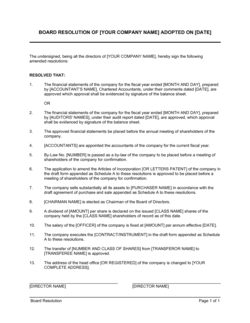
A Board Resolution to Purchase Equipment is a formal corporate document in which a company's board of directors officially votes to authorize the acquisition of specific equipment — whether bought outright, financed, or leased. This free Word download gives you a structured, ready-to-sign resolution you can edit online, tailor to your purchase details, and export as PDF for corporate records, lenders, or vendors in minutes.
When you need it
Use it whenever a capital expenditure on equipment requires formal board approval — typically when the purchase exceeds your company's internal authorization threshold, when a lender or lessor requires documented board consent, or when corporate bylaws mandate a recorded vote before significant asset acquisitions.
What's inside
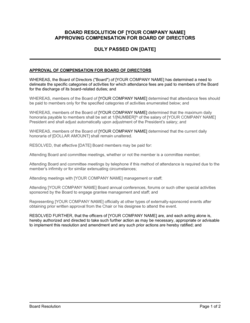
Company and meeting details, a recitals block explaining the business rationale, the formal resolution granting purchase authority, equipment description and purchase price, financing or lease terms if applicable, authorized signatories, and a certification block with officer signatures and date.

What is a Board Resolution to Purchase Equipment?

A Board Resolution to Purchase Equipment is a formal written document in which a corporation's board of directors officially votes to authorize the acquisition of specific equipment — whether purchased outright, financed through a bank loan, or acquired under a lease arrangement. It records the corporate decision, identifies the equipment being acquired, sets a maximum authorized purchase price, designates the officer empowered to sign purchase and financing documents on the company's behalf, and is filed in the corporate minute book as the permanent governance record of the transaction. The resolution functions as the bridge between the board's strategic decision and the officer's legal authority to execute binding agreements in the company's name.

Why You Need This Document

Without a board resolution, an officer who signs an equipment purchase agreement or financing contract may be acting beyond their actual authority — exposing themselves to personal liability and giving the company grounds to void the transaction. Lenders and equipment financing companies routinely require a certified board resolution as a condition to funding; missing or defective authorization is one of the most common reasons equipment loan closings are delayed. For audit and tax purposes, a resolution ties a capital expenditure to a documented business decision, supporting the depreciation schedule and satisfying internal controls requirements. This template gives you a clean, lender-ready resolution in under 30 minutes — with the recitals, operative clauses, financing authorization, and certification block that counterparties actually need to proceed.

Which variant fits your situation?

If your situation is…Use this template
Purchasing equipment outright with no financingBoard Resolution To Purchase Equipment (Cash)
Financing equipment through a bank loanBoard Resolution To Obtain a Loan
Leasing equipment under an operating or finance leaseBoard Resolution To Enter Into a Lease Agreement
Authorizing an officer to sign a vendor contract for equipmentBoard Resolution To Authorize a Signing Officer
Approving a broad capital expenditure budget rather than a single itemBoard Resolution To Approve Annual Budget
Disposing of or selling existing equipmentBoard Resolution To Sell Assets
Authorizing the purchase of a vehicle specificallyBoard Resolution To Purchase a Vehicle

Common mistakes to avoid

❌ Using a trade name instead of the registered corporate name

Why it matters: Lenders and auditors require the exact legal entity name from the articles of incorporation. A mismatch between the resolution and the financing agreement can void the authorization and delay or kill a closing.

Fix: Pull the exact legal name from your certificate of incorporation or state corporate registry before drafting, and use that name verbatim throughout the resolution.

❌ Omitting a maximum dollar cap on the authorized purchase

Why it matters: Without a ceiling, the resolution could be read to authorize an officer to spend any amount on that equipment category, exposing the company to unauthorized expenditure and board liability.

Fix: Always state a specific not-to-exceed dollar amount in the resolved clause, set slightly above the expected final price to allow for minor cost increases without requiring a new resolution.

❌ Failing to separately authorize the financing agreement

Why it matters: A resolution that authorizes only the purchase, not the loan or lease used to fund it, is insufficient for most lenders and will stall the financing closing.

Fix: Add a separate 'resolved further' clause that explicitly authorizes entering into the financing agreement, names the lender, states the principal amount and key terms, and grants the officer authority to execute all related loan documents.

❌ Collecting fewer director signatures than required by the bylaws

Why it matters: A resolution signed by fewer directors than the bylaw-mandated threshold is legally void, even if a majority of those who signed approved it — leaving the purchase unauthorized and the officer personally exposed.

Fix: Review your bylaws before circulating the resolution for signature, confirm the required consent threshold (majority, supermajority, or unanimous), and collect signatures from the correct number of directors before proceeding.

❌ Passing the resolution after the purchase agreement is already signed

Why it matters: An after-the-fact resolution does not provide prior authorization — it only ratifies. Some lenders and courts distinguish between prospective authorization and post-hoc ratification, particularly if the company later faces insolvency or shareholder challenge.

Fix: Pass and date the resolution before the officer executes any binding purchase or financing agreement. If pre-signing action was already taken, include explicit ratification language and ensure the resolution is adopted as early as possible.

❌ Vague equipment description in the resolution

Why it matters: A description like 'manufacturing equipment' or 'IT hardware' does not tie the resolution to a specific asset, creating ambiguity for depreciation schedules, insurance claims, and future disposal or refinancing.

Fix: Include make, model, quantity, and serial number or product reference, and attach the vendor's quote or purchase order as an exhibit referenced in the resolution body.

The 9 key clauses, explained

Corporation identification and meeting details

In plain language: States the full legal name of the corporation, the date and type of meeting (regular, special, or written consent), and confirms a quorum was present.

Sample language
The Board of Directors of [CORPORATION LEGAL NAME], a [STATE/PROVINCE] [ENTITY TYPE], held a [special / regular / annual] meeting on [DATE] at [TIME], at which a quorum of directors was present and acting throughout.

Common mistake: Using a trade name or DBA instead of the registered corporate name. Lenders and auditors require the exact legal name from the articles of incorporation, and a mismatch can delay or void a financing transaction.

Recitals (whereas clauses)

In plain language: Sets out the background facts and business justification for the purchase — why the equipment is needed and how it benefits the company.

Sample language
WHEREAS, the Corporation requires [EQUIPMENT DESCRIPTION] to [BUSINESS PURPOSE]; and WHEREAS, the Board has reviewed the proposed acquisition and determined it to be in the best interests of the Corporation;

Common mistake: Skipping recitals entirely and jumping straight to the resolution. Without documented justification, the resolution looks procedurally thin and provides less protection if the decision is later challenged by shareholders or auditors.

Resolved clause — purchase authorization

In plain language: The core operative clause formally authorizing the company to purchase the specified equipment, setting a maximum purchase price.

Sample language
RESOLVED, that the Corporation is hereby authorized to purchase [EQUIPMENT DESCRIPTION], from [VENDOR NAME], for a total purchase price not to exceed [$ AMOUNT], on terms acceptable to the authorized officer.

Common mistake: Omitting a maximum dollar cap on the authorized purchase. Without a cap, the resolution could be interpreted to authorize unlimited expenditure on any equipment of that type.

Equipment description

In plain language: Identifies the equipment being purchased with enough specificity — make, model, serial number if available, and quantity — to be unambiguous in the corporate record.

Sample language
[QUANTITY] [YEAR] [MAKE/MODEL] [EQUIPMENT TYPE], Serial No. [SERIAL NUMBER IF KNOWN], to be used for [INTENDED USE] at [LOCATION].

Common mistake: Using a generic description like 'office equipment' or 'machinery.' Vague descriptions create disputes about what was actually authorized, which can complicate insurance claims, depreciation schedules, and future sale or disposal.

Financing or payment terms

In plain language: Specifies whether the purchase will be made by cash, bank financing, or lease, and authorizes the corporation to enter into the related financing agreement on stated terms.

Sample language
RESOLVED FURTHER, that the Corporation is authorized to enter into a financing agreement with [LENDER NAME] in the principal amount of $[AMOUNT], bearing interest at [RATE]% per annum, repayable over [TERM] months, secured by the purchased equipment.

Common mistake: Authorizing the purchase without separately authorizing the financing. Lenders require a resolution that explicitly references the loan or lease agreement — a purchase-only resolution is insufficient for most equipment financing closings.

Designation of authorized officer

In plain language: Names the specific officer — by title and name — who is authorized to execute all documents, agreements, and payments necessary to complete the purchase.

Sample language
RESOLVED FURTHER, that [OFFICER TITLE], [OFFICER NAME], is hereby authorized and directed to execute and deliver, on behalf of the Corporation, any and all agreements, instruments, and documents required to complete the acquisition described herein.

Common mistake: Authorizing 'any officer' without naming a specific individual. Vendors and lenders often require a named signatory that matches the signing line on their agreements, and a mismatch can cause a closing to fail.

Ratification of prior acts

In plain language: Confirms and ratifies any actions already taken by officers in connection with the purchase before the resolution was formally adopted — covering preliminary agreements, deposits, or letters of intent.

Sample language
RESOLVED FURTHER, that all actions taken by officers of the Corporation prior to the date hereof in connection with the transactions contemplated by this resolution are hereby ratified, confirmed, and approved.

Common mistake: Omitting ratification language when a deposit or letter of intent has already been signed. Without it, those prior acts may be characterized as unauthorized, creating potential personal liability for the officer who signed.

Certification block

In plain language: A statement by the corporate secretary or an officer certifying that the resolution was duly adopted, that a quorum was present, and that the resolution remains in full force.

Sample language
I, [CORPORATE SECRETARY NAME], Secretary of [CORPORATION NAME], hereby certify that the foregoing is a true and correct copy of a resolution duly adopted by the Board of Directors on [DATE], and that the same is in full force and effect.

Common mistake: Having the same person who benefited from or advocated for the purchase certify the resolution. The certifying officer should be the corporate secretary or another officer not directly involved in the transaction.

Director signatures

In plain language: Signature lines for each consenting director with their printed name, title, and date of signature — confirming each director's individual approval.

Sample language
IN WITNESS WHEREOF, the undersigned, being all of the directors of [CORPORATION NAME], have executed this Resolution as of [DATE]. [DIRECTOR NAME] ___________________ [DIRECTOR NAME] ___________________

Common mistake: Collecting only one signature when bylaws require a majority or unanimous consent of the full board. Resolutions signed by fewer directors than the bylaw-required threshold are void, even if every signing director approved.

How to fill it out

  1. 1

    Enter the corporation's full legal name and jurisdiction

    Use the exact legal name as it appears on your articles of incorporation or certificate of formation. Include the state or province of incorporation and entity type (corporation, LLC, etc.).

    💡 Cross-reference your corporate registry filing before filling in this field — a single word difference from the registered name can cause issues with lenders.

  2. 2

    Record the meeting date, type, and quorum confirmation

    Specify whether this is a regular board meeting, a special meeting called for this purpose, or a unanimous written consent in lieu of meeting. Confirm that the required quorum of directors was present.

    💡 If passing by written consent rather than a meeting, check your bylaws and state law to confirm unanimous consent is permitted for this type of transaction.

  3. 3

    Complete the recitals with the business justification

    Describe in two to three 'whereas' clauses why the equipment is needed, how it supports company operations, and that the board reviewed and approved the purchase as being in the company's best interests.

    💡 Concrete justifications — 'to replace aging machinery that has caused three production shutdowns in the past six months' — are more defensible than generic language if the decision is later reviewed.

  4. 4

    Describe the equipment with specificity

    Enter the make, model, quantity, approximate serial number or product SKU if known, and the location or department where the equipment will be used. Attach the vendor quote as an exhibit if available.

    💡 Attach the vendor's purchase order or quote as Exhibit A so the resolution and transaction documents are tied together in the minute book.

  5. 5

    Set the purchase price cap and payment method

    Enter the maximum authorized purchase price. If the purchase is financed, add the financing resolved clause with the lender name, principal amount, interest rate, and repayment term.

    💡 Set the cap at 10–15% above the quoted price to avoid needing a second resolution if final pricing increases slightly during negotiations.

  6. 6

    Name the authorized officer

    Enter the specific officer's full name and title who is authorized to sign purchase agreements, financing documents, and any related instruments on behalf of the corporation.

    💡 Confirm that the named officer's authority is consistent with your bylaws — some bylaws require two officers to co-sign transactions above a certain dollar amount.

  7. 7

    Include ratification language for prior acts

    If any officer has already signed a letter of intent, paid a deposit, or entered negotiations with the vendor before the resolution was adopted, include the ratification clause to formalize those actions retroactively.

    💡 When in doubt, include the ratification clause even if you are not aware of prior acts — it adds no risk and provides a safety net.

  8. 8

    Execute, certify, and file in the minute book

    Collect signatures from the required number of directors, have the corporate secretary certify the resolution, and file the executed original in the corporate minute book alongside any related vendor or lender documents.

    💡 Provide a certified copy to your lender, vendor, and bank account manager if the purchase involves a wire transfer — they will each need it before processing.

Frequently asked questions

What is a board resolution to purchase equipment?

A board resolution to purchase equipment is a formal written record of the board of directors' decision to authorize a specific equipment acquisition. It identifies the equipment, sets a maximum purchase price, designates the officer authorized to sign purchase and financing documents, and is filed in the company's corporate minute book. It serves as both an internal governance record and external evidence of authorized corporate action for lenders, vendors, and auditors.

When is a board resolution required for an equipment purchase?

A board resolution is typically required when the purchase amount exceeds the dollar threshold set in your corporate bylaws for officer-level approval, when a lender or equipment lessor requires documented board consent before funding, or when your company's internal controls mandate board approval for all capital expenditures. Even when not strictly required, passing a resolution creates a clean governance record that protects officers from claims of unauthorized action.

Can a board resolution be passed without a formal meeting?

Yes. Most corporations can pass a resolution by unanimous written consent — where all directors sign the document outside of a formal meeting — provided the company's bylaws and applicable state or provincial corporate law permit this method. Unanimous written consent is the most common approach for routine authorizations like equipment purchases where shareholder controversy is unlikely. Check your bylaws and jurisdiction before using this method.

What information does a lender need from a board resolution?

Lenders typically require the resolution to contain the corporation's full legal name and jurisdiction, the date the resolution was adopted, confirmation that a quorum acted, the specific authorization to enter into the loan or financing agreement, the principal amount and general terms of the financing, and the full name and title of the officer authorized to sign loan documents. Many lenders also require a certification block signed by the corporate secretary.

Does a board resolution to purchase equipment need to be notarized?

Notarization is generally not required for a board resolution to be valid as a corporate governance document. However, some lenders, international vendors, or government contracting authorities may request a notarized or apostilled copy when the transaction involves significant sums or cross-border elements. Check with your lender or counterparty before closing to confirm their specific requirements.

How specific does the equipment description need to be?

As specific as the information available at the time of the resolution allows. At minimum, include the type of equipment, make and model, quantity, and intended use or location. If a serial number or product SKU is known, include it. Attaching the vendor's quote or purchase order as an exhibit to the resolution is best practice and ties the governance record to the transaction document unambiguously.

Can one resolution authorize multiple equipment purchases?

Yes, a single resolution can authorize the purchase of multiple pieces of equipment, provided each item is described with reasonable specificity and a combined or individual dollar cap is stated. Many companies pass an annual capital expenditure resolution that covers a list of approved equipment purchases for the fiscal year, subject to individual and aggregate spending limits.

What happens if equipment is purchased without a board resolution?

A purchase made without required board authorization is technically an ultra vires act — one taken beyond the officer's actual authority. The consequences can include the contract being voidable by the corporation, personal liability for the officer who signed, rejection of the transaction by the company's auditors, and a breach of lender covenants if the company has credit agreements that require board approval for capital expenditures above a threshold.

Do I need a lawyer to prepare a board resolution to purchase equipment?

For a straightforward domestic equipment purchase of moderate value, a well-structured template reviewed against your bylaws is typically sufficient. Engage a lawyer when the purchase involves complex financing structures, cross-border elements, security interests over significant assets, or when the acquisition is large enough to require shareholder approval in addition to board approval. A one-hour legal review typically costs $200–$400 and is worthwhile for any purchase that involves a significant loan commitment.

How this compares to alternatives

vs Board Resolution To Obtain a Loan

A board resolution to obtain a loan authorizes the company to borrow funds generally and designates the signing officer for loan documents, but does not specify what the funds will be used to purchase. A board resolution to purchase equipment authorizes a specific asset acquisition and may incorporate financing terms within the same document. When equipment is financed, lenders often require both resolutions — one for the loan and one for the purchase — or a single combined resolution that covers both authorizations.

vs Board Resolution To Purchase a Vehicle

A vehicle purchase resolution is a narrower document tailored to motor vehicle acquisitions, which typically involve DMV registration, title transfer, and fleet insurance considerations not present in general equipment purchases. Use the vehicle-specific resolution when acquiring cars, trucks, or commercial vehicles; use the equipment resolution for machinery, hardware, and other capital assets.

vs Board Resolution To Enter Into a Contract

A general contract authorization resolution empowers an officer to execute any type of agreement on the company's behalf but lacks the asset-specific and financing-specific language that lenders and auditors require for equipment acquisitions. Use a general contract resolution for services agreements, leases, or vendor contracts; use the equipment purchase resolution when acquiring a physical asset with a defined purchase price.

vs Minutes of Board Meeting

Board meeting minutes are a narrative record of everything discussed and decided at a meeting — agenda, attendees, motions, votes, and outcomes. A board resolution is the operative authorization document extracted or adopted from that meeting. Lenders and counterparties request the resolution, not the full minutes, because it states the specific authorization in a compact, certifiable form. Both should be filed in the minute book.

Industry-specific considerations

Manufacturing

Authorizing CNC machinery, production lines, or industrial equipment purchases that trigger lender covenant reviews and require precise asset descriptions for depreciation schedules.

Healthcare

Medical device and diagnostic equipment purchases often require board authorization to satisfy both corporate governance and regulatory compliance documentation requirements.

Construction

Heavy equipment acquisitions — excavators, cranes, and paving equipment — are typically financed and require lender-compliant board resolutions before loan closing.

Technology / SaaS

Server infrastructure, data center equipment, and specialized hardware purchases above capex thresholds require board authorization to maintain clean governance records for investors and auditors.

Retail / E-commerce

Point-of-sale systems, warehouse automation equipment, and refrigeration units often require financing that mandates a board resolution before the lender disburses funds.

Professional Services

Office fit-out equipment, specialized professional hardware, and fleet vehicles purchased by partnerships or incorporated firms require a resolution to authorize the signatory and satisfy lender requirements.

Jurisdictional notes

United States

Corporate authorization requirements are governed by state corporation law — Delaware, Nevada, and most other states permit unanimous written consent in lieu of a meeting for routine resolutions. The Model Business Corporation Act (adopted in whole or part by most states) requires that resolutions be consistent with the corporation's articles and bylaws. UCC Article 9 governs security interests in equipment, and lenders routinely require a board resolution as a condition to funding under their loan covenants.

Canada

Federal corporations governed by the Canada Business Corporations Act and provincial corporations under equivalent statutes (e.g., Ontario's Business Corporations Act) may pass resolutions by unanimous written consent without a meeting. Quebec civil law corporations follow the same principle but require French-language governance documents for Quebec-regulated entities. Equipment financing lenders in Canada typically require a certified resolution and sometimes a corporate profile report from the relevant provincial registry.

United Kingdom

Under the Companies Act 2006, private limited companies may pass ordinary resolutions by written resolution signed by the requisite majority of shareholders or directors without a physical meeting. Board resolutions for equipment purchases are typically passed by a simple majority of directors unless the company's articles require a higher threshold. For asset finance arrangements, UK lenders commonly request a certified board resolution confirming authorization and the named signing officer.

European Union

EU member states each maintain their own corporate governance frameworks, but most permit resolutions by written consent for private companies on routine matters such as equipment acquisitions. German GmbH rules, French SAS governance, and Dutch BV law all have specific procedural requirements for documenting board decisions. GDPR considerations are generally not triggered by an equipment purchase resolution itself, but any financing arrangement involving personal data of guarantors or directors should be handled with appropriate privacy notices.

Template vs lawyer — what fits your deal?

PathBest forCostTime
Use the templateStandard domestic equipment purchases with straightforward cash or single-lender financing below $500KFree15–30 minutes
Template + legal reviewEquipment purchases involving complex financing structures, security interests over significant assets, or cross-border vendors$200–$400 (1-hour lawyer review)1–2 business days
Custom draftedLarge-scale acquisitions requiring shareholder approval, multi-lender syndications, or regulated-industry asset purchases$800–$2,500+3–7 business days

Glossary

Board Resolution
A formal written record of a decision made by a company's board of directors, which creates an official and legally binding authorization.
Unanimous Written Consent
A method of passing a board resolution without a physical meeting, where all directors sign a written consent document agreeing to the decision.
Quorum
The minimum number of directors who must be present or participating for a board meeting to be valid and its decisions binding.
Capital Expenditure (Capex)
Spending on the acquisition or improvement of long-term physical assets such as machinery, equipment, vehicles, or technology infrastructure.
Authorized Signatory
A person specifically named in a resolution as having the legal authority to sign contracts, loans, or other documents on behalf of the company.
Corporate Minute Book
The official record-keeping binder or file maintained by a corporation containing all resolutions, minutes, share registers, and governance documents.
Recitals
The 'whereas' clauses at the top of a resolution that state the background facts and business justification supporting the decision.
Financing Terms
The agreed conditions of a loan or lease arrangement covering principal amount, interest rate, repayment schedule, and any security interest granted.
Security Interest
A lender's legal right to take possession of the purchased equipment if the borrower defaults on a financing agreement secured by that asset.
Corporate Seal
An embossed or stamped impression used by a corporation to authenticate official documents, required in some jurisdictions and by some lenders.
Ultra Vires
A Latin term meaning 'beyond the powers' — an act taken by a corporation or its officers without proper authorization, which may be void or unenforceable.

Part of your Business Operating System

This document is one of 3,000+ business & legal templates included in Business in a Box.

  • Fill-in-the-blanks — ready in minutes
  • 100% customizable Word document
  • Compatible with all office suites
  • Export to PDF and share electronically

Create your document in 3 simple steps.

From template to signed document — all inside one Business Operating System.
1
Download or open template

Access over 3,000+ business and legal templates for any business task, project or initiative.

2
Edit and fill in the blanks with AI

Customize your ready-made business document template and save it in the cloud.

3
Save, Share, Send, Sign

Share your files and folders with your team. Create a space of seamless collaboration.

Save time, save money, and create top-quality documents.

★★★★★

"Fantastic value! I'm not sure how I'd do without it. It's worth its weight in gold and paid back for itself many times."

Managing Director · Mall Farm
Robert Whalley
Managing Director, Mall Farm Proprietary Limited
★★★★★

"I have been using Business in a Box for years. It has been the most useful source of templates I have encountered. I recommend it to anyone."

Business Owner · 4+ years
Dr Michael John Freestone
Business Owner
★★★★★

"It has been a life saver so many times I have lost count. Business in a Box has saved me so much time and as you know, time is money."

Owner · Upstate Web
David G. Moore Jr.
Owner, Upstate Web

Run your business with a system — not scattered tools

Stop downloading documents. Start operating with clarity. Business in a Box gives you the Business Operating System used by over 250,000 companies worldwide to structure, run, and grow their business.

Start free · No credit card required