Board Meeting Minutes Template

Free Word download • Edit online • Save & share with Drive • Export to PDF

3 pages25–30 min to fillDifficulty: StandardSignature requiredLegal review recommended
Learn more ↓
FreeBoard Meeting Minutes Template

At a glance

What it is
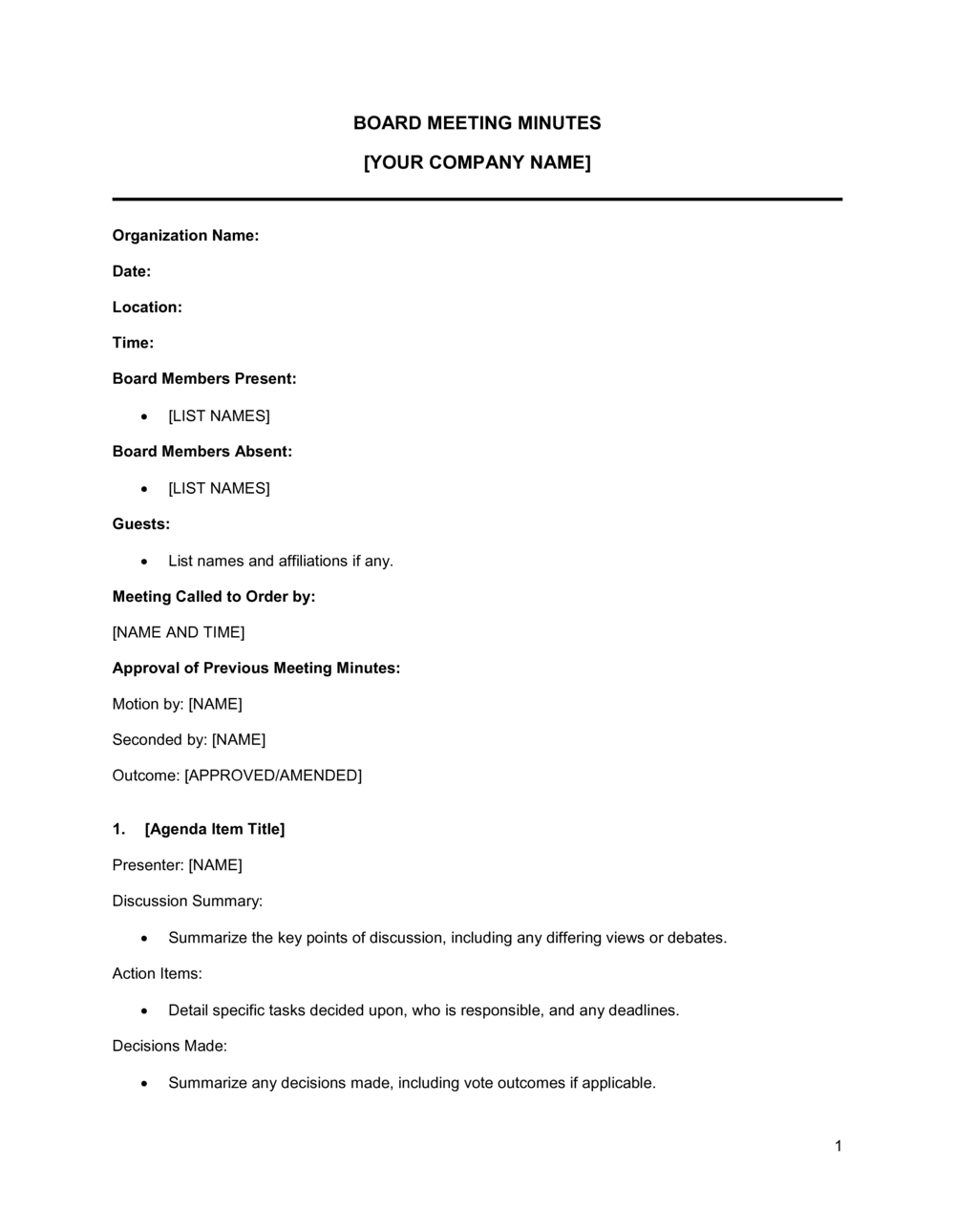
Board Meeting Minutes are the official written record of a corporation's or nonprofit's board of directors meeting — documenting who attended, what was discussed, which resolutions were proposed, how each director voted, and what actions were approved. This free Word download gives you a structured, legally compliant template you can edit online and export as PDF for execution, filing, and storage in your corporate record book.
When you need it
Use it after every formal board meeting — annual, regular, or special — where the board approves budgets, authorizes officers, adopts resolutions, or takes any other action that must be documented in the corporate record. Many jurisdictions require minutes to be kept as a condition of maintaining limited liability protection.
What's inside
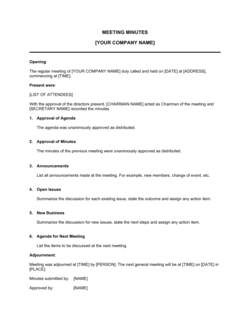
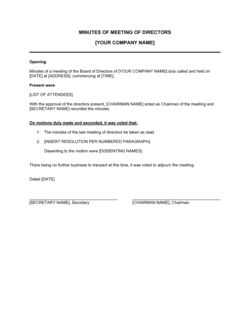
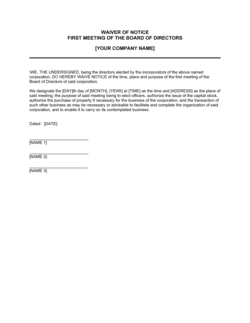
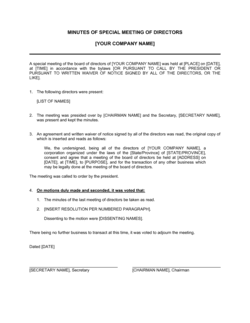
Meeting details and quorum confirmation, attendee and proxy record, approval of prior minutes, full text of each resolution with vote counts, officer and committee reports, action items with owners and deadlines, and the secretary's signature block.

What is a Board Meeting Minutes?

Board Meeting Minutes are the official written record of every formal meeting of a corporation's or nonprofit's board of directors — documenting who was present, what was discussed, every resolution proposed and adopted, how each director voted, and what actions were assigned for follow-up. They are not simply a summary of conversation; they are a primary legal document that constitutes the board's authoritative record of its decisions, creates enforceable officer authorizations, and demonstrates that the corporation observed the governance formalities required to maintain its legal standing and limited liability protections. This free Word download gives you a structured template with all required components pre-formatted, ready to edit online and export as a signed PDF for your corporate record book.

Why You Need This Document

Without properly maintained board meeting minutes, a corporation's most consequential decisions — authorizing a bank loan, approving an equity grant, entering a major contract — exist without an official record, leaving officers vulnerable to disputes over the scope of their authority and directors exposed to personal liability claims. Courts in every common-law jurisdiction treat the absence of minutes as a critical factor in piercing the corporate veil and holding shareholders personally responsible for corporate debts. Banks routinely require certified minutes as a condition of closing a loan; investors demand them during due diligence before every financing round; auditors test their completeness as part of an annual financial audit. A nonprofit without minutes risks its IRS tax-exempt status and state charitable registration. This template gives you a complete, legally structured record for every meeting — drafted to satisfy statutory requirements, survive due diligence, and protect every director who serves on your board.

Which variant fits your situation?

If your situation is…Use this template
Annual meeting of the full board to approve audited financials and elect officersAnnual Board Meeting Minutes
Special or emergency meeting called outside the regular scheduleSpecial Board Meeting Minutes
Written consent action taken without a formal meetingBoard Consent Resolution (Written Action)
First meeting of a newly incorporated entityOrganizational Meeting Minutes
Nonprofit board meeting with committee reports and grant approvalsNonprofit Board Meeting Minutes
LLC member or manager meeting requiring a similar recordLLC Meeting Minutes
Shareholders meeting separate from board-level governanceAnnual General Meeting (AGM) Minutes

Common mistakes to avoid

❌ Summarizing resolutions instead of quoting full operative language

Why it matters: A summary like 'the board approved the loan' does not establish what terms were authorized, what officer had signing authority, or what dollar limit applied — creating ambiguity that banks, investors, and courts will exploit.

Fix: Draft the full 'RESOLVED, THAT...' text for every board action before the meeting and paste it verbatim into the minutes after adoption.

❌ Failing to confirm quorum in the minutes

Why it matters: Resolutions adopted without a documented quorum can be challenged as invalid, voiding officer authorizations and contract approvals — a serious problem during financing or M&A due diligence.

Fix: Add a standing sentence after the attendance list that explicitly states the number of directors present, the quorum threshold from the bylaws, and that a quorum was present.

❌ Leaving minutes unsigned for weeks or months after the meeting

Why it matters: Unsigned minutes are not part of the official corporate record. Lenders and investors frequently request certified minutes on short notice — unsigned drafts delay closings and raise governance red flags.

Fix: Set a 5-business-day rule: draft, circulate, correct, and have the secretary sign within 5 days of every meeting. Use digital signature tools to eliminate the paper chase.

❌ Omitting conflict of interest disclosures from the record

Why it matters: An undocumented conflict is one of the primary grounds on which shareholders or creditors challenge board decisions and seek to pierce the corporate veil or void a transaction.

Fix: Add a standing conflict-of-interest disclosure item to every board agenda and record the disclosure — or the affirmative statement that none exists — in every set of minutes.

❌ Using informal meeting notes as the official minutes

Why it matters: Bullet-point notes circulated by email do not satisfy the formal minutes requirement under most corporate statutes and will not be accepted by banks, auditors, or courts as the official corporate record.

Fix: Use a structured minutes template with defined sections for each required element. Convert notes to formal minutes language before the secretary signs.

❌ Recording detailed deliberations and individual director opinions

Why it matters: Overly detailed minutes become a liability — director statements taken out of context in litigation, disclosed during regulatory investigation, or used to challenge whether the board exercised proper business judgment.

Fix: Record what was decided and the vote, not why each director voted as they did. A single sentence noting that the board 'considered the matter and determined it was in the best interests of the Company' is sufficient deliberation language.

The 10 key clauses, explained

Meeting header and identification

In plain language: Records the type of meeting (annual, regular, or special), the date, time, and location or virtual platform, and the name of the entity holding the meeting.

Sample language
Minutes of the [REGULAR / SPECIAL / ANNUAL] Meeting of the Board of Directors of [COMPANY LEGAL NAME], a [STATE/PROVINCE] [CORPORATION / LLC], held on [DATE] at [TIME] [TIME ZONE] at [LOCATION / via [PLATFORM]].

Common mistake: Recording only the date and omitting the time and location. Many corporate statutes require all three for minutes to be valid, and auditors flag missing fields during due diligence.

Attendance and quorum confirmation

In plain language: Lists all directors present (in person or by video), directors absent with or without excuse, any observers or guests, and confirms whether a quorum was achieved.

Sample language
Directors present: [NAME], [NAME], [NAME]. Directors absent: [NAME] (excused). Also present: [NAME], [TITLE] (observer). A quorum of [X] of [Y] directors being present, the meeting was duly called to order by [CHAIR NAME] at [TIME].

Common mistake: Listing attendees without confirming quorum. If quorum is not affirmatively stated, the minutes do not establish that the resolutions adopted were validly passed.

Approval of prior meeting minutes

In plain language: Records the motion to approve the minutes from the previous board meeting, any corrections noted, and the vote result.

Sample language
The minutes of the [DATE] board meeting were presented. Upon motion duly made and seconded, the minutes were approved as presented / as amended [describe amendment], with [X] votes in favor, [Y] opposed, and [Z] abstaining.

Common mistake: Skipping approval of prior minutes because no one raised objections. Unapproved prior minutes are not formally part of the corporate record and can be challenged.

Officer and committee reports

In plain language: Summarizes reports delivered by the CEO, CFO, or committee chairs — capturing key figures, decisions flagged for board awareness, and any board discussion of the reports.

Sample language
CEO Report: [NAME] reported that [SUMMARY OF KEY METRICS OR DEVELOPMENTS]. CFO Report: [NAME] presented the [PERIOD] financial statements showing revenue of $[X] and cash of $[X]. The board took note of the reports. No formal action was required.

Common mistake: Omitting financial figures presented during the meeting. Investors and auditors use minutes to confirm what financial information was before the board — a vague 'financials were reviewed' entry is insufficient.

Resolutions and votes

In plain language: The operative core of the minutes — records each resolution in full, who moved and seconded it, the vote count by director, and whether it was adopted or defeated.

Sample language
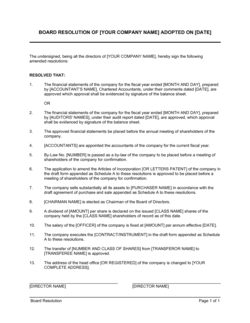
RESOLVED, that the Board of Directors of [COMPANY NAME] hereby authorizes [OFFICER NAME], as [TITLE], to execute and deliver on behalf of the Company [DESCRIPTION OF ACTION], on such terms and conditions as [he/she/they] deems appropriate. Moved by [NAME], seconded by [NAME]. Vote: [X] in favor, [Y] opposed, [Z] abstaining. Resolution ADOPTED.

Common mistake: Writing a resolution in summary form rather than quoting the exact operative language. If the resolution is later disputed — in litigation or a financing — the minutes must show exactly what was authorized.

Conflict of interest disclosures

In plain language: Documents any director who disclosed a personal or financial interest in a matter on the agenda, whether they recused from the vote, and the board's determination that the transaction was fair.

Sample language
[DIRECTOR NAME] disclosed a [financial / personal] interest in [MATTER] and recused [himself/herself/themselves] from discussion and the vote. The remaining directors, having considered the matter independently, determined that the transaction was fair and in the best interests of the Company.

Common mistake: Leaving out recusal details when a conflict exists. An undisclosed or undocumented conflict is one of the most common grounds for piercing corporate formalities or voiding a board action.

Executive session record

In plain language: Notes that the board convened in executive session (independent directors only), the approximate duration, and the general topic — without recording the substance of confidential deliberations.

Sample language
The independent directors convened in executive session at [TIME], with no members of management present. The session addressed [GENERAL TOPIC — e.g., CEO performance review]. The session concluded at [TIME] and no formal action was taken.

Common mistake: Recording detailed deliberations from executive session. The purpose of an executive session is candid discussion — detailed notes defeat that purpose and can be discoverable in litigation.

Action items and follow-up assignments

In plain language: Lists each task arising from the meeting, the person responsible, and the target completion date, forming a running accountability record between meetings.

Sample language
Action Items: (1) [NAME] to circulate revised [DOCUMENT] to all directors by [DATE]. (2) [NAME] to obtain three bids for [PROJECT] and report back at the [NEXT MEETING DATE] meeting. (3) [NAME] to file [FORM] with [AGENCY] by [DATE].

Common mistake: Omitting action items from the minutes and tracking them only in a separate email or project tool. Action items not in the minutes are invisible to future boards, auditors, and directors who join after the meeting.

Adjournment and next meeting date

In plain language: Records the time the meeting was formally adjourned and, where known, the date and location of the next scheduled meeting.

Sample language
There being no further business to come before the Board, the meeting was adjourned at [TIME] upon motion duly made and seconded. The next regular meeting of the Board is scheduled for [DATE] at [TIME].

Common mistake: Forgetting to record the adjournment time. Without it, the minutes do not establish when the board's authority under the meeting ended — relevant if actions are challenged as taken outside the meeting.

Secretary's certification and signature

In plain language: The corporate secretary attests that the minutes are a true and accurate record of the meeting, and signs and dates the document, giving it its legal authority as the official record.

Sample language
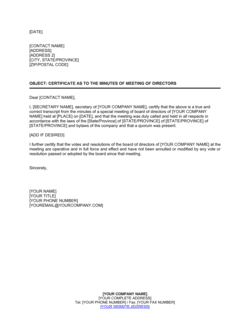
The undersigned, being the duly appointed Secretary of [COMPANY NAME], hereby certifies that the foregoing are true and correct minutes of the meeting described herein. Signed: ___________________________ [SECRETARY NAME], Secretary. Date: ___________

Common mistake: Having the CEO or a director sign instead of the corporate secretary. Most corporate statutes assign the record-keeping function specifically to the secretary — a signature by another officer does not satisfy the requirement.

How to fill it out

  1. 1

    Complete the meeting header before the meeting starts

    Enter the entity's full legal name, the type of meeting, the date, time, time zone, and location (physical address or video platform URL). These details are often forgotten in the rush of starting the meeting.

    💡 Create a meeting-header template saved with your company details pre-filled so you only update date, time, and meeting type each time.

  2. 2

    Record attendance and confirm quorum

    As directors join, note each name and whether they are present in person, by video, or by phone. Count attendees against the quorum threshold in your bylaws and record the quorum determination explicitly.

    💡 Keep a printed director roster at the table with a checkbox column so you can mark attendance in real time without disrupting the flow of the meeting.

  3. 3

    Document the approval of prior minutes

    Present the prior meeting's minutes for review, note any corrections proposed, and record the vote approving them. Attach or reference the prior minutes in the record.

    💡 Circulate prior minutes to all directors at least 48 hours before the meeting so corrections are handled quickly and the vote is uncontested.

  4. 4

    Summarize officer and committee reports with key figures

    For each report presented, capture the speaker's name, the period covered, two to four key metrics or developments, and any board questions or follow-up. Attach the full report as an exhibit if it was formally presented.

    💡 Ask each officer to send you a one-paragraph summary of their report before the meeting — it becomes your draft minutes entry for that section.

  5. 5

    Draft each resolution in full operative language

    Write out the complete 'RESOLVED, THAT...' text for every action the board approves — do not summarize. Record who moved, who seconded, and the vote by name or count.

    💡 Prepare draft resolution language before the meeting for any items on the agenda where board action is expected. Having language ready prevents ambiguous or incomplete resolutions.

  6. 6

    Record any conflict disclosures and recusals

    If any director discloses an interest in a matter, note the disclosure verbatim, confirm the director left the room or did not vote, and record the remaining directors' fairness determination.

    💡 Build a standing agenda item for conflict disclosures at the top of every meeting — it normalizes disclosure and ensures it is never skipped.

  7. 7

    List all action items with owners and due dates

    Before adjournment, review every task assigned during the meeting and confirm the responsible person and deadline for each. Enter them in the action items section of the minutes.

    💡 Read the action item list aloud before adjournment so each responsible person verbally confirms their assignment — it eliminates 'I didn't know that was on me' follow-ups.

  8. 8

    Have the secretary sign and distribute for approval

    The corporate secretary signs the final minutes. Circulate them to all directors for review within 5 business days of the meeting, and store the executed copy in the corporate record book.

    💡 Use a digital signature tool to execute and timestamp the minutes — it creates an immutable audit trail and avoids the delay of chasing wet-ink signatures.

Frequently asked questions

What are board meeting minutes?

Board meeting minutes are the official written record of a corporation's board of directors meeting. They document who attended, what resolutions were proposed and adopted, how each director voted, and what actions were assigned. Minutes are a legal requirement under most corporate statutes and form the primary evidence that the board exercised its governance responsibilities properly.

Are board meeting minutes legally required?

In most jurisdictions — including all US states, Canada, the UK, and EU member states — corporations are required by statute to keep minutes of board meetings. Failure to maintain minutes is one of the most common grounds on which courts disregard the corporate form and hold shareholders personally liable for corporate debts. Nonprofits also need minutes to satisfy IRS governance requirements and state charitable registration rules.

Who is responsible for taking board meeting minutes?

The corporate secretary is typically responsible for preparing, certifying, and maintaining the official minutes under both corporate statutes and the company's bylaws. In practice, a staff member or outside counsel often drafts the minutes, but the secretary must review and sign them. The secretary's signature is what gives the document its legal authority as the official record.

How detailed should board meeting minutes be?

Minutes should capture what was decided — resolutions in full operative language, vote counts, attendees, quorum, action items, and disclosures — without recording the detail of deliberations or individual director opinions. Over-detailed minutes become a litigation liability; under-detailed minutes fail to establish that governance obligations were met. The goal is a complete record of actions taken, not a transcript of the discussion.

How long should board meeting minutes be retained?

Most corporate statutes require that minutes be kept permanently as part of the corporate record — there is typically no expiration. In the US, the IRS recommends retaining corporate records, including minutes, permanently for tax-exempt organizations. Practically, minutes are stored in the corporate record book for the life of the entity and are commonly requested in M&A due diligence going back 5–10 years or to the company's founding, whichever is more recent.

What is the difference between board meeting minutes and a written consent resolution?

Board meeting minutes document decisions made at a formal meeting of directors — in person or by video — including discussion, reports, and votes. A written consent resolution (or unanimous written consent) is a document signed by all directors outside of a formal meeting, used to take a discrete action without convening a meeting. Most corporate statutes allow written consents for routine actions but require formal meetings for certain decisions, such as annual elections. Both are legally equivalent when properly executed.

Can board meeting minutes be amended after they are signed?

Yes — minutes can be corrected or amended, but the amendment must itself be approved by the board at a subsequent meeting and noted in the record. Amendments should be made by resolution at the next meeting, not by editing the original document. Altering signed minutes without board approval and a proper record of the change constitutes falsification of corporate records and can expose directors and officers to personal liability.

Do board meeting minutes need to be notarized?

Notarization is not required for standard board meeting minutes in most jurisdictions. The secretary's signature and certification are sufficient to authenticate the document for corporate purposes. However, some jurisdictions require notarized minutes for specific filings — such as certain real estate transactions or foreign qualification applications — and some lenders request notarized secretary's certificates as a closing condition. Check the specific requirement before execution.

What should be left out of board meeting minutes?

Avoid recording individual director opinions, the substance of legal advice received (to protect attorney-client privilege), detailed deliberations from executive sessions, preliminary financial figures that were not formally presented, and informal comments made before or after the meeting was called to order. Including privileged legal advice in minutes can waive the privilege; recording deliberations in detail creates a litigation roadmap for plaintiffs challenging board decisions.

How this compares to alternatives

vs Written Consent Resolution

A written consent resolution is signed by all directors outside of a formal meeting and produces the same legal effect as a board resolution adopted at a meeting. Board meeting minutes are the record of an actual meeting — they capture discussion, reports, and multiple resolutions in one document. Use a written consent for discrete, routine approvals; use formal minutes when the board needs to deliberate, receive reports, or take multiple actions at once.

vs Annual General Meeting Minutes

Annual general meeting (AGM) minutes document a shareholders meeting — the election of directors, approval of auditors, and presentation of annual financials to the ownership group. Board meeting minutes document a directors meeting — the governance body making operational and strategic decisions. Both are required, but they serve different legal functions and involve different participants.

vs Corporate Resolution

A corporate resolution is a standalone document recording a single board decision — often extracted from full meeting minutes and certified separately for use by banks, title companies, or counterparties. Full board meeting minutes contain multiple resolutions plus attendance, reports, and other meeting business. Use a standalone corporate resolution when a third party needs proof of one specific authorization without the full meeting record.

vs LLC Operating Agreement

An LLC operating agreement is the foundational governance document establishing member rights, manager authority, and decision-making rules. LLC meeting minutes record specific manager or member decisions made under that agreement. The operating agreement sets the rules; the minutes document compliance with those rules on a meeting-by-meeting basis.

Industry-specific considerations

Technology / SaaS

Board approvals for equity grants, investor rights agreements, and major commercial contracts are documented at each funding stage and scrutinized in Series A and beyond due diligence.

Healthcare and life sciences

Regulatory compliance decisions, IRB-related approvals, and executive compensation tied to clinical milestones must appear in board minutes to satisfy FDA, CMS, and state health department requirements.

Nonprofit organizations

IRS Form 990 governance questions directly reference whether minutes are kept — nonprofits without complete minutes risk loss of tax-exempt status and failure of state charitable registration renewal.

Financial services

Regulators including the SEC, FINRA, and banking supervisors routinely examine board minutes as evidence of risk oversight, compliance committee activity, and approval of related-party transactions.

Real estate

Property acquisitions, mortgage authorizations, and joint venture approvals require board resolutions referenced in closing documents — title companies and lenders request certified minutes at every transaction closing.

Manufacturing

Capital expenditure approvals, environmental compliance decisions, and union contract authorizations are documented in board minutes and reviewed during lender covenant compliance audits.

Jurisdictional notes

United States

Corporate minutes requirements are governed by each state's business corporation act — Delaware General Corporation Law §142, for example, requires a secretary to keep minutes of board proceedings. Most states require corporations to keep minutes at their principal office or registered agent and make them available to directors on demand. Failure to maintain minutes is a primary factor in alter-ego and veil-piercing claims under US common law. S-corporations must maintain minutes to preserve their tax election.

Canada

The Canada Business Corporations Act (CBCA) and provincial equivalents (e.g., Ontario Business Corporations Act) require corporations to prepare and maintain minutes of directors' meetings. Minutes must be kept at the registered office and are part of the corporate records that shareholders and directors have the right to inspect. Quebec corporations must maintain records in French. Federal non-share capital corporations (nonprofits) are governed by the Canada Not-for-profit Corporations Act with similar minute-keeping requirements.

United Kingdom

The Companies Act 2006 (sections 248–249) requires every company to keep minutes of all proceedings at board meetings and retain them for at least 10 years from the date of the meeting. Minutes signed by the chair of the meeting or the chair of the next meeting are admissible as evidence of the proceedings. Failure to maintain minutes is a criminal offence for every officer in default under section 248(4). Public companies face additional disclosure requirements for board decisions under the UK Corporate Governance Code.

European Union

EU member state company laws uniformly require written records of board decisions, though the specific form varies. German Aktiengesetz requires minutes (Protokolle) to be signed by the meeting chair and retained permanently. French law requires procès-verbaux signed by the chair and secretary, retained for 5 years. The EU's Shareholder Rights Directive II (2017/828) strengthens transparency and board accountability requirements across member states, indirectly increasing the importance of complete minutes. GDPR considerations apply where minutes reference personal data of employees or individuals.

Template vs lawyer — what fits your deal?

PathBest forCostTime
Use the templateCorporations and nonprofits with straightforward agendas — routine approvals, officer elections, and standard resolutions with no unusual transactionsFree30–60 minutes per meeting
Template + legal reviewMinutes covering related-party transactions, equity grants, significant debt authorizations, or conflict-of-interest disclosures$200–$500 for a lawyer or corporate secretary service review1–2 business days
Custom draftedBoard meetings in regulated industries, minutes required for M&A or financing closings, or entities with complex multi-class governance structures$500–$2,000+ depending on complexity and counsel rates2–5 business days

Glossary

Quorum
The minimum number of directors who must be present for the board to validly conduct business and adopt resolutions — typically a majority of the total board seats.
Resolution
A formal written decision adopted by the board, stating what was approved and by what vote — the operative legal output of the meeting.
Proxy
Written authorization allowing one director to be represented by another at a meeting, counted toward quorum in jurisdictions that permit director proxies.
Abstention
A director's deliberate choice not to vote for or against a resolution, recorded separately from yes and no votes in the minutes.
Conflict of Interest
A situation where a director has a personal financial or other interest in a matter before the board, requiring disclosure and typically recusal from the vote.
Corporate Record Book
The official file — physical or digital — where a corporation stores its articles, bylaws, share register, and all meeting minutes, required to be maintained under most corporate statutes.
Secretary's Certificate
A signed attestation by the corporate secretary confirming that the attached minutes are a true and accurate record of the meeting, often required by banks and counterparties.
Action Item
A specific task arising from board discussion, assigned to a named individual with a target completion date, tracked until closed.
Executive Session
A portion of a board meeting restricted to independent directors only — typically used to discuss CEO performance, litigation, or sensitive HR matters.
Ratification
Board approval of an action previously taken by an officer or employee without prior board authorization, giving the action retroactive legal validity.
Unanimous Written Consent
A resolution signed by all directors outside of a formal meeting, treated as equivalent to a board resolution under most corporate statutes.

Part of your Business Operating System

This document is one of 3,000+ business & legal templates included in Business in a Box.

  • Fill-in-the-blanks — ready in minutes
  • 100% customizable Word document
  • Compatible with all office suites
  • Export to PDF and share electronically

Create your document in 3 simple steps.

From template to signed document — all inside one Business Operating System.
1
Download or open template

Access over 3,000+ business and legal templates for any business task, project or initiative.

2
Edit and fill in the blanks with AI

Customize your ready-made business document template and save it in the cloud.

3
Save, Share, Send, Sign

Share your files and folders with your team. Create a space of seamless collaboration.

Save time, save money, and create top-quality documents.

★★★★★

"Fantastic value! I'm not sure how I'd do without it. It's worth its weight in gold and paid back for itself many times."

Managing Director · Mall Farm
Robert Whalley
Managing Director, Mall Farm Proprietary Limited
★★★★★

"I have been using Business in a Box for years. It has been the most useful source of templates I have encountered. I recommend it to anyone."

Business Owner · 4+ years
Dr Michael John Freestone
Business Owner
★★★★★

"It has been a life saver so many times I have lost count. Business in a Box has saved me so much time and as you know, time is money."

Owner · Upstate Web
David G. Moore Jr.
Owner, Upstate Web

Run your business with a system — not scattered tools

Stop downloading documents. Start operating with clarity. Business in a Box gives you the Business Operating System used by over 250,000 companies worldwide to structure, run, and grow their business.

Start free · No credit card required