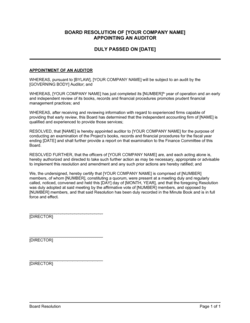
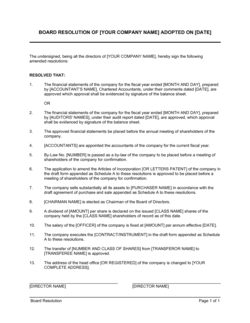
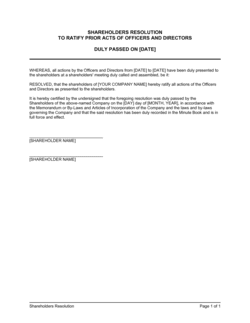
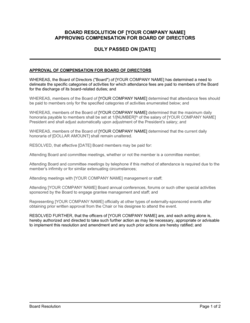
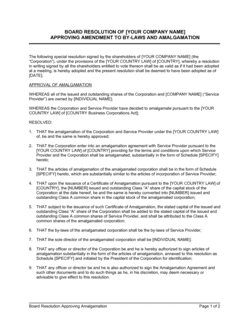
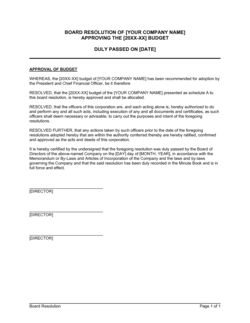
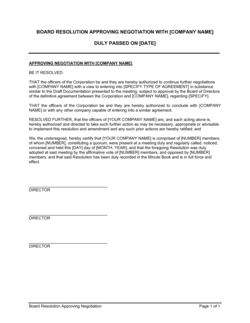
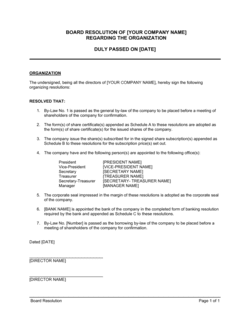
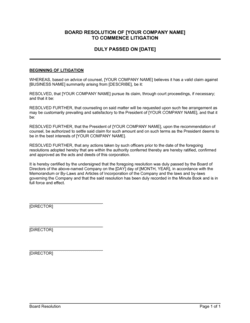
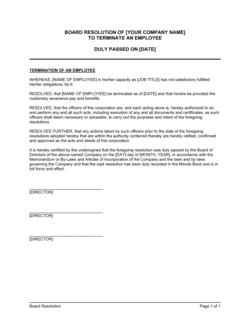
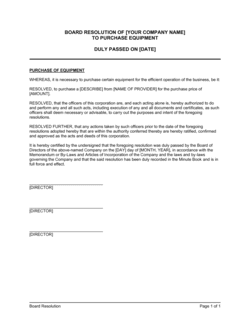
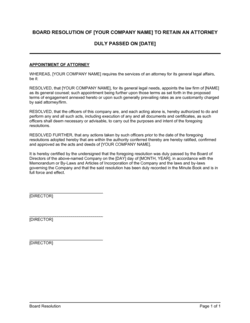
Board Resolution Appointing Officers Template

Free Word download • Edit online • Save & share with Drive • Export to PDF

1 page20–25 min to fillDifficulty: StandardSignature requiredLegal review recommended
Learn more ↓
FreeBoard Resolution Appointing Officers Template

At a glance

What it is
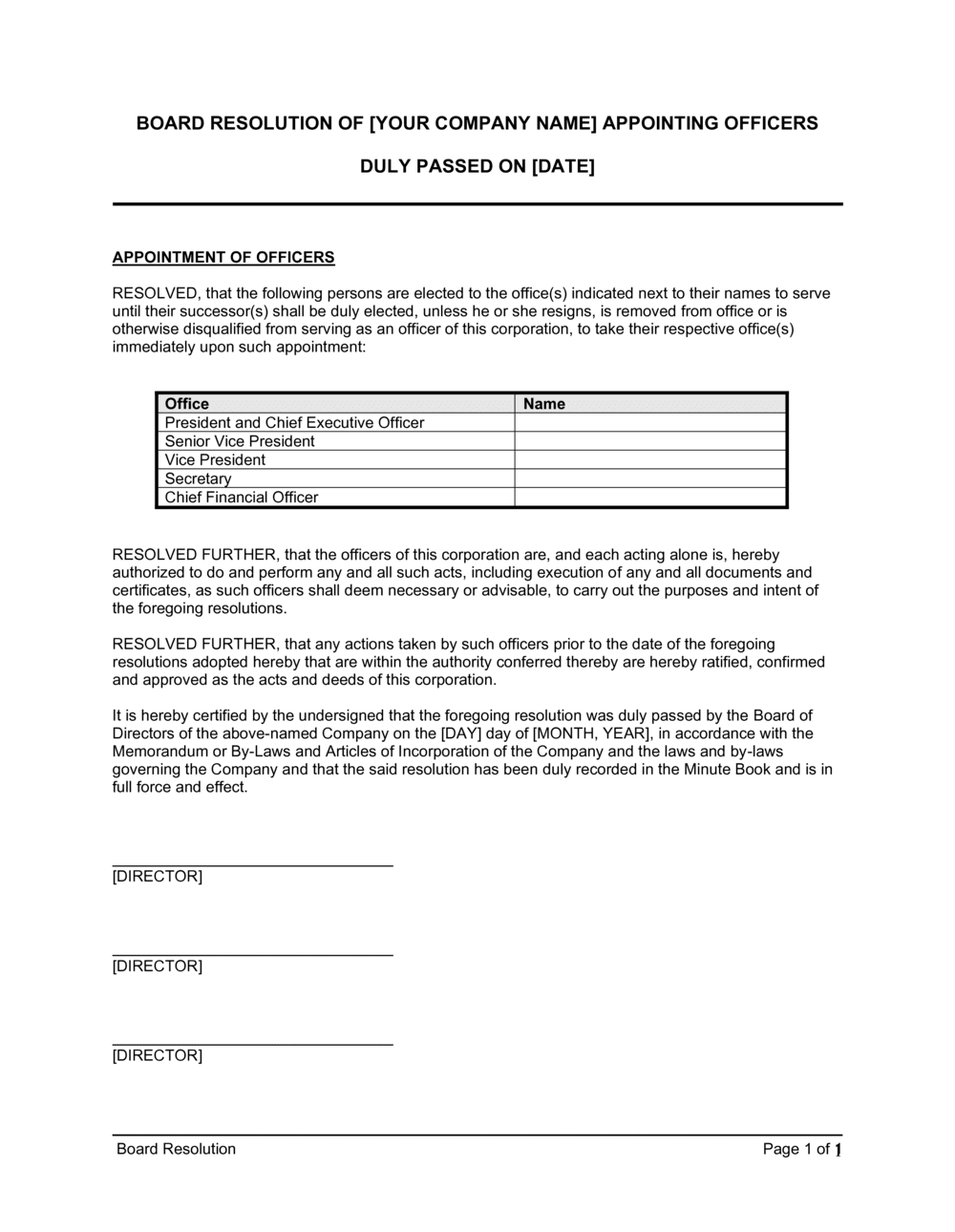
A Board Resolution Appointing Officers is a formal corporate document in which the board of directors officially designates individuals to named executive and officer positions — CEO, CFO, COO, Secretary, Treasurer, and others. This free Word download gives you an editable, signature-ready resolution you can tailor to your company structure and export as PDF for banks, registrars, and counterparties.
When you need it
Use it at incorporation when officers are first named, annually when the board reconfirms or rotates officer assignments, or whenever an officer resigns, is terminated, or a new position is created. Banks, lenders, and commercial counterparties routinely require a certified copy before extending credit or executing major contracts.
What's inside
The resolution identifies the corporation, records the meeting or written consent context, names each officer with their exact title and effective date, states the authority granted to each position, and is signed by the required directors or authorized officers with a corporate secretary certification block.

What is a Board Resolution Appointing Officers?

A Board Resolution Appointing Officers is a formal corporate governance document in which a company's board of directors officially designates named individuals to executive officer positions — including Chief Executive Officer, Chief Financial Officer, Chief Operating Officer, Corporate Secretary, Treasurer, and any other offices defined in the corporate bylaws. The resolution records the board's decision, states the authority granted to each officer, specifies the effective date and term of each appointment, and is signed by the required directors and certified by the corporate secretary. It functions as the primary evidence that a specific individual holds the legal authority to bind the corporation in contracts, open bank accounts, and execute official documents.

Why You Need This Document

Without a current, signed board resolution on file, your corporation's officers lack documented authority — and the parties you deal with know it. Banks will not open a business account or fund a loan without a certified copy confirming who is authorized to sign. Title companies require it before recording real estate in the corporation's name. Investors and sophisticated counterparties request it at the start of due diligence to verify that the executives they are negotiating with actually have the power to commit the company. Internally, an undocumented officer appointment creates gaps in the minute book that auditors flag and that become genuine legal vulnerabilities if governance is ever challenged. This template gives you a properly structured, signature-ready resolution that satisfies bank certification requirements, integrates cleanly with your bylaws, and takes less than 30 minutes to complete for a standard appointment.

Which variant fits your situation?

If your situation is…Use this template
Appointing officers at initial incorporationBoard Resolution Appointing Officers
Replacing or removing a specific officer mid-termBoard Resolution Removing an Officer
Authorizing a specific officer to open or manage a bank accountCorporate Resolution to Open a Bank Account
Approving a major transaction or contract on behalf of the corporationBoard Resolution Authorizing a Contract
Annual reconfirmation of existing officers without changeAnnual Board Resolution (Officer Reconfirmation)
Passing a resolution without a physical meeting via written consentUnanimous Written Consent of Directors
Appointing or reconfirming directors rather than officersBoard Resolution Appointing Directors

Common mistakes to avoid

❌ Using a trade name instead of the registered corporate name

Why it matters: Banks and registrars match the resolution against the articles of incorporation. A name mismatch — even punctuation differences — causes the document to be rejected and delays account openings or contract closings.

Fix: Copy the corporation's legal name verbatim from the certificate of incorporation or the most recent annual report filing.

❌ Omitting the tenure and succession clause

Why it matters: Without a defined term, a disputed officer removal becomes a credibility contest over when authority actually ended, and counterparties may continue to treat the former officer as authorized.

Fix: Include a standard tenure clause stating the appointment runs until the next annual meeting, a successor is appointed, or earlier resignation or removal — whichever occurs first.

❌ Fewer director signatures than the bylaw quorum requires

Why it matters: A resolution signed by fewer directors than required for a valid board action is legally defective. Third parties who discover the quorum failure can challenge the officer's authority to bind the corporation.

Fix: Before circulating the resolution for signature, confirm the quorum requirement in the bylaws and ensure every required director signs — or use the written consent format if available.

❌ The certifying secretary is the only director

Why it matters: If the sole director also signs as corporate secretary, there is no independent attestation of the resolution's authenticity. Banks and sophisticated counterparties routinely reject sole-director certifications.

Fix: Appoint a different individual as corporate secretary for certification purposes, or have an officer who did not sign as director certify the resolution.

The 9 key clauses, explained

Corporation identification and recitals

In plain language: Names the corporation by its full legal name, state or province of incorporation, and the date and context of the board action — whether a duly convened meeting or written consent.

Sample language
WHEREAS, [CORPORATION LEGAL NAME], a [STATE/PROVINCE] [ENTITY TYPE] (the 'Corporation'), held a [meeting of / written consent of] the Board of Directors on [DATE], at which a quorum was [present / obtained];

Common mistake: Using a trade name or 'doing business as' name instead of the exact registered corporate name. Counterparties and registrars match against the articles of incorporation — any mismatch delays or voids reliance on the resolution.

Officer appointment operative clause

In plain language: The core resolved clause that formally appoints each named individual to their specific officer title, effective on a stated date.

Sample language
RESOLVED, that the following individuals are hereby appointed to the offices of the Corporation set forth opposite their respective names, effective [EFFECTIVE DATE]: [OFFICER NAME] — [TITLE]; [OFFICER NAME] — [TITLE].

Common mistake: Listing informal titles like 'Head of Finance' instead of the title defined in the bylaws (e.g., 'Chief Financial Officer'). A title mismatch between the resolution and the bylaws creates ambiguity about the scope of authority.

Term and tenure statement

In plain language: States how long each appointment runs — typically until the next annual meeting, until a successor is appointed, or until resignation or removal — whichever comes first.

Sample language
Each officer appointed herein shall serve in such capacity until the next annual meeting of the Board of Directors, until their successor is duly appointed, or until their earlier resignation or removal.

Common mistake: Omitting the tenure clause entirely. Without it, there is no defined end to the appointment, which creates complications if an officer is later removed and disputes when their authority actually ceased.

Authority and powers granted

In plain language: Describes the scope of authority each office carries — including signing contracts, executing documents, managing operations, and representing the corporation with third parties.

Sample language
Each officer is hereby authorized and empowered to execute and deliver, on behalf of the Corporation, any and all agreements, instruments, certificates, and other documents as may be necessary or appropriate to carry out the duties of their office.

Common mistake: Granting unlimited signing authority without dollar-value limits. Banks and auditors expect officer authority to be bounded — include a cap (e.g., 'contracts not exceeding $[AMOUNT]') or cross-reference the bylaws for limits.

Compensation reference clause

In plain language: Notes whether officer compensation is addressed in this resolution or governed separately by an employment agreement, the bylaws, or a compensation committee determination.

Sample language
The compensation of each officer shall be as set forth in their respective employment agreement or as determined by the Board of Directors from time to time, and is not fixed by this Resolution.

Common mistake: Specifying a salary figure inside the resolution. Compensation embedded in a resolution is harder to adjust than compensation in a separate employment agreement, and can inadvertently create a contractual entitlement.

Ratification of prior acts

In plain language: Ratifies any actions already taken by the named officers before the resolution was formally adopted — common when officers acted informally during an incorporation gap.

Sample language
RESOLVED FURTHER, that all acts, transactions, and agreements undertaken by [OFFICER NAME(S)] on behalf of the Corporation prior to the date of this Resolution in their capacity as [TITLE(S)] are hereby ratified, confirmed, and approved.

Common mistake: Including a blanket ratification without limiting it to a defined period. An open-ended ratification can inadvertently validate unauthorized acts well before the individuals were acting in any officer capacity.

Corporate secretary certification block

In plain language: A certification signed by the corporate secretary (or an authorized director) attesting that the resolution is a true extract of the corporate minutes and that the meeting or consent was properly conducted.

Sample language
I, [SECRETARY NAME], Secretary of [CORPORATION LEGAL NAME], hereby certify that the foregoing is a true and correct copy of a Resolution duly adopted by the Board of Directors on [DATE], and that such Resolution is in full force and effect as of the date hereof.

Common mistake: Having the same person sign as both a director approving the resolution and as the certifying secretary. Banks and registrars may reject a resolution where the certifying secretary is also the sole director, as there is no independent attestation.

Governing law clause

In plain language: States that the resolution and the officers' authority are governed by the laws of the jurisdiction of incorporation.

Sample language
This Resolution shall be governed by and construed in accordance with the laws of the State/Province of [JURISDICTION], without regard to its conflict of law provisions.

Common mistake: Omitting the governing law clause in multi-jurisdiction corporations. When a company is incorporated in one state but operates primarily in another, the absence of a governing law clause creates uncertainty about which corporate statute applies.

Signature and adoption block

In plain language: The execution block where each director signs and dates the resolution, along with any required vote-count notation.

Sample language
IN WITNESS WHEREOF, the undersigned, being all [the directors / a majority of the directors] of [CORPORATION LEGAL NAME], hereby adopt this Resolution as of [DATE]. [DIRECTOR NAME] _____________ Date: _____

Common mistake: Collecting fewer signatures than required for a quorum under the bylaws. If the bylaws require a majority of directors and only one of three signs, the resolution is not validly adopted and third parties who discover this can challenge the officer's authority.

How to fill it out

  1. 1

    Enter the corporation's full legal name and jurisdiction

    Use the exact name on the articles of incorporation or certificate of incorporation, including any 'Inc.', 'Corp.', 'Ltd.', or 'LLC' suffix. State the jurisdiction of incorporation — not the principal place of business.

    💡 Pull the name directly from your articles of incorporation to avoid any mismatch with the corporate registry.

  2. 2

    Select meeting or written consent format

    Choose whether this resolution arises from a duly convened board meeting (require quorum and minutes) or a written consent in lieu of meeting (require all or the required majority of directors to sign). The template includes both formats — delete the inapplicable one.

    💡 Written consent is faster for small boards but requires the signature threshold set in your bylaws — typically unanimous consent in most US states unless the certificate permits a lower threshold.

  3. 3

    List each officer with their exact bylaw title and effective date

    Enter each officer's full legal name and the title exactly as it appears in your bylaws. Set the effective date — which may be the resolution date, the first day of a fiscal year, or the date of a predecessor's departure.

    💡 Cross-check your bylaws officer list before completing this step — appointing a title that does not exist in the bylaws undermines the resolution's authority.

  4. 4

    Define the tenure and succession language

    State how long each appointment runs. 'Until the next annual meeting or until a successor is duly appointed, whichever is later' is the most common formulation and avoids unintended gaps in officer authority.

    💡 If different officers have different terms (e.g., CFO appointed for a fixed 2-year term), create a separate tenure line for each rather than using a blanket statement.

  5. 5

    Confirm or limit signing authority

    Decide whether to grant open-ended authority (cross-referenced to the bylaws) or to set explicit dollar thresholds for each officer class. Enter any transaction-value caps or subject-matter restrictions in the authority clause.

    💡 Banks often require that the officer authorized to open or operate accounts be specifically named in the resolution — a separate bank account resolution referencing this one may still be needed.

  6. 6

    Add the ratification clause if officers acted before the resolution

    If any officer signed documents, opened accounts, or entered agreements before this resolution was formally adopted, include the ratification clause and specify the earliest date to be ratified.

    💡 Limit the ratification period to a specific date range — for example, 'acts taken on or after [INCORPORATION DATE] and prior to [RESOLUTION DATE]' — to avoid inadvertently ratifying unrelated acts.

  7. 7

    Collect director signatures and certify

    Have each required director sign and date the resolution. Then have the corporate secretary (or a director acting as secretary) sign the certification block, attesting the resolution is a true copy of the corporate record.

    💡 Date the signatures on or after the effective date of the resolution. A resolution dated before the meeting it purports to record creates a credibility problem with auditors and lenders.

  8. 8

    File in the minute book and distribute certified copies

    Place the original signed resolution in the corporate minute book. Provide certified copies to the bank, any government registry that requires notice of officer changes, and each appointed officer for their own records.

    💡 Scan and store a digital copy immediately — banks and lenders regularly request certified copies months after the original signing, and originals can be lost.

Frequently asked questions

What is a board resolution appointing officers?

A board resolution appointing officers is a formal written decision by a corporation's board of directors that officially names individuals to executive and officer positions — CEO, CFO, COO, Secretary, Treasurer, and others. It records the appointment, defines the term and authority of each office, and is signed by the required directors. Banks, registrars, and commercial counterparties rely on it as evidence that a named individual has legal authority to act on behalf of the corporation.

When is a board resolution appointing officers required?

It is typically required at three points: at initial incorporation when officers are named for the first time, annually when the board reconfirms or changes officer assignments, and whenever an officer resigns, is removed, or a new position is created. Banks almost universally require a current certified copy before opening a business account or processing a loan application in the corporation's name.

Does a board resolution need to be notarized?

In most jurisdictions, notarization is not required for a board resolution appointing officers to be legally valid internally. However, some banks, foreign registrars, and government agencies require notarization or apostille certification when the resolution will be used in a cross-border transaction or filed with a foreign authority. Check the specific requirements of the institution requesting the document before execution.

Can a single-member LLC or sole director corporation pass this resolution?

Yes. A sole director can pass a resolution appointing officers, including appointing themselves. In most US states and Canadian provinces, the sole director may also hold multiple officer titles simultaneously. The limitation is that the certifying secretary should ideally be a different person — or the resolution should clearly note that the sole director is also acting as secretary for this purpose, which some banks will accept.

What is the difference between a board resolution and corporate bylaws for appointing officers?

Bylaws define which officer positions exist and the general scope of each role. A board resolution is the specific act of naming individuals to those positions. Bylaws are the standing rules; the resolution is the individual appointment decision. Both are needed — bylaws without a resolution leave positions vacant, and a resolution that names titles not defined in the bylaws creates authority ambiguity.

How long is a board resolution appointing officers valid?

The resolution remains valid until its own tenure clause expires — typically the next annual board meeting — or until a superseding resolution removes or replaces the officer. Best practice is to pass a new or reconfirming resolution at each annual meeting even when officer assignments do not change, so the corporate minute book reflects a current, dated record of authorized officers.

Do I need a lawyer to prepare a board resolution appointing officers?

For straightforward domestic appointments at a standard corporation, a high-quality template is generally sufficient. Engage a lawyer when the resolution involves complex authority grants, is required by an institutional lender with specific certification requirements, relates to a multi-jurisdiction corporation, or is part of a broader restructuring where officer authority is contested. A brief lawyer review typically costs $150–$400 and is worthwhile for any appointment that will be relied on in a significant transaction.

What happens if an officer acts without a valid board resolution on file?

Actions taken by an officer without a valid resolution may still bind the corporation under apparent authority or agency principles in most jurisdictions — particularly if third parties reasonably relied on the officer's title. However, internally the officer may be acting ultra vires, and the corporation may be unable to enforce the ratification clause against the counterparty. Maintaining a current resolution protects both the corporation and the third parties it deals with.

How this compares to alternatives

vs Corporate Resolution to Open a Bank Account

A bank account resolution is a narrow, purpose-specific document authorizing one or more named individuals to open and operate a specific account at a named financial institution. A board resolution appointing officers is the broader governing document that establishes who holds each executive role across the entire corporation. Banks typically require both — the officer appointment resolution establishes authority in general; the bank resolution specifies the account and signatories.

vs Unanimous Written Consent of Directors

A unanimous written consent is a procedural mechanism that allows directors to pass any resolution — including an officer appointment — without holding a formal meeting. The board resolution appointing officers is the substantive content of what is being decided. The two documents are often combined: a unanimous written consent that contains the officer-appointment resolution as its operative text.

vs Employment Contract

An employment contract governs the terms of the working relationship — compensation, duties, IP assignment, non-compete, and termination. A board resolution appointing officers is a governance document that establishes legal authority to act on the corporation's behalf. Both are typically needed for senior hires: the resolution confers corporate authority; the employment contract defines the commercial terms of the engagement.

vs Board Resolution Authorizing a Contract

A contract-authorization resolution is a one-time board action approving a specific transaction or agreement. An officer-appointment resolution is a standing grant of authority that enables officers to enter into contracts within defined limits without returning to the board each time. For major or unusual transactions, both may be needed: the standing authority from the officer appointment plus a specific resolution for the particular deal.

Industry-specific considerations

Technology and SaaS

Fast-moving startups routinely cycle through officer titles during funding rounds; a current resolution is required by Series A investors and bank account applications at every stage.

Financial Services

Regulated entities must file officer appointment records with FINRA, state banking departments, or the FCA, and counterparties require certified copies before executing trading or custody agreements.

Real Estate

Title companies and lenders require a certified resolution confirming officer signing authority before recording a deed or closing a commercial mortgage in the corporation's name.

Professional Services

Law firms, accounting firms, and consulting corporations use officer-appointment resolutions to satisfy state licensing board and malpractice insurer requirements for designated responsible officers.

Jurisdictional notes

United States

Corporate officer appointments are governed by state corporate statutes (e.g., Delaware DGCL §142, California Corporations Code §312). Most states permit written consent in lieu of a meeting unless the certificate of incorporation or bylaws require otherwise. Delaware and many other states allow one person to hold multiple officer titles simultaneously. Some states require officer information to be reported in the annual franchise tax filing or registered agent report.

Canada

Under the Canada Business Corporations Act and provincial equivalents (OBCA, BCBCA), officers are appointed by the board and must include at least a president and a secretary under some statutes, though modern acts are more flexible. Quebec corporations must comply with the Business Corporations Act (Quebec) and French-language requirements for internal corporate documents may apply. Officer information is typically disclosed in annual returns filed with Corporations Canada or the provincial registry.

United Kingdom

UK companies incorporated under the Companies Act 2006 must have at least one director; a company secretary is no longer mandatory for private companies but remains best practice. Board resolutions are governed by the company's articles of association. Changes to directors and certain officers must be notified to Companies House on Form AP01 or AP03 within 14 days of the change. Written resolutions require approval from the requisite majority of eligible members or directors as set out in the articles.

European Union

Corporate governance requirements for officer appointments vary significantly across EU member states. German GmbHs require a managing director (Geschäftsführer) whose appointment must be registered in the Handelsregister. French SAS and SARL structures have president and manager roles governed by the statuts and require publication in a legal announcement journal. Many member states require certified translations of officer-appointment resolutions when used in cross-border transactions or presented to a foreign notary.

Template vs lawyer — what fits your deal?

PathBest forCostTime
Use the templateStandard domestic officer appointments at closely held corporations, LLCs, and startups with straightforward board structuresFree15–30 minutes
Template + legal reviewCorporations with multiple share classes, institutional investors requiring specific certification language, or officer appointments tied to a financing round$150–$4001–2 days
Custom draftedMulti-jurisdiction corporations, regulated entities filing with government agencies, or officer changes in a contested governance situation$500–$1,500+3–7 days

Glossary

Board Resolution
A formal written decision made by a corporation's board of directors that is recorded in the corporate minute book and carries legal authority.
Corporate Officer
An individual appointed by the board to a named executive role — such as CEO, CFO, COO, Secretary, or Treasurer — with defined authority to act on behalf of the corporation.
Minutes
The official written record of a board meeting, including the resolutions passed, votes cast, and attendees present.
Written Consent in Lieu of Meeting
A mechanism allowing directors to pass a resolution without convening a formal meeting, provided the required majority signs a written document.
Certified Copy
A copy of a corporate resolution that has been signed and stamped by the corporate secretary to attest that it is a true and accurate record of the original.
Signing Authority
The legal power conferred on a named officer to execute contracts, open accounts, and bind the corporation in transactions up to defined limits.
Corporate Seal
An embossed or ink stamp bearing the corporation's name and jurisdiction, used to authenticate formal corporate documents in jurisdictions where it is still required.
Quorum
The minimum number of directors who must be present or consent for a board meeting or resolution to be legally valid, as set by the bylaws.
Effective Date
The specific calendar date on which an officer's appointment takes effect, which may differ from the date the resolution is signed.
Bylaws
The internal rules governing a corporation's management structure, meeting procedures, officer roles, and decision-making authority.
Fiduciary Duty
The legal obligation of directors and officers to act in the best interests of the corporation and its shareholders, with care, loyalty, and good faith.

Part of your Business Operating System

This document is one of 3,000+ business & legal templates included in Business in a Box.

  • Fill-in-the-blanks — ready in minutes
  • 100% customizable Word document
  • Compatible with all office suites
  • Export to PDF and share electronically

Create your document in 3 simple steps.

From template to signed document — all inside one Business Operating System.
1
Download or open template

Access over 3,000+ business and legal templates for any business task, project or initiative.

2
Edit and fill in the blanks with AI

Customize your ready-made business document template and save it in the cloud.

3
Save, Share, Send, Sign

Share your files and folders with your team. Create a space of seamless collaboration.

Save time, save money, and create top-quality documents.

★★★★★

"Fantastic value! I'm not sure how I'd do without it. It's worth its weight in gold and paid back for itself many times."

Managing Director · Mall Farm
Robert Whalley
Managing Director, Mall Farm Proprietary Limited
★★★★★

"I have been using Business in a Box for years. It has been the most useful source of templates I have encountered. I recommend it to anyone."

Business Owner · 4+ years
Dr Michael John Freestone
Business Owner
★★★★★

"It has been a life saver so many times I have lost count. Business in a Box has saved me so much time and as you know, time is money."

Owner · Upstate Web
David G. Moore Jr.
Owner, Upstate Web

Run your business with a system — not scattered tools

Stop downloading documents. Start operating with clarity. Business in a Box gives you the Business Operating System used by over 250,000 companies worldwide to structure, run, and grow their business.

Start free · No credit card required