1
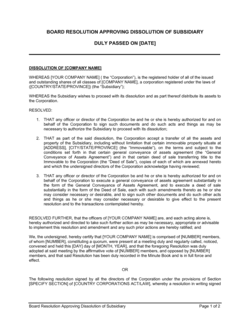
Enter the corporation's full legal name and jurisdiction
At the top of the resolution, fill in the company's exact registered name as it appears in its articles of incorporation, along with the state, province, or country of incorporation and the entity type.
💡 Pull the entity name directly from a recent government registry printout — even minor name discrepancies can raise questions during audits or benefit plan administration.
2
Complete the recitals with the employee's details
Insert the retiring employee's full legal name, job title, hire date, and the retirement effective date in the whereas clauses. These facts anchor every downstream clause and must match HR and payroll records exactly.
💡 Confirm the hire date against the original employment agreement, not just the HR database — the two sometimes differ after acquisitions or system migrations.
3
Confirm and state the effective date of retirement
Enter the specific calendar date on which employment ends. This date determines benefit eligibility cutoffs, final paycheck timing, and any equity vesting calculations — so precision matters.
💡 Align the effective date with the last day of a pay period wherever possible to simplify final payroll processing.
4
Specify all authorized benefits and entitlements
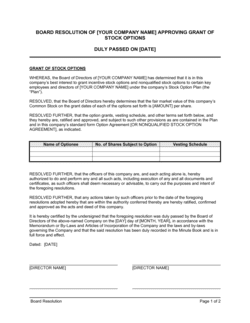
List each category of benefit the board is approving — accrued vacation payout, pension contributions, deferred compensation disbursement, health benefit continuation. Cross-reference the relevant plan documents by name.
💡 Do not use dollar amounts in the resolution unless they are fixed and confirmed; use plan-document references instead to avoid creating a conflict if the calculated amount differs.
5
Address equity and deferred compensation treatment
If the retiring employee holds unvested options, RSUs, or deferred compensation, include the equity and deferred compensation clause and specify which plan governs the treatment. If no equity is involved, delete this clause cleanly.
💡 Check the equity plan document for a definition of 'retirement' — many plans require the employee to be a minimum age (typically 55 or 65) and to have a minimum years-of-service threshold to qualify for favorable retirement treatment.
6
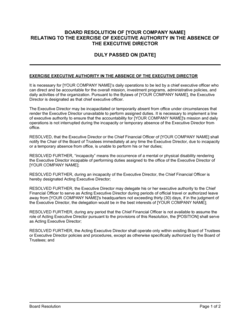
Name at least two authorized officers in the implementation clause
Identify by title (not name) at least two officers — e.g., CEO and CFO, or President and Corporate Secretary — who are authorized to execute follow-on documents and take administrative steps.
💡 Using titles rather than personal names means the clause remains valid if an officer changes between the resolution date and the date a follow-on document is signed.
7
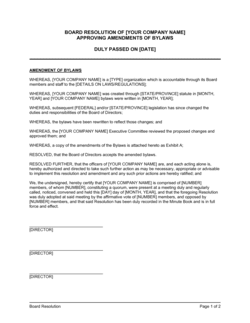
Collect director signatures and have the secretary certify
Circulate the resolution for signature by the required number of directors per the bylaws, then have the corporate secretary sign the certification block and enter the document in the corporate minute book.
💡 If using written consent in lieu of a meeting, confirm that your jurisdiction and bylaws permit unanimous written consent for this type of action before proceeding.
8
Distribute and file copies
Provide a certified copy to the retiring employee, the benefits plan administrator, payroll, and any external pension fund or insurer. Retain the original signed copy in the corporate minute book.
💡 Date-stamp every copy distributed and log the recipients — this record is frequently requested during benefit audits or estate proceedings years later.