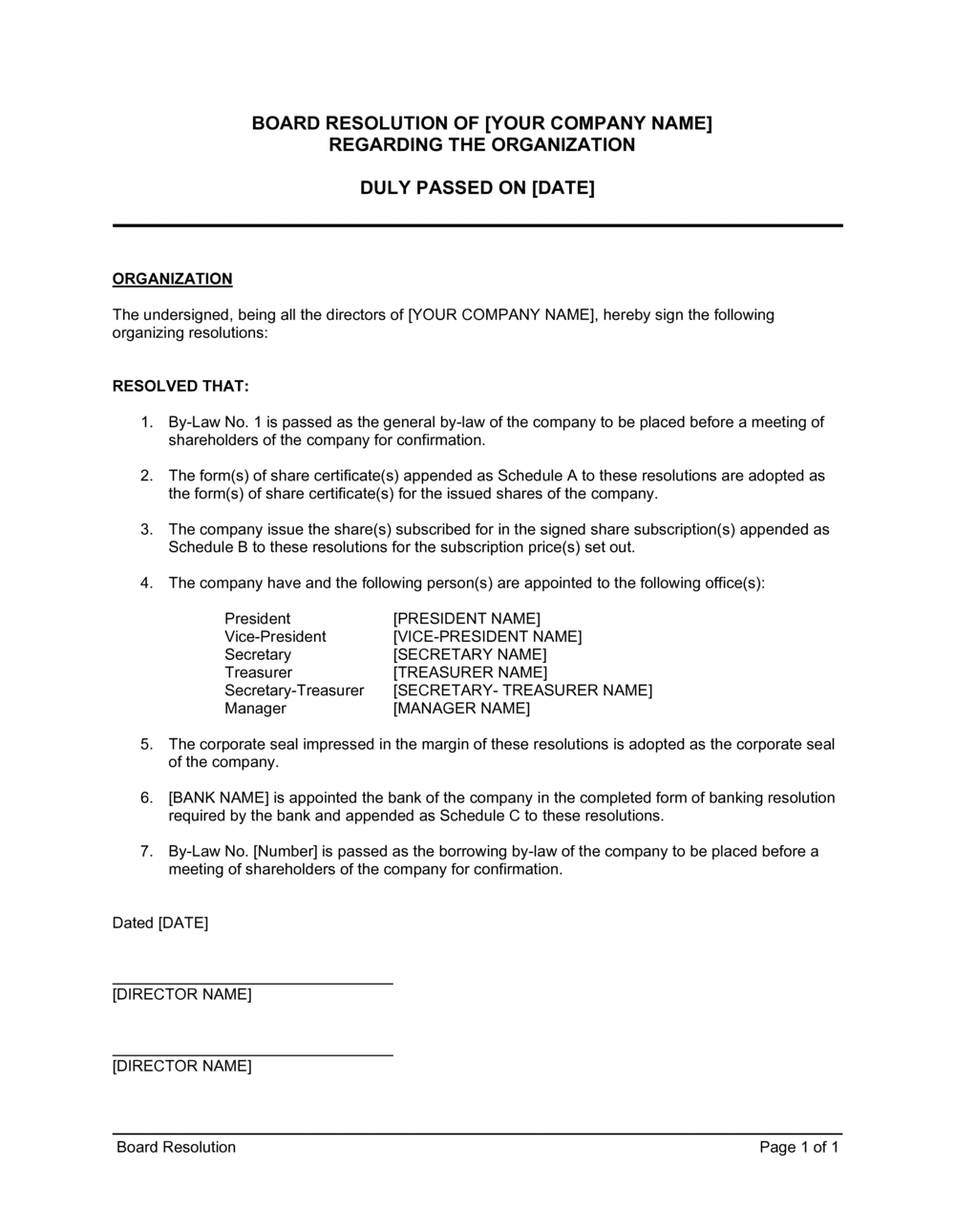
Board Resolution Regarding Organization Template

Free Word download • Edit online • Save & share with Drive • Export to PDF

1 page20–30 min to fillDifficulty: StandardSignature requiredLegal review recommended
Learn more ↓
FreeBoard Resolution Regarding Organization Template

At a glance

What it is
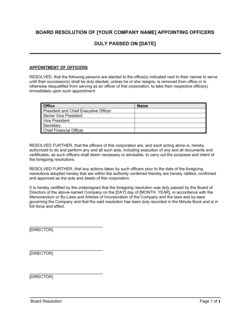
A Board Resolution Regarding Organization is a formal written record of an official decision made by a company's board of directors concerning the structure, governance, or authority of the organization. This free Word download gives you a ready-to-edit template you can customize for your corporation and export as PDF for signing, filing, and inclusion in your corporate minute book.
When you need it
Use it whenever the board takes a formal action that affects the company's organizational structure — such as appointing officers, granting signing authority, establishing committees, amending bylaws, or authorizing the opening of bank accounts. Banks, regulators, and legal counsel routinely require a certified copy before acting on these decisions.
What's inside
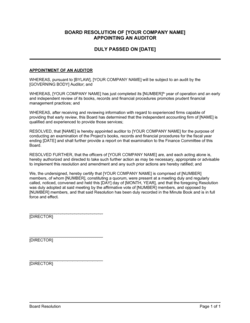
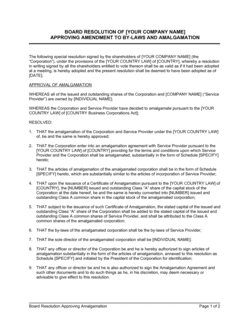
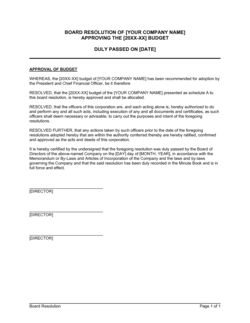
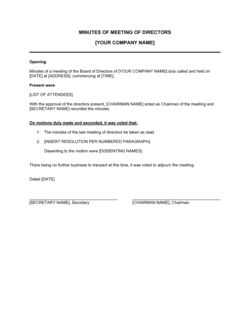
Corporate identification and recitals, meeting or consent details, the resolution text itself with specific action clauses, officer authority grants, certification language, and signature and date blocks for the board secretary and any required officers.

What is a Board Resolution Regarding Organization?

A Board Resolution Regarding Organization is a formal written record of an official decision made by a corporation's board of directors concerning the structure, governance, or internal authority of the company. It memorializes specific organizational actions — such as appointing officers, delegating signing authority, establishing committees, or authorizing bank accounts — in a legally operative document that becomes part of the corporation's permanent minute book. Unlike informal management decisions, a properly adopted board resolution carries the full legal authority of the board and creates enforceable obligations binding on the corporation and its officers.

Why You Need This Document

Without a formal board resolution, organizational decisions exist only as informal understandings — and when those understandings are tested by a bank, a regulator, an auditor, or a court, the absence of documentation is treated as an absence of authority. Banks will refuse to open accounts or process transactions for officers whose authority has not been certified by resolution. Investors conducting due diligence on a financing round will flag missing or deficient resolutions as a governance red flag requiring remediation before closing. Officers who act without documented board authorization expose themselves and the corporation to ultra vires claims that can void contracts and create personal liability. This template gives you a properly structured, jurisdiction-aware starting point you can complete in under 30 minutes — ensuring every organizational decision the board makes is recorded, certified, and ready to withstand scrutiny.

Which variant fits your situation?

If your situation is…Use this template
Authorizing the company to open or modify a bank accountBoard Resolution to Open a Bank Account
Appointing or removing a corporate officerBoard Resolution for Officer Appointment
Approving a major contract or business transactionBoard Resolution Authorizing a Contract
Issuing or authorizing shares of stockBoard Resolution to Issue Shares
Amending the company's bylaws or articles of incorporationBoard Resolution to Amend Bylaws
Approving the annual budget or financial statementsBoard Resolution Approving Financial Statements
Taking action without a formal meeting via written consentWritten Consent in Lieu of Board Meeting

Common mistakes to avoid

❌ Using a trade name instead of the registered legal entity name

Why it matters: Banks, government agencies, and courts match the resolution against the corporate registration. A DBA or brand name that differs from the registered name will cause the resolution to be rejected, stalling the transaction it was meant to authorize.

Fix: Pull the exact legal name from the most recent articles of incorporation or certificate of formation filing and use it verbatim throughout the document, including in the certification block.

❌ Adopting a written consent resolution without checking unanimity requirements

Why it matters: Many jurisdictions and most standard bylaws require that written consent resolutions be signed by all directors, not just a majority. A consent signed by only a quorum may be void, making any action taken under it legally vulnerable.

Fix: Review your bylaws and the applicable corporate statute before circulating a written consent. If unanimity is required, obtain all signatures before treating the resolution as adopted.

❌ Granting open-ended authority with no expiry or dollar limit

Why it matters: A resolution that authorizes an officer to sign 'any and all agreements on behalf of the company' with no time limit or cap creates ongoing liability exposure long after the specific transaction is complete — including for successors in the same role.

Fix: Include a specific expiry date (e.g., 12 months from adoption) and, where relevant, a maximum transaction value or defined scope of permitted actions.

❌ Omitting the corporate secretary's certification

Why it matters: Directors' signatures alone are insufficient for most third-party reliance purposes. Banks, lenders, and legal counterparties require the secretary's certification as independent verification that the resolution was duly adopted and remains in effect.

Fix: Always include a separate certification block signed by the secretary, dated the same day as or after the director signatures, and confirm it references the resolution by subject and date.

❌ Writing operative clauses in vague or conditional language

Why it matters: Phrases like 'as the officer deems appropriate' or 'subject to further board approval' undermine the authority the resolution is meant to grant, causing delays when counterparties require clear evidence of authorization.

Fix: State the authorized action in precise, affirmative language: who is authorized, to do what, within what limits, and for how long. Remove hedging language from operative clauses.

❌ Failing to retain the signed original in the corporate minute book

Why it matters: If the corporation is audited, acquired, or involved in litigation, missing or incomplete minute book records raise presumptions of improper governance and can expose directors personally.

Fix: File the original signed resolution in the corporate minute book immediately after adoption. Issue certified photocopies or PDF copies to banks and counterparties — never the original.

The 10 key clauses, explained

Corporate identification and date

In plain language: Identifies the full legal name of the corporation, its state or province of incorporation, and the date on which the resolution is adopted.

Sample language
RESOLVED, that the following is a resolution of the Board of Directors of [CORPORATION FULL LEGAL NAME], a [STATE/PROVINCE] [ENTITY TYPE], adopted as of [DATE].

Common mistake: Using a trade name or DBA instead of the registered legal entity name. Third parties — especially banks and government agencies — match the resolution to the corporate registration, and a name mismatch causes the document to be rejected.

Recitals (whereas clauses)

In plain language: Describes the factual background and the purpose of the resolution — why the board is acting and what circumstances prompted the decision.

Sample language
WHEREAS, the Board of Directors has determined that it is in the best interests of the Corporation to [DESCRIBE PURPOSE]; and WHEREAS, the Board has reviewed [RELEVANT MATERIALS OR CIRCUMSTANCES];

Common mistake: Omitting recitals entirely on short resolutions. Without context, a resolution may appear ambiguous or arbitrary to future reviewers, auditors, or courts assessing whether the board exercised proper business judgment.

Meeting or written consent authorization

In plain language: Confirms whether the resolution was adopted at a duly convened meeting with a quorum present, or by unanimous written consent in lieu of a meeting.

Sample language
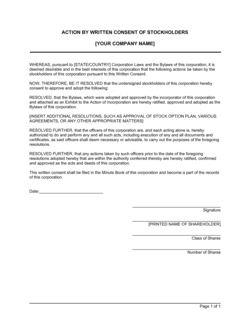
The undersigned, constituting all the members of the Board of Directors of [CORPORATION NAME], hereby adopt the following resolution by written consent in lieu of a meeting, pursuant to Section [X] of the Corporation's Bylaws and [APPLICABLE STATUTE].

Common mistake: Failing to confirm that a quorum was present for meeting-based resolutions. A resolution adopted without quorum is void, exposing any resulting action — such as a signed contract — to legal challenge.

Operative resolution clause

In plain language: The core RESOLVED statement that sets out the specific action the board is authorizing, directing, or approving in clear and unambiguous terms.

Sample language
RESOLVED, that the Board of Directors hereby [AUTHORIZES / APPROVES / DIRECTS] [SPECIFIC ACTION], effective [DATE OR IMMEDIATELY], on the terms and conditions described herein.

Common mistake: Drafting the operative clause in vague language like 'the company is authorized to proceed as appropriate.' Courts and third parties interpret ambiguous authority grants narrowly — state the action, the scope, and any dollar or time limits explicitly.

Officer appointment or authority grant

In plain language: Names specific individuals authorized to act on behalf of the corporation in connection with the resolution, and describes the scope and limits of that authority.

Sample language
FURTHER RESOLVED, that [OFFICER TITLE], [OFFICER NAME], is hereby authorized and directed to execute and deliver, on behalf of the Corporation, any and all documents, agreements, and instruments necessary to carry out the foregoing resolution.

Common mistake: Granting authority to a job title without naming the current incumbent. If the title holder changes, the resolution becomes ambiguous. Always name the individual and cross-reference their title.

Ratification of prior acts

In plain language: Retroactively approves actions already taken by officers or agents before the formal resolution was adopted, closing the gap between when action was taken and when board approval is recorded.

Sample language
FURTHER RESOLVED, that all actions previously taken by the officers of the Corporation in furtherance of the foregoing resolutions prior to the date hereof are hereby ratified, confirmed, and approved in all respects.

Common mistake: Using a blanket ratification clause to cover undisclosed or unknown prior acts. Ratification without itemizing what is being ratified can inadvertently authorize unauthorized acts and expose directors to liability.

Effective date and conditions

In plain language: States when the resolution takes effect and whether it is conditional on any subsequent event, regulatory approval, or fulfillment of a condition precedent.

Sample language
This resolution shall take effect immediately upon adoption [or: upon receipt of [REGULATORY APPROVAL / THIRD-PARTY CONSENT]] and shall remain in effect until revoked by a subsequent resolution of the Board.

Common mistake: Omitting an expiry or revocation clause for authority grants. An open-ended authority grant — particularly for banking or contract signing — creates unlimited ongoing exposure if the authorized officer's role or relationship changes.

Certification by corporate secretary

In plain language: A signed statement by the corporate secretary confirming that the resolution was duly adopted, that the board had the authority to act, and that the document is a true copy of the corporate records.

Sample language
I, [SECRETARY NAME], Secretary of [CORPORATION NAME], hereby certify that the foregoing is a true, correct, and complete copy of a resolution duly adopted by the Board of Directors of the Corporation, and that such resolution is in full force and effect as of the date hereof.

Common mistake: Having the resolution signed only by the directors and not separately certified by the secretary. Banks and legal counterparties require the certification as independent confirmation — a resolution without it is frequently rejected.

Director signature blocks

In plain language: Signature lines for each director adopting the resolution, with printed name, title, and date, confirming individual consent to the action.

Sample language
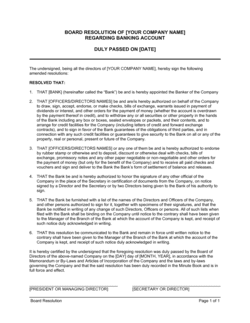
IN WITNESS WHEREOF, the undersigned directors of [CORPORATION NAME] have executed this Resolution as of the date first written above. [DIRECTOR NAME] _________________________ Director

Common mistake: Collecting only a majority of director signatures when the bylaws or applicable statute require unanimity for a written consent resolution. Always check whether unanimous consent is required before circulating the document.

Governing law reference

In plain language: Identifies the jurisdiction whose corporate law governs the adoption and interpretation of the resolution.

Sample language
This resolution is adopted pursuant to the [STATE/PROVINCE] [BUSINESS CORPORATIONS ACT / GENERAL CORPORATION LAW] and the Bylaws of the Corporation as currently in effect.

Common mistake: Omitting the governing law reference on resolutions intended for use with foreign banks or counterparties. Without it, a reviewer unfamiliar with the corporation's home jurisdiction cannot confirm that the resolution was validly adopted.

How to fill it out

  1. 1

    Enter the corporation's full legal name and jurisdiction

    Use the exact registered name from your articles of incorporation or certificate of formation. Include the state or province of incorporation and the entity type (e.g., Delaware Corporation, Ontario Corporation).

    💡 Cross-check the name against your most recent state or provincial registry filing — even minor discrepancies cause bank and regulatory rejections.

  2. 2

    Choose the adoption method: board meeting or written consent

    If the resolution is being adopted at a formal board meeting, confirm that a quorum was present and record the date and location. If using written consent, confirm that your bylaws and applicable corporate statute permit it — most do, but some require unanimous consent.

    💡 For single-director or closely held corporations, written consent is almost always faster and equally binding as a formal meeting.

  3. 3

    Draft the recitals to explain the purpose

    Write one or two whereas clauses summarizing why the board is acting — the factual background, the business need, and any documents the board reviewed before deciding.

    💡 Recitals are not operative — they cannot expand or restrict the authority granted — but they establish the business judgment record that protects directors against future liability challenges.

  4. 4

    Write the operative RESOLVED clause with specific authority

    State the exact action being authorized, including any dollar limits, time limits, or geographic restrictions. If authorizing a contract, name the counterparty and describe the transaction. If appointing an officer, name the individual and state the title.

    💡 Read the RESOLVED clause aloud. If a banker or lawyer unfamiliar with the transaction cannot understand exactly what is authorized from the clause alone, tighten it.

  5. 5

    Name the authorized signatories with their titles

    In the authority grant clause, name each individual authorized to sign documents, open accounts, or take further action. State whether authority is individual or joint (i.e., requires two signatories).

    💡 For banking resolutions, confirm the bank's specific formatting requirements before finalizing — many institutions have their own required language that must appear verbatim.

  6. 6

    Add a ratification clause if prior actions have already been taken

    If any officer has already signed a document or taken action in anticipation of this resolution, add a specific ratification clause identifying those acts. Do not use a blanket catch-all ratification.

    💡 List each prior act by date and description in the ratification clause — vague ratifications are regularly challenged and sometimes disregarded.

  7. 7

    Have the corporate secretary complete the certification block

    The secretary signs and dates the certification separately from the director signature blocks. The certification confirms the resolution is a true extract from the corporate records and is currently in force.

    💡 Keep the original signed resolution in the corporate minute book and issue certified copies — not originals — to banks and counterparties.

  8. 8

    Obtain all required director signatures

    Circulate the resolution to all required directors for signature. For written consents, check whether your jurisdiction requires unanimity. For meeting resolutions, confirm signatures from a quorum and note the vote count.

    💡 Use a dated cover email when circulating for e-signature — it creates a contemporaneous record of when each director received and signed the document.

Frequently asked questions

What is a board resolution regarding organization?

A board resolution regarding organization is a formal written record of a decision made by a company's board of directors concerning the structure, governance, or internal authority of the corporation — such as appointing officers, establishing committees, granting signing authority, or authorizing the opening of bank accounts. It is legally binding on the corporation once properly adopted in accordance with the bylaws and applicable corporate statute, and it creates an official record in the corporate minute book.

When does a company need a board resolution?

A board resolution is required whenever a corporation takes a significant organizational action that must be formally authorized by the board. Common triggers include appointing or removing officers, opening or closing bank accounts, granting contract signing authority, amending bylaws, issuing shares, and approving major transactions. Banks, government agencies, and legal counterparties routinely require a certified copy of the relevant resolution before acting on the corporate decision.

Does a board resolution need to be signed by all directors?

Whether all directors must sign depends on the form of adoption. For a written consent resolution adopted without a meeting, most jurisdictions and standard bylaws require unanimous director consent. For a resolution adopted at a formal board meeting, only a quorum — typically a majority of directors — need be present, and the resolution passes by majority vote of those present. Always review your specific bylaws and the corporate statute of your jurisdiction before circulating a resolution for signature.

What is the difference between a board resolution and meeting minutes?

Meeting minutes are a narrative record of everything that occurred during a board meeting — discussions, votes, attendance, and decisions. A board resolution is the formal operative document recording a specific decision and the authority granted by it. Resolutions may be extracted from meeting minutes or adopted as standalone written consents. Third parties such as banks typically require a certified copy of the specific resolution, not the full meeting minutes.

Can a board resolution be adopted without a meeting?

Yes. In most jurisdictions — including all US states, Canadian provinces, the UK, and EU member states — corporate statutes permit directors to adopt resolutions by written consent without convening a formal meeting, provided the consent is signed by the required number of directors (typically all of them) and the bylaws do not prohibit it. Written consents are common in closely held corporations and startups where convening a formal meeting is impractical.

Does a board resolution need to be notarized?

Notarization is generally not required for a standard board resolution to be valid in most jurisdictions. However, some banks, foreign registries, and government filings require a notarized or apostilled copy when the resolution will be used internationally or to authenticate signatures for a foreign authority. Check the specific requirements of the institution or jurisdiction requesting the document before assuming a standard certified copy is sufficient.

How long should a board resolution be kept on file?

Board resolutions should be retained permanently as part of the corporate minute book. They may be required as evidence of proper governance during regulatory audits, due diligence for mergers and acquisitions, financing transactions, and litigation. Many jurisdictions require corporations to maintain minute books for the life of the corporation plus a statutory retention period — in Canada, for example, the Canada Business Corporations Act requires records to be kept for six years after the end of the fiscal year to which they relate, but governance records are typically kept indefinitely.

Can an officer act on behalf of the company without a board resolution?

In many cases, officers have apparent or implied authority under the bylaws and corporate statute to take ordinary course business actions without a specific resolution. However, significant organizational decisions — opening bank accounts, signing major contracts, appointing senior officers, issuing shares — generally require express board authorization. Acting without a required resolution exposes the officer and the corporation to the risk that the action is treated as unauthorized or ultra vires, which can void contracts and create personal liability.

Do I need a lawyer to prepare a board resolution?

For routine organizational resolutions — officer appointments, bank account authorization, or standard authority grants — a high-quality template is typically sufficient for most corporations. Legal counsel is advisable when the resolution relates to a complex transaction, amends constitutional documents, authorizes issuance of securities, or will be submitted to a foreign regulatory authority. A lawyer review of a template-based resolution typically costs $200–$500 and is worthwhile for any action with material legal or financial consequences.

How this compares to alternatives

vs Board Meeting Minutes

Meeting minutes are a narrative record of everything discussed and decided at a board meeting — who attended, what was debated, and how votes were cast. A board resolution is the formal operative document extracting and certifying the specific decision. Banks and counterparties require the resolution; the minutes are the internal governance record that supports it. Both should exist for every significant board action.

vs Written Consent in Lieu of Board Meeting

A written consent achieves the same legal effect as a resolution adopted at a meeting but without convening directors in person or by call. It is the adoption mechanism; the board resolution is the content of what is being decided. For closely held corporations, written consent is often faster, but most jurisdictions require all directors — not just a quorum — to sign, which can slow adoption if the board is large.

vs Shareholder Resolution

A shareholder resolution is passed by the company's shareholders rather than its directors, and is typically required for decisions that affect shareholders' rights — such as amending the articles of incorporation, approving a merger, or removing a director. A board resolution covers decisions within the board's delegated authority. Confusing the two can result in invalid actions that require expensive re-approval at the correct level.

vs Corporate Bylaws

Bylaws are the standing rules that govern how the corporation operates, including how resolutions must be adopted. A board resolution is a one-time or recurring decision made within the framework established by the bylaws. Bylaws require shareholder approval to amend; resolutions can be adopted and revoked by the board alone within the limits the bylaws set.

Industry-specific considerations

Technology / SaaS

Frequently used to authorize officer appointments at incorporation, grant signing authority for SaaS subscription agreements, and formalize board-level decisions ahead of funding rounds where investors require a clean minute book.

Financial Services

Regulators and banking counterparties require certified resolutions confirming authorized signatories for every account, transaction, and regulatory filing — making properly certified resolutions a compliance necessity rather than a best practice.

Real Estate

Corporate resolutions are required to authorize real property transactions, grant signing authority for purchase agreements and mortgages, and confirm the authority of officers executing closing documents on behalf of the entity.

Professional Services

Law firms, accounting firms, and consultancies use organizational resolutions to appoint managing partners or directors, establish internal committees, and formalize authority delegations that govern client-facing engagements and fee arrangements.

Jurisdictional notes

United States

Corporate resolutions are governed by state law. Delaware General Corporation Law (DGCL) §141 and the Model Business Corporation Act (adopted by most other states) permit written consent resolutions signed by a majority of directors unless the certificate of incorporation or bylaws require unanimity. Some states require specific statutory language for resolutions that authorize banking transactions. California imposes additional requirements for closely held corporations under Corporations Code §186.

Canada

Federal corporations under the Canada Business Corporations Act (CBCA) and provincially incorporated corporations (e.g., under the Ontario Business Corporations Act or the British Columbia Business Corporations Act) may adopt resolutions by written consent of all directors in lieu of a meeting. Quebec corporations must comply with the Business Corporations Act (Quebec) and, where applicable, ensure that resolutions and certifications used in commercial transactions are available in French.

United Kingdom

Under the Companies Act 2006, private companies may pass written resolutions signed by the requisite majority of directors without holding a board meeting, provided the articles of association do not restrict this. Public companies (PLCs) must generally pass resolutions at a properly convened board meeting. Board resolutions authorizing significant transactions, officer appointments, or banking authority should be filed or referenced in the company's statutory registers maintained at Companies House where required.

European Union

There is no single EU-wide corporate resolution requirement — rules vary significantly by member state. German GmbH boards (Geschäftsführer) and French SAS boards operate under distinct national frameworks, each with its own formality requirements. Resolutions intended for cross-border use within the EU — particularly for banking, notarial transactions, or regulatory filings — may require apostille certification under the Hague Convention and, in some jurisdictions, notarization. GDPR considerations arise when resolutions reference individual personal data of officers or employees.

Template vs lawyer — what fits your deal?

PathBest forCostTime
Use the templateRoutine organizational resolutions — officer appointments, bank account authorization, and standard authority grants — for closely held or small corporationsFree15–30 minutes
Template + legal reviewResolutions related to a financing round, material contract, regulatory filing, or cross-border transaction where a counterparty will scrutinize the authorization$200–$5001–2 business days
Custom draftedComplex governance restructurings, resolutions authorizing securities issuances, multi-jurisdiction corporations, or actions subject to regulatory approval$800–$3,000+3–10 business days

Glossary

Board Resolution
A formal written record of a decision made by a company's board of directors, binding on the corporation once properly adopted.
Quorum
The minimum number of directors who must be present or participating for a board meeting to conduct official business — typically a majority of the total board.
Written Consent in Lieu of Meeting
A mechanism allowing directors to adopt a resolution without holding a physical meeting, by signing a written document instead — permitted in most jurisdictions.
Corporate Minute Book
The official corporate record containing all meeting minutes, resolutions, share certificates, and governance documents maintained by the corporation.
Authorized Signatory
An individual formally designated by the board to sign contracts, financial instruments, or legal documents on behalf of the corporation.
Certification
A statement by the corporate secretary confirming that the resolution was duly adopted by the board in accordance with the company's bylaws and applicable law.
Recitals
Introductory whereas clauses in a resolution that set out the factual background and reason for the board's action, without themselves being operative.
Bylaws
The internal rules governing a corporation's management, including director voting thresholds, officer roles, and the procedure for adopting resolutions.
Ultra Vires
A Latin term for an act taken beyond the legal authority of the corporation or the board — resolutions that exceed the company's charter or bylaw authority can be voided.
Fiduciary Duty
The legal obligation of directors to act in the best interests of the corporation and its shareholders when making decisions, including those recorded in resolutions.
Incumbency Certificate
A document certifying the names, titles, and signatures of a company's current officers, often issued alongside a resolution to satisfy third-party verification requirements.

Part of your Business Operating System

This document is one of 3,000+ business & legal templates included in Business in a Box.

  • Fill-in-the-blanks — ready in minutes
  • 100% customizable Word document
  • Compatible with all office suites
  • Export to PDF and share electronically

Create your document in 3 simple steps.

From template to signed document — all inside one Business Operating System.
1
Download or open template

Access over 3,000+ business and legal templates for any business task, project or initiative.

2
Edit and fill in the blanks with AI

Customize your ready-made business document template and save it in the cloud.

3
Save, Share, Send, Sign

Share your files and folders with your team. Create a space of seamless collaboration.

Save time, save money, and create top-quality documents.

★★★★★

"Fantastic value! I'm not sure how I'd do without it. It's worth its weight in gold and paid back for itself many times."

Managing Director · Mall Farm
Robert Whalley
Managing Director, Mall Farm Proprietary Limited
★★★★★

"I have been using Business in a Box for years. It has been the most useful source of templates I have encountered. I recommend it to anyone."

Business Owner · 4+ years
Dr Michael John Freestone
Business Owner
★★★★★

"It has been a life saver so many times I have lost count. Business in a Box has saved me so much time and as you know, time is money."

Owner · Upstate Web
David G. Moore Jr.
Owner, Upstate Web

Run your business with a system — not scattered tools

Stop downloading documents. Start operating with clarity. Business in a Box gives you the Business Operating System used by over 250,000 companies worldwide to structure, run, and grow their business.

Start free · No credit card required