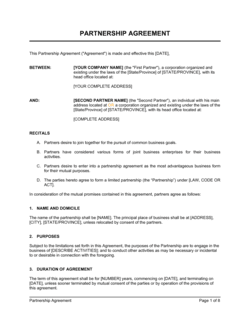
Board Resolution Approving Negotiation Template

Free Word download • Edit online • Save & share with Drive • Export to PDF

1 page20–30 min to fillDifficulty: StandardSignature requiredLegal review recommended
Learn more ↓
FreeBoard Resolution Approving Negotiation Template

At a glance

What it is
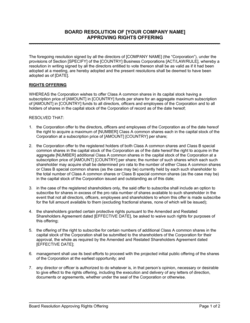
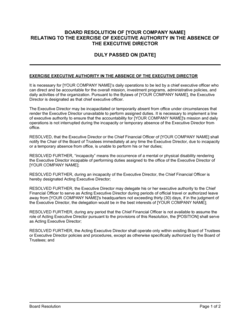
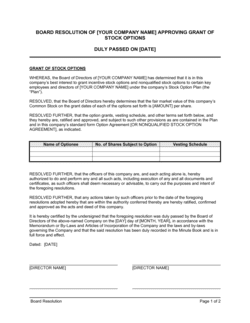
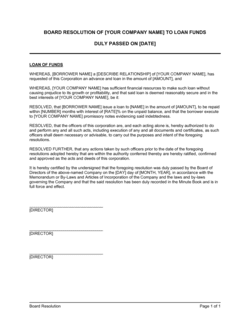
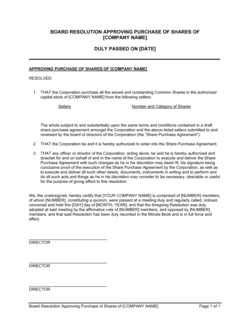
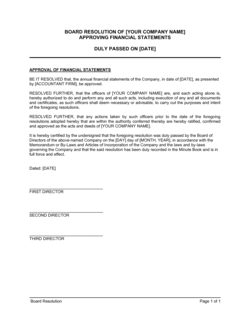
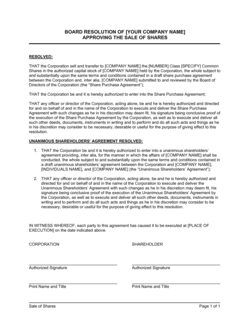
A Board Resolution Approving Negotiation is a formal corporate document in which a company's board of directors votes to authorize one or more designated officers or agents to enter into negotiations on the company's behalf. This free Word download gives you a ready-to-edit template you can adapt to any deal type — acquisition, partnership, financing, vendor contract, or real estate transaction — and export as PDF for inclusion in your corporate records or delivery to a counterparty.
When you need it
Use it whenever board approval is required before management can legally commit the company to a negotiating process — typically for material transactions, acquisitions, significant vendor agreements, or any deal where a counterparty or financier demands written evidence that the authorized representative has board backing. It is also needed when corporate bylaws or applicable law requires a recorded board vote before certain negotiations can proceed.
What's inside
Company identification, recitals describing the proposed negotiation, the formal resolution granting authority, identification of authorized signatories, scope and limitations of the negotiating mandate, voting record, director signatures, and a secretary's certification attesting that the resolution was duly adopted.

What is a Board Resolution Approving Negotiation?

A Board Resolution Approving Negotiation is a formal corporate governance document in which a company's board of directors votes to authorize one or more named officers or agents to enter into negotiations on the company's behalf for a specific transaction or class of transactions. It records the board's decision in writing, identifies who has the authority to negotiate, defines the scope and limits of that authority, and creates the official corporate paper trail required by counterparties, lenders, and regulators before substantive discussions can begin. Unlike a casual internal memo or an email chain, a properly adopted and certified board resolution is a recognized legal instrument that binds the corporation to the grant of authority it describes.

Why You Need This Document

Without a board resolution, an officer's authority to negotiate a material deal rests on implied or apparent authority — a shaky foundation that counterparties' counsel will challenge, that lenders will reject, and that can expose individual directors to personal liability if the transaction later goes wrong. Banks require certified resolutions before opening credit discussions. Title companies require them before a corporate officer can sign a real estate LOI. Sophisticated acquirers and institutional partners request them as the first item in any due diligence checklist. Beyond satisfying external demands, a resolution with explicit scope limits prevents an overzealous officer from committing the company to terms the board never intended — a protection that becomes especially valuable when a deal turns contentious. This template gives you a compliant, customizable starting point that takes 15 minutes to complete and eliminates the most common defects that cause resolutions to be rejected or challenged.

Which variant fits your situation?

If your situation is…Use this template
Authorizing negotiation of a merger or acquisitionBoard Resolution Approving Merger Negotiation
Approving negotiation of a bank loan or credit facilityBoard Resolution Authorizing Loan
Authorizing an officer to sign a specific contract once negotiatedBoard Resolution Authorizing Execution of Agreement
Approving negotiation and execution of a real estate leaseBoard Resolution Approving Lease
Granting broad ongoing authority to an officer for day-to-day contractsBoard Resolution Granting Signing Authority
Documenting written consent in lieu of a formal board meetingWritten Consent of Board of Directors
Ratifying negotiations that were conducted before formal approval was recordedBoard Resolution Ratifying Actions of Officers

Common mistakes to avoid

❌ Authorizing 'any officer' without naming individuals

Why it matters: Counterparties and their counsel typically require a named person before accepting a resolution as proof of authority. An unnamed grant creates uncertainty about who can bind the company and may cause the document to be rejected.

Fix: Name each authorized representative by full legal name and title in the operative clause. If a backup is needed, add a 'and/or [ALTERNATE NAME], [TITLE]' rather than a blanket officer reference.

❌ Omitting a scope cap or dollar limit

Why it matters: Without a defined ceiling, an officer can technically commit the company to any deal value under the resolution — exposing the board to liability for transactions they never intended to authorize.

Fix: Add an explicit maximum transaction value and a list of terms (e.g., equity issuance, personal guarantees, exclusivity periods longer than 60 days) that require a second board resolution before the officer may agree to them.

❌ Skipping the secretary's certification

Why it matters: Banks, institutional lenders, title companies, and sophisticated counterparties routinely require a certified resolution before proceeding. Without certification, the document may be treated as a draft rather than an official corporate act.

Fix: Always have the corporate secretary complete and sign the certification block before distributing any copies. If the company has no secretary, a director may certify in most jurisdictions — confirm with local counsel.

❌ Leaving the authorization open-ended with no expiry date

Why it matters: An undated or perpetual authorization can be relied upon by an officer months or years after the board's intent has changed — creating unexpected liability or binding the company to a deal the board would no longer approve.

Fix: Set a specific expiry date (typically 90–180 days from the meeting date) or tie expiry to a defined event such as execution of a definitive agreement or a subsequent board resolution.

❌ Failing to ratify prior preliminary actions

Why it matters: If officers have already held exploratory calls, signed a preliminary NDA, or exchanged term sheets before the resolution was adopted, those acts technically lacked board authorization and could be challenged.

Fix: Include a ratification clause confirming all prior acts taken in connection with the negotiation are approved as of the resolution date. This retroactively cures the authorization gap.

❌ Using a trade name instead of the registered legal entity name

Why it matters: A resolution that names 'Acme Design' instead of 'Acme Design Studio Inc.' may not legally bind the correct corporate entity. Counterparties conducting diligence will flag the mismatch and may require a corrected resolution.

Fix: Verify the exact legal name in your certificate of incorporation or state/provincial registry before completing the resolution, and use that name verbatim throughout the document.

The 10 key clauses, explained

Company identification and meeting details

In plain language: Names the corporation, its jurisdiction of incorporation, and records the date, time, and format of the board meeting at which the resolution was adopted.

Sample language
The undersigned, being all of the directors of [COMPANY NAME], a [STATE/PROVINCE] [CORPORATION/LLC] ('Company'), held a [special / regular] meeting on [DATE] at [TIME], [in person / by videoconference], at which a quorum was present.

Common mistake: Using a trade name or brand name instead of the exact registered legal entity name. A mismatch creates uncertainty about which entity is authorized and can cause a counterparty's legal team to reject the document.

Recitals (Whereas clauses)

In plain language: Describes the proposed negotiation in plain business terms — what is being negotiated, with whom, and why the board considers it in the company's interests.

Sample language
WHEREAS, the Company has identified an opportunity to negotiate [DESCRIPTION OF TRANSACTION] with [COUNTERPARTY NAME]; and WHEREAS, the Board has reviewed the strategic rationale for the proposed negotiation and deems it in the best interests of the Company;

Common mistake: Writing recitals so vague that the resolution could authorize almost anything. Courts and counterparties read recitals to understand the scope of the grant — vague recitals invite scope disputes.

Granting clause (core resolution)

In plain language: The operative decision of the board — the 'Resolved' language that formally grants the named representative authority to negotiate on the company's behalf.

Sample language
RESOLVED, that [OFFICER NAME/TITLE] ('Authorized Representative') is hereby authorized and directed to negotiate, on behalf of the Company, the terms and conditions of [TRANSACTION DESCRIPTION] with [COUNTERPARTY NAME], subject to the limitations set forth herein.

Common mistake: Authorizing 'any officer' without naming specific individuals. Counterparties typically require a named person; an unnamed grant creates ambiguity about who can bind the company.

Scope and limitations of authority

In plain language: Defines the boundaries of what the authorized representative may negotiate — deal type, dollar threshold, term limits, and any conditions that require further board approval.

Sample language
The authority granted herein is limited to negotiation of [TRANSACTION TYPE] with a total value not to exceed $[AMOUNT] and a term not to exceed [X] years. Any negotiated terms materially different from the parameters in Exhibit A require further board approval prior to execution.

Common mistake: Omitting any financial or scope cap. An unlimited authorization exposes the company to an officer negotiating terms far beyond what the board intended, with the company potentially bound by those terms.

Authorization to execute ancillary documents

In plain language: Grants the authorized representative authority to sign non-disclosure agreements, letters of intent, term sheets, and other preliminary documents necessary to facilitate the negotiation.

Sample language
RESOLVED FURTHER, that the Authorized Representative is authorized to negotiate, execute, and deliver any non-disclosure agreement, letter of intent, term sheet, or other preliminary document reasonably necessary to conduct the negotiation described herein.

Common mistake: Forgetting to authorize NDAs and LOIs separately. Without this clause, an officer who signs an NDA before the main negotiation begins may have done so without proper authority.

Ratification of prior acts

In plain language: Confirms board approval of any preliminary steps already taken by officers in anticipation of the negotiation, such as initial conversations or preliminary correspondence.

Sample language
RESOLVED FURTHER, that all actions previously taken by officers or agents of the Company in connection with the proposed negotiation, prior to the date of this resolution, are hereby ratified, approved, and confirmed in all respects.

Common mistake: Omitting ratification when preliminary conversations have already occurred. Without it, earlier acts technically lack board authorization and could be challenged by counterparties or shareholders.

Voting record

In plain language: Records how each director voted — for, against, or abstaining — to demonstrate that the resolution was validly adopted by the required majority.

Sample language
The foregoing resolutions were adopted by the following vote: FOR: [NAMES]; AGAINST: [NAMES or 'None']; ABSTAINING: [NAMES or 'None']. The resolutions were duly adopted.

Common mistake: Recording only 'unanimous approval' without listing individual directors. If a quorum or majority is later disputed, a detailed voting record is essential evidence of valid adoption.

Director signatures

In plain language: Each director who voted in favor signs the resolution to authenticate it and create an enforceable corporate record.

Sample language
IN WITNESS WHEREOF, the undersigned directors of [COMPANY NAME] have executed this Resolution as of [DATE]. [DIRECTOR NAME] _______________ [DIRECTOR NAME] _______________

Common mistake: Having only one director sign when the bylaws require a majority or all directors. A signature block that doesn't match the quorum requirement makes the resolution defective.

Secretary's certification

In plain language: A signed certification by the corporate secretary confirming that the resolution was properly adopted at a duly constituted meeting and is a true record of the board's decision.

Sample language
I, [SECRETARY NAME], Secretary of [COMPANY NAME], hereby certify that the foregoing is a true and correct copy of a resolution duly adopted by the Board of Directors at a meeting held on [DATE], at which a quorum was present and acting throughout.

Common mistake: Skipping the secretary's certification entirely. Banks, title companies, and sophisticated counterparties routinely require a certified copy before accepting a board resolution — without it, the document may be refused.

Expiration and revocation clause

In plain language: States how long the authorization remains valid and confirms the board's right to revoke or modify it by subsequent resolution.

Sample language
The authority granted by this Resolution shall expire on [DATE] or upon execution of a definitive agreement, whichever occurs first, unless earlier revoked by resolution of the Board of Directors.

Common mistake: Leaving the authorization open-ended with no expiry date. An undated or perpetual authorization can create ongoing authority the company no longer intends — creating liability if an officer relies on a stale resolution.

How to fill it out

  1. 1

    Enter the company's full legal name and jurisdiction

    Use the exact registered corporate name — including entity type (Inc., LLC, Ltd.) — and the state or province of incorporation. Cross-reference your certificate of incorporation or articles to confirm spelling.

    💡 If the company operates under a trade name different from its legal name, add a line noting the DBA — some counterparties require it for clarity.

  2. 2

    Record the meeting date, format, and quorum confirmation

    Enter the date, time, and whether the meeting was in person, by phone, or by videoconference. Confirm that the number of directors present meets the quorum requirement in your bylaws.

    💡 Check your bylaws for the quorum threshold before the meeting — many companies require a majority of the entire board, not just a majority of those present.

  3. 3

    Draft the recitals with specific transaction detail

    Name the counterparty, describe the deal type (acquisition, partnership, loan, lease), and state the business rationale in one or two sentences. Specificity here defines the scope of the authority granted.

    💡 If the counterparty is under NDA at this stage, refer to them by a code name (e.g., 'Project Atlas counterparty') and keep the full name in a sealed board exhibit.

  4. 4

    Name the authorized representative by title and full name

    Insert the officer's legal name and title in the granting clause. If more than one person is authorized, list each individually and specify whether they may act separately or must act jointly.

    💡 Joint authorization (both signatures required) provides more control but slows execution. Use it for deals above a material threshold; use individual authority for routine negotiations.

  5. 5

    Set explicit scope limits and dollar thresholds

    Define the maximum transaction value, permitted deal structures, and any terms that require a second board vote before the officer can agree to them. Attach a term sheet or parameters as Exhibit A if the deal is complex.

    💡 A hard dollar cap is more defensible than a vague 'material terms' standard. State the number explicitly: 'not to exceed $500,000 in aggregate value.'

  6. 6

    Add authorization for ancillary documents

    Include a 'Resolved Further' clause authorizing the representative to sign NDAs, LOIs, and term sheets needed to facilitate the negotiation. Confirm whether the officer may also authorize legal counsel to act on the company's behalf.

    💡 Authorize legal counsel by name or firm here if they will be signing correspondence or documents as the company's representative — some counterparties require it.

  7. 7

    Record the vote and collect director signatures

    List each director's name and their vote (for, against, or abstaining). Have all directors who voted in favor sign the resolution before it is filed in the corporate minute book.

    💡 For fully remote boards, use a written consent in lieu of meeting instead — it produces the same legal result without coordinating a live meeting.

  8. 8

    Obtain the secretary's certification and file in the minute book

    Have the corporate secretary sign and date the certification block confirming valid adoption, then file the original in the corporate minute book and provide certified copies to the authorized representative and any counterparty who requests one.

    💡 Prepare two certified copies at execution: one for your deal file and one to deliver to the counterparty's counsel. This avoids delays when their legal team asks for it during diligence.

Frequently asked questions

What is a board resolution approving negotiation?

A board resolution approving negotiation is a formal document in which a company's board of directors votes to authorize a named officer or agent to enter into negotiations on the company's behalf. It creates a written record of the board's decision, defines who has authority to negotiate, and typically sets boundaries on the scope and value of any deal the officer may agree to. Counterparties, banks, and legal counsel frequently require a certified copy before negotiations can formally begin.

When does a company need a board resolution before negotiating?

Most corporate bylaws require board approval for material transactions — acquisitions, significant vendor agreements, real estate deals, financing arrangements, and partnerships above a certain dollar threshold. Even when bylaws are silent, sophisticated counterparties will typically request evidence of board authorization before entering binding preliminary documents such as an LOI or term sheet. Regulated industries and publicly traded companies face additional statutory requirements that mandate board involvement before negotiations begin.

Is a board resolution legally binding?

A properly adopted board resolution is generally binding on the corporation as a formal exercise of the board's governing authority. It does not itself create a contract with a counterparty — that requires a separately signed agreement — but it does authorize a specific person to negotiate and, if separately authorized, to execute such an agreement. Courts treat duly adopted resolutions as official corporate acts, and third parties who rely on a certified resolution in good faith are typically protected even if internal governance requirements were not perfectly followed.

Can a board resolution be passed without a formal meeting?

Yes. Most corporate statutes in the US, Canada, and the UK allow directors to adopt resolutions by written consent in lieu of a meeting, provided the required majority (or unanimity, as the bylaws specify) of directors sign the written consent. This is often faster and more practical for closely held companies or boards that operate remotely. The written consent must be dated, signed by each consenting director, and filed in the corporate minute book exactly as a meeting-based resolution would be.

What is the difference between a board resolution approving negotiation and one authorizing execution?

A resolution approving negotiation grants authority to discuss and agree on deal terms — it does not authorize the officer to sign a binding contract. A resolution authorizing execution (or authorizing signature) grants authority to sign the final agreement once terms are settled. Many boards pass both at separate stages: the first at the start of negotiations to give the officer mandate, and the second once the board has reviewed and approved the final negotiated terms. Some boards combine both grants in a single resolution when they are comfortable pre-approving execution subject to defined parameters.

Who typically signs a board resolution?

All directors who voted in favor sign the resolution, and the corporate secretary signs the certification block. For a written consent in lieu of meeting, the number of signatures required depends on the bylaws — typically a majority of the board, though some bylaws require unanimity. The authorized representative named in the resolution does not need to sign it. The signed original is stored in the corporate minute book; certified copies are provided to the authorized representative and requesting counterparties.

Does a board resolution need to be notarized?

Notarization is not required for a standard board resolution in most jurisdictions. The secretary's certification typically provides sufficient authentication for counterparties. However, certain real estate transactions, cross-border deals, or public-sector contracts may require a notarized or apostilled resolution — confirm requirements with local counsel before the transaction closes.

How long does the authority granted in a board resolution last?

The duration depends on what the resolution itself specifies. Best practice is to include an explicit expiry date — typically 90 to 180 days from adoption — or to tie expiry to a specific event, such as execution of a definitive agreement or a subsequent board resolution. Without an expiry clause, the authorization is technically valid until revoked by the board, which creates the risk of an officer relying on a stale resolution for a transaction the board no longer supports.

Can the board revoke a negotiation resolution after it has been issued?

Yes. The board retains authority to revoke or modify any resolution by passing a subsequent resolution to that effect at any time before a binding agreement is signed. Once a counterparty has relied on the resolution to enter a binding commitment, revocation may not undo contractual obligations already created — but it will prevent the authorized officer from taking further steps under the original grant. Any revocation should be promptly communicated in writing to the authorized representative and any counterparty who holds a copy of the original resolution.

How this compares to alternatives

vs Board Resolution Authorizing Execution of Agreement

A resolution authorizing execution grants authority to sign a final, agreed contract — it assumes negotiations are complete and the board has reviewed the deal terms. A resolution approving negotiation grants authority only to negotiate and does not permit the officer to execute a binding agreement without a separate board vote. Both are often needed in sequence for material transactions.

vs Written Consent of Board of Directors

A written consent is the procedural mechanism for adopting any board resolution without a live meeting — all consenting directors sign a document rather than gathering in person or by call. A board resolution approving negotiation is the substantive decision being made; it can be adopted either at a meeting or by written consent. The two documents are complementary, not alternatives.

vs Letter of Intent (LOI)

A letter of intent is a document signed by both parties summarizing agreed deal terms and indicating intent to enter a definitive agreement. A board resolution approving negotiation is an internal corporate document authorizing an officer to engage in the discussions that produce an LOI. The resolution comes before the LOI; the LOI is the first external output of an authorized negotiation.

vs Power of Attorney

A power of attorney grants broad or specific legal authority to an individual to act on behalf of a person or entity across a wide range of acts, enforceable directly against third parties. A board resolution is an internal corporate governance document that authorizes an officer already empowered by their role — it does not create new legal standing with third parties the way a power of attorney does. For cross-border or notarized transactions, a power of attorney may be needed in addition to a board resolution.

Industry-specific considerations

Technology / SaaS

Boards authorize officers to negotiate acquisition targets, strategic partnership agreements, or enterprise licensing deals, often under strict NDA before any term sheet is exchanged.

Real estate and construction

Lenders, title companies, and sellers routinely require a certified board resolution before an officer can sign a letter of intent or purchase agreement for a commercial property.

Financial services

Regulatory requirements and institutional counterparty standards in banking and investment management typically mandate documented board authorization before any material financing negotiation proceeds.

Healthcare

Hospital systems, physician groups, and health-tech companies use negotiation resolutions to authorize officers to negotiate vendor contracts, payer agreements, and M&A transactions subject to strict compliance review.

Manufacturing

Large supply-chain agreements, joint ventures, and equipment financing deals require board authorization resolutions that satisfy both the company's internal governance and the counterparty's legal due diligence.

Professional services

Law firms, accounting firms, and consulting practices use negotiation resolutions to authorize managing partners or officers to negotiate merger-of-equals or lateral-hire agreements where board-level consent is required by partnership agreements.

Jurisdictional notes

United States

Corporate resolutions are governed by state law — typically the Model Business Corporation Act or state-specific statutes such as Delaware General Corporation Law. Most states permit action by written consent of directors without a meeting unless the articles of incorporation prohibit it. Some states require that resolutions authorizing certain transactions (real estate, secured debt) be filed or referenced in public records. Confirm quorum and vote thresholds in the company's bylaws before the meeting.

Canada

Under the Canada Business Corporations Act (CBCA) and provincial equivalents, directors may act by written resolution signed by all directors entitled to vote, unless the articles require otherwise. Quebec corporations governed under the Business Corporations Act (QC) follow similar rules but documents may need to be in French for provincially regulated entities. Corporations in federally regulated industries (banking, insurance, transport) may face additional requirements from their sector regulator before authorizing material negotiations.

United Kingdom

Under the Companies Act 2006, private companies may pass board resolutions by written consent of the majority of directors, while public companies typically require a board meeting with proper notice. Resolutions should be recorded in the company's statutory registers and minute books. For transactions requiring shareholder approval under the Act (e.g., substantial property transactions with directors), a board resolution alone is insufficient — shareholder consent must be obtained in parallel.

European Union

Requirements for board resolutions vary significantly across EU member states. German GmbH and AG boards follow strict procedural rules under the GmbHG and AktG, including notarial involvement for certain transactions. French SAS and SA structures have different board composition and voting requirements. In the Netherlands, a managing board resolution may require supervisory board co-approval for material transactions. Always confirm local corporate law requirements before relying on a standardized resolution template for an EU-domiciled entity.

Template vs lawyer — what fits your deal?

PathBest forCostTime
Use the templateStandard domestic negotiations where the authorized officer is a named executive and the transaction is within typical business operationsFree15–30 minutes
Template + legal reviewMaterial transactions above $250K, regulated industries, or where a counterparty's counsel will scrutinize the resolution$150–$400 for a one-hour attorney review1–2 business days
Custom draftedM&A transactions, cross-border deals, regulated financial entities, or situations requiring customized authority scope and multi-level delegation$500–$2,000+3–7 business days

Glossary

Board Resolution
A formal decision adopted by a company's board of directors, recorded in writing, that carries the legal authority of the board as a governing body.
Quorum
The minimum number of directors who must be present at a board meeting for any vote taken at that meeting to be legally valid.
Authorized Representative
The specific officer, director, or agent named in the resolution as having authority to act on the company's behalf in the described negotiation.
Recitals
Introductory 'Whereas' clauses that set out the background facts and business justification for the resolution before the operative language appears.
Operative Clause
The 'Resolved' language that constitutes the actual decision of the board — as distinct from recitals, which are background only.
Secretary's Certificate
A statement signed by the corporate secretary certifying that the resolution was duly adopted at a properly constituted meeting and accurately recorded.
Written Consent in Lieu of Meeting
A procedure allowing directors to adopt a resolution by signing a written document without convening a formal meeting, permitted under most corporate statutes.
Delegated Authority
The specific powers granted by the board to an officer or agent, defined by scope and duration, to act on the corporation's behalf without further board approval for each act.
Material Transaction
A deal or commitment whose value, risk, or strategic significance is significant enough that corporate governance rules or bylaws require board-level approval before proceeding.
Minutes
The official written record of proceedings at a board meeting, including attendees, matters discussed, motions made, votes cast, and resolutions adopted.
Fiduciary Duty
The legal obligation of directors to act in the best interests of the company and its shareholders — governing how they evaluate and approve transactions.

Part of your Business Operating System

This document is one of 3,000+ business & legal templates included in Business in a Box.

  • Fill-in-the-blanks — ready in minutes
  • 100% customizable Word document
  • Compatible with all office suites
  • Export to PDF and share electronically

Create your document in 3 simple steps.

From template to signed document — all inside one Business Operating System.
1
Download or open template

Access over 3,000+ business and legal templates for any business task, project or initiative.

2
Edit and fill in the blanks with AI

Customize your ready-made business document template and save it in the cloud.

3
Save, Share, Send, Sign

Share your files and folders with your team. Create a space of seamless collaboration.

Save time, save money, and create top-quality documents.

★★★★★

"Fantastic value! I'm not sure how I'd do without it. It's worth its weight in gold and paid back for itself many times."

Managing Director · Mall Farm
Robert Whalley
Managing Director, Mall Farm Proprietary Limited
★★★★★

"I have been using Business in a Box for years. It has been the most useful source of templates I have encountered. I recommend it to anyone."

Business Owner · 4+ years
Dr Michael John Freestone
Business Owner
★★★★★

"It has been a life saver so many times I have lost count. Business in a Box has saved me so much time and as you know, time is money."

Owner · Upstate Web
David G. Moore Jr.
Owner, Upstate Web

Run your business with a system — not scattered tools

Stop downloading documents. Start operating with clarity. Business in a Box gives you the Business Operating System used by over 250,000 companies worldwide to structure, run, and grow their business.

Start free · No credit card required