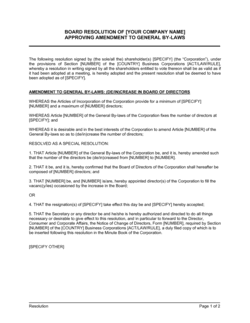
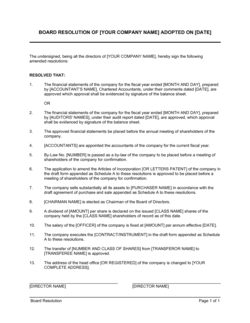
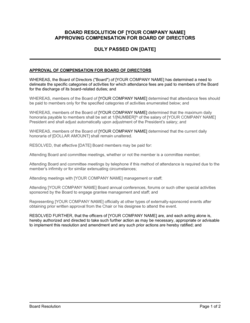
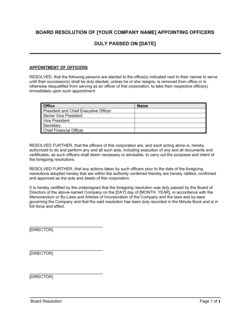
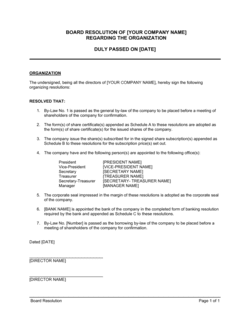
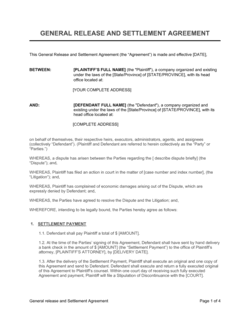
Board Resolution to Issue General Release Template

Free Word download • Edit online • Save & share with Drive • Export to PDF

1 page20–30 min to fillDifficulty: StandardSignature requiredLegal review recommended
Learn more ↓
FreeBoard Resolution to Issue General Release Template

At a glance

What it is
A Board Resolution To Issue General Release is a formal corporate document in which a company's board of directors votes to authorize the release of all known and unknown claims the corporation holds against a specified party. This free Word download gives you a structured, legally grounded starting point you can edit online and export as PDF for execution and filing with corporate records.
When you need it
Use it when settling a dispute with a former employee, officer, contractor, or counterparty and the settlement requires the corporation itself — not just an individual officer — to formally waive its legal claims. It is also required when a bank, acquirer, or counterparty demands documented board authority before accepting a release as binding on the company.
What's inside
Recitals identifying the corporation and the releasing circumstances, the board vote and quorum confirmation, the operative release clause covering all claims through the effective date, consideration recital, authorized signatory designation, and officer certification of the resolution's adoption.

What is a Board Resolution To Issue General Release?

A Board Resolution To Issue General Release is a formal corporate governance document in which a company's board of directors votes to authorize the corporation to waive all claims — known and unknown — that it holds against a named party as of a specified effective date. It records the board's quorum, vote, and best-interests determination, designates the officer authorized to execute the release on the company's behalf, and is certified by the corporate secretary for filing in the minute book. The resolution does not itself release the claims; rather, it establishes the documented corporate authority that makes any resulting release binding on the company.

Why You Need This Document

A release signed by a single officer without board authorization may be challenged as ultra vires — outside that officer's authority — leaving the corporation still legally holding the claims it intended to waive. Counterparties, lenders, and acquirers routinely demand a certified board resolution before accepting a corporate release as valid, and failure to produce one can stall a settlement closing, a transaction, or a financing. Beyond enforceability, the board's documented best-interests determination protects directors against shareholder derivative claims that the release was a waste of corporate assets. This template gives you a structured, legally grounded starting point that covers every required element — quorum, consideration, scope of claims, authorized signatory, and governing law — so your settlement authority is clear, your corporate records are complete, and no counterparty can question whether the company was properly bound.

Which variant fits your situation?

If your situation is…Use this template
Releasing claims against a departing executive or officerBoard Resolution To Issue General Release (Officer)
Settling a contractual dispute with a vendor or supplierGeneral Release Agreement
Authorizing settlement and payment of a monetary claimBoard Resolution To Settle Litigation
Releasing a personal guarantor from a corporate obligationRelease of Personal Guarantee
Mutual release of claims between two corporate partiesMutual Release Agreement
Releasing claims as part of a full acquisition closingBoard Resolution To Approve Asset Purchase Agreement
Documenting unanimous written consent in lieu of a formal meetingUnanimous Written Consent of the Board

Common mistakes to avoid

❌ Releasing claims without documented consideration

Why it matters: A release with no real consideration — or only nominal 'good and valuable consideration' language — may be unenforceable in a contract dispute. Courts require a genuine exchange of value.

Fix: State the specific consideration in the recitals: the settlement amount, mutual releases given, or other tangible benefit the corporation receives in exchange.

❌ Omitting the quorum confirmation

Why it matters: A release signed by a single officer without proof of board authorization can be challenged as ultra vires — beyond the officer's authority — leaving the company still holding the released claims.

Fix: Include the quorum and vote count in the resolution body, or attach the signed unanimous written consent pages as evidence of board authority.

❌ Skipping the best-interests determination

Why it matters: Without a documented finding that the release serves the company's best interests, directors who authorize the release of valuable claims risk shareholder derivative suits for waste of corporate assets.

Fix: Add a specific 'be it resolved' clause stating the board's determination that the release is in the best interests of the company and its shareholders.

❌ Using a trade name instead of the registered legal entity name

Why it matters: A release signed in a trade name may not bind the corporation, and a counterparty could argue that the legal entity never actually released its claims.

Fix: Verify the exact corporate name in the state or provincial registry before drafting the resolution, and use that name consistently throughout.

❌ No carve-outs for preserved rights

Why it matters: A broad general release with no carve-outs may inadvertently waive the corporation's indemnification rights, insurance recovery rights, or claims under agreements executed after the effective date.

Fix: Review the underlying settlement and related agreements with counsel to identify any rights the company intends to keep, and list them as explicit exclusions.

❌ Authorizing the same officer to sign and certify the resolution

Why it matters: Many banks, acquirers, and counterparties require the certifying officer to be a different person from the authorized signatory as a check on authority. Dual execution by the same person may cause the counterparty to reject the resolution.

Fix: Assign the certification to the corporate secretary or another officer who is not the designated signatory. If the company has only one officer, note this in the resolution and obtain additional board member signatures.

The 10 key clauses, explained

Corporate identification and recitals

In plain language: Identifies the corporation by its full legal name and state or jurisdiction of incorporation, and sets out the factual background — the nature of the dispute, claim, or relationship that makes the release appropriate.

Sample language
WHEREAS, [CORPORATION LEGAL NAME], a [STATE] [ENTITY TYPE] (the 'Company'), has certain claims or potential claims arising from or relating to [BRIEF DESCRIPTION OF MATTER] against [RELEASED PARTY NAME] (the 'Released Party');

Common mistake: Using a trade name or DBA instead of the registered corporate name. If the releasing entity name does not match the corporate charter, the release may not bind the corporation.

Quorum and vote confirmation

In plain language: Confirms that a quorum of the board was present at the meeting (or that unanimous written consent was obtained), that the resolution was put to a vote, and that it passed by the required threshold.

Sample language
RESOLVED, that the Board of Directors of the Company, a quorum being present and voting, hereby approves and authorizes the execution and delivery of a General Release in favor of the Released Party.

Common mistake: Omitting the quorum confirmation. Without it, a party receiving the release cannot confirm the action was validly taken, making the release vulnerable to challenge.

Authorization of the general release

In plain language: The operative clause authorizing the corporation to issue the release — the specific 'resolved' language that creates the corporate authority.

Sample language
RESOLVED FURTHER, that the Company is hereby authorized and directed to execute a General Release, releasing and forever discharging the Released Party from any and all claims, demands, actions, causes of action, obligations, and liabilities of any kind, whether known or unknown, arising through the date of the Release.

Common mistake: Limiting the release to 'known claims' only. In most commercial settlements, the releasing party intends to close the matter entirely — failing to include unknown claims can leave residual liability exposure unresolved.

Consideration recital

In plain language: Recites the value or benefit the corporation receives in exchange for issuing the release, establishing that adequate consideration supports the instrument.

Sample language
WHEREAS, in consideration of [SETTLEMENT PAYMENT OF $[AMOUNT] / MUTUAL RELEASES / [OTHER CONSIDERATION]], the receipt and sufficiency of which are hereby acknowledged, the Board has determined it is in the best interests of the Company to issue the General Release;

Common mistake: Reciting consideration in vague or nominal terms such as 'good and valuable consideration' without any specifics. Courts and counterparties may question enforceability where no real exchange is documented.

Best interests determination

In plain language: A finding by the board that authorizing the release serves the corporation's best interests, which protects directors from breach-of-fiduciary-duty claims by shareholders.

Sample language
RESOLVED, that the Board of Directors has determined that it is in the best interests of the Company and its shareholders to authorize and issue the General Release in favor of the Released Party on the terms described herein.

Common mistake: Skipping this clause in resolutions involving releases of material claims. Without a documented best-interests finding, directors may face shareholder derivative suits challenging the release as a waste of corporate assets.

Designation of authorized signatory

In plain language: Names the specific officer — typically the CEO, President, or Secretary — authorized to sign the release on the corporation's behalf and to take any related actions.

Sample language
RESOLVED FURTHER, that [OFFICER TITLE], [OFFICER NAME], is hereby authorized and directed to execute and deliver the General Release and any related documents on behalf of the Company, and to take all actions necessary to carry out the purposes of this Resolution.

Common mistake: Authorizing a title rather than a named individual. If the officer in that title has changed since the resolution was signed, the counterparty may dispute authority.

Scope of claims released

In plain language: Specifies the categories of claims covered — breach of contract, tort, employment claims, regulatory claims, or all claims of any nature — and any explicit carve-outs the board wishes to preserve.

Sample language
The General Release shall cover any and all claims, known or unknown, including but not limited to claims for breach of contract, negligence, fraud, misrepresentation, and any claims arising under applicable federal, state, or provincial law, excepting only [CARVE-OUTS, IF ANY].

Common mistake: Including no carve-outs when specific rights must be preserved — such as indemnification rights, insurance claims, or post-settlement payment obligations. A release with no carve-outs may inadvertently waive rights the company intends to keep.

Effective date of the release

In plain language: States the date as of which the release takes effect, which may differ from the date the resolution is adopted or the release is signed.

Sample language
The General Release shall be effective as of [DATE] (the 'Effective Date'), and shall release all claims arising prior to and including the Effective Date.

Common mistake: Leaving the effective date blank or writing 'to be determined.' An undated release is ambiguous as to which claims are covered and may be unenforceable.

Officer certification

In plain language: A certification block signed by the corporate secretary or another officer confirming that the resolution was duly adopted and that it is a true and correct extract of the company's board records.

Sample language
I, [SECRETARY NAME], Secretary of [CORPORATION LEGAL NAME], hereby certify that the foregoing is a true, correct, and complete copy of resolutions duly adopted by the Board of Directors at a [meeting held on / written consent effective] [DATE], and that such resolutions remain in full force and effect.

Common mistake: Having the same person who is the authorized signatory also certify the resolution. Many counterparties and banks require the certifying officer to be someone other than the person executing the document.

Governing law

In plain language: Specifies which jurisdiction's law governs the resolution and the release it authorizes, ensuring consistent interpretation.

Sample language
This Resolution and the General Release authorized hereby shall be governed by and construed in accordance with the laws of the State of [STATE], without regard to its conflict-of-laws principles.

Common mistake: Omitting a governing law clause entirely. When the corporation, the released party, and the subject matter are in different jurisdictions, courts must guess which law applies — producing unpredictable results.

How to fill it out

  1. 1

    Enter the corporation's full legal name and jurisdiction

    Use the exact registered name from the corporate charter or certificate of incorporation — not a trade name or abbreviation. Include the state or province of incorporation and entity type (e.g., 'a Delaware corporation').

    💡 Pull the exact legal name from your most recent state filing or certificate of good standing to avoid discrepancies that could invalidate the resolution.

  2. 2

    Identify the released party with precision

    Name every individual, entity, and related party being released. If the release covers a company's affiliates, officers, directors, and agents, list them explicitly or define them as a class within the recitals.

    💡 Ambiguity about who is released is the most litigated issue in release enforcement. If in doubt, be over-inclusive in defining the released parties.

  3. 3

    Describe the background and consideration

    Fill in the recitals with a factual summary of the matter being released — the dispute, agreement, or transaction — and state the specific consideration being received (settlement amount, mutual releases, or other benefit).

    💡 Avoid overly detailed factual recitals that could be used against the company in future litigation. A two-to-three sentence summary is sufficient.

  4. 4

    Confirm quorum and vote threshold

    Check your corporate bylaws for the required quorum and vote threshold for this type of resolution. Enter the number of directors present and the vote count (e.g., 'approved by a vote of 4 in favor, 0 opposed, 0 abstaining').

    💡 If the board is acting by unanimous written consent rather than at a meeting, replace the quorum and vote language with the UWC recital and attach the signed consent pages.

  5. 5

    Name the authorized signatory by title and full name

    Designate the specific officer who will sign the release — typically the CEO, President, or CFO. Use both title and full legal name to eliminate ambiguity.

    💡 If there is any chance the officer's role will change before the release is executed, authorize 'the [TITLE] of the Company, whoever holds that office at the time of execution' as a fallback.

  6. 6

    Define the scope of claims and any carve-outs

    List the categories of claims being released. Then explicitly list any rights, claims, or obligations the corporation is preserving — indemnification rights, post-settlement payment claims, or ongoing contractual obligations.

    💡 Run the carve-out list past whoever negotiated the underlying settlement to ensure nothing material is inadvertently waived.

  7. 7

    Set and enter the effective date

    Agree on a specific calendar date as of which the release is effective. Enter it consistently in both the resolution and the release agreement itself.

    💡 The effective date is often the date the settlement consideration is received or the last party signs — confirm this with all parties before filing.

  8. 8

    Have the secretary certify and file with corporate records

    The corporate secretary (or another officer who did not sign the release) should execute the certification block. File the executed resolution in the company's minute book and provide a certified copy to any counterparty that requires it.

    💡 Banks, acquirers, and counterparties often require a certified copy with a corporate seal or apostille — confirm the required form before closing.

Frequently asked questions

What is a board resolution to issue a general release?

A board resolution to issue a general release is a formal corporate document in which the board of directors votes to authorize the company to waive all claims it holds against a specified party as of a defined effective date. It establishes the corporate authority for the release, names the officer who will sign it, and confirms that adequate consideration was received. Without this resolution, a release signed only by an officer may lack the authority to bind the corporation.

When does a company need a board resolution before issuing a release?

A board resolution is generally required when the claims being released are material — meaning their value or strategic significance is significant enough that a single officer should not waive them unilaterally. It is also required when the counterparty, a lender, or an acquirer demands documented board authority as a condition of accepting the release. Most corporate bylaws require board approval for settlements or releases above a threshold dollar amount.

What is the difference between a board resolution and a general release agreement?

A board resolution is the internal corporate authorization document — it records the vote and designates who can sign. A general release agreement is the external binding instrument that actually waives the claims. The resolution authorizes the release; the release executes it. Both documents are typically required, and the release agreement should reference the authorizing resolution by date and subject matter.

Can one officer sign a general release without board approval?

In many cases, no. Corporate bylaws and governance documents typically limit an officer's unilateral authority to bind the company on matters above a defined threshold. Releasing material claims without board authorization may be voidable by the corporation and may expose the officer to liability for acting without authority. Review your bylaws and operating agreement before any officer signs a release unilaterally.

Does a board resolution to issue a general release need to be notarized?

Notarization is not typically required for the board resolution itself in most US states or Canadian provinces, but some counterparties — particularly banks and foreign parties — may request a notarized or apostilled certified copy. The general release agreement the resolution authorizes may have its own execution requirements depending on the jurisdiction and the subject matter of the claims being released.

What claims can a board resolution authorize a company to release?

A properly drafted board resolution can authorize the release of virtually any claims the corporation holds — breach of contract, tort, employment claims, regulatory claims, or claims arising from a specific transaction. The resolution should specify the scope, and the release agreement itself should enumerate the categories of claims covered. Certain statutory rights — such as workers' compensation claims in some jurisdictions — cannot be waived by a private agreement regardless of board authorization.

What consideration is required for a general release to be enforceable?

A general release requires real, identifiable consideration to be enforceable as a contract. Typical consideration includes a settlement payment, mutual releases from the other party, dismissal of pending litigation, or a combination. Nominal or recited-only consideration ('one dollar and other good and valuable consideration') is increasingly scrutinized by courts, particularly where substantial claims are released. State the actual consideration in the resolution's recitals whenever possible.

How should the board resolution be stored and certified?

The executed resolution should be filed in the company's official minute book alongside the meeting minutes or unanimous written consent that records its adoption. The corporate secretary should execute a certification confirming the resolution was duly adopted. Counterparties typically require a certified copy — some may also request a certificate of good standing or a legal opinion confirming the officer's authority.

Is a board resolution to issue a general release different for an LLC versus a corporation?

The functional purpose is the same, but the governance mechanics differ. An LLC uses a manager or member resolution rather than a board resolution, and the authority structure is governed by the operating agreement rather than bylaws. The resolution template should be adapted to reference 'members' or 'managers' as applicable, and quorum and voting thresholds should reflect what the operating agreement requires rather than corporate statute defaults.

How this compares to alternatives

vs General Release Agreement

A general release agreement is the operative instrument that actually waives the claims — it is signed by both parties and creates the binding obligation. A board resolution is the internal authorization document that gives an officer authority to sign that release on the corporation's behalf. Both are typically needed: the resolution authorizes; the release executes.

vs Mutual Release Agreement

A mutual release agreement involves both parties releasing each other simultaneously — useful when both sides have potential claims arising from the same matter. A board resolution to issue a general release is a one-way corporate authorization. If both parties are corporations, each may need its own board resolution authorizing its side of a mutual release.

vs Settlement Agreement

A settlement agreement is a broader document that covers the full terms of resolving a dispute — payment amounts, confidentiality, non-disparagement, and the release of claims. A board resolution authorizes the corporation to enter into that settlement and execute any release it contains. The resolution is typically a prerequisite to, not a substitute for, the settlement agreement itself.

vs Unanimous Written Consent of the Board

A unanimous written consent (UWC) is the procedural mechanism by which directors approve a resolution without holding a formal meeting — all directors sign the consent in lieu of convening. A board resolution to issue a general release can be adopted either at a meeting or by UWC. The resolution is the substance of what is authorized; the UWC is the process by which it is adopted when no meeting is held.

Industry-specific considerations

Technology / SaaS

Releases tied to founder buyouts, executive departures, or IP dispute settlements frequently require board authorization before a VC-backed company can waive claims.

Financial Services

Regulated entities often require documented board authority for any release of claims as part of internal controls and regulatory examination readiness.

Healthcare

Releases tied to vendor disputes, physician departures, or billing settlements typically require board-level sign-off to satisfy compliance and governance requirements.

Professional Services

Law firms, accounting firms, and consultancies use board or partnership resolutions to authorize releases as part of client dispute settlements or lateral partner departures.

Jurisdictional notes

United States

Board authority to issue releases is governed by the corporation's state of incorporation — Delaware, for example, allows broad delegation to officers but requires board approval for extraordinary transactions. California Civil Code §1542 requires an express waiver to release unknown claims; without it, released parties may argue that unknown claims survive. Several states impose additional requirements for releases of employment-related claims, including mandatory waiting periods and attorney consultation rights under the ADEA for workers over 40.

Canada

Canadian corporate law (federal CBCA or provincial equivalents) requires that board resolutions be adopted by the required quorum and recorded in the company's minute book. Employment-related releases must comply with each province's employment standards legislation, which may impose minimum entitlements that cannot be waived. In Quebec, releases and resolutions must be in French for provincially regulated corporations, and notarization may be required for certain instruments.

United Kingdom

Under the Companies Act 2006, board resolutions must be passed by the requisite majority set out in the company's articles of association and recorded in board minutes or as a written resolution. Releases of employment claims are subject to strict rules — a compromise agreement releasing statutory employment rights must be signed by a qualified independent legal adviser. Releases involving directors may also require shareholder approval under sections 177–182 of the Companies Act.

European Union

EU member states vary significantly in their corporate governance requirements for board resolutions. In Germany, the supervisory board may need to approve releases involving management board members. French companies must comply with conventions réglementées procedures for certain related-party releases. Across the EU, employment-related releases are heavily regulated, and collective agreements or works council consultation may be required before a release of employment claims is valid. GDPR considerations apply when the release involves acknowledgment of personal data processing disputes.

Template vs lawyer — what fits your deal?

PathBest forCostTime
Use the templateSmall businesses and closely held companies releasing routine vendor or contractor claims with no litigation pendingFree30–60 minutes
Template + legal reviewCompanies releasing employment claims, officer liability, or claims above $50,000 in value$500–$1,5001–3 days
Custom draftedPublic companies, VC-backed startups, regulated entities, or releases tied to M&A transactions or active litigation$2,000–$7,500+1–2 weeks

Glossary

General Release
A legal instrument by which one party waives all known and unknown claims it holds against another party as of a specified effective date.
Board Resolution
A formal decision adopted by a corporation's board of directors, recorded in writing, that authorizes a specific action on behalf of the company.
Recitals
The introductory 'whereas' clauses in a resolution or agreement that state the background facts and purpose, providing context without creating operative obligations.
Quorum
The minimum number of board members required to be present or voting for a resolution to be validly adopted, typically set by the corporate bylaws.
Operative Clause
The binding, action-creating portion of a resolution — the 'resolved' or 'be it resolved' paragraph that constitutes the actual corporate act.
Consideration
Something of value exchanged between parties that makes a release legally enforceable — typically a settlement payment, mutual releases, or other benefit received.
Authorized Signatory
The officer or director designated by board resolution to sign a document on the corporation's behalf, binding the company to its terms.
Released Parties
The specific individuals, entities, or classes of persons whose liability the corporation is waiving through the general release.
Effective Date
The calendar date as of which the release takes effect and beyond which the releasor retains the right to assert new claims.
Unknown Claims
Claims that a releasing party is not yet aware of at the time of signing; a general release typically waives both known and unknown claims, sometimes requiring an express waiver of statutes that would otherwise preserve unknown claims.
Corporate Authority
The documented legal power of a corporation to take a specific action, established through its charter, bylaws, and authorizing resolutions.

Part of your Business Operating System

This document is one of 3,000+ business & legal templates included in Business in a Box.

  • Fill-in-the-blanks — ready in minutes
  • 100% customizable Word document
  • Compatible with all office suites
  • Export to PDF and share electronically

Create your document in 3 simple steps.

From template to signed document — all inside one Business Operating System.
1
Download or open template

Access over 3,000+ business and legal templates for any business task, project or initiative.

2
Edit and fill in the blanks with AI

Customize your ready-made business document template and save it in the cloud.

3
Save, Share, Send, Sign

Share your files and folders with your team. Create a space of seamless collaboration.

Save time, save money, and create top-quality documents.

★★★★★

"Fantastic value! I'm not sure how I'd do without it. It's worth its weight in gold and paid back for itself many times."

Managing Director · Mall Farm
Robert Whalley
Managing Director, Mall Farm Proprietary Limited
★★★★★

"I have been using Business in a Box for years. It has been the most useful source of templates I have encountered. I recommend it to anyone."

Business Owner · 4+ years
Dr Michael John Freestone
Business Owner
★★★★★

"It has been a life saver so many times I have lost count. Business in a Box has saved me so much time and as you know, time is money."

Owner · Upstate Web
David G. Moore Jr.
Owner, Upstate Web

Run your business with a system — not scattered tools

Stop downloading documents. Start operating with clarity. Business in a Box gives you the Business Operating System used by over 250,000 companies worldwide to structure, run, and grow their business.

Start free · No credit card required