Board Resolution Approving Declaration of Dividend & Loan Template

Free Word download • Edit online • Save & share with Drive • Export to PDF

2 pages20–30 min to fillDifficulty: StandardSignature requiredLegal review recommended
Learn more ↓
FreeBoard Resolution Approving Declaration of Dividend & Loan Template

At a glance

What it is
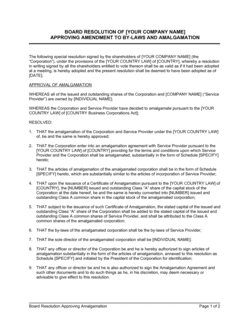
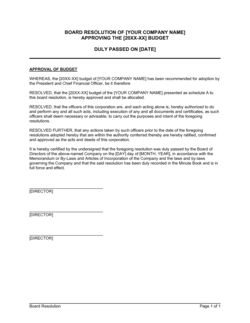
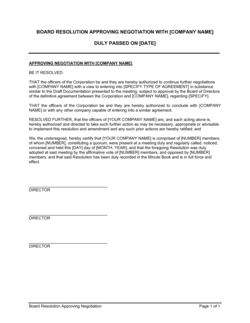
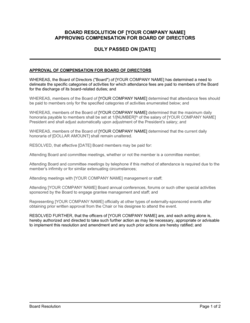
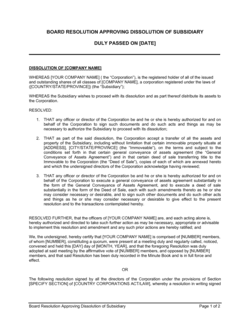
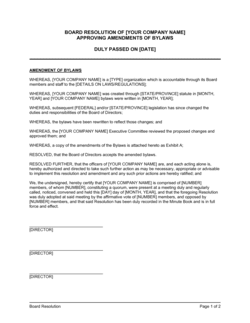
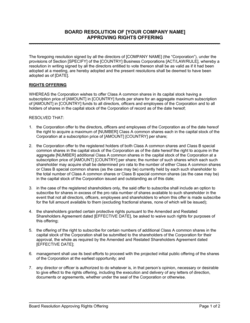
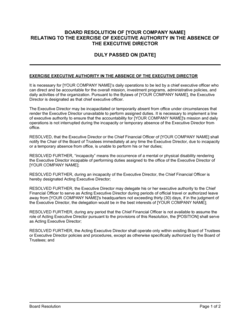
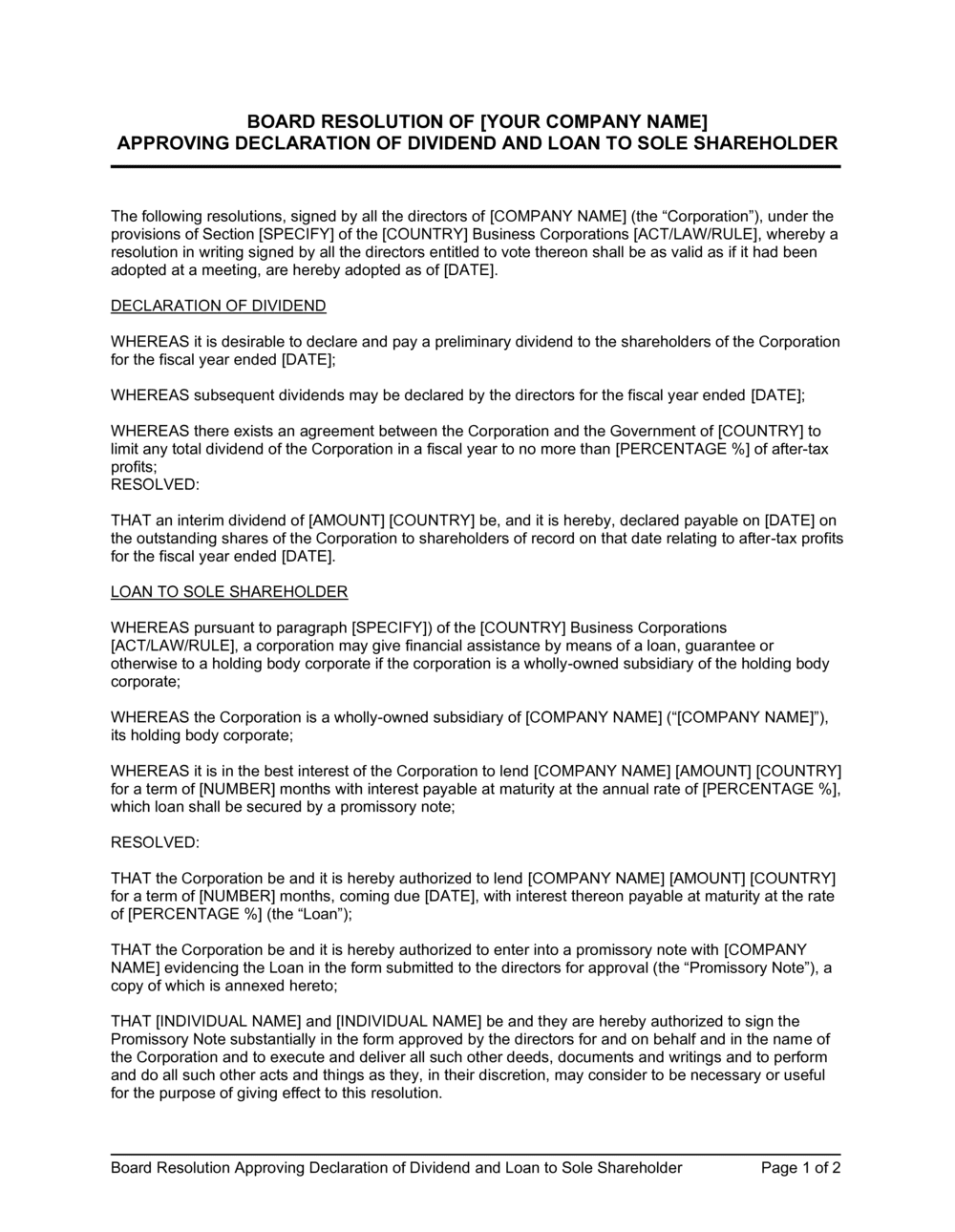
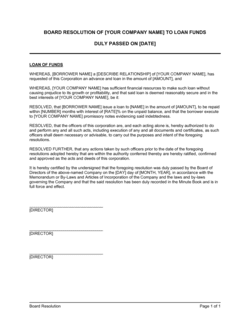
A Board Resolution Approving Declaration of Dividend or Loan is a formal corporate document in which the board of directors officially authorizes either a distribution of profits to shareholders or the advancement of an inter-company or shareholder loan. This free Word download captures the board's decision in writing — recording the amount, record date, payment date, recipient class, and a directors' solvency affirmation — and serves as the binding internal record required before any funds are transferred.
When you need it
Use it whenever the board decides to declare a cash dividend, a stock dividend, or an inter-company loan, and a formal written resolution is needed to authorize the disbursement, satisfy corporate governance requirements, or support year-end tax and audit documentation.
What's inside
Meeting details and quorum confirmation, dividend or loan type and amount, eligible shareholder class or loan recipient, record and payment dates, directors' solvency affirmation, authorized signatories, and the secretary's certification of the resolution.

What is a Board Resolution Approving Declaration of Dividend or Loan?

A Board Resolution Approving Declaration of Dividend or Loan is a formal corporate document in which a company's board of directors officially authorizes either a distribution of profits to shareholders or the advancement of an inter-company or shareholder loan. It records the specific decision made at a duly convened board meeting — or by written consent — capturing the amount, share class, record and payment dates, loan terms where applicable, and a directors' affirmation that the company remains solvent after the transaction. The resolution functions as the definitive internal authorization that must precede any transfer of funds and provides the documentary evidence required by banks, auditors, and tax authorities to confirm that the board acted within its legal authority.

Why You Need This Document

Paying a dividend or advancing a shareholder loan without a properly executed board resolution exposes directors to personal liability, invites tax recharacterization, and creates audit deficiencies that can surface years later. Without a contemporaneous resolution, tax authorities may treat an undocumented dividend as a salary or undisclosed shareholder benefit — each carrying different and potentially heavier tax consequences. Directors who approve an undocumented distribution that renders the company insolvent can be held jointly and severally liable to restore the funds under corporate statutes in most jurisdictions. Banks routinely require a certified board resolution before processing significant outflows, and auditors flag missing resolutions as a material weakness in internal controls. This template gives you a professionally structured, jurisdiction-aware resolution that satisfies solvency-test, record-keeping, and authorization requirements in one document — ready to sign before the first dollar moves.

Which variant fits your situation?

If your situation is…Use this template
Declaring a cash dividend to all common shareholdersBoard Resolution Approving Declaration of Dividend or Loan
Declaring a stock or share dividend instead of cashBoard Resolution Authorizing Stock Dividend
Approving a loan from the company to a director or officerBoard Resolution Approving Director Loan
Authorizing an inter-company loan between parent and subsidiaryIntercompany Loan Agreement
Approving a special or irregular one-time dividendBoard Resolution Approving Special Dividend
Documenting a routine board meeting covering multiple resolutionsBoard Meeting Minutes
Ratifying a dividend already paid without prior board approvalBoard Resolution Ratifying Prior Acts

Common mistakes to avoid

❌ Signing the resolution after the dividend has already been paid

Why it matters: A post-payment resolution is a fabrication, not a contemporaneous record. Tax authorities and auditors can challenge the deductibility of the dividend and may treat it as an undocumented loan or shareholder benefit.

Fix: Always obtain board approval and signed resolution before instructing the bank or transfer agent to release funds. If payment has already occurred, obtain legal advice on ratification before filing.
❌ No solvency review before signing the affirmation

Why it matters: Directors who sign a solvency affirmation without reviewing current financials expose themselves to personal liability if the company cannot meet its debts after the distribution.

Fix: Request a current balance sheet and a 12-month cash flow forecast from the CFO before the board meeting. Attach a brief solvency memo to the resolution file.

❌ Setting the record date after the payment date

Why it matters: An inverted record-to-payment sequence makes it impossible to determine which shareholders are entitled to the dividend, rendering the declaration defective and potentially requiring it to be re-issued.

Fix: Always set the record date before the payment date, with enough lead time — at least 5 business days for private companies — to compile the share register.

❌ Omitting an interest rate on a shareholder loan resolution

Why it matters: A zero-rate or below-market loan is treated as a taxable benefit to the recipient in most jurisdictions, creating unexpected income tax exposure for the borrower and potential withholding obligations for the company.

Fix: Set the interest rate at or above the applicable federal rate (US), prescribed rate (Canada), or official rate (UK) in effect at the time the loan is made, and document the rate in the resolution.

The 9 key clauses, explained

Meeting details and quorum confirmation

In plain language: Identifies the date, time, and location of the board meeting (or confirms written consent in lieu of meeting), names the directors present, and affirms that a quorum was achieved.

Sample language
A duly convened meeting of the Board of Directors of [COMPANY LEGAL NAME] was held on [DATE] at [TIME] at [LOCATION / via [PLATFORM]]. The following directors were present: [NAMES]. A quorum of [NUMBER] directors being present, the meeting was called to order.

Common mistake: Failing to confirm quorum before recording the resolution. If quorum is not met, the resolution is void, and any subsequent dividend payment may constitute an unauthorized distribution.

Recitals — authority and purpose

In plain language: States the governing authority (bylaws, articles, or applicable statute) under which the board is acting and summarizes the purpose of the resolution — dividend declaration or loan authorization.

Sample language
WHEREAS, the Board is authorized under [COMPANY NAME]'s Bylaws and [APPLICABLE STATE/PROVINCIAL LAW] to declare dividends on the [CLASS] shares and to approve inter-company financing arrangements;

Common mistake: Omitting the statutory or bylaw reference. Without it, auditors and tax authorities have no basis on which to confirm the board acted within its delegated authority.

Dividend or loan type and amount

In plain language: Specifies whether the resolution authorizes a cash dividend, a stock dividend, or a loan; states the exact dollar amount per share (for dividends) or the principal amount (for loans); and identifies the share class or loan recipient.

Sample language
RESOLVED, that the Board hereby declares a cash dividend of $[AMOUNT] per [CLASS] share [OR: authorizes a loan of $[PRINCIPAL AMOUNT] to [RECIPIENT ENTITY/NAME]] from funds legally available for such purpose.

Common mistake: Stating the total aggregate amount rather than the per-share amount for a dividend. Per-share precision is what auditors and transfer agents need to process payments correctly.

Record date

In plain language: Sets the date on which shareholder ownership is determined for dividend eligibility, giving the company time to compile its share register before the payment date.

Sample language
The record date for determining shareholders entitled to receive the dividend shall be [DATE], at the close of business.

Common mistake: Setting the record date after the payment date. The record date must always precede the payment date; reversing them makes it impossible to identify who is eligible.

Payment date and method

In plain language: States the date on which the dividend will be paid and the method of payment — typically direct deposit, check, or wire transfer — and names the paying agent if applicable.

Sample language
The dividend shall be paid on [PAYMENT DATE] to shareholders of record by [PAYMENT METHOD — check / ACH / wire transfer]. [PAYING AGENT NAME], if engaged, is hereby authorized to effect payment.

Common mistake: No payment method specified. When the method is left open, finance teams must make ad hoc arrangements, creating delays, reconciliation errors, and potential disputes with shareholders.

Loan terms (for loan resolutions)

In plain language: For loan resolutions, sets the principal amount, interest rate, repayment schedule, and any security or subordination terms, and confirms the transaction is on arm's-length terms.

Sample language
The loan shall bear interest at [RATE]% per annum, be repayable on [MATURITY DATE OR ON DEMAND], and shall be documented by a promissory note on terms no less favorable than those available from an arm's-length lender.

Common mistake: Authorizing the loan without specifying an interest rate. A zero- or below-market-rate loan creates a deemed benefit that triggers income tax consequences for the recipient in most jurisdictions.

Solvency affirmation

In plain language: Records the directors' confirmation that, after the dividend or loan, the company will remain able to pay its debts as they fall due — satisfying the statutory solvency test required in most jurisdictions.

Sample language
The Board hereby affirms that, having regard to the financial position of [COMPANY NAME] immediately after the dividend payment [or loan advancement], the Company will be able to pay its debts as they fall due in the ordinary course of business.

Common mistake: Treating the solvency affirmation as boilerplate and not reviewing current financials before signing. Directors who approve a dividend that renders the company insolvent can face personal liability under corporate statutes in most jurisdictions.

Authorization of officers

In plain language: Designates specific officers — typically the CEO, CFO, or corporate secretary — to carry out all actions necessary to implement the resolution, including signing documents and instructing the transfer agent or bank.

Sample language
FURTHER RESOLVED, that the Chief Financial Officer and the Corporate Secretary are each hereby authorized and directed to take all actions, execute all documents, and make all filings necessary to carry out the intent of this resolution.

Common mistake: Authorizing 'any officer' without naming specific titles. Blanket authorization creates ambiguity about who has actual signing authority and can delay bank or transfer-agent processing.

Secretary's certification

In plain language: A signed statement by the corporate secretary — placed at the end of the document — certifying that the resolution was duly adopted, that a quorum was present, and that the document is a true and correct copy.

Sample language
I, [SECRETARY NAME], Corporate Secretary of [COMPANY NAME], hereby certify that the foregoing is a true and correct copy of a resolution duly adopted by the Board of Directors at a meeting held on [DATE], at which a quorum was present and acting throughout.

Common mistake: Having a director sign the certification who is also a party to the dividend or loan. The certification should be signed by a disinterested secretary or director to avoid a conflict of interest that could invalidate the record.

How to fill it out

  1. 1

    Enter company and meeting details

    Insert the company's full legal name, the meeting date, time, and location (or note written consent in lieu of meeting), and list all directors present. Confirm the quorum threshold from your bylaws and check it is met.

    💡 If your quorum requirement is not in the bylaws, check your jurisdiction's default corporate statute — most set it at a simple majority of the total board.

  2. 2

    Choose dividend or loan and specify the amount

    Select the resolution type — cash dividend, stock dividend, or loan — and enter the precise per-share amount (for dividends) or principal amount (for loans). Identify the share class or loan recipient entity.

    💡 Use the exact share class designation from your articles of incorporation (e.g., 'Class A common shares') to avoid ambiguity at the transfer-agent level.

  3. 3

    Set the record date and payment date

    Enter the record date first, then set the payment date at least 10–15 business days later to allow time for register reconciliation and payment processing.

    💡 Public companies must comply with exchange rules on minimum record-to-payment intervals — private companies have more flexibility but should still allow at least 5 business days.

  4. 4

    Complete loan terms if applicable

    For loan resolutions, fill in the interest rate, maturity date or demand terms, repayment schedule, and any security arrangement. Confirm the rate is at least equal to the applicable federal rate (AFR) in the US or the prescribed rate in Canada.

    💡 Document the arm's-length rationale in a brief memo attached to the resolution — transfer-pricing auditors look for this support in related-party transactions.

  5. 5

    Complete the solvency affirmation

    Before signing, review the company's most recent balance sheet and cash flow forecast. Confirm the company can meet its obligations after the distribution or loan. Have the CFO sign off on the financial review underlying the affirmation.

    💡 Attach a one-page solvency certificate from the CFO to the resolution as supporting evidence — it materially strengthens the directors' position if the payment is ever challenged.

  6. 6

    Name the authorized officers

    List the specific titles — CEO, CFO, and/or Corporate Secretary — authorized to implement the resolution. Avoid generic references to 'any officer.'

    💡 If your bank requires a certified resolution to process the payment, confirm the bank's format requirements before finalizing the officer authorization language.

  7. 7

    Obtain director signatures and secretary certification

    Have each director present sign the resolution. The corporate secretary then signs the certification block, confirming the resolution was duly adopted.

    💡 For written resolutions in lieu of a meeting, all directors (or the required majority under your bylaws) must sign — a single missing signature can invalidate the document.

Frequently asked questions

What is a board resolution approving a dividend?

A board resolution approving a dividend is a formal written record of the board of directors' decision to distribute a portion of the company's profits to its shareholders. It specifies the amount per share, the share class, the record date, and the payment date, and includes the directors' affirmation that the company remains solvent after the distribution. The resolution is the authoritative internal document that must exist before any funds are transferred.

Is a board resolution required before paying a dividend?

In most jurisdictions, yes. Corporate statutes in the US, Canada, the UK, and the EU generally require a formal board or director decision before a dividend can be lawfully declared and paid. Paying a dividend without a resolution can expose directors to personal liability for an unauthorized distribution and may create tax complications if the payment cannot be properly characterized.

What is the difference between a record date and a payment date?

The record date is the cut-off date on which a shareholder must be registered on the company's books to be entitled to the dividend. The payment date is the later date on which the company actually transfers the funds. The gap between the two — typically 5 to 15 business days for private companies — allows the company to compile the eligible shareholder list and arrange payment processing.

What solvency test must directors satisfy before declaring a dividend?

Most corporate statutes require directors to confirm that, after paying the dividend, the company will be able to pay its debts as they fall due in the ordinary course of business and that the company's assets exceed its liabilities. The specific statutory test varies by jurisdiction — the CBCA in Canada, the Companies Act in the UK, and state corporation laws in the US each frame the test differently, but the core principle is the same: dividends cannot be paid from capital if doing so would render the company insolvent.

Can the same resolution authorize both a dividend and a loan?

A single resolution can address both matters if both items are on the meeting agenda and both are duly voted on. In practice, many companies prefer separate resolutions for clarity — particularly where the dividend and loan have different recipients, different authorized officers, or different tax treatment. Using one template that covers both allows you to choose the appropriate operative clause for each transaction.

What are the tax implications of a shareholder loan authorized by board resolution?

In most jurisdictions, a loan to a shareholder or related party at below- market interest creates a taxable benefit equal to the foregone interest. In the US, the IRS requires interest at or above the applicable federal rate (AFR). In Canada, the CRA prescribes a quarterly rate. In the UK, HMRC applies the official rate. Documenting an arm's-length interest rate in the resolution and in a promissory note is the primary way to avoid these deemed-benefit consequences.

Do all directors need to sign the resolution?

If the resolution is passed at a properly convened meeting with a quorum present, typically only the directors who attended need to sign, and the corporate secretary certifies the document. If the resolution is passed by written consent in lieu of a meeting, most corporate statutes and bylaws require signatures from all directors, or at least the minimum number required to constitute a quorum. Check your bylaws and applicable statute for the exact requirement.

Can a board resolution be used for an inter-company loan?

Yes. An inter-company loan — between a parent company and a subsidiary, or between two affiliates — requires the same board authorization as any other significant corporate financial transaction. The resolution should specify the lender, the borrower, the principal amount, the interest rate, the maturity date, and any security. A promissory note should then be executed between the two entities, referencing the resolution as the authorizing document.

What happens if a dividend is paid without a proper board resolution?

A dividend paid without a valid board resolution may be treated as an unauthorized distribution. Depending on the jurisdiction, this can expose directors to personal liability to creditors for the amount distributed, require the shareholders to return the funds, or lead tax authorities to recharacterize the payment as a salary, loan, or shareholder benefit — each with different and potentially more adverse tax consequences. A contemporaneous, properly signed resolution is the simplest way to avoid all of these outcomes.

How this compares to alternatives

vs Board Meeting Minutes

Board meeting minutes are a comprehensive record of everything discussed and decided at a full board meeting, covering multiple agenda items. A board resolution is a standalone document focusing on a single, specific decision — such as declaring a dividend. The resolution is extracted from minutes or issued separately when the decision needs to be cited independently by a bank, tax authority, or auditor.

vs Shareholder Resolution

A shareholder resolution is passed by shareholders — not directors — and is typically required for decisions that alter the company's capital structure, articles, or director appointments. A board resolution is passed by directors and governs day-to-day management decisions, including dividend declarations and authorized loans. In some jurisdictions, final dividend approval requires a shareholder resolution after an initial board declaration.

vs Intercompany Loan Agreement

An intercompany loan agreement is the binding bilateral contract between two related entities setting out the full terms of the loan — interest, repayment, default, and security. A board resolution is the internal authorization that allows the company to enter into that agreement. Both documents are needed: the resolution provides corporate authority; the loan agreement creates the legal obligation.

vs Dividend Reinvestment Plan (DRIP) Agreement

A DRIP agreement governs a shareholder's election to reinvest dividends in additional shares rather than receive cash. A board resolution declaring the dividend is the prerequisite document — it must exist before shareholders can elect reinvestment. The two documents operate in sequence, not as alternatives.

Industry-specific considerations

Private equity and venture capital

Dividend recapitalizations and inter-fund loans require board resolutions that satisfy both corporate statute solvency tests and limited-partner agreement restrictions on distributions.

Family-owned and closely held businesses

Closely held corporations routinely use dividend resolutions to distribute profits tax-efficiently among family shareholders, where informal payments without board authorization create significant audit risk.

Professional services firms

Law firms, accounting firms, and consulting corporations incorporated as professional corporations use dividend resolutions to extract profits while managing employment income and self-employment tax exposure.

Multinational corporations

Inter-company loans and upstream dividends from subsidiaries to parent entities require resolutions in each relevant jurisdiction, with arm's-length documentation to satisfy transfer-pricing rules and withholding tax requirements.

Jurisdictional notes

United States

Dividend authority is governed by the corporation's home state law — Delaware, for example, permits dividends from surplus or net profits; California requires a more stringent assets-to-liabilities solvency test. The IRS requires shareholder loans to carry interest at or above the applicable federal rate (AFR) published monthly, or the foregone interest is treated as a taxable dividend. State documentary requirements vary, but a signed board resolution is standard practice in all 50 states.

Canada

The Canada Business Corporations Act and most provincial statutes require directors to satisfy a two-part solvency test before declaring a dividend: the company must be able to pay its liabilities as they fall due, and its realizable assets must not be less than its liabilities. Shareholder loans must bear interest at or above the CRA-prescribed rate to avoid a shareholder benefit inclusion. Directors who approve a dividend in contravention of the solvency test are jointly and severally liable to restore the amount to the corporation.

United Kingdom

Under the Companies Act 2006, dividends may only be paid from distributable profits — accumulated realized profits less accumulated realized losses — and must be supported by relevant accounts (usually the most recent statutory accounts). Unlawful dividends must be repaid by shareholders who knew or had reasonable grounds to believe the distribution was unlawful. Loans to directors require shareholder approval under CA 2006 s.197 unless a specific exemption applies. HMRC applies the official rate to beneficial loans for P11D purposes.

European Union

EU member states implement dividend rules through national company law, but the EU Capital Maintenance Directive requires that dividends not reduce net assets below the aggregate of subscribed capital and non-distributable reserves. Germany, France, and the Netherlands each impose additional solvency and distributable-profits tests. Inter-company loans between EU affiliates are subject to the OECD transfer-pricing arm's-length standard and must be documented under each member state's local transfer-pricing rules. Withholding tax on cross-border dividends within the EU may be reduced or eliminated under the EU Parent-Subsidiary Directive.

Template vs lawyer — what fits your deal?

PathBest forCostTime
Use the templateClosely held private companies declaring routine cash dividends or straightforward shareholder loans in a single jurisdictionFree15–30 minutes
Template + legal reviewCompanies with multiple share classes, preferred shareholders, or a loan involving non-arm's-length parties where tax treatment matters$300–$8001–3 days
Custom draftedMultinational structures, dividend recapitalizations, regulated industries, or inter-company loans with transfer-pricing implications$1,500–$5,000+1–2 weeks

Glossary

Board Resolution
A formal written record of a decision made by a company's board of directors, which serves as the authoritative internal authorization for corporate actions.
Dividend
A distribution of a portion of a company's profits to its shareholders, typically declared in a fixed dollar amount per share or as a percentage of par value.
Record Date
The cut-off date on which shareholders must be registered on the company's books to be entitled to receive a declared dividend.
Payment Date
The date on which the declared dividend is actually transferred to eligible shareholders.
Solvency Test
A legal check requiring directors to confirm that, after paying the dividend or advancing the loan, the company will be able to meet its debts as they fall due.
Inter-Company Loan
A loan advanced between two related entities — such as a parent company and its subsidiary — that must be documented to support arm's-length treatment for tax and accounting purposes.
Quorum
The minimum number of directors who must be present at a board meeting for its decisions to be legally valid, as specified in the company's bylaws or articles.
Par Value
The nominal face value of a share as stated in the company's articles of incorporation, sometimes used as the basis for calculating a stated dividend rate.
Secretary's Certification
A signed statement by the corporate secretary confirming that the resolution was duly adopted at a properly convened meeting and accurately reflects the board's decision.
Shareholder of Record
A shareholder whose name appears on the company's share register as of the record date, making them eligible to receive the declared dividend.

Part of your Business Operating System

This document is one of 3,000+ business & legal templates included in Business in a Box.

  • Fill-in-the-blanks — ready in minutes
  • 100% customizable Word document
  • Compatible with all office suites
  • Export to PDF and share electronically

Create your document in 3 simple steps.

From template to signed document — all inside one Business Operating System.
1
Download or open template

Access over 3,000+ business and legal templates for any business task, project or initiative.

2
Edit and fill in the blanks with AI

Customize your ready-made business document template and save it in the cloud.

3
Save, Share, Send, Sign

Share your files and folders with your team. Create a space of seamless collaboration.

Save time, save money, and create top-quality documents.

★★★★★

"Fantastic value! I'm not sure how I'd do without it. It's worth its weight in gold and paid back for itself many times."

Managing Director · Mall Farm
Robert Whalley
Managing Director, Mall Farm Proprietary Limited
★★★★★

"I have been using Business in a Box for years. It has been the most useful source of templates I have encountered. I recommend it to anyone."

Business Owner · 4+ years
Dr Michael John Freestone
Business Owner
★★★★★

"It has been a life saver so many times I have lost count. Business in a Box has saved me so much time and as you know, time is money."

Owner · Upstate Web
David G. Moore Jr.
Owner, Upstate Web

Run your business with a system — not scattered tools

Stop downloading documents. Start operating with clarity. Business in a Box gives you the Business Operating System used by over 250,000 companies worldwide to structure, run, and grow their business.

Start free · No credit card required