Board Resolution Approving Rights Offering Template

Free Word download • Edit online • Save & share with Drive • Export to PDF

2 pages20–30 min to fillDifficulty: StandardSignature requiredLegal review recommended
Learn more ↓
FreeBoard Resolution Approving Rights Offering Template

At a glance

What it is
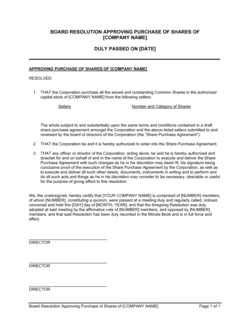
A Board Resolution Approving Rights Offering is a formal corporate action document in which the board of directors authorizes a company to offer existing shareholders the right to purchase additional shares at a set subscription price, typically at a discount to market value, in proportion to their current holdings. This free Word download gives you a structured, execution-ready template you can edit online and export as PDF for corporate records, regulatory filings, and shareholder distribution.
When you need it
Use it when a company's board meets to formally authorize a rights offering as a capital-raising mechanism — whether to fund operations, retire debt, finance an acquisition, or strengthen the balance sheet — and needs a documented resolution to satisfy corporate governance, securities law, and transfer agent requirements.
What's inside
Recitals establishing the board's authority, subscription terms including per-share price and ratio, record date and offering period, standby commitment or backstop arrangements, regulatory exemption reliance, officer authorization, and a signature block for director approval.

What is a Board Resolution Approving Rights Offering?

A Board Resolution Approving Rights Offering is a formal corporate governance document in which a company's board of directors votes to authorize a rights offering — a capital-raising transaction that gives existing shareholders the right to purchase new shares at a fixed subscription price, typically at a discount to market value, in proportion to their current holdings. The resolution records the offering's key terms (subscription price, ratio, record date, and offering period), confirms the statutory and charter authority for the issuance, delegates implementation authority to named officers, and satisfies the documentation requirements of transfer agents, stock exchanges, and securities regulators. Without a properly executed board resolution, no transfer agent will distribute rights, no regulatory filing will be accepted, and the share issuance may be voidable.

Why You Need This Document

A rights offering that launches without a formally adopted board resolution exposes the company and its directors to serious governance and legal risk. Officers who negotiate pricing, engage transfer agents, or file regulatory notices before the board formally approves the offering are acting without authorization — creating unauthorized commitments the company may be unable to unwind. For public companies, stock exchange rules impose strict pre-notification timelines tied to the record date, and missing those windows can trigger trading halts or regulatory inquiries. For private companies, the resolution is the primary evidence that directors exercised their business judgment and acted in the best interests of shareholders — essential protection if a non-participating shareholder later challenges the dilutive issuance. This template gives you a structured, execution-ready resolution that covers every material term, satisfies transfer agent requirements, and provides the documented authorization your legal counsel, bankers, and regulators will require before the offering can proceed.

Which variant fits your situation?

If your situation is…Use this template
Public company conducting a registered rights offering under the Securities ActBoard Resolution Approving Rights Offering (Registered)
Private company offering subscription rights to existing shareholders onlyBoard Resolution Approving Rights Offering (Private)
Company using a standby underwriter or backstop commitmentBoard Resolution Approving Rights Offering with Standby Commitment
Board approving a general share issuance rather than a rights offeringBoard Resolution Authorizing Issuance of Shares
Company seeking stockholder approval before issuing sharesShareholder Resolution Approving Share Issuance
Board approving a private placement instead of a rights offeringBoard Resolution Approving Private Placement
Board adopting a shareholder rights plan (poison pill) rather than a capital raiseBoard Resolution Adopting Shareholder Rights Plan

Common mistakes to avoid

❌ No maximum share cap in the approval clause

Why it matters: An open-ended authorization allows officers to issue more shares than the board contemplated, causing unintended dilution and potential liability for breach of fiduciary duty.

Fix: Always specify the maximum number of Rights Shares in the operative resolution clause and confirm it does not exceed the authorized but unissued share pool.

❌ Citing the wrong securities law exemption

Why it matters: Relying on an exemption the offering does not actually qualify for — such as Section 4(a)(2) for a large public shareholder base — exposes the company to rescission claims and SEC enforcement.

Fix: Have securities counsel confirm the applicable exemption or registration pathway before the resolution is finalized, and document that analysis in board minutes.

❌ Insufficient lead time between record date and offering launch

Why it matters: Transfer agents and DTC require 10–20 business days of advance notice to set up rights distribution mechanics; a compressed timeline causes administrative failures and may invalidate the record date.

Fix: Set the record date at least 15 business days before the planned offering launch and notify the transfer agent in writing immediately after the resolution is adopted.

❌ Single-officer authorization with no alternate

Why it matters: If the sole authorized officer is unavailable during the offering period, the company cannot execute subscription agreements, file required documents, or respond to regulatory inquiries on time.

Fix: Name at least two officers — each authorized to act singly — in the authorization clause, covering both operational continuity and potential conflicts of interest.

❌ Omitting oversubscription allocation mechanics

Why it matters: If the oversubscription privilege is offered without a defined allocation method, competing shareholder claims arise at expiration and may require emergency board action to resolve, delaying share delivery.

Fix: State explicitly that oversubscribed shares will be allocated pro rata based on the number of basic subscription rights each oversubscribing shareholder originally held.

❌ Adopting the resolution after preparatory actions have already bound the company

Why it matters: Officers who negotiate pricing or sign engagement letters before board authorization create unauthorized commitments — retroactive ratification may not be enforceable if the terms conflict with the final resolution.

Fix: Adopt the resolution before officers execute any binding agreements related to the offering, and limit preliminary discussions to non-binding term sheets or engagement letters subject to board approval.

The 10 key clauses, explained

Recitals and authority

In plain language: Identifies the company, confirms the board has authority under the articles of incorporation and applicable corporate statute to approve the offering, and summarizes the business purpose for the capital raise.

Sample language
WHEREAS, the Board of Directors (the 'Board') of [COMPANY NAME] (the 'Company'), a [STATE/PROVINCE] [ENTITY TYPE], is authorized under the Company's Articles of Incorporation and the [GOVERNING STATUTE] to issue shares of common stock; and WHEREAS, the Board has determined that a rights offering is in the best interests of the Company and its shareholders to [BUSINESS PURPOSE];

Common mistake: Citing the wrong statutory authority — for example, referencing a Delaware provision when the company is incorporated in Nevada. A mismatch invalidates the resolution and may require a corrective board action.

Approval of the rights offering

In plain language: The operative clause formally resolving that the board approves the rights offering and authorizes the issuance of a specified maximum number of shares.

Sample language
RESOLVED, that the Board hereby approves and authorizes a rights offering (the 'Rights Offering') to holders of record of the Company's common stock, pursuant to which the Company shall offer up to [MAXIMUM SHARES] shares of common stock (the 'Rights Shares') at a subscription price of $[PRICE] per share.

Common mistake: Omitting a maximum share cap in the resolution. Without it, officers have unlimited authority to issue shares, which can result in unintended dilution beyond what the board contemplated.

Subscription terms (ratio and price)

In plain language: Sets the subscription ratio — how many new shares each shareholder may buy per share held — and confirms the subscription price at which rights are exercisable.

Sample language
RESOLVED FURTHER, that each holder of record shall receive one (1) non-transferable subscription right for each [X] shares of common stock held as of the Record Date, entitling such holder to purchase one (1) share of common stock at $[PRICE] per share.

Common mistake: Setting the subscription price above the current market price. A rights offering priced at or above market gives shareholders no economic incentive to subscribe, resulting in a failed offering.

Record date and offering period

In plain language: Establishes the date used to determine shareholder eligibility and the window during which rights may be exercised.

Sample language
RESOLVED FURTHER, that the Record Date for the Rights Offering shall be [DATE], and the Rights Offering shall commence on [START DATE] and expire at 5:00 p.m. Eastern Time on [EXPIRATION DATE] (the 'Expiration Date'), unless extended by the officers of the Company.

Common mistake: Setting a record date fewer than 10 business days before the offering commencement. Transfer agents and DTC require adequate processing time; a short record-to-launch window causes administrative failures and potential regulatory violations.

Oversubscription privilege

In plain language: Optionally grants shareholders who exercise their full basic subscription rights the ability to apply for unsubscribed shares on a pro-rata basis.

Sample language
RESOLVED FURTHER, that each holder of record who exercises all basic subscription rights in full may apply to purchase additional Rights Shares that remain unsubscribed at the Expiration Date (the 'Oversubscription Privilege'), allocated on a pro-rata basis among oversubscribing shareholders.

Common mistake: Including an oversubscription privilege without specifying the allocation mechanism. If multiple shareholders oversubscribe, an undefined allocation creates disputes and may require a supplemental board action to resolve.

Standby commitment or backstop arrangement

In plain language: Documents any agreement with an underwriter, major shareholder, or affiliate to purchase all shares not subscribed to by other holders, ensuring the offering is fully funded.

Sample language
RESOLVED FURTHER, that the Company is authorized to enter into a standby purchase agreement with [BACKSTOP PARTY], pursuant to which [BACKSTOP PARTY] shall purchase any and all Rights Shares not subscribed to by other holders of record, on terms approved by the Board.

Common mistake: Omitting the backstop party's identity and commitment terms from the resolution. A vague standby authorization leaves open whether any binding commitment exists, undermining the certainty of proceeds.

Securities law compliance and exemption reliance

In plain language: Confirms that the offering is being conducted in reliance on applicable registration exemptions or pursuant to a filed registration statement, and directs officers to make required regulatory filings.

Sample language
RESOLVED FURTHER, that the Rights Offering shall be conducted in reliance on [APPLICABLE EXEMPTION — e.g., Section 4(a)(2) of the Securities Act of 1933 / Regulation S / Rule 801] and that the appropriate officers are directed to prepare and file any required registration statement, prospectus, or exemption notices with the SEC and applicable state securities regulators.

Common mistake: Citing an exemption without confirming that the offering structure actually qualifies. A rights offering to more than 35 non-accredited investors in the US, for example, does not qualify for the Section 4(a)(2) exemption, exposing the company to securities violations.

Officer authorization

In plain language: Delegates authority to named officers — typically the CEO and CFO — to execute all documents, engage advisors, and take all actions necessary to implement the rights offering.

Sample language
RESOLVED FURTHER, that the CEO, CFO, and Secretary of the Company, and each of them acting singly, are authorized and directed to execute and deliver, on behalf of the Company, any and all agreements, certificates, notices, instruments, and other documents, and to take such other actions, as any such officer shall deem necessary or advisable to carry out the purposes of the foregoing resolutions.

Common mistake: Restricting officer authority to a single named individual without an alternate. If that officer is unavailable at a critical execution moment, the company has no authorized signatory and may miss regulatory deadlines.

Transfer agent and DTC instructions

In plain language: Authorizes the company's transfer agent and DTC (where applicable) to distribute rights, process subscriptions, and deliver shares upon exercise.

Sample language
RESOLVED FURTHER, that the transfer agent of the Company, [TRANSFER AGENT NAME], is hereby authorized and instructed to distribute subscription rights to eligible holders of record as of the Record Date, process subscription forms and payments, and arrange for the delivery of Rights Shares through The Depository Trust Company or in certificated form.

Common mistake: Failing to notify the transfer agent of the resolution before the record date. Transfer agents require advance notice — typically 10–20 business days — to set up the rights distribution mechanics.

Ratification clause

In plain language: Ratifies all prior actions taken by officers in anticipation of the rights offering, providing a clean authorization backstop for any preparatory steps taken before the formal resolution.

Sample language
RESOLVED FURTHER, that all actions previously taken by any officer or director of the Company in connection with or in anticipation of the Rights Offering are hereby ratified, confirmed, and approved in all respects.

Common mistake: Using a blanket ratification clause to cure unauthorized actions that are materially inconsistent with the resolution itself — for example, a pre-resolution commitment to pricing terms the board later rejects. Courts have declined to enforce retroactive ratifications that contradict the substantive resolution.

How to fill it out

  1. 1

    Confirm corporate authority and outstanding share capital

    Verify that the company's articles of incorporation and applicable corporate statute authorize the board to approve a rights offering without additional shareholder consent. Confirm the number of authorized but unissued shares available to cover the maximum offering size.

    💡 If authorized share capital is insufficient to cover the offering, a shareholder vote to increase authorized shares must precede the rights offering resolution.

  2. 2

    Set the subscription price and ratio

    Determine the per-share subscription price — typically 10–25% below current market or the most recent valuation — and the subscription ratio that produces the target capital raise. Confirm the total shares to be issued do not exceed authorized unissued shares.

    💡 Model the post-offering cap table at 50%, 75%, and 100% subscription rates before finalizing the ratio — partial subscription scenarios affect dilution and governance outcomes significantly.

  3. 3

    Fix the record date and offering period

    Set a record date at least 10–15 business days before the offering launch to allow transfer agent processing. Set an offering period of 16–30 days, which is standard for rights offerings in North America and the UK.

    💡 Coordinate the record date with your transfer agent before finalizing it in the resolution — agents impose their own minimum lead-time requirements.

  4. 4

    Decide on oversubscription privilege and backstop

    Determine whether to offer an oversubscription privilege and whether a standby purchaser is in place. Include the backstop party's name and the key terms of the standby commitment in the resolution.

    💡 A confirmed backstop significantly increases investor confidence and press release credibility — if one is in place, name the party in the resolution rather than describing it generically.

  5. 5

    Identify the applicable securities law exemption

    With counsel, confirm which registration exemption or registration pathway applies — Section 4(a)(2), Regulation D, Regulation S, Rule 801, or a filed Form S-1 or F-3. Enter the specific exemption or filing reference in the compliance clause.

    💡 For a public company with a shelf registration statement already effective, reference the specific prospectus supplement rather than a new exemption.

  6. 6

    Complete the officer authorization clause

    List the CEO, CFO, and corporate secretary (or equivalent officers) by title — not by name alone — and confirm that each may act singly. This avoids operational bottlenecks if any one officer is unavailable.

    💡 Include the general counsel or outside counsel as an authorized signatory for regulatory filings if officers will be unavailable during the offering window.

  7. 7

    Obtain director signatures and record in the minute book

    Circulate the resolution for signature by a quorum of directors — or the full board if required by the company's bylaws. File the executed resolution in the corporate minute book and provide a certified copy to the transfer agent and legal counsel.

    💡 If the resolution is adopted by written consent rather than at a meeting, confirm that the company's governing documents and applicable corporate statute permit written consent resolutions for this type of action.

  8. 8

    File required regulatory notices before the record date

    Submit required notices to the SEC (Form 8-K for public companies), applicable stock exchange, and state or provincial securities regulators within the timeframes mandated by the applicable exemption or registration pathway.

    💡 For Nasdaq and NYSE-listed companies, exchange rules require advance notification of rights offerings — typically 10 business days before the record date — and non-compliance can result in trading halts.

Frequently asked questions

What is a board resolution approving a rights offering?

A board resolution approving a rights offering is a formal corporate document in which a company's board of directors votes to authorize the issuance of subscription rights to existing shareholders, entitling them to purchase new shares at a fixed price — typically at a discount to market — in proportion to their current holdings. It records the key terms of the offering, delegates implementation authority to officers, and satisfies corporate governance, transfer agent, and securities regulatory requirements before the offering launches.

Why does a rights offering require a board resolution?

Issuing new shares is a fundamental corporate action that requires formal board authorization under most corporate statutes and a company's own articles of incorporation. Without a board resolution, the company has no documented authority to proceed, transfer agents will not distribute rights, securities regulators will not accept filings, and the issuance may be voidable by shareholders who challenge the process. The resolution also creates a clear record that directors exercised their business judgment in approving the offering.

What is the difference between a rights offering and a private placement?

A rights offering is made exclusively to existing shareholders in proportion to their current holdings, preserving their ability to maintain ownership percentage. A private placement sells new shares directly to selected outside investors — typically institutions or accredited investors — without a pro-rata offer to all existing holders. Rights offerings are generally more complex to administer but are less dilutive to participating shareholders and are sometimes preferred for governance reasons in closely held or listed companies.

Do shareholders need to approve a rights offering before the board resolution?

In most jurisdictions, shareholder approval is not required if the board has authority under the articles of incorporation to issue shares up to the authorized limit. However, if the offering would require an increase in authorized share capital, listed companies often need stock exchange approval, or shareholder consent may be triggered by exchange rules (such as Nasdaq's 20% issuance rule for listed companies). Always confirm authorized share headroom before relying solely on board authority.

What securities law exemptions apply to a rights offering?

For US public companies conducting a registered offering, the rights shares are typically offered under a registration statement on Form S-1, S-3, or F-3. Rule 801 provides a limited exemption for cross-border rights offerings where fewer than 10% of eligible offerees are US residents. Private companies may rely on Section 4(a)(2) or Regulation D if the offering is limited to accredited investors or a small number of sophisticated shareholders. Securities counsel should confirm the applicable pathway before the resolution is finalized.

What is a standby commitment in a rights offering?

A standby commitment — also called a backstop — is an agreement by an underwriter, major shareholder, or affiliated party to purchase any shares not subscribed to by other rights holders at the expiration of the offering period. It guarantees that the company raises the full targeted amount regardless of overall shareholder participation. Standby commitments increase offering certainty and are often disclosed in the offering materials to encourage broader participation.

Can a rights offering resolution be adopted by written consent instead of at a board meeting?

Yes, in most jurisdictions — including Delaware, most Canadian provinces, and England and Wales — board resolutions may be adopted by unanimous written consent of the directors without a formal meeting, provided the company's bylaws or articles permit it. The written consent must be signed by the requisite number of directors (unanimous consent is required in most jurisdictions for this route) and filed in the corporate minute book with the same formality as a meeting resolution.

How far in advance must the board resolution be adopted before a rights offering launches?

The resolution should be adopted at least 15–20 business days before the planned record date to allow the transfer agent and DTC sufficient processing time, and before any binding engagement letters or regulatory notices are filed. For public companies, stock exchange rules typically require notification 10 business days before the record date, meaning the resolution must precede that notification by at least a few days to provide proper authorization for the filing.

What happens to shareholders who do not exercise their rights?

Shareholders who do not exercise their subscription rights by the expiration date simply let their rights lapse. If the rights are transferable, they may sell them on a secondary market before expiry. Non-exercising shareholders experience dilution — their proportional ownership and earnings-per-share decrease as new shares are issued to exercising holders. The oversubscription privilege, if offered, allows participating shareholders to purchase additional unsubscribed shares, further concentrating ownership away from non-participants.

Does the board resolution need to be notarized?

Notarization is not typically required for a board resolution approving a rights offering in the US, Canada, or the UK. However, a certified copy — bearing the corporate secretary's certification and the company seal where applicable — is commonly required by transfer agents, banks, and regulatory bodies. Some cross-border transactions and certain international filings may require apostille certification of the resolution; securities counsel should confirm requirements early.

How this compares to alternatives

vs Board Resolution Approving Private Placement

A private placement resolution authorizes share issuance to a limited group of selected outside investors, bypassing existing shareholder pro-rata rights. A rights offering resolution authorizes a pro-rata offer to all existing shareholders first, preserving their ability to avoid dilution. Rights offerings are procedurally more complex and require transfer agent involvement; private placements close faster but can trigger shareholder complaints about dilution and fairness.

vs Board Resolution Authorizing Issuance of Shares

A general share issuance resolution authorizes the board to issue shares at its discretion — to employees, investors, or in exchange for assets — without a structured offering mechanism. A rights offering resolution authorizes a specific, time-limited offering to existing shareholders at a fixed price and ratio, with transfer agent distribution and regulatory notice obligations that a general issuance resolution does not address.

vs Board Resolution Adopting Shareholder Rights Plan

A shareholder rights plan (poison pill) resolution adopts a defensive mechanism that dilutes hostile acquirers by issuing rights triggered by a threshold ownership acquisition — it is not a capital-raising tool. A rights offering resolution is an offensive capital-raising action that proactively offers new shares to existing shareholders at a discount to raise funds. The two documents serve entirely different strategic purposes and are not interchangeable.

vs Shareholder Resolution Approving Share Issuance

A shareholder resolution is passed by the shareholders themselves — typically required when share issuance exceeds authorized capital or triggers exchange approval thresholds — and represents a higher level of corporate approval. A board resolution operates within existing authorized capital and does not require a shareholder vote. For rights offerings that require both, the shareholder resolution must precede and authorize the board resolution.

Industry-specific considerations

Public equity / listed companies

Rights offerings are a primary capital-raise mechanism for listed companies seeking to avoid investment banker fees and preserve existing shareholder relationships, with exchange notification and SEC filing obligations built into the resolution.

Banking and financial services

Regulated financial institutions use rights offerings to bolster Tier 1 capital ratios under Basel III requirements, with the resolution incorporating regulatory capital compliance language and central bank notification obligations.

Mining and natural resources

Junior mining companies frequently use rights offerings to raise exploration or development capital from existing shareholders, often with a standby backstop from a major shareholder or streaming partner.

Real estate and REITs

REITs use rights offerings to raise equity for property acquisitions without triggering taxable income distribution requirements, with the resolution addressing REIT qualification and distribution reinvestment plan (DRIP) interactions.

Jurisdictional notes

United States

US rights offerings to the general public require registration under the Securities Act of 1933 unless an exemption applies. Public companies typically use a shelf registration (Form S-3 or F-3) and file a prospectus supplement. Rule 801 provides a limited exemption for cross-border offerings with fewer than 10% US holders. Nasdaq and NYSE both require 10-business-day advance notice of the record date. State blue sky laws may impose additional filing or exemption requirements depending on where shareholders are located.

Canada

Canadian rights offerings by reporting issuers are governed by National Instrument 45-106 (Prospectus Exemptions) and NI 44-101 (Short Form Prospectus). Listed issuers on the TSX or TSX-V must comply with exchange policies requiring advance notice and may need shareholder approval if the offering exceeds 25% of outstanding shares. The offering circular must be filed on SEDAR+. Quebec requires French-language disclosure for offerings to Quebec residents.

United Kingdom

UK rights offerings by listed companies are regulated by the FCA's Prospectus Regulation Rules and the UK Listing Rules. A prospectus is required for offers to the public above the applicable threshold (currently £8M), though rights offerings to existing shareholders may qualify for an exemption. Companies Act 2006 Section 561 gives existing shareholders statutory pre-emption rights that must be disapplied by a special resolution before shares can be issued to outside parties. Nil-paid rights trading on the London Stock Exchange requires FCA notification.

European Union

EU rights offerings are governed by the EU Prospectus Regulation (2017/1129), which requires a prospectus for public offers above €8M unless an exemption applies — including an exemption for offers to existing shareholders. Member states retain pre-emption right regimes under national company law, and disapplication requires shareholder approval in most jurisdictions. GDPR applies to the processing of shareholder personal data during rights distribution. Cross-border offerings within the EU may use a single passported prospectus, but local language summaries are required for each member state where the offering is made.

Template vs lawyer — what fits your deal?

PathBest forCostTime
Use the templatePrivate companies conducting a straightforward rights offering to a small number of existing shareholders under a clear exemptionFree30–60 minutes
Template + legal reviewPrivate companies with more than 35 shareholders, any cross-border element, or where exchange or regulatory filings are required$500–$1,5002–5 business days
Custom draftedPublic companies, regulated financial institutions, rights offerings above $5M, or any offering with a standby underwriting commitment$3,000–$15,000+1–3 weeks

Glossary

Rights Offering
A capital-raising transaction in which a company offers existing shareholders the right to purchase additional shares at a set price, typically at a discount, in proportion to their current holdings.
Subscription Price
The per-share price at which shareholders may exercise their rights to purchase new shares — usually set at a 10–25% discount to the current market price.
Subscription Ratio
The number of new shares a shareholder may purchase for each share already held — for example, one new share for every four shares owned (1:4).
Record Date
The date on which the company determines which shareholders are eligible to receive subscription rights, based on registered ownership as of that date.
Rights Period (Offering Period)
The window of time — typically 16 to 30 days — during which eligible shareholders may exercise or transfer their subscription rights.
Standby Commitment
An arrangement with an underwriter or major shareholder who agrees to purchase any shares not subscribed to by other shareholders, guaranteeing the full capital raise.
Preemptive Rights
A contractual or statutory right giving existing shareholders the first opportunity to maintain their proportional ownership by subscribing to new share issuances before outside investors.
Oversubscription Privilege
An option allowing shareholders who exercise all of their basic rights to apply for additional shares left unsubscribed by other rights holders.
Dilution
The reduction in each existing shareholder's percentage ownership and earnings per share that results from issuing new shares.
Transferable Rights
Subscription rights that can be sold on a secondary market by shareholders who do not wish to exercise them, preserving some economic value.
SEC Exemption (Rule 801 / Regulation S)
Regulatory safe harbors permitting certain rights offerings to foreign private issuers or in cross-border transactions without full registration under the Securities Act of 1933.

Part of your Business Operating System

This document is one of 3,000+ business & legal templates included in Business in a Box.

  • Fill-in-the-blanks — ready in minutes
  • 100% customizable Word document
  • Compatible with all office suites
  • Export to PDF and share electronically

Create your document in 3 simple steps.

From template to signed document — all inside one Business Operating System.
1
Download or open template

Access over 3,000+ business and legal templates for any business task, project or initiative.

2
Edit and fill in the blanks with AI

Customize your ready-made business document template and save it in the cloud.

3
Save, Share, Send, Sign

Share your files and folders with your team. Create a space of seamless collaboration.

Save time, save money, and create top-quality documents.

★★★★★

"Fantastic value! I'm not sure how I'd do without it. It's worth its weight in gold and paid back for itself many times."

Managing Director · Mall Farm
Robert Whalley
Managing Director, Mall Farm Proprietary Limited
★★★★★

"I have been using Business in a Box for years. It has been the most useful source of templates I have encountered. I recommend it to anyone."

Business Owner · 4+ years
Dr Michael John Freestone
Business Owner
★★★★★

"It has been a life saver so many times I have lost count. Business in a Box has saved me so much time and as you know, time is money."

Owner · Upstate Web
David G. Moore Jr.
Owner, Upstate Web

Run your business with a system — not scattered tools

Stop downloading documents. Start operating with clarity. Business in a Box gives you the Business Operating System used by over 250,000 companies worldwide to structure, run, and grow their business.

Free Forever Plan · No credit card required