Board Resolution Approving Dissolution of Subsidiary Template

Free Word download • Edit online • Save & share with Drive • Export to PDF

2 pages20–30 min to fillDifficulty: StandardSignature requiredLegal review recommended
Learn more ↓
FreeBoard Resolution Approving Dissolution of Subsidiary Template

At a glance

What it is
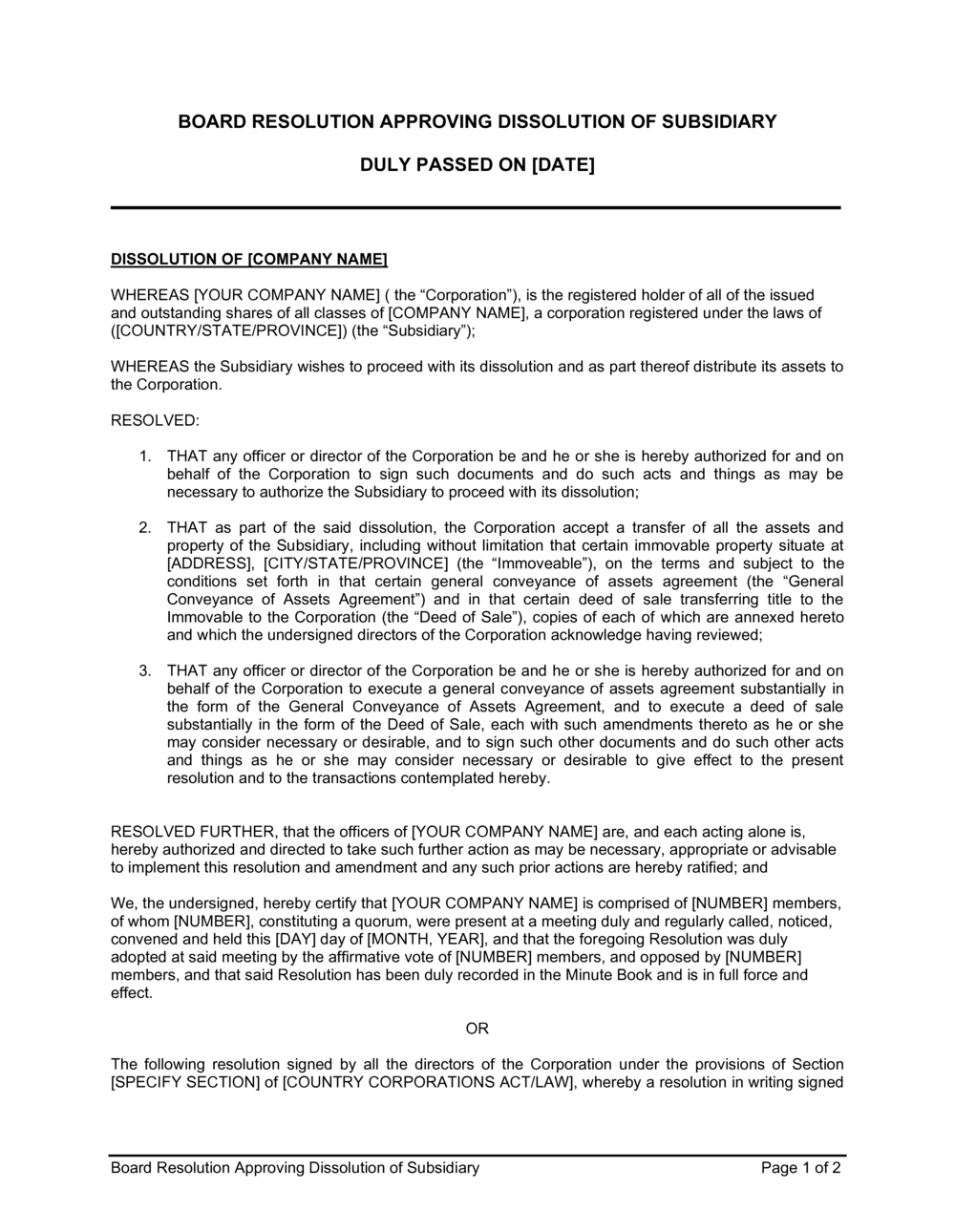
A Board Resolution Approving Dissolution of Subsidiary is a formal corporate governance document by which a parent company's board of directors votes to authorize the winding up and legal dissolution of a wholly owned or majority-owned subsidiary entity. This free Word download provides a structured, ready-to-edit template you can complete online and export as PDF for execution, filing, and record-keeping.
When you need it
Use it when a parent company's board has decided to cease the operations of a subsidiary — whether due to strategic restructuring, redundancy, insolvency, sale of the subsidiary's assets, or regulatory requirements. It is typically required before filing dissolution paperwork with the state, province, or national registry where the subsidiary is incorporated.
What's inside
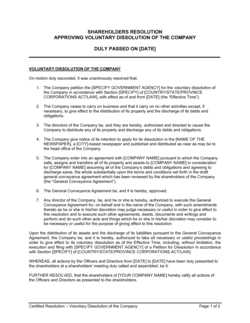
The resolution covers recitals identifying the subsidiary and the reasons for dissolution, the formal approval clause, authorization of named officers to execute winding-up steps, instructions for settling liabilities and distributing remaining assets, filing and notification obligations, and an effective date. It concludes with the signature block for the requisite number of directors.

What is a Board Resolution Approving Dissolution of Subsidiary?

A Board Resolution Approving Dissolution of Subsidiary is a formal corporate governance document in which the parent company's board of directors votes to authorize the legal winding up and termination of a subsidiary entity. It records the board's decision in writing, establishes the factual and business basis for dissolution, designates authorized officers to execute every step of the wind-down, and creates the internal corporate record that regulators, auditors, banks, and counterparties will reference throughout the dissolution process. Without this document, no external filing — from articles of dissolution to tax account closures — carries valid corporate authorization.

Why You Need This Document

Dissolving a subsidiary without a properly executed board resolution creates compounding legal and operational risk at every stage of the wind-down. Corporate registries in every major jurisdiction will reject dissolution filings that lack authorizing documentation, and tax authorities may refuse to issue clearance certificates without evidence of board approval. More critically, directors who authorize distributions or direct asset transfers before a resolution is in place may be acting outside their authority — exposing themselves and the parent company to claims of breach of fiduciary duty or fraudulent conveyance. A clear, complete resolution protects every person involved: it confirms quorum, documents the business rationale, names who is authorized to act, and sets the sequence for settling liabilities before assets move. This template gives you a professionally structured starting point you can complete in under two hours for a straightforward domestic dissolution — saving legal drafting costs while ensuring nothing critical is omitted.

Which variant fits your situation?

If your situation is…Use this template
Dissolving a wholly owned domestic subsidiaryBoard Resolution Approving Dissolution of Subsidiary
Dissolving a foreign or cross-border subsidiaryBoard Resolution Approving Dissolution of Foreign Subsidiary
Winding up a dormant shell company with no liabilitiesBoard Resolution for Voluntary Strike-Off
Authorizing a merger of the subsidiary into the parent before dissolutionBoard Resolution Approving Merger of Subsidiary
Selling the subsidiary's assets before dissolving the entityBoard Resolution Approving Sale of Subsidiary Assets
Documenting shareholder consent alongside the board resolutionWritten Consent of Shareholders for Dissolution
Appointing a liquidator to oversee the winding-up processBoard Resolution Appointing Liquidator

Common mistakes to avoid

❌ Using a trade name instead of the registered legal name

Why it matters: A name mismatch between the resolution and the corporate registry causes the dissolution filing to be rejected, requiring amendment and refile — sometimes after a costly delay.

Fix: Retrieve the subsidiary's exact registered name from the corporate registry portal before drafting the resolution and paste it verbatim into the identification clause.

❌ Distributing residual assets before clearing all liabilities

Why it matters: Premature distribution of assets while creditors remain unpaid constitutes fraudulent conveyance in most jurisdictions, exposing parent directors to personal liability.

Fix: Obtain confirmation — from the subsidiary's accountants and legal counsel — that all liabilities, including contingent claims and tax obligations, are satisfied or adequately reserved before authorizing any distribution.

❌ Failing to cancel tax registrations and licenses

Why it matters: Tax authorities and licensing bodies continue to impose filing obligations and penalties until formally notified of dissolution — obligations that technically survive the entity's registry strike-off in many jurisdictions.

Fix: Mandate in the resolution that authorized officers close all federal, state, and local tax accounts and cancel every active license and permit held by the subsidiary as part of the wind-down checklist.

❌ Omitting intercompany balances from the liability analysis

Why it matters: Loans from affiliates or the parent that are forgiven without documentation may be treated as taxable income to the subsidiary or a taxable dividend to the parent, triggering unexpected tax liabilities.

Fix: Document all intercompany balances before the resolution is passed, and obtain tax advice on whether to repay, convert, or formally forgive each balance in a tax-efficient manner.

❌ Signing the resolution after beginning the dissolution process

Why it matters: Steps taken to wind down the subsidiary before the resolution is executed — closing bank accounts, terminating employees — may lack corporate authorization and expose the parent to liability.

Fix: Execute the fully signed resolution before any operational or administrative wind-down steps are taken, and date the resolution consistently with the actual signature date.

❌ Naming only one authorized officer

Why it matters: If the sole named officer is unavailable when a registry deadline falls due, no one has documented authority to sign the filing — causing delays and potentially missed statutory deadlines.

Fix: Name at least two authorized officers in the resolution, and include broad authorization language so that each can act individually and independently.

The 10 key clauses, explained

Caption and meeting recitals

In plain language: Identifies the parent company's board, the date and manner of the meeting or written consent, and confirms that quorum was achieved.

Sample language
The undersigned, being all of the directors of [PARENT COMPANY LEGAL NAME] (the 'Company'), a [STATE/PROVINCE] [ENTITY TYPE], hereby adopt the following resolutions by [written consent / at a duly convened meeting held on [DATE]] at which a quorum was present and acting throughout.

Common mistake: Failing to confirm quorum in the recitals. If quorum is not documented, the resolution may be challenged as improperly constituted and the subsequent dissolution filings can be invalidated.

Identification of the subsidiary

In plain language: States the full legal name, jurisdiction of incorporation, registration number, and ownership structure of the entity being dissolved.

Sample language
WHEREAS, the Company is the sole/majority shareholder of [SUBSIDIARY LEGAL NAME] (the 'Subsidiary'), a [STATE/PROVINCE] [ENTITY TYPE] incorporated on [DATE] under registration number [NUMBER], of which the Company owns [100% / X%] of the issued and outstanding [shares / membership interests].

Common mistake: Using a trade name or abbreviation instead of the subsidiary's full registered legal name. A mismatch between the resolution and the corporate registry record delays or invalidates the dissolution filing.

Recitals — basis for dissolution

In plain language: Sets out the business reasons for dissolving the subsidiary — redundancy, cessation of operations, strategic restructuring, or completion of purpose.

Sample language
WHEREAS, the board has determined that it is in the best interests of the Company to dissolve the Subsidiary because [STATE REASON: e.g., the Subsidiary has ceased active operations / its business purpose has been fulfilled / it is no longer required for operational or tax purposes].

Common mistake: Omitting the business rationale entirely. Many jurisdictions and third parties (lenders, auditors) require documented justification for the dissolution decision as part of corporate governance records.

Formal approval of dissolution

In plain language: The operative resolution clause that formally authorizes and approves the voluntary dissolution and winding up of the subsidiary.

Sample language
RESOLVED, that the board of directors hereby approves and authorizes the voluntary dissolution and winding up of the Subsidiary in accordance with the laws of [STATE/PROVINCE/COUNTRY] and the Subsidiary's governing documents.

Common mistake: Drafting the approval as a recommendation rather than a binding resolution. Language like 'the board recommends dissolution' does not constitute formal authorization — use 'RESOLVED' or equivalent imperative language.

Authorization of officers to act

In plain language: Designates one or more named officers or directors to carry out all steps necessary to complete the dissolution, including signing and filing documents.

Sample language
RESOLVED FURTHER, that [NAME / TITLE] and [NAME / TITLE] (each, an 'Authorized Officer') are hereby authorized and directed, individually and collectively, to execute and deliver all documents, make all filings, and take all other actions necessary or advisable to effect the dissolution of the Subsidiary.

Common mistake: Naming only one authorized officer with no backup. If that officer is unavailable when a registry filing deadline arrives, the process stalls — always name at least two authorized signatories.

Settlement of liabilities and obligations

In plain language: Instructs the authorized officers to identify, verify, and pay or otherwise discharge all debts, liabilities, and obligations of the subsidiary before distribution of residual assets.

Sample language
RESOLVED FURTHER, that the Authorized Officers are directed to cause the Subsidiary to pay, satisfy, or make adequate provision for all known liabilities and obligations of the Subsidiary, including taxes, accounts payable, and intercompany balances, prior to any distribution of residual assets.

Common mistake: Overlooking intercompany balances owed by the subsidiary to the parent or affiliates. Undisclosed or unresolved intercompany debts can expose the parent to fraudulent transfer claims and delay the dissolution process.

Distribution of residual assets

In plain language: Authorizes the transfer of any remaining assets — cash, receivables, intellectual property, equipment — to the parent company after all liabilities are settled.

Sample language
RESOLVED FURTHER, that following satisfaction of all liabilities, any residual assets of the Subsidiary shall be distributed to the Company as sole shareholder in accordance with applicable law and the Subsidiary's constitutive documents.

Common mistake: Distributing assets before confirming all creditor claims are extinguished. Premature distributions can constitute fraudulent conveyance, creating personal liability for directors who approved the distribution.

Regulatory filings and notifications

In plain language: Directs the authorized officers to submit articles of dissolution, close tax registrations, cancel licenses, and notify regulators, creditors, and counterparties as required by law.

Sample language
RESOLVED FURTHER, that the Authorized Officers are directed to file Articles of Dissolution with the [STATE/PROVINCIAL/NATIONAL] corporate registry, close all tax accounts, cancel business licenses and permits, and provide required notices to creditors, taxing authorities, and contract counterparties.

Common mistake: Forgetting to cancel industry-specific licenses and permits. Regulatory authorities may continue billing for annual fees or impose penalties until formal cancellation is confirmed, even after dissolution is recorded.

Effective date

In plain language: States the date on which the resolution takes effect — either the date of execution or a specified future date.

Sample language
This resolution shall be effective as of [DATE OF EXECUTION / a specific future date of [DATE]], and shall be filed in the minute book of the Company.

Common mistake: Leaving the effective date blank or ambiguous. Regulatory filings, tax closing returns, and contract termination notices all reference the resolution date — an undefined date creates inconsistency across every downstream document.

Signature block and certification

In plain language: Provides execution lines for all required directors, confirming their individual approval and the authenticity of the resolution.

Sample language
IN WITNESS WHEREOF, the undersigned directors of [PARENT COMPANY LEGAL NAME] have executed this resolution as of the date first written above. [DIRECTOR NAME] _________________ [DIRECTOR NAME] _________________

Common mistake: Collecting signatures in counterpart without assembling a single fully executed copy. Many registries and banks require a complete document showing all signatures on one or concatenated pages — confirm the filing format before execution.

How to fill it out

  1. 1

    Confirm the subsidiary's legal details

    Retrieve the subsidiary's full registered legal name, jurisdiction of incorporation, registration or company number, and the parent's exact ownership percentage from the corporate registry or share register.

    💡 Pull the certificate of incorporation directly from the registry — name discrepancies between the resolution and registry records are the single most common cause of rejected dissolution filings.

  2. 2

    Verify board authority and quorum requirements

    Review the parent company's articles, bylaws, or shareholder agreement to confirm the voting threshold required to authorize a subsidiary dissolution. Most private companies require a simple majority; some require unanimous consent.

    💡 If any director has a conflict of interest — for example, they also serve as an officer of the subsidiary — confirm whether recusal is required under your governing documents or applicable law.

  3. 3

    Document the business reason for dissolution

    Write a clear, factual statement in the recitals explaining why the subsidiary is being dissolved — cessation of operations, strategic consolidation, completion of project purpose, or tax simplification.

    💡 Auditors and tax authorities may request the board resolution when reviewing the parent's consolidated returns. A documented business reason reduces the risk of adverse inference.

  4. 4

    Name at least two authorized officers

    Identify by name and title two or more individuals authorized to execute dissolution filings, close bank accounts, cancel licenses, and sign on behalf of the subsidiary during wind-down.

    💡 Include a 'catch-all' authorization phrase — 'and any other actions necessary or advisable' — to avoid needing a second resolution for steps not explicitly listed.

  5. 5

    Confirm the liability and asset position

    Before executing the resolution, obtain a current balance sheet of the subsidiary and confirm that all liabilities — including taxes, trade payables, intercompany loans, and lease obligations — are identified and have a resolution plan.

    💡 Consult with tax counsel to determine whether a final tax return, sales tax clearance certificate, or payroll tax closing is required before the registry will accept the dissolution filing.

  6. 6

    Set a specific effective date

    Enter a clear effective date — typically the date all directors sign, or a specific future date coordinated with the planned registry filing. Align this date with the subsidiary's final accounting period.

    💡 Where possible, align the dissolution effective date with a fiscal year-end to simplify preparation of the subsidiary's final financial statements and tax return.

  7. 7

    Execute and circulate for signatures

    Circulate the resolution to all required directors for signature — either at a formal board meeting with minutes, or as a written consent in lieu of meeting. Collect all signatures before initiating any registry filing.

    💡 Use Business in a Box eSign to timestamp execution and create a tamper-evident record. Store the fully executed resolution in the parent's corporate minute book immediately.

  8. 8

    File with the corporate registry and notify stakeholders

    Submit the articles of dissolution and any supporting documents to the relevant registry. Simultaneously notify the subsidiary's bank, creditors, counterparties, and tax authorities of the dissolution and the effective date.

    💡 Request a certified copy or acknowledgment from the registry — this becomes the definitive evidence of dissolution for lenders, auditors, and counterparties who held contracts with the subsidiary.

Frequently asked questions

What is a board resolution approving dissolution of a subsidiary?

A board resolution approving dissolution of a subsidiary is a formal corporate governance document in which the parent company's board of directors votes to authorize the legal winding up and termination of a subsidiary entity. It is the foundational internal authorization document required before any external dissolution filings can be made with the relevant corporate registry, tax authority, or regulatory body.

Is a board resolution required to dissolve a subsidiary?

Yes, in virtually all jurisdictions a formal board or shareholder resolution is required to authorize voluntary dissolution of a subsidiary. Most corporate registries will not accept articles of dissolution unless the filing is accompanied by or references an authorizing resolution. Additionally, banks, auditors, and counterparties typically require a certified copy of the resolution before releasing funds or closing accounts in the subsidiary's name.

What is the difference between dissolution and winding up?

Winding up is the operational process of settling a company's affairs — collecting receivables, paying creditors, canceling contracts, and distributing residual assets. Dissolution is the legal event that formally terminates the entity's existence and removes it from the corporate registry. Winding up happens first; dissolution is the legal endpoint. The board resolution typically authorizes both steps together.

Do shareholders need to approve dissolution of a subsidiary?

For a wholly owned subsidiary, the parent company is the sole shareholder, so the parent's board resolution typically serves as both board and shareholder authorization. For a majority-owned subsidiary with minority shareholders, separate shareholder approval may be required — and minority shareholders may have statutory rights to dissent or demand fair value. Always review the subsidiary's articles and applicable corporate law before proceeding.

What happens to the subsidiary's debts when it is dissolved?

All known debts and liabilities of the subsidiary must be paid, assumed, or adequately reserved before dissolution is finalized. In most jurisdictions, the subsidiary's directors remain personally liable for directing distributions while debts remain outstanding. The parent company may become indirectly liable if it received assets in a distribution later challenged as fraudulent conveyance. Always obtain a tax clearance and creditor confirmation before finalizing the dissolution.

How long does it take to dissolve a subsidiary?

The timeline varies significantly by jurisdiction. In many US states, the formal registry process takes 2–6 weeks after filing, though obtaining tax clearance certificates can add several months. In the UK, a voluntary strike-off under the Companies Act takes approximately 3 months from application. Canadian provinces typically process dissolution filings within 4–8 weeks. Cross-border dissolutions involving multiple registries can take 6–18 months in complex cases.

What documents are typically filed with the corporate registry to dissolve a subsidiary?

Most jurisdictions require articles of dissolution (or a dissolution application), a certificate of tax clearance or tax standing, and evidence of shareholder or board authorization — typically a certified copy of the board resolution. Some states and provinces also require publication of a dissolution notice in a local newspaper or official gazette, a final annual report, and proof that all licenses have been surrendered.

Can a dissolved subsidiary be reinstated?

Yes, most jurisdictions permit reinstatement of a dissolved corporation within a defined window — typically 2 to 5 years after dissolution — upon payment of fees and outstanding taxes and filing a reinstatement application. However, reinstatement is not available in all jurisdictions once the entity has been fully struck off. If there is any possibility the subsidiary may need to resume operations, consider a dormant company filing instead of full dissolution.

Do I need a lawyer to dissolve a subsidiary?

For a simple wholly owned domestic subsidiary with no employees, no outstanding litigation, and a clean balance sheet, a well-drafted template and careful compliance with registry requirements is often sufficient. Engage a corporate lawyer when the subsidiary has minority shareholders, unresolved liabilities, regulatory licenses, employees in multiple jurisdictions, or cross-border operations. A 2–4 hour legal review typically costs $500–$1,500 and is worthwhile for any dissolution involving material assets or complex obligations.

How this compares to alternatives

vs Board Resolution Approving Sale of Subsidiary

A resolution approving sale authorizes transfer of the subsidiary's shares or assets to a third-party buyer, leaving the entity itself intact or dissolving it post-closing. A dissolution resolution authorizes wind-down and legal termination without a buyer. Use a sale resolution when value can be extracted through a transaction; use a dissolution resolution when the subsidiary has no buyer and operations have ceased.

vs Articles of Dissolution

Articles of dissolution are the external statutory filing submitted to the corporate registry — the public-facing document that legally terminates the entity. The board resolution is the internal corporate authorization that must precede the articles filing. Both are required; the resolution is produced first and is typically attached to or referenced in the articles.

vs Written Consent of Shareholders for Dissolution

A shareholder consent authorizes dissolution at the equity-holder level, which is required when shareholders (rather than the board alone) must approve winding up under the governing documents or applicable law. A board resolution operates at the director level. For wholly owned subsidiaries, the parent's board resolution typically serves both functions; for subsidiaries with minority shareholders, both documents are needed.

vs Board Resolution Appointing Liquidator

A resolution appointing a liquidator designates a named professional to oversee the winding-up process, which is required in formal liquidation proceedings — particularly for insolvent subsidiaries or in jurisdictions that mandate a supervised wind-down. A dissolution resolution is sufficient for solvent voluntary dissolutions that do not require a court-supervised or registered liquidator.

Industry-specific considerations

Financial Services

Special-purpose vehicles and holding companies require regulatory notification to the FCA, SEC, or equivalent before and after dissolution, and deregistration from financial services registries.

Technology / SaaS

IP assignment from the subsidiary to the parent must be formally documented and recorded before dissolution, including patents, trademarks, domain names, and software licenses.

Real Estate

Property-holding subsidiaries require transfer of title deeds and discharge of mortgages before dissolution; land registry filings are required in addition to corporate registry filings.

Manufacturing

Environmental permits, waste disposal licenses, and equipment certifications held by the subsidiary must be formally surrendered or transferred to avoid ongoing regulatory liability after dissolution.

Jurisdictional notes

United States

Dissolution procedures are governed by the corporate law of the state of incorporation — not the state where the subsidiary operates. Most states require filing articles of dissolution with the Secretary of State, obtaining a tax clearance certificate, and paying any outstanding franchise taxes. Delaware, the most common state of incorporation, requires a certificate of dissolution signed by a majority of directors. California imposes a two-step process (certificate of election and certificate of dissolution) and mandatory creditor notification.

Canada

Federally incorporated subsidiaries under the Canada Business Corporations Act require articles of dissolution filed with Corporations Canada and confirmation that all assets have been distributed and liabilities discharged. Each province has its own dissolution procedure for provincially incorporated subsidiaries — Ontario, Alberta, and British Columbia each have distinct filing requirements and fees. Quebec requires French-language documentation for provincially regulated entities. CRA tax clearance is strongly recommended before distribution of assets.

United Kingdom

In the UK, voluntary dissolution of a subsidiary is most commonly achieved via a striking-off application under section 1003 of the Companies Act 2006 — a streamlined process for solvent companies that have ceased trading. The directors must confirm no pending legal proceedings and no trading within the last three months. Companies House publishes a notice in the London Gazette, and interested parties have two months to object. HMRC de-registration must be completed separately. Insolvency practitioners are required for formal liquidation of insolvent subsidiaries.

European Union

Dissolution procedures vary significantly across EU member states, as corporate law remains a national competence. France requires a shareholders' dissolution resolution followed by appointment of a liquidateur and publication in the BODACC gazette. Germany mandates a three-month creditor waiting period after publication before final dissolution. Spain and Italy impose notarial requirements on dissolution deeds. GDPR obligations regarding personal data held by the subsidiary must be addressed during wind-down — data must be securely deleted or transferred under a lawful basis.

Template vs lawyer — what fits your deal?

PathBest forCostTime
Use the templateWholly owned domestic subsidiaries with no employees, no outstanding litigation, and a clean balance sheetFree1–2 hours to complete; 2–8 weeks for registry processing
Template + legal reviewSubsidiaries with employees, intercompany balances, industry licenses, or tax clearance requirements$500–$1,500 for a 2–4 hour corporate lawyer review1–3 days for legal review; 4–12 weeks for full wind-down
Custom draftedCross-border dissolutions, subsidiaries with minority shareholders, regulated industries, or contested creditor claims$2,000–$8,000+ depending on complexity and jurisdictions involved2–6 weeks for drafting and approvals; 3–18 months for full process

Glossary

Dissolution
The formal legal process of terminating a corporation's existence, resulting in cancellation of its charter and removal from the register of companies.
Winding Up
The operational process preceding dissolution — collecting assets, paying creditors, and distributing any remaining property before the entity is formally struck off.
Wholly Owned Subsidiary
A subsidiary in which 100% of the issued shares are owned by a single parent company, giving the parent full control over governance decisions including dissolution.
Articles of Dissolution
A formal filing submitted to the relevant state, provincial, or national corporate registry to legally terminate a corporation's existence.
Quorum
The minimum number of directors who must be present or represented at a board meeting for resolutions passed at that meeting to be valid.
Written Consent in Lieu of Meeting
A mechanism allowing all directors to sign a resolution outside of a formal meeting, treated as equivalent to a unanimous vote at a properly convened meeting.
Authorized Officer
A director, officer, or agent specifically named in the resolution and granted authority to execute filings, agreements, and other documents on behalf of the entity.
Certificate of Dissolution
The document issued by the corporate registry confirming that a corporation has been legally dissolved and its existence terminated.
Intercompany Balances
Receivables and payables existing between the subsidiary and the parent or affiliated entities that must be settled or formally waived before dissolution.
Residual Assets
Any property, cash, or rights remaining in the subsidiary after all liabilities are satisfied, which are distributed to the parent company upon dissolution.

Part of your Business Operating System

This document is one of 3,000+ business & legal templates included in Business in a Box.

  • Fill-in-the-blanks — ready in minutes
  • 100% customizable Word document
  • Compatible with all office suites
  • Export to PDF and share electronically

Create your document in 3 simple steps.

From template to signed document — all inside one Business Operating System.
1
Download or open template

Access over 3,000+ business and legal templates for any business task, project or initiative.

2
Edit and fill in the blanks with AI

Customize your ready-made business document template and save it in the cloud.

3
Save, Share, Send, Sign

Share your files and folders with your team. Create a space of seamless collaboration.

Save time, save money, and create top-quality documents.

★★★★★

"Fantastic value! I'm not sure how I'd do without it. It's worth its weight in gold and paid back for itself many times."

Managing Director · Mall Farm
Robert Whalley
Managing Director, Mall Farm Proprietary Limited
★★★★★

"I have been using Business in a Box for years. It has been the most useful source of templates I have encountered. I recommend it to anyone."

Business Owner · 4+ years
Dr Michael John Freestone
Business Owner
★★★★★

"It has been a life saver so many times I have lost count. Business in a Box has saved me so much time and as you know, time is money."

Owner · Upstate Web
David G. Moore Jr.
Owner, Upstate Web

Run your business with a system — not scattered tools

Stop downloading documents. Start operating with clarity. Business in a Box gives you the Business Operating System used by over 250,000 companies worldwide to structure, run, and grow their business.

Start free · No credit card required