Shareholders Resolution Ratyfing Prior Acts of Officers Template

Free Word download • Edit online • Save & share with Drive • Export to PDF

1 page20–30 min to fillDifficulty: StandardSignature requiredLegal review recommended
Learn more ↓
FreeShareholders Resolution Ratyfing Prior Acts of Officers Template

At a glance

What it is
A Shareholders Resolution Ratifying Prior Acts of Officers is a formal corporate document by which a company's shareholders retroactively approve actions taken by officers — such as a CEO, CFO, or Secretary — that were executed without prior shareholder authorization. This free Word download gives you a structured, legally organized template you can edit online and export as PDF for execution at or outside of a formal shareholder meeting.
When you need it
Use it when officers have already executed contracts, financial commitments, or operational decisions that required shareholder approval under the company's bylaws, articles of incorporation, or applicable corporate law — and that approval was not obtained in advance. It is also used during annual housekeeping reviews to confirm and ratify the general conduct of officers over the prior fiscal period.
What's inside
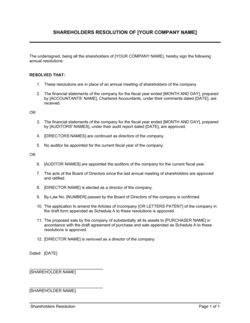
Recitals identifying the company and officers involved, a description of the specific prior acts being ratified, the resolution clause granting formal approval, confirmation that the acts are consistent with the company's interests, signature blocks for all required shareholders, and an effective date. The template covers both specific-act ratifications and omnibus annual ratifications.

What is a Shareholders Resolution Ratifying Prior Acts of Officers?

A Shareholders Resolution Ratifying Prior Acts of Officers is a formal corporate governance document by which a company's shareholders retroactively approve actions already taken by one or more officers — such as a CEO, CFO, or Corporate Secretary — that were executed without the prior shareholder authorization required by the company's bylaws, articles of incorporation, or applicable corporate statute. By passing this resolution, shareholders give those past actions the same legal effect they would have had if properly authorized in advance. It is used both for targeted ratifications of specific transactions and as a routine annual housekeeping measure confirming the general conduct of officers across a completed fiscal period.

Why You Need This Document

Without a formal ratification resolution, unauthorized officer acts create a persistent gap in your corporate governance record — one that surfaces at the worst possible moment. Lenders conducting loan covenant reviews, acquirers completing M&A due diligence, and investors reviewing governance prior to a financing round routinely identify unauthorized officer acts and require correction before proceeding. A contract signed by an officer without proper shareholder authority may be voidable by the counterparty or challenged by minority shareholders, exposing the corporation to renegotiation risk or litigation. Officers who acted without authorization also carry personal liability exposure that an indemnification clause in the ratification resolution resolves. Passing a properly drafted shareholders ratification resolution closes these gaps cleanly, gives third parties certainty about the corporation's obligations, and protects the officers involved — all without the cost or delay of unwinding the underlying transaction.

Which variant fits your situation?

If your situation is…Use this template
Ratifying all officer acts taken during a completed fiscal year in one documentAnnual Omnibus Shareholders Resolution Ratifying Officer Acts
Ratifying a specific contract signed by an officer without prior approvalShareholders Resolution Ratifying Prior Acts of Officers
Authorizing a specific future officer action (not retroactive)Shareholders Resolution Authorizing Officer Action
Board of directors (not shareholders) retroactively approving officer actsBoard of Directors Resolution Ratifying Officer Acts
Shareholders ratifying acts taken during a period of corporate transition or restructuringSpecial Shareholders Resolution — Corporate Transition
Ratifying officer acts in the context of an M&A transaction closingShareholders Written Consent in Lieu of Meeting

Common mistakes to avoid

❌ Backdating the resolution to a date before the acts occurred

Why it matters: A ratification by definition approves past acts — making the effective date precede those acts is legally meaningless and constitutes document fraud in most jurisdictions.

Fix: Always date the resolution on or after the latest act being ratified. The retroactive legal effect is built into the ratification concept itself.

❌ Using vague or omnibus language without identifying specific acts

Why it matters: Resolutions that ratify 'all acts and things done' without specifics can be challenged as ineffective because neither the corporation nor third parties can determine what was actually ratified.

Fix: Describe each act with the date, officer involved, counterparty, and the nature of the transaction. For multiple acts, attach a schedule listing each one.

❌ Omitting the savings clause

Why it matters: Without a carve-out for illegal or ultra vires acts, an omnibus ratification could be read to approve conduct that is not legally ratifiable — exposing approving shareholders to derivative liability.

Fix: Include the standard savings clause in every ratification resolution, regardless of how routine the acts being ratified appear to be.

❌ Failing to verify quorum before circulating for signature

Why it matters: A resolution signed by shareholders representing less than the required quorum is void. Discovering this after the fact — particularly during M&A due diligence — requires a corrective resolution and delays closings.

Fix: Calculate quorum against the current share register before drafting. Confirm all shareholders whose signatures are needed are reachable and capable of signing within the required timeline.

❌ Ratifying acts that are legally incapable of ratification

Why it matters: Not all unauthorized acts can be retroactively approved — acts that were illegal at the time, that required a license the company lacked, or that defrauded a third party cannot be cured by ratification.

Fix: Have legal counsel review the specific acts before proceeding. If an act cannot be ratified, the remedy is negotiation with the affected party or a legal correction — not a shareholder resolution.

❌ Circulating the resolution without attaching supporting documentation

Why it matters: Shareholders who approve acts they cannot verify may later claim they were misled, opening the door to challenges of the ratification's validity.

Fix: Attach all relevant underlying documents — contracts, correspondence, financial records — as numbered exhibits referenced in the recitals before circulating for signature.

The 9 key clauses, explained

Preamble and corporate identification

In plain language: Identifies the corporation by its full legal name, jurisdiction of incorporation, and the date the resolution is adopted.

Sample language
The undersigned, being all (or the requisite majority) of the shareholders of [CORPORATION FULL LEGAL NAME], a corporation incorporated under the laws of [STATE / PROVINCE / COUNTRY] (the 'Corporation'), hereby adopt the following resolution as of [DATE].

Common mistake: Using a trade name instead of the registered legal name. Resolutions that do not match the exact corporate registry name can be rejected by banks, registrars, and counterparties.

Recitals — description of prior acts

In plain language: Sets out the background facts: who acted, what they did, and when — providing the factual foundation for the ratification.

Sample language
WHEREAS, [OFFICER NAME], acting in their capacity as [TITLE] of the Corporation, did on or about [DATE(S)], [DESCRIPTION OF ACT — e.g., 'execute a lease agreement with [LANDLORD NAME] for premises at [ADDRESS] for a term of [X] years at a monthly rent of $[AMOUNT]'].

Common mistake: Writing vague recitals like 'performed various acts on behalf of the Corporation.' Courts and third parties require specific descriptions to determine whether ratification covers the act in question.

Resolution clause — ratification

In plain language: The operative sentence that formally and retroactively approves the described prior acts, giving them the same legal effect as if pre-authorized.

Sample language
RESOLVED, that the shareholders of the Corporation hereby ratify, confirm, and approve all acts, transactions, agreements, and decisions made by [OFFICER NAME(S)] in their capacity as [TITLE(S)] during the period from [START DATE] to [END DATE], as described in the recitals above.

Common mistake: Omitting a defined period or specific act description in the resolution clause, leaving ambiguity about exactly what is and is not ratified — which creates disputes if the officer's conduct is later challenged.

Confirmation of authority and corporate benefit

In plain language: States that the ratified acts were within the officer's authority as extended by this resolution and were in the best interests of the corporation.

Sample language
FURTHER RESOLVED, that the actions described herein are hereby confirmed as having been taken on behalf of, and for the benefit of, the Corporation, and all persons relying on such actions are hereby notified of their validity and binding effect.

Common mistake: Omitting this clause when ratifying acts that could be challenged as self-interested. Without a corporate-benefit statement, minority shareholders may have grounds to contest the ratification.

Indemnification and hold-harmless clause

In plain language: Protects the officer from personal liability for the ratified acts by committing the corporation to defend and indemnify them against related claims.

Sample language
FURTHER RESOLVED, that the Corporation shall indemnify and hold harmless [OFFICER NAME(S)] from and against any claims, liabilities, costs, and expenses arising from the acts ratified herein, to the fullest extent permitted by applicable law and the Corporation's bylaws.

Common mistake: Including indemnification for acts that are not within the scope of what the bylaws or applicable statute permits — unenforceable indemnification language can void the entire clause.

Savings clause for unauthorized acts

In plain language: Clarifies that the resolution does not ratify any acts that were illegal, fraudulent, or outside the corporation's permitted purposes.

Sample language
PROVIDED THAT, nothing in this resolution shall be construed to ratify any act that was illegal, fraudulent, or contrary to the best interests of the Corporation, or any act that the Corporation was not legally empowered to authorize.

Common mistake: Omitting the savings clause. Without it, an omnibus ratification resolution could be interpreted as approving fraud or illegal acts — exposing the corporation and approving shareholders to liability.

Shareholder vote and quorum confirmation

In plain language: Confirms that the required quorum of shareholders approved the resolution and that the vote met the threshold required by the bylaws.

Sample language
This resolution has been adopted by shareholders holding [X]% of the issued and outstanding voting shares of the Corporation, representing a [majority / supermajority] of votes entitled to be cast, constituting the quorum required under the Corporation's bylaws.

Common mistake: Not recording the actual vote percentage. If the resolution is later challenged, there must be a documented record that the required threshold was met.

Authority to implement

In plain language: Directs the officers and corporate secretary to take any additional steps necessary to give effect to the ratified acts and file any required notices.

Sample language
FURTHER RESOLVED, that the officers and Secretary of the Corporation are hereby authorized and directed to take all actions, execute all documents, and make all filings necessary or appropriate to carry out the purposes of this resolution.

Common mistake: Omitting this clause when the ratification involves a filed document (e.g., a recorded deed or a registered agreement). Without explicit authority, officers may face uncertainty about whether they can act further on the ratified matter.

Effective date and signatures

In plain language: States the date the resolution takes effect and provides signature blocks for all required shareholders, confirming their consent.

Sample language
This resolution is effective as of [DATE]. Signed by the shareholders of [CORPORATION NAME]: [SHAREHOLDER NAME], [SHARE CLASS], [NUMBER OF SHARES] shares held. Signature: ______________________ Date: ____________.

Common mistake: Dating the resolution before the acts being ratified. A ratification cannot be effective before the acts it approves occurred — backdating creates fraud risk and may void the resolution.

How to fill it out

  1. 1

    Enter the corporation's full legal name and jurisdiction

    Use the exact registered legal name from your corporate registry or certificate of incorporation. Include the jurisdiction (state, province, or country) and entity type (Inc., Ltd., LLC, Corp.).

    💡 Cross-reference the exact legal name against your latest annual filing or certificate of good standing — any variation can cause the resolution to be rejected by a bank or registrar.

  2. 2

    Identify the officer and describe each prior act specifically

    Name the officer by their full legal name and title, then describe each act with specific details: what was done, the date it was done, the counterparty involved, and the financial or legal effect.

    💡 If ratifying a contract, attach the signed agreement as Exhibit A and reference it by name and date in the recitals — this leaves no ambiguity about what is being ratified.

  3. 3

    Define the ratification period

    Set a clear start and end date for the period covered by the ratification. For an annual omnibus ratification, use the first and last day of the fiscal year.

    💡 For M&A due diligence cleanups, use the specific dates of the unauthorized acts rather than a broad period — narrow scope reduces the risk of inadvertently ratifying unidentified issues.

  4. 4

    Confirm the voting threshold and quorum

    Check your bylaws or shareholders agreement to determine the required vote percentage for this type of resolution (simple majority or supermajority). Calculate the shares held by consenting shareholders and confirm quorum is met.

    💡 Record the exact percentage of voting shares represented — not just 'majority' — so the resolution is self-evidencing if challenged later.

  5. 5

    Review and tailor the indemnification clause

    Confirm that the indemnification language matches the scope permitted by your bylaws and applicable corporate statute. Remove or limit the clause if the acts involved any third-party dispute that could create insurance coverage issues.

    💡 Check your D&O insurance policy before including a broad indemnification clause — some policies are voided or limited by resolutions that expand indemnification beyond the policy terms.

  6. 6

    Include the savings clause

    Retain the savings clause carving out illegal, fraudulent, or ultra vires acts from the scope of ratification. Do not delete it, even for a routine annual ratification.

    💡 Add a line specifically excluding any acts that are currently the subject of litigation or regulatory inquiry — broad ratification during active proceedings creates additional liability risk.

  7. 7

    Obtain shareholder signatures before the effective date

    Circulate the resolution for signature by all shareholders, or the requisite majority, as required by your bylaws. Use a written consent procedure if a formal meeting is not convened.

    💡 In jurisdictions that permit electronic signatures (US, Canada, UK, EU), DocuSign or Business in a Box eSign timestamps execution automatically — critical for establishing the resolution predates any challenge.

Frequently asked questions

What is a shareholders resolution ratifying prior acts of officers?

A shareholders resolution ratifying prior acts of officers is a formal corporate document by which a company's shareholders retroactively approve actions taken by one or more officers — such as a CEO, CFO, or Secretary — that were carried out without prior shareholder authorization. The resolution gives those actions the same legal validity they would have had if the shareholders had approved them in advance. It is a standard governance tool used during annual housekeeping, M&A due diligence, and any time an officer acts ahead of a formal vote.

When is a shareholders ratification resolution required?

It is required whenever an officer takes an action that the company's bylaws, articles of incorporation, or applicable corporate statute reserves for shareholder approval — and that approval was not obtained beforehand. Common triggers include signing leases or material contracts, opening or closing bank accounts, making significant financial commitments, and approving major operational decisions. It is also used as routine annual housekeeping to confirm the general conduct of officers over the prior fiscal year.

Can shareholders ratify any officer act?

No. Shareholders can ratify unauthorized acts that were within the corporation's legal capacity and in its best interests. They cannot ratify acts that were illegal at the time they were taken, acts that constituted fraud against the corporation or third parties, or acts that the corporation itself was not legally empowered to authorize (ultra vires acts). If an act falls into one of these categories, legal counsel should be engaged to determine the appropriate remedy.

What is the difference between a board resolution and a shareholders resolution ratifying officer acts?

A board of directors resolution is passed by the directors and is appropriate for ratifying acts that fell within the board's authority but were not formally voted on. A shareholders resolution is required when the act in question exceeded the board's authority and required shareholder approval under the bylaws or statute — for example, authorizing the sale of substantially all corporate assets or approving a major related-party transaction. In practice, the two documents are sometimes used together during annual governance reviews.

Does a shareholders ratification resolution need to be signed by all shareholders?

Not necessarily. The required threshold depends on the company's bylaws and applicable corporate law. Most jurisdictions allow ordinary resolutions to pass with a simple majority of voting shares. Some matters require a supermajority (typically 66.7% or 75%). If the resolution is passed by written consent rather than at a formal meeting, many jurisdictions require unanimous consent unless the bylaws or statute permit a written majority consent procedure.

Is a shareholders resolution ratifying officer acts legally binding on third parties?

Generally yes, once the acts are ratified, the corporation is bound to third parties who relied on the officer's apparent authority when the original acts were taken. Third parties dealing with a corporation in good faith are typically protected even before ratification under the doctrine of apparent authority. The resolution formally confirms the corporation's liability and removes any ambiguity about enforceability. Consider consulting a lawyer in your jurisdiction for advice on specific transactions.

What is the difference between ratification and indemnification in this context?

Ratification approves the underlying act itself — making it valid and binding on the corporation going forward. Indemnification protects the individual officer from personal liability arising from the ratified act. They serve different purposes: ratification benefits the corporation and third parties by confirming the act's validity; indemnification benefits the officer by shifting any remaining personal risk to the corporation. A well-drafted resolution typically includes both.

How is a shareholders resolution passed without holding a formal meeting?

Most corporate statutes in the US, Canada, UK, and EU permit shareholders to pass resolutions by written consent in lieu of a meeting — provided the required majority (or unanimity, depending on jurisdiction and resolution type) of shareholders sign the written consent document. The resolution must include a statement that it is passed in lieu of a meeting, the effective date, and signatures of the required shareholders. Electronic signatures are accepted in most jurisdictions for this purpose.

Do I need a lawyer to prepare a shareholders ratification resolution?

For routine annual omnibus ratifications of standard officer acts in a closely held company, a high-quality template is generally sufficient. Engage a lawyer when the acts being ratified involved material contracts, related-party transactions, regulatory filings, or significant financial commitments; when the company is preparing for an M&A transaction or financing round; or when there is any dispute among shareholders about whether the acts were in the corporation's best interests.

How this compares to alternatives

vs Board of Directors Resolution

A board resolution is passed by directors and covers acts within the board's authority. A shareholders resolution is required when the act exceeded board authority and required shareholder approval under the bylaws or statute. For many routine officer acts, a board resolution is sufficient; a shareholders resolution is needed only when the shareholder threshold is triggered. Using a board resolution when a shareholders resolution is required does not cure the authorization defect.

vs Shareholders Written Consent in Lieu of Meeting

A written consent in lieu of meeting is the procedural mechanism by which shareholders pass resolutions without convening a formal meeting. A ratification resolution is the substantive content — what is being approved. The two are often combined: a ratification resolution passed by written consent rather than at a formal meeting uses both documents together.

vs Corporate Bylaws Amendment

A bylaws amendment changes the rules governing how the corporation operates going forward. A ratification resolution approves specific past acts without changing the underlying rules. If an officer acted outside the current bylaws, a ratification resolution cures the specific instance; a bylaws amendment would change the rules to authorize similar acts in the future — both may be needed together.

vs Officers Certificate

An officer's certificate is a sworn statement by an officer confirming specific facts about the corporation — often used in financing transactions and closings. A shareholders ratification resolution is a governance document that retroactively authorizes past officer conduct. In M&A and lending transactions, both documents are typically required: the ratification resolution corrects the governance gap; the officer's certificate certifies to the counterparty that the gap has been cured.

Industry-specific considerations

Technology / SaaS

Ratifying software licensing agreements, cloud infrastructure contracts, and employment offer letters signed by founders before governance structures were formalized.

Real estate

Ratifying lease agreements, property management contracts, and financing commitments executed by officers ahead of a shareholder authorization meeting.

Financial services

Ratifying banking resolutions, account opening authorizations, and investment management agreements to satisfy regulatory and audit requirements.

Professional services

Ratifying client engagement letters, subcontractor agreements, and office lease renewals signed by managing partners or officers without a prior shareholder vote.

Manufacturing

Ratifying supply agreements, equipment purchase commitments, and distribution contracts entered into by operations officers during production ramp-ups.

Healthcare

Ratifying vendor contracts, facility leases, and technology licensing agreements executed by administrators ahead of board or shareholder approval cycles.

Jurisdictional notes

United States

Under the Model Business Corporation Act and most state corporation statutes, shareholders may ratify unauthorized officer acts by a majority vote of shares entitled to vote. Delaware General Corporation Law Section 204 provides a detailed statutory ratification mechanism for defective corporate acts. Written consent procedures are permitted in all 50 states but may require unanimous consent for certain resolution types. California, New York, and several other states impose additional procedural requirements for closely held corporations.

Canada

Under the Canada Business Corporations Act and provincial equivalents, shareholders may ratify unauthorized officer acts by ordinary resolution (majority) unless the act required a special resolution (two-thirds majority) to authorize in the first place. Quebec civil law companies follow different ratification rules under the Civil Code. Written resolution procedures are permitted under most Canadian corporate statutes without a formal meeting, provided all shareholders entitled to vote sign the resolution or the requisite majority does, depending on the jurisdiction.

United Kingdom

Under the Companies Act 2006, shareholders may ratify acts of directors and officers by ordinary resolution (simple majority) in most cases. Section 239 of the Act specifically addresses ratification of acts by directors, requiring that votes cast by the director whose acts are being ratified (or their connected persons) are disregarded. Written resolutions are permitted for private companies under Part 13 of the Act. Public companies must pass ratification resolutions at a general meeting.

European Union

Ratification of officer acts is governed by individual member state company law rather than EU-wide regulation. Germany, France, Spain, and the Netherlands each have distinct rules on the required majority, notification requirements, and the effect of ratification on third parties. The EU Single Market Directive harmonizes some aspects of company authority and officer representation, but ratification procedure remains a member-state matter. GDPR considerations apply when resolutions reference personal data of officers or counterparties in attached exhibits.

Template vs lawyer — what fits your deal?

PathBest forCostTime
Use the templateClosely held companies conducting routine annual ratifications of standard officer acts with no shareholder disputesFree30–60 minutes
Template + legal reviewCompanies ratifying material contracts, related-party transactions, or preparing for financing or M&A due diligence$300–$8001–3 days
Custom draftedPublic or widely held companies, resolutions involving disputed acts, regulated industries, or cross-border officer authority questions$1,000–$3,500+1–2 weeks

Glossary

Ratification
The formal, retroactive approval of an act already taken, giving it the same legal effect as if it had been authorized in advance.
Officer
An individual appointed by the board or shareholders to manage the corporation's day-to-day operations, such as a CEO, CFO, COO, or Secretary.
Shareholder Resolution
A formal decision made by a company's shareholders, either at a meeting or by written consent, that is binding on the corporation.
Quorum
The minimum percentage or number of shareholders (by vote or share count) required to be present or represented for a shareholder vote to be valid.
Written Consent in Lieu of Meeting
A procedure allowing shareholders to pass a resolution by signing a written document rather than convening a formal meeting, permitted in most jurisdictions.
Ultra Vires
An act performed beyond the legal authority of the corporation or the individual officer — ratification can cure some but not all ultra vires acts.
Indemnification
A commitment by the corporation to reimburse or defend an officer against claims arising from authorized actions taken in their official capacity.
Recitals
The introductory 'whereas' clauses in a resolution that set out the background facts and context that justify the resolution being passed.
Omnibus Ratification
A single resolution that retroactively approves all acts taken by officers during a defined period rather than ratifying each act individually.
Majority Vote
Approval by shareholders holding more than 50% of the voting shares — the standard threshold for ordinary resolutions unless the bylaws require a supermajority.
Supermajority
A voting threshold higher than a simple majority — typically 66.7% or 75% — required by some bylaws or statutes for certain significant corporate actions.

Part of your Business Operating System

This document is one of 3,000+ business & legal templates included in Business in a Box.

  • Fill-in-the-blanks — ready in minutes
  • 100% customizable Word document
  • Compatible with all office suites
  • Export to PDF and share electronically

Create your document in 3 simple steps.

From template to signed document — all inside one Business Operating System.
1
Download or open template

Access over 3,000+ business and legal templates for any business task, project or initiative.

2
Edit and fill in the blanks with AI

Customize your ready-made business document template and save it in the cloud.

3
Save, Share, Send, Sign

Share your files and folders with your team. Create a space of seamless collaboration.

Save time, save money, and create top-quality documents.

★★★★★

"Fantastic value! I'm not sure how I'd do without it. It's worth its weight in gold and paid back for itself many times."

Managing Director · Mall Farm
Robert Whalley
Managing Director, Mall Farm Proprietary Limited
★★★★★

"I have been using Business in a Box for years. It has been the most useful source of templates I have encountered. I recommend it to anyone."

Business Owner · 4+ years
Dr Michael John Freestone
Business Owner
★★★★★

"It has been a life saver so many times I have lost count. Business in a Box has saved me so much time and as you know, time is money."

Owner · Upstate Web
David G. Moore Jr.
Owner, Upstate Web

Run your business with a system — not scattered tools

Stop downloading documents. Start operating with clarity. Business in a Box gives you the Business Operating System used by over 250,000 companies worldwide to structure, run, and grow their business.

Free Forever Plan · No credit card required