1
Confirm the amendment is within board authority
Review your existing bylaws and the applicable state or provincial corporate statute to confirm which bylaw provisions the board can amend unilaterally and which require shareholder approval. Some matters — voting rights, class rights, dissolution — typically require a shareholder vote.
💡 Flag the specific statutory section that grants the board amendment authority in your recitals — this pre-empts any later challenge to the resolution's validity.
2
Enter the corporation's full legal name and meeting details
Use the exact registered corporate name, the state or province of incorporation, the meeting type (regular or special), and the precise date, time, and location or virtual platform.
💡 For virtual meetings, record the video-conferencing platform and the dial-in or URL used — some jurisdictions require virtual meeting records to specify the technology.
3
Confirm and record quorum
Before the vote, verify that the number of directors present meets the quorum threshold in your current bylaws. Record the number present, the total number of directors, and the quorum article reference.
💡 If any director participates remotely, confirm your bylaws permit telephonic or electronic participation — and note it in the resolution.
4
Draft the background recitals
Write one to three WHEREAS clauses explaining why the amendment is needed — regulatory update, operational change, investor requirement, or governance best practice. Be specific: cite the rule or circumstance driving the change.
💡 Recitals are used by courts and acquirers to interpret ambiguous amendment language — the more specific, the more protective.
5
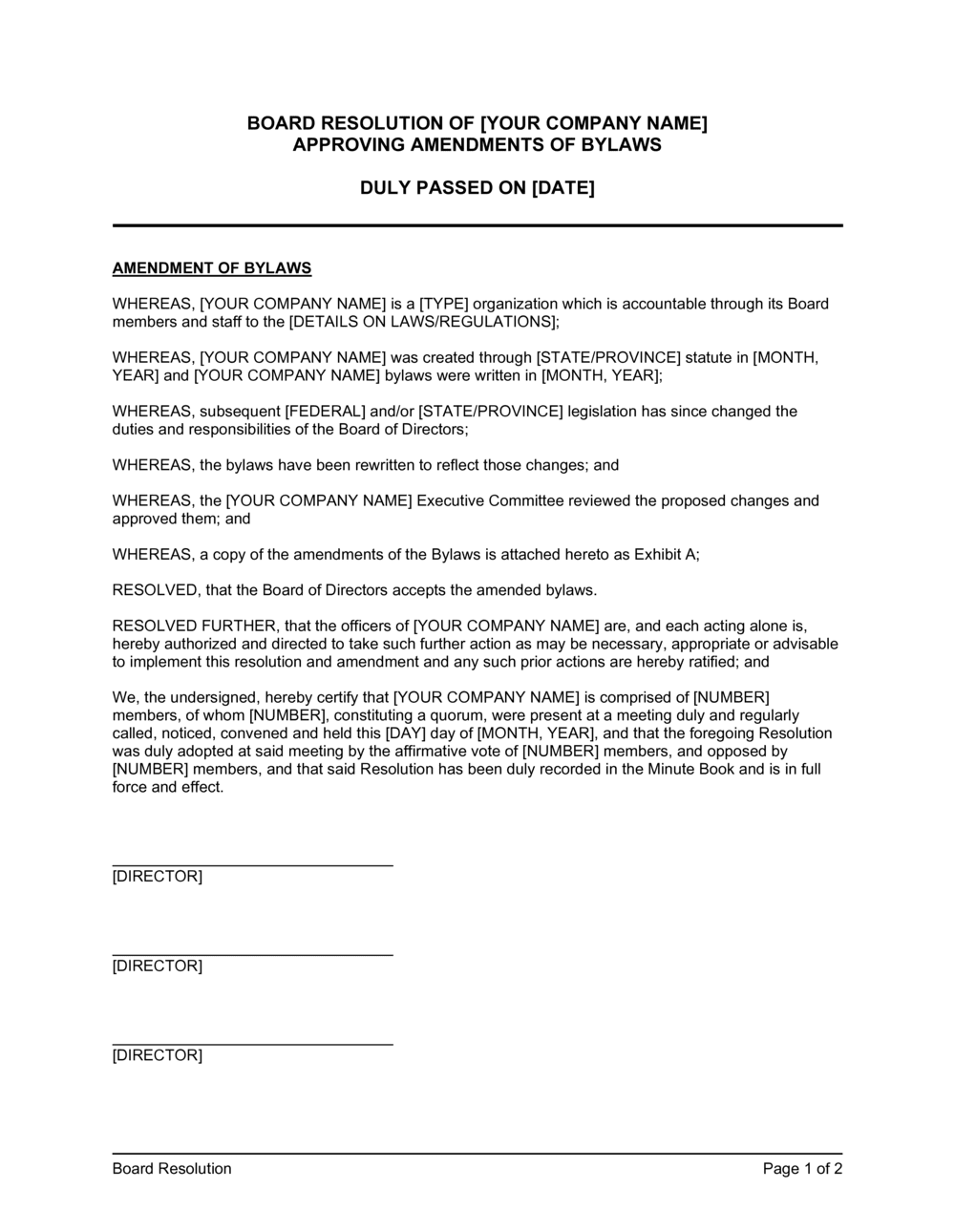
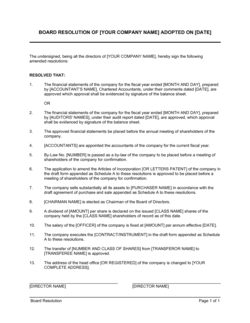
Insert the exact amendment language
Quote the current bylaw text verbatim, then state the amended replacement text in full. If the change is extensive, reference Exhibit A and attach the full marked-up section. Do not paraphrase.
💡 Use the same numbering and capitalization conventions as the existing bylaws — stylistic inconsistencies create interpretation confusion.
6
Record the vote outcome
Enter the number of directors voting for, against, and abstaining. Confirm this meets the threshold required — simple majority, two-thirds, or other supermajority as specified in your bylaws.
💡 If the vote threshold is a supermajority, cite the specific bylaw article that requires it so the compliance is self-evidencing.
7
Set the effective date
Choose a specific calendar date for the amendment to take effect. If the change requires a regulatory filing or shareholder ratification before it applies, make the effective date contingent on that event.
💡 Avoid backdating the effective date to before the meeting date — backdated governance documents raise red flags in due diligence and can be challenged as fraudulent.
8
Obtain signatures and file in the minute book
Have the corporate secretary sign the certification block, collect director signatures as required by your bylaws, update the official bylaw document, and file the completed resolution in the corporate minute book.
💡 Send a certified copy to your registered agent and any lender or investor who holds a covenant requiring notice of bylaw amendments — overlooking this step can trigger a technical default.