Board Resolution Approving Loan of Funds Template

Free Word download β€’ Edit online β€’ Save & share with Drive β€’ Export to PDF

1 pageβ€’20–30 min to fillβ€’Difficulty: Standardβ€’Signature requiredβ€’Legal review recommended
Learn more ↓
FreeBoard Resolution Approving Loan of Funds Template

At a glance

What it is
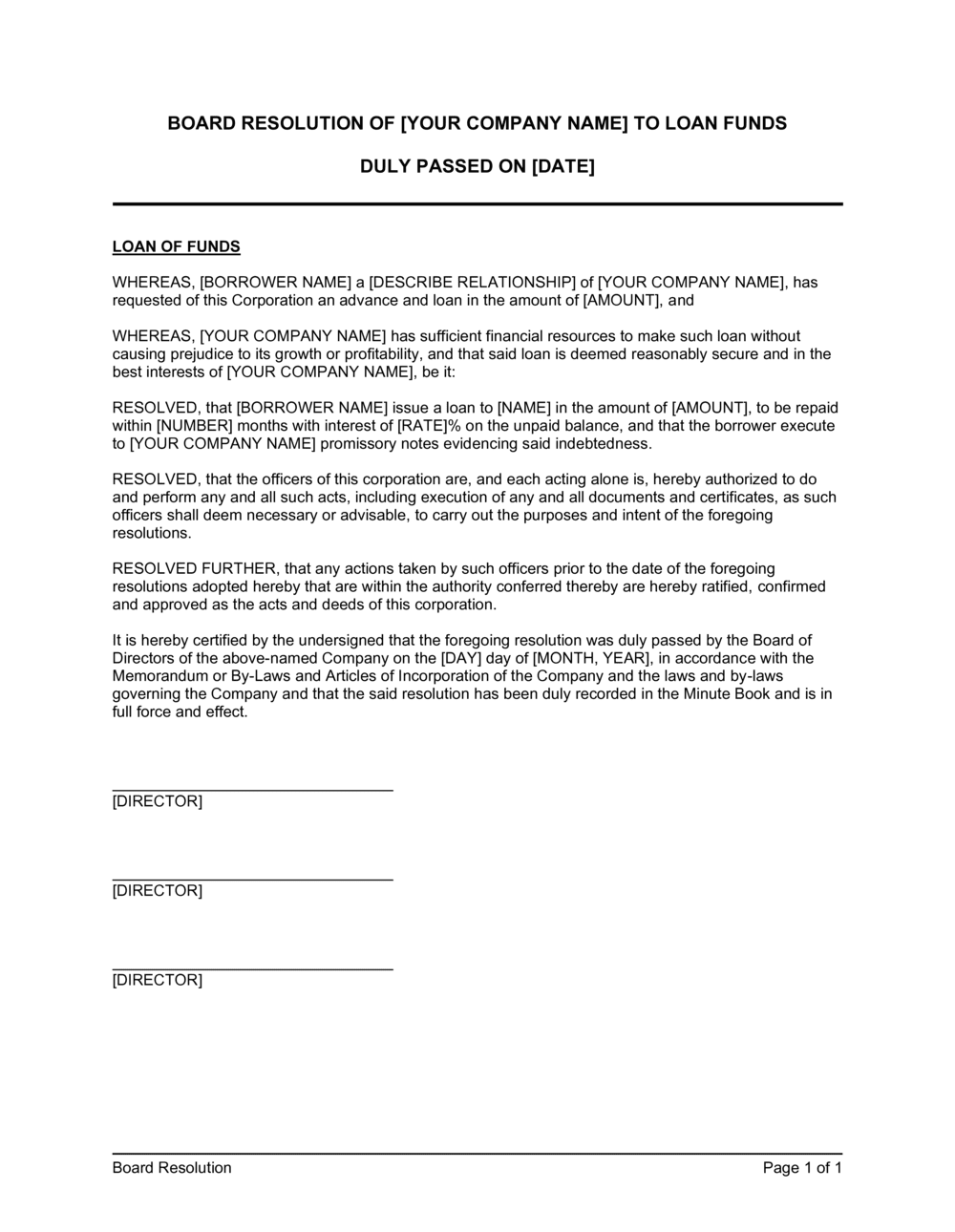
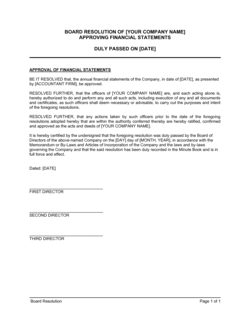
A Board Resolution Approving Loan of Funds is a formal corporate document in which the board of directors officially authorizes the company to borrow a specified sum of money from a named lender on defined terms β€” including principal amount, interest rate, repayment period, and any security or collateral. This free Word download gives you a legally structured starting point you can edit online and export as PDF for bank submission or corporate records in minutes.
When you need it
Use it before closing any commercial loan, line of credit, or inter-company loan where the lender, tax authority, or corporate governance rules require documented board authorization. Banks typically require a certified copy before disbursing funds.
What's inside
Recitals establishing authority, a resolution clause naming the lender and authorizing the specific loan terms, an officer authorization clause designating signatories, security and collateral acknowledgment, a certification block signed by the corporate secretary, and exhibit lines for any attached loan agreement.

What is a Board Resolution Approving Loan of Funds?

A Board Resolution Approving Loan of Funds is a formal corporate governance document in which a company's board of directors officially authorizes the corporation to borrow a specified sum of money from a named lender on defined financial terms β€” including principal amount, interest rate, repayment period, and any collateral or security to be granted. It is not the loan agreement itself; rather, it is the internal corporate authorization that empowers designated officers to execute the loan agreement and all related security documents on the corporation's behalf. Without a properly adopted and certified resolution, the officers signing the loan documents may lack the authority to bind the corporation, potentially rendering the transaction voidable.

Why You Need This Document

Commercial banks and institutional lenders require a certified board resolution as a standard closing condition before disbursing any corporate loan β€” without it, they have no documented evidence that the individual signing the loan agreement was authorized to do so by the governing body. Beyond the lender's requirement, tax authorities in the United States, Canada, and the European Union scrutinize inter-company loans for transfer-pricing compliance, and a board resolution naming the specific rate, term, and use of proceeds is the foundational document that substantiates an arm's-length structure. Skipping the resolution β€” or relying on a vague or undated authorization β€” exposes the company to loan disbursement delays, challenges to the validity of the security interest, and potential recharacterization of related-party advances as taxable dividends. This template gives corporate officers and secretaries a structured, bank-ready starting point that can be customized and certified in under 30 minutes.

Which variant fits your situation?

If your situation is…Use this template
Authorizing a bank to disburse a commercial term loanBoard Resolution Approving Loan of Funds
Authorizing the company to open or expand a line of creditBoard Resolution Approving Line of Credit
Approving a loan made by the company to another entityBoard Resolution Authorizing Loan to Third Party
Documenting an inter-company or shareholder loan for tax purposesIntercompany Loan Agreement
Authorizing a mortgage or real-property security on company assetsBoard Resolution Authorizing Mortgage
Recording all board decisions from a single formal meetingBoard Meeting Minutes
Documenting a shareholder vote to approve major financingShareholders Resolution

Common mistakes to avoid

❌ Authorized amount does not match the loan documents

Why it matters: A resolution authorizing 'up to $500,000' when the loan agreement specifies exactly $500,000 creates an ambiguity that many lenders' legal teams will flag and refuse to accept without amendment.

Fix: State the exact principal amount in both figures and words, matching the loan agreement dollar for dollar before submitting the resolution to the bank.

❌ Resolution signed after the loan closing date

Why it matters: A board resolution ratifying a borrowing after the fact is legally weaker than one adopted before the loan closes, and some jurisdictions and lenders will not accept retroactive authorization.

Fix: Schedule the board meeting or circulate the written consent before the loan is signed, ensuring the effective date of the resolution precedes the loan closing date.

❌ Corporate secretary also named as an authorized signatory

Why it matters: When the certifying officer is also a signatory on the loan, the certification carries less evidentiary weight and some banks require a separate independent certification.

Fix: Where possible, have a director who is not a named authorized signatory serve as corporate secretary and certify the resolution.

❌ No expiry clause on the borrowing authorization

Why it matters: An open-ended resolution can be used by an authorized officer to draw on the credit facility at any future point without returning to the board, creating unauthorized debt.

Fix: Add a 90-day expiry clause β€” or tie expiry to the loan closing date β€” so the authorization lapses automatically if the transaction does not proceed on schedule.

❌ Collateral description mismatches the security agreement

Why it matters: A generic or incomplete collateral description in the resolution that differs from the security agreement can create gaps in the lender's perfected security interest and may be challenged in an insolvency proceeding.

Fix: Copy the collateral description verbatim from the lender's draft security agreement and paste it into the resolution before the resolution is adopted.

❌ Insufficient director signatures for the required threshold

Why it matters: If the bylaws require a supermajority (e.g., two-thirds of directors) for borrowing above a set threshold and only a simple majority signs, the resolution is invalid and the loan may be unenforceable against the corporation.

Fix: Check the borrowing threshold provisions in the bylaws before circulating the resolution and collect signatures from the required number of directors.

The 9 key clauses, explained

Recitals and authority

In plain language: States the company's legal name, the date of the board meeting or consent, and references the provision of the articles or bylaws conferring borrowing authority on the board.

Sample language
WHEREAS, [COMPANY LEGAL NAME] (the 'Corporation'), a [STATE/PROVINCE] [ENTITY TYPE], is duly authorized under its [Articles / Bylaws] to borrow money and incur indebtedness for corporate purposes; and WHEREAS, the Board of Directors has determined that it is in the best interests of the Corporation to borrow the funds described herein;

Common mistake: Omitting the bylaw or articles reference. Without it, the resolution cannot demonstrate that the board had the authority to approve the borrowing in the first place.

Loan authorization

In plain language: The operative resolution clause β€” names the lender, states the exact principal amount, interest rate, and repayment term, and formally authorizes the borrowing.

Sample language
RESOLVED, that the Corporation is hereby authorized to borrow the sum of $[PRINCIPAL AMOUNT] from [LENDER NAME] at an interest rate of [X]% per annum, repayable over [TERM] months commencing [START DATE], on the terms set out in the Loan Agreement attached hereto as Exhibit A.

Common mistake: Stating a range ('up to $500,000') when the bank's commitment letter specifies an exact amount. Lenders routinely reject resolutions where the authorized amount does not match the loan documents dollar for dollar.

Officer authorization

In plain language: Designates specific officers β€” by title and optionally by name β€” who are authorized to execute the loan agreement and any related documents on behalf of the corporation.

Sample language
RESOLVED FURTHER, that [OFFICER TITLE β€” e.g., President] and [OFFICER TITLE β€” e.g., CFO], or either of them acting alone, are hereby authorized and directed to execute and deliver the Loan Agreement, promissory note, and all other instruments required to consummate the borrowing contemplated herein.

Common mistake: Naming only one officer when the bank requires two authorized signatories. Check the bank's corporate resolution form before finalizing this clause.

Security and collateral

In plain language: Identifies any assets pledged as security β€” real property, equipment, accounts receivable, or a general security agreement β€” and authorizes the officers to grant the security interest.

Sample language
RESOLVED FURTHER, that the Corporation is authorized to grant [LENDER NAME] a security interest in [COLLATERAL DESCRIPTION β€” e.g., all present and after-acquired personal property of the Corporation] as security for repayment of the loan, and the authorized officers are directed to execute and register any security documents required by the Lender.

Common mistake: Describing collateral in general terms when the lender's security agreement specifies exact assets. A mismatch between the resolution and the security document creates a gap in the lender's perfected security interest.

Conditions and use of proceeds

In plain language: States the intended purpose of the borrowed funds β€” capital expenditure, working capital, acquisition, or refinancing β€” and any conditions precedent to drawing on the loan.

Sample language
RESOLVED FURTHER, that the proceeds of the loan shall be used solely for [PURPOSE β€” e.g., the acquisition of capital equipment / working capital purposes] and shall not be applied to any other purpose without further board approval.

Common mistake: Leaving the use-of-proceeds clause blank or vague. Tax authorities examining inter-company loans look first at whether proceeds were actually deployed for the stated purpose.

Representations and acknowledgment

In plain language: The board acknowledges that the borrowing does not violate any existing covenant, agreement, or statutory debt limit, and that required shareholder approvals (if any) have been obtained.

Sample language
RESOLVED FURTHER, that the Board hereby represents that the incurrence of this indebtedness does not violate any existing agreement to which the Corporation is a party, any restriction in the Corporation's constating documents, or any applicable statutory limit on corporate borrowing.

Common mistake: Skipping this clause when the company already has outstanding loans with negative-pledge or debt-cap covenants. Borrowing in violation of an existing covenant without lender consent can trigger default on the prior facility.

Effective date and expiry

In plain language: States when the resolution takes effect and, optionally, an expiry date after which the authorization lapses if the loan has not closed.

Sample language
This Resolution is effective as of [DATE] and, unless extended by further board action, the authorization granted herein shall expire [90] days from the effective date if the loan has not closed by that date.

Common mistake: No expiry clause at all. An open-ended authorization can be used by an officer to draw on credit facilities years later without the board's current knowledge.

Certification by corporate secretary

In plain language: The corporate secretary certifies under penalty of perjury that the resolution was duly adopted, that a quorum was present or unanimous written consent was obtained, and that the resolution remains in full force.

Sample language
I, [CORPORATE SECRETARY NAME], Secretary of [COMPANY LEGAL NAME], hereby certify that the foregoing is a true and correct copy of a resolution duly adopted by the Board of Directors at a meeting held on [DATE] at which a quorum was present, or by unanimous written consent, and that said resolution has not been amended or rescinded and remains in full force and effect.

Common mistake: Having an officer other than the corporate secretary certify the resolution. Banks and courts give reduced evidentiary weight to certifications by parties who are also authorized signatories on the loan.

Signature and attestation block

In plain language: Provides dated signature lines for the required number of directors β€” or for all directors in a unanimous written consent β€” along with the corporate secretary's attestation.

Sample language
IN WITNESS WHEREOF, the undersigned, being all [or a majority] of the directors of [COMPANY LEGAL NAME], hereby adopt the foregoing resolution as of [DATE]. [DIRECTOR NAME] ______________ [DIRECTOR NAME] ______________ Certified by: [CORPORATE SECRETARY NAME], Secretary ______________

Common mistake: Collecting only one director's signature when the bylaws require a majority or supermajority for borrowing decisions above a defined threshold.

How to fill it out

  1. 1

    Enter the corporation's legal name and jurisdiction

    Use the exact registered name from your articles of incorporation or certificate of formation β€” not a trade name or abbreviation. Include the state or province of incorporation and the entity type (e.g., Delaware corporation, Ontario corporation).

    πŸ’‘ Cross-reference your corporate registry certificate to confirm spelling and punctuation before populating the template.

  2. 2

    Set the meeting date or written-consent date

    Enter the date the board met to vote on the resolution, or the date on which the last director signed the unanimous written consent. This date is the resolution's effective date and must match the bank's required authorization date.

    πŸ’‘ If the bank's commitment letter specifies a required authorization date, align the resolution date to it β€” even a one-day mismatch can require re-execution.

  3. 3

    Complete the loan authorization clause

    Enter the lender's full legal name, the exact principal amount in figures and words, the annual interest rate, the repayment term in months, and the loan start date. Cross-check each figure against the lender's commitment letter or term sheet.

    πŸ’‘ Match the principal amount, rate, and term dollar-for-dollar and basis-point-for-basis-point to the loan documents β€” any discrepancy will require an amended resolution.

  4. 4

    Name the authorized signatories

    List the officers authorized to sign the loan agreement by their exact corporate titles. If the bank requires two signatories, name both in the officer authorization clause and confirm their authority extends to all related security documents.

    πŸ’‘ Ask the bank for its standard corporate resolution form before finalizing this clause β€” some institutions require specific officer combinations or dual-signature thresholds.

  5. 5

    Describe the collateral

    Identify all assets pledged as security using the same description that will appear in the lender's security agreement or mortgage. For a general security agreement, use 'all present and after-acquired personal property of the Corporation.'

    πŸ’‘ If no collateral is required (unsecured loan), state 'the loan is unsecured' explicitly so the resolution is self-contained.

  6. 6

    State the use of proceeds

    Write a specific one-sentence description of how the borrowed funds will be deployed β€” capital equipment, working capital, acquisition financing, or debt refinancing. Avoid 'general corporate purposes' for inter-company loans subject to tax scrutiny.

    πŸ’‘ For related-party loans, the use-of-proceeds clause is the first thing a tax auditor will examine β€” be precise.

  7. 7

    Have the resolution adopted and certified

    Circulate the resolution for director signatures β€” by meeting vote or unanimous written consent β€” ensuring the required quorum or consent threshold is met. Then have the corporate secretary execute the certification block.

    πŸ’‘ File the certified resolution in the corporate minute book immediately after signing and provide the bank with a certified copy β€” not a photocopy of an uncertified draft.

  8. 8

    Attach the loan agreement as Exhibit A

    Staple or bind the final executed loan agreement to the resolution as the referenced exhibit. If the loan agreement is not yet finalized, note 'form attached' and re-certify when the final version is available.

    πŸ’‘ Some banks require the exhibit to be attached before they will accept the resolution β€” confirm the bank's requirements before scheduling the signing.

Frequently asked questions

What is a board resolution approving a loan of funds?

A board resolution approving a loan of funds is a formal corporate document in which the board of directors authorizes the company to borrow a specific sum of money from a named lender on defined terms β€” principal amount, interest rate, repayment period, and collateral. It is the internal corporate authorization that precedes the external loan agreement and is required by most commercial lenders and tax authorities before funds are disbursed.

Why do banks require a board resolution before releasing loan funds?

Banks need to confirm that the individual signing the loan agreement on behalf of the company has been properly authorized by the governing body β€” the board of directors. Without a certified resolution, the bank cannot be certain the officer had authority to bind the corporation, which could make the loan documents unenforceable. Most commercial lenders include a certified board resolution as a closing condition precedent.

Is a board resolution required for all corporate loans?

In most jurisdictions, a board resolution is required whenever a corporation enters into material indebtedness, as a matter of good corporate governance and lender requirement. The threshold above which a resolution is mandatory is typically set by the company's bylaws or articles. For inter-company loans, tax authorities in Canada, the US, and the EU also expect documented board authorization to substantiate the transaction's arm's-length character.

Can a board resolution be adopted without a formal meeting?

Yes β€” in most jurisdictions, including all US states, Canadian provinces, and the UK, a board resolution can be adopted by unanimous written consent without holding a formal meeting. All directors must sign the written consent document, and it must be filed in the corporate minute book. Some jurisdictions require the articles or bylaws to expressly permit written consent in lieu of a meeting.

What is the difference between a board resolution and a corporate authorization letter?

A board resolution is a formal governance document adopted by the full board and certified by the corporate secretary β€” it creates binding corporate authority. A corporate authorization letter is typically signed by a single officer and is used for routine operational matters. For commercial borrowing, lenders require a board resolution, not just an authorization letter, because a resolution demonstrates that the governing body β€” not just an individual officer β€” approved the transaction.

How should the certified resolution be delivered to the bank?

Provide the bank with a certified copy of the resolution β€” meaning a copy that includes the corporate secretary's executed certification block attesting that it is a true and accurate copy of the original. Most banks also require the company's corporate seal (where applicable) on the certified copy. Deliver it as part of the loan closing package, typically before or simultaneously with the execution of the loan agreement.

Do inter-company loans require a separate board resolution?

Yes β€” inter-company loans between a parent company and its subsidiary, or between affiliated entities, require a board resolution from the borrowing entity's board in most jurisdictions. Tax authorities in the US (IRS), Canada (CRA), and the EU treat the resolution as evidence that the loan was made on arm's-length commercial terms, which is required to avoid the borrowing being recharacterized as a dividend or equity contribution.

How long should the authorization remain valid?

Most practitioners include a 90-day expiry clause tied to the expected loan closing date. If the transaction does not close within that window, the board should re-adopt the resolution rather than rely on an authorization that is months old. For revolving credit facilities with no fixed closing date, an annual renewal of the resolution is a common best practice.

Does the resolution need to be filed with a government registry?

In most jurisdictions β€” including US states, Canadian provinces, and the UK β€” a board resolution approving a loan is an internal corporate document and does not need to be filed with a government registry. However, any security documents authorized by the resolution (such as a UCC financing statement, PPSA registration, or mortgage) must be registered with the appropriate registry to perfect the lender's security interest.

How this compares to alternatives

vs Board Meeting Minutes

Board meeting minutes are a comprehensive narrative record of everything discussed and decided at a full board meeting, including routine business, reports, and multiple resolutions. A board resolution approving a loan is a single-purpose document focused on one specific authorization. Banks and lenders prefer the standalone resolution because it is unambiguous and easy to certify without disclosing unrelated board deliberations.

vs Shareholders Resolution

A shareholders resolution records a decision made by the company's shareholders β€” the owners β€” rather than the directors. Some jurisdictions and corporate bylaws require shareholder approval for borrowings above a material threshold or for secured debt against all company assets. A board resolution and a shareholder resolution may both be required for the same loan transaction.

vs Loan Agreement

The loan agreement is the binding contract between the lender and the borrower setting out all commercial and legal terms β€” repayment schedule, covenants, events of default, and remedies. The board resolution is the internal corporate authorization that empowers the company's officers to sign and perform that agreement. The resolution precedes the agreement; without it, the agreement may be voidable.

vs Promissory Note

A promissory note is a written promise by the borrower to repay a specific sum on defined terms β€” it is the debt instrument itself. A board resolution authorizes the corporation to issue or execute the promissory note. The note evidences the debt to the lender; the resolution demonstrates the corporation had board-level authority to incur it.

Industry-specific considerations

Real estate and property development

Resolutions for construction loans and mortgage financing must describe the specific property as collateral and reference any related security or title documents being executed concurrently.

Manufacturing

Equipment financing and capex loans require the resolution to authorize both the borrowing and any purchase-money security interest granted over the financed machinery.

Technology / SaaS

Venture debt and revenue-based financing arrangements often require resolutions that authorize not only the principal loan but also any warrant coverage or material adverse change covenants embedded in the facility.

Professional services

Working capital lines of credit secured by accounts receivable require the resolution to authorize a general security agreement and, in Canada, PPSA registration against the receivables pool.

Jurisdictional notes

United States

State corporation statutes (e.g., DGCL for Delaware, NYBCL for New York) govern board authority to authorize debt. The bylaws typically set the threshold above which board approval is required. For secured loans, the lender must file a UCC-1 financing statement to perfect its security interest β€” the resolution should authorize both the borrowing and the UCC filing. Some states require a corporate seal on the certified resolution, though this requirement has been relaxed in most modern statutes.

Canada

The Canada Business Corporations Act (CBCA) and provincial equivalents (e.g., OBCA in Ontario) require that borrowing authority be set out in the articles or delegated to the board by shareholder resolution. The lender typically requires a PPSA registration against collateral, and the board resolution should authorize the officers to execute and register all PPSA documents. For Quebec entities under the QBCA, the resolution and any security documents may need to be in French or bilingual form.

United Kingdom

Under the Companies Act 2006, directors' authority to borrow is typically set by the articles of association, which may impose a borrowing limit requiring shareholder approval if exceeded. The board resolution should reference the relevant article. Charges over company assets must be registered at Companies House within 21 days of creation β€” the resolution should authorize the officers to execute and register the particulars of the charge.

European Union

Corporate authorization requirements for borrowing vary significantly by member state β€” German GmbH rules differ materially from French SAS or Dutch BV requirements. For inter-company loans within EU corporate groups, transfer-pricing documentation must support the arm's-length rate, and a board resolution naming the rate and term is a foundational element of that documentation. GDPR considerations are generally not relevant to this document type, but some member states require public filing of security interests in a national register.

Template vs lawyer β€” what fits your deal?

PathBest forCostTime
Use the templateStandard commercial bank loans for established corporations with straightforward security and a single domestic lenderFree15–30 minutes
Template + legal reviewInter-company loans subject to transfer-pricing scrutiny, secured debt above $500K, or borrowings involving covenant restrictions in existing facilities$300–$8001–2 business days
Custom draftedComplex multi-lender facilities, cross-border secured lending, or transactions where the resolution must satisfy the requirements of multiple jurisdictions simultaneously$1,000–$3,500+3–7 business days

Glossary

Board Resolution
A formal written record of a decision made by a company's board of directors, binding on the corporation when properly adopted and documented.
Principal Amount
The face value of the loan β€” the sum actually borrowed, excluding interest, fees, or penalties.
Authorized Signatory
An officer or director named in the resolution who has board-granted authority to sign loan documents on behalf of the corporation.
Corporate Secretary Certification
A statement signed by the corporate secretary confirming that the resolution was duly adopted by the board and accurately reflects the board's decision.
Security / Collateral
An asset pledged by the borrower to the lender as security for repayment; if the borrower defaults, the lender may seize or sell the collateral.
Quorum
The minimum number of directors who must be present and voting for a board meeting β€” or action by written consent β€” to produce a valid resolution.
Inter-Company Loan
A loan made between two related entities β€” such as a parent corporation and its subsidiary β€” requiring documented authorization and arm's-length terms to satisfy tax authorities.
Unanimous Written Consent
A method of adopting a board resolution without a formal meeting, where all directors sign a written consent document approving the resolution.
Term
The agreed repayment period of the loan β€” typically expressed in months or years β€” after which the outstanding principal and accrued interest are due in full.
Arm's-Length Terms
Loan conditions (rate, term, security) that reflect what unrelated parties would negotiate in an open market, required by tax authorities to avoid imputed interest or deemed dividends on related-party loans.

Part of your Business Operating System

This document is one of 3,000+ business & legal templates included in Business in a Box.

  • Fill-in-the-blanks β€” ready in minutes
  • 100% customizable Word document
  • Compatible with all office suites
  • Export to PDF and share electronically

Create your document in 3 simple steps.

From template to signed document β€” all inside one Business Operating System.
1
Download or open template

Access over 3,000+ business and legal templates for any business task, project or initiative.

2
Edit and fill in the blanks with AI

Customize your ready-made business document template and save it in the cloud.

3
Save, Share, Send, Sign

Share your files and folders with your team. Create a space of seamless collaboration.

Save time, save money, and create top-quality documents.

β˜…β˜…β˜…β˜…β˜…

"Fantastic value! I'm not sure how I'd do without it. It's worth its weight in gold and paid back for itself many times."

Managing Director Β· Mall Farm
Robert Whalley
Managing Director, Mall Farm Proprietary Limited
β˜…β˜…β˜…β˜…β˜…

"I have been using Business in a Box for years. It has been the most useful source of templates I have encountered. I recommend it to anyone."

Business Owner Β· 4+ years
Dr Michael John Freestone
Business Owner
β˜…β˜…β˜…β˜…β˜…

"It has been a life saver so many times I have lost count. Business in a Box has saved me so much time and as you know, time is money."

Owner Β· Upstate Web
David G. Moore Jr.
Owner, Upstate Web

Run your business with a system β€” not scattered tools

Stop downloading documents. Start operating with clarity. Business in a Box gives you the Business Operating System used by over 250,000 companies worldwide to structure, run, and grow their business.

Free Forever PlanΒ Β·Β No credit card required