Board Resolution Approving Grant of Options Template

Free Word download • Edit online • Save & share with Drive • Export to PDF

1 page20–30 min to fillDifficulty: StandardSignature requiredLegal review recommended
Learn more ↓
FreeBoard Resolution Approving Grant of Options Template

At a glance

What it is
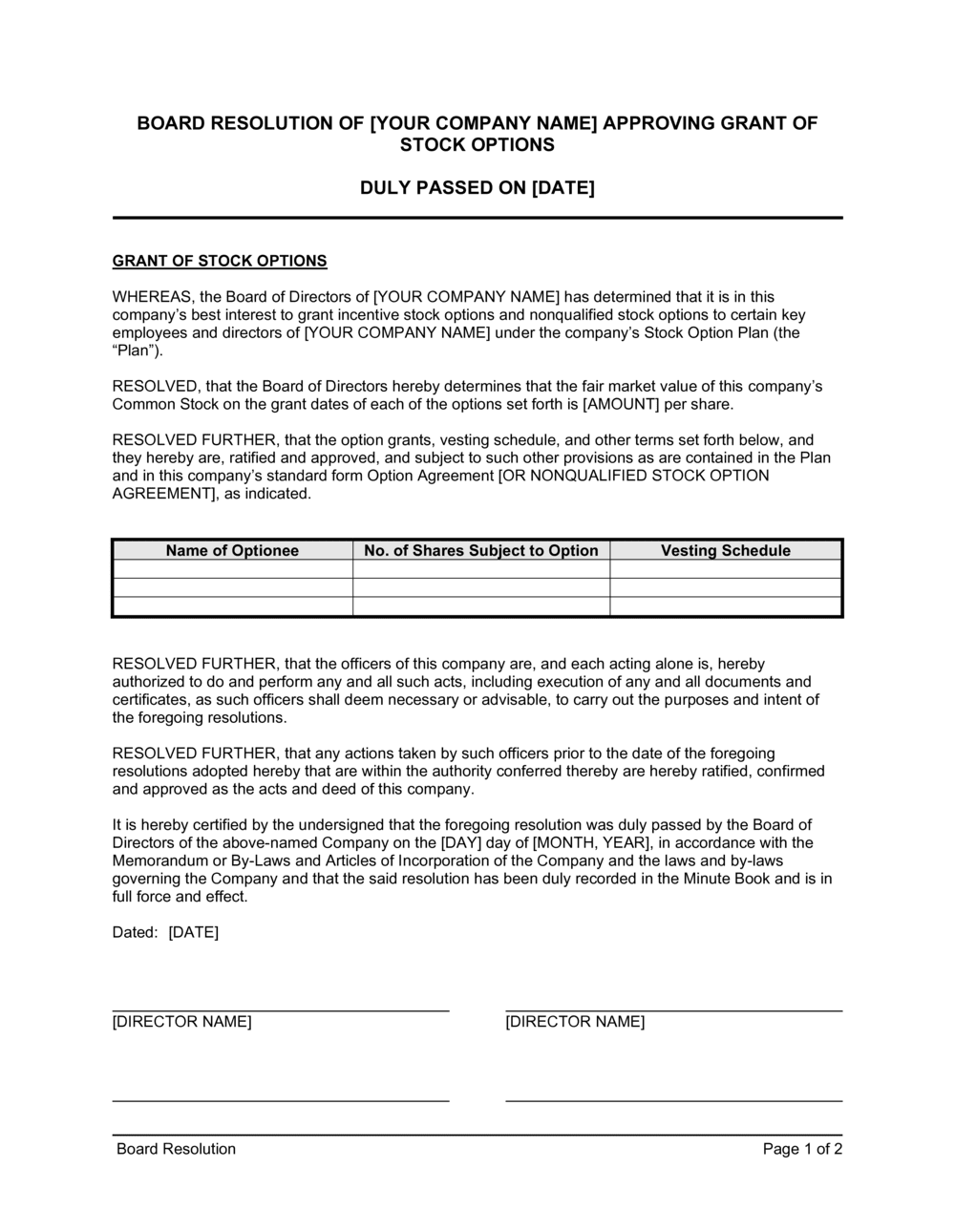
A Board Resolution Approving Grant of Options is a formal corporate document recording the board of directors' authorized decision to grant stock options to one or more recipients under an equity incentive plan. This free Word download captures every required element — grantee identity, number of options, exercise price, vesting schedule, and plan authority — in a format you can edit online and export as PDF for execution and filing.
When you need it
Use it every time your company grants stock options to employees, consultants, or directors, since most equity incentive plans and securities laws require documented board approval before or at the time of each grant. Without it, the grant date and exercise price can be legally disputed, triggering adverse tax consequences and regulatory liability.
What's inside
Recitals identifying the authorizing plan, operative resolutions setting each grantee's name, option count, grant date, exercise price, and vesting terms, an authorization clause empowering officers to execute grant agreements, and a signature or consent block for all approving directors.

What is a Board Resolution Approving Grant of Options?

A Board Resolution Approving Grant of Options is a formal corporate authorization document by which a company's board of directors records its decision to issue stock options to one or more recipients under an existing equity incentive plan. It establishes the legally binding grant date, sets the exercise price at fair market value, identifies each grantee and the number of options awarded, and defines the vesting schedule — creating the complete record required before any individual option agreement can be executed. Unlike informal board discussions or offer-letter mentions of equity, this resolution provides the documented corporate authority that securities laws, tax regulations, and equity incentive plans require as a precondition to a valid grant.

Why You Need This Document

Every option grant without a properly executed board resolution is legally exposed on multiple fronts simultaneously. The IRS requires the grant date and exercise price to be formally documented; a missing or reconstructed resolution invites IRC Section 409A penalties — a 20% excise tax plus interest on the full option spread, borne by the employee. In an M&A transaction, acquirers routinely walk away from or reprice deals where the option history contains undocumented grants, gaps in the minute book, or inconsistent grant dates. Without this resolution, your cap table is unverifiable, your 409A compliance is indefensible, and every grantee you have ever issued options to faces potential tax liability. A properly executed board resolution, filed in the corporate minute book and reflected in your cap table software, closes all of these risks for the cost of 30 minutes and a lawyer review when the stakes justify it.

Which variant fits your situation?

If your situation is…Use this template
Granting options to a single executive with non-standard vestingBoard Resolution Approving Grant of Options (Individual)
Approving a broad annual option pool refresh for all employeesBoard Resolution Approving Grant of Options (Annual Pool)
Issuing restricted stock units instead of optionsBoard Resolution Approving Grant of RSUs
Amending a previously approved option grantBoard Resolution Amending Stock Option Grant
Adopting or amending the underlying equity incentive planBoard Resolution Adopting Stock Option Plan
Documenting board consent without a formal meetingWritten Consent of the Board of Directors
Recording a board meeting at which options were among multiple agenda itemsBoard Meeting Minutes

Common mistakes to avoid

❌ Using a stale 409A valuation to set the exercise price

Why it matters: An exercise price below FMV on the grant date triggers IRC Section 409A excise taxes — a 20% penalty plus interest on the full spread, borne by the employee, not the company.

Fix: Obtain a new 409A appraisal if the existing one is more than 12 months old or if a material event (new financing, acquisition offer) has occurred since the last valuation.

❌ Backdating the grant date to a lower valuation period

Why it matters: Setting a grant date earlier than the actual board approval date to capture a lower stock price constitutes securities fraud and exposes directors and the company to criminal liability and SEC enforcement.

Fix: The grant date is the date the board formally approves the grants — no earlier. Document the approval with a timestamped signature or meeting minutes.

❌ Granting ISOs to non-employees

Why it matters: ISO status under IRC Section 422 is limited to employees. Options granted to contractors, advisors, or board members who are not employees are NSOs by law, regardless of how the resolution labels them.

Fix: Review each grantee's employment status before designating an option as an ISO. Mislabeled ISOs create tax reporting errors for both the company and the recipient.

❌ Executing the resolution after delivering grant agreements to employees

Why it matters: If employees receive and sign grant agreements before board approval, the grant date is disputed — potentially resulting in a discounted exercise price and Section 409A exposure.

Fix: Board approval must occur on or before the date grant agreements are delivered. Use a written consent in lieu of meeting to approve grants quickly when a board meeting cannot be convened in time.

❌ Omitting the ISO $100,000 annual vesting cap check

Why it matters: Options vesting in excess of $100,000 in a calendar year automatically convert from ISOs to NSOs, triggering ordinary income tax treatment on the excess — an outcome the employee almost never anticipates.

Fix: For each ISO grant, calculate the FMV of shares vesting in each calendar year. If it exceeds $100,000, split the grant into an ISO tranche and an NSO tranche at the time of the board resolution.

❌ Failing to attach or reference the form of option agreement

Why it matters: A resolution that authorizes grants but does not reference a specific form agreement leaves officers with no clear authority on the terms they can offer grantees, creating inconsistency across grants.

Fix: Attach the form of option agreement as an exhibit to the resolution, or reference the specific previously-approved form by name and date so there is no ambiguity about which document governs.

The 10 key clauses, explained

Recitals and Plan Authority

In plain language: Identifies the company, states that the board has previously adopted an equity incentive plan, and confirms the plan has sufficient shares available for the grants being approved.

Sample language
WHEREAS, [COMPANY NAME] (the 'Company') has previously adopted the [PLAN NAME] (the 'Plan'), under which [NUMBER] shares of Common Stock remain available for future awards as of [DATE];

Common mistake: Failing to verify the available share count before the resolution is signed. If the plan reserve is exhausted, any purported grant is void until additional shares are authorized.

Identification of Grantees and Grant Terms

In plain language: Lists each recipient by name and title, the number of options granted, the grant date, and whether each option is an ISO or NSO.

Sample language
RESOLVED, that the Company hereby grants to [GRANTEE NAME], [TITLE], a stock option to purchase [NUMBER] shares of Common Stock, designated as [ISO / NSO], effective [GRANT DATE];

Common mistake: Listing grantees in an attached exhibit that is never signed or attached to the executed resolution — creating a gap between the resolution and the cap table record.

Exercise Price and FMV Determination

In plain language: Sets the per-share exercise price and references the FMV determination supporting it — typically the most recent 409A valuation or board-determined FMV for early-stage companies.

Sample language
RESOLVED, that the exercise price per share shall be $[PRICE], which the Board hereby determines to be not less than the fair market value of the Common Stock on the Grant Date, as supported by [409A VALUATION REPORT / BOARD DETERMINATION] dated [DATE];

Common mistake: Backdating or omitting the exercise price entirely and filling it in later. The IRS requires the price to equal FMV on the grant date; a blank or altered exercise price triggers Section 409A penalties.

Vesting Schedule and Acceleration Provisions

In plain language: Defines the vesting timeline for each grant — typically a four-year schedule with a one-year cliff — and states any conditions under which unvested options accelerate, such as a change of control.

Sample language
RESOLVED, that the option shall vest as follows: 25% of the shares shall vest on the one-year anniversary of [VESTING COMMENCEMENT DATE], with the remaining 75% vesting in equal monthly installments over the following 36 months, subject to continued service;

Common mistake: Setting a vesting commencement date that differs from the grant date without documenting why. Auditors and acquirers flag unexplained retroactive vesting commencement dates as potential backdating.

Option Term and Expiration

In plain language: States the maximum period during which the option may be exercised — usually 10 years from the grant date for ISOs — and the shorter post-termination exercise window.

Sample language
RESOLVED, that the option shall expire on the earlier of [10 years] from the Grant Date or [90 days / 1 year] following the optionee's termination of service, as further described in the Option Agreement;

Common mistake: Extending ISO post-termination exercise windows beyond 90 days for most separations. A window exceeding 90 days automatically converts an ISO to an NSO, eliminating the favorable tax treatment.

Authorization to Execute Grant Agreements

In plain language: Empowers one or more named officers to sign individual option agreements with each grantee on terms consistent with the plan and this resolution.

Sample language
RESOLVED, that the [CEO / CFO / General Counsel] of the Company is hereby authorized and directed to execute and deliver an Option Agreement to each grantee in the form previously approved by the Board, with such modifications as the authorized officer deems appropriate;

Common mistake: Authorizing 'any officer' without naming a title. If disputed, an unnamed authorization creates ambiguity about who had actual authority to bind the company at the time of execution.

Tax Compliance and Plan Conditions

In plain language: Confirms that ISO grants comply with IRC Section 422 eligibility requirements, including the $100,000 ISO annual vesting cap, and subjects all grants to the plan's terms.

Sample language
RESOLVED, that each ISO grant is intended to qualify as an 'incentive stock option' under Section 422 of the Internal Revenue Code, and the aggregate fair market value of shares subject to ISOs vesting in any calendar year shall not exceed $100,000 per optionee;

Common mistake: Ignoring the $100,000 ISO annual vesting cap when issuing large grants to executives. Options vesting above the cap in any year automatically become NSOs, creating unexpected tax consequences for the recipient.

Cap Table and Records Update

In plain language: Directs the company's officers or equity administrator to update the capitalization table and stock ledger to reflect each approved grant.

Sample language
RESOLVED, that the officers of the Company are hereby directed to update the Company's capitalization table and option register to reflect each grant approved by this resolution, and to provide each grantee with a copy of their executed Option Agreement;

Common mistake: Treating the resolution as the cap table update itself. The resolution is authorization — a separate cap table entry, usually in software like Carta or Pulley, must still be created for each grantee.

Ratification of Prior Actions

In plain language: Ratifies any preparatory actions taken by officers before the resolution was formally executed, such as notifying grantees or preparing grant agreements.

Sample language
RESOLVED, that all actions taken by officers of the Company prior to the adoption of these resolutions in furtherance of the purposes hereof are hereby ratified, confirmed, and approved in all respects;

Common mistake: Omitting ratification language when offer letters or grant agreements were delivered before board approval — leaving a gap between the employee's expectation and the company's formal authorization.

Director Signatures or Written Consent

In plain language: Records the approval by the required number of directors — either as signatures in a written consent in lieu of meeting or as an entry in formal meeting minutes.

Sample language
IN WITNESS WHEREOF, the undersigned, being all of the directors of [COMPANY NAME], hereby consent to the foregoing resolutions as of [DATE]. [DIRECTOR NAME]: _______________ [DIRECTOR NAME]: _______________

Common mistake: Collecting only one director's signature when the bylaws or plan require majority or unanimous consent. A resolution executed below the required quorum threshold is invalid.

How to fill it out

  1. 1

    Confirm plan availability and share reserve

    Before drafting the resolution, verify how many shares remain available in the equity incentive plan. Check the plan document, current cap table, and any prior grant records to confirm the pool is sufficient for all grants being approved.

    💡 Pull an option activity report from your cap table software — outstanding grants plus this grant cannot exceed the total authorized pool without a plan amendment.

  2. 2

    Obtain or confirm the current 409A valuation

    The exercise price must equal fair market value on the grant date. Confirm you have a current 409A appraisal — most firms treat a valuation as stale after 12 months or after a material event such as a funding round.

    💡 If you are within 30 days of completing a new financing round, wait until the round closes and obtain a new 409A before granting options — the pre-round valuation may not reflect post-round FMV.

  3. 3

    Complete the grantee schedule

    Enter each grantee's full legal name, title, number of options, ISO or NSO designation, and individual vesting commencement date. If attaching a schedule, ensure it is physically attached and cross-referenced in the resolution body.

    💡 ISO grants are only available to employees — any grant to a consultant, advisor, or director who is not also an employee must be designated as an NSO.

  4. 4

    Set the exercise price and grant date

    Enter the exact per-share exercise price drawn from the 409A report or board determination, and confirm the grant date as the date the board is approving or has approved the grants — not a future or retroactive date.

    💡 Never leave the exercise price blank to fill in later. A missing or altered exercise price on a signed resolution is a red flag in any M&A due diligence and can trigger Section 409A penalties.

  5. 5

    Define vesting terms and any acceleration triggers

    State the vesting commencement date, cliff period, and monthly or quarterly vesting cadence for each grant. If any grant includes double-trigger or single-trigger acceleration on a change of control, state it explicitly here or reference the grant agreement section that governs it.

    💡 Use the same vesting commencement date language in the resolution and the individual option agreement to prevent contradictions between the two documents.

  6. 6

    Name the authorized officer and attach the form agreement

    Identify the specific officer title — CEO, CFO, or General Counsel — authorized to execute grant agreements. Confirm the form of option agreement to be used is already board-approved or attach it as an exhibit.

    💡 If the form agreement has not been previously approved by the board, include a separate resolution approving the form in the same document to avoid a second consent.

  7. 7

    Circulate for director signatures

    Send the resolution to all required directors for signature. Check your bylaws and plan for the required approval threshold — many plans require unanimous consent or majority approval of the full board, not just those present at a meeting.

    💡 Use a dated electronic signature platform so each director's signature is timestamped, which locks the grant date and prevents any later dispute about when approval occurred.

  8. 8

    Update the cap table and distribute grant agreements

    Once the resolution is fully executed, enter each grant in your cap table software and deliver a countersigned option agreement to each grantee within 30 days of the grant date.

    💡 File the executed resolution in the corporate minute book and store a copy in your equity management platform — due diligence in any acquisition will request both.

Frequently asked questions

What is a board resolution approving grant of options?

A board resolution approving grant of options is a formal corporate document recording the board of directors' decision to issue stock options to one or more recipients. It establishes the legally binding grant date, exercise price, vesting terms, and option type (ISO or NSO), and authorizes officers to execute individual grant agreements. Most equity incentive plans and securities laws require this resolution before any option grant is legally effective.

Why does a board resolution need to be created for every option grant?

Stock option grants are corporate actions that affect the company's capitalization and create contractual obligations to optionees. Equity incentive plans typically require board (or compensation committee) approval for each grant, and securities laws in most jurisdictions require the grant date and exercise price to be formally documented. Without a resolution, the grant date and FMV determination are legally uncertain, which can void the grant or trigger tax penalties.

What is the difference between an ISO and an NSO in a board resolution?

An ISO (Incentive Stock Option) qualifies for preferential tax treatment under IRC Section 422 — no ordinary income tax at grant or exercise if holding periods are met. An NSO (Non-Qualified Stock Option) is taxed as ordinary income to the recipient at exercise on the spread between the exercise price and FMV. ISOs can only be granted to employees; NSOs can be granted to anyone. The resolution must correctly designate each grant to avoid unintended tax consequences for the recipient.

What is a 409A valuation and why is it required?

A 409A valuation is an independent appraisal of a private company's common stock fair market value, required by IRC Section 409A as the basis for setting option exercise prices. Without a current 409A, any exercise price below actual FMV triggers a 20% excise tax plus interest on the full spread — payable by the employee. Most companies obtain a 409A annually or after each material funding event, and the resolution should reference the specific appraisal report used.

Can a board resolution for options be approved without a meeting?

Yes. Most corporate statutes — including the Delaware General Corporation Law and equivalent statutes in most US states, Canadian provinces, and the UK — permit the board to act by written consent in lieu of meeting, provided all required directors (or the required majority, per the bylaws) sign the consent. Using a written consent is common for option grants where time-sensitive grant dates must be locked without scheduling a full board meeting.

How does the board resolution relate to the individual option agreement?

The board resolution is the authorization document — it records the corporate decision and sets the material terms. The individual option agreement is the contract between the company and each grantee that incorporates those terms in detail, along with exercise procedures, transfer restrictions, and tax representations. Both documents are needed: the resolution for the corporate record and regulatory compliance, the option agreement to create enforceable rights between the parties.

What happens if the exercise price is set below fair market value?

An exercise price below FMV on the grant date causes the option to be treated as a deferred compensation arrangement under IRC Section 409A. The recipient owes a 20% excise tax plus interest on the full spread (FMV minus exercise price) for the year the option vests — not when it is exercised — in addition to ordinary income tax. The company may also face payroll tax exposure and securities law issues if the discounted grant was not properly disclosed.

Do shareholders need to approve individual option grants?

Shareholders typically do not vote on individual grants. They approve the equity incentive plan itself (the total share reserve and rules), and board approval is then sufficient for individual grants made within the plan's parameters. However, grants to directors or related parties may require separate shareholder approval or compensation committee oversight under exchange listing rules if the company is publicly traded.

How long should a board resolution for options be retained?

Option-related board resolutions should be retained indefinitely — or at a minimum for the life of the option plus the applicable statute of limitations for tax and securities claims, typically 7–10 years after the option expires or is exercised. In practice, these records are critical for M&A due diligence, and most acquirers request the full grant history back to inception. Store executed resolutions in the corporate minute book and your equity management platform.

How this compares to alternatives

vs Board Meeting Minutes

Board meeting minutes record the proceedings of a formal board meeting at which many items — including option grants — may have been discussed and voted on. A standalone board resolution is a focused document approving a single action, often executed as a written consent without a meeting. For option grants, a dedicated resolution is cleaner for the corporate record and easier to locate during due diligence.

vs Written Consent of the Board of Directors

A written consent in lieu of meeting is the procedural vehicle by which directors approve resolutions without convening. The Board Resolution Approving Grant of Options is the substantive content — the specific decisions being made. In practice, the two documents are often merged: the resolution text is embedded in the written consent, signed by all required directors.

vs Stock Option Agreement

A stock option agreement is the bilateral contract between the company and each individual grantee, governing the mechanics of exercise, vesting, transfer restrictions, and tax elections. The board resolution is the company's internal authorization that must precede or coincide with the option agreement. Neither document substitutes for the other: the resolution proves board authority; the agreement creates enforceable rights.

vs Equity Incentive Plan

The equity incentive plan is the foundational shareholder-approved document that establishes the total share reserve, eligible recipients, and rules for all awards. The board resolution operates under the plan's authority, approving specific grants within its parameters. If the plan has not been adopted, the resolution has no legal foundation — the plan comes first.

Industry-specific considerations

Technology / SaaS

Annual option refresh cycles tied to performance reviews, large executive grants with double-trigger acceleration, and frequent 409A updates driven by rapid valuation growth between funding rounds.

Biotech and Life Sciences

Long vesting timelines aligned to clinical development milestones, grants to scientific advisory board members as NSOs, and heightened SEC scrutiny of grant timing relative to data disclosures for public companies.

Financial Services and Fintech

Regulatory restrictions on equity grants to licensed personnel, clawback provisions tied to regulatory capital requirements, and compensation committee sign-off required for grants above defined thresholds.

Professional Services

Option grants used to retain senior partners and key contributors without diluting equity in early stages, with NSO structures common for non-employee service providers and advisory roles.

Jurisdictional notes

United States

IRC Section 409A requires exercise prices to equal FMV on the grant date, enforced through a 409A valuation for private companies. ISO eligibility under IRC Section 422 is limited to employees, with a $100,000 annual vesting cap. Delaware corporations — the most common issuer jurisdiction — permit written consents in lieu of meeting under DGCL Section 141(f), making resolutions by consent routine. State securities (Blue Sky) laws generally exempt option grants to employees under Rule 701 or equivalent state exemptions.

Canada

Canadian private corporations most commonly issue stock options under agreements governed by the Canada Business Corporations Act or provincial equivalents. There is no IRC Section 409A equivalent, but exercise prices below FMV on the grant date create an employment benefit taxable at exercise under the Income Tax Act. The stock option deduction (analogous to ISO treatment) is available for qualifying CCPCs if the exercise price equals FMV at grant. Quebec requires corporate documents affecting employee compensation to comply with French-language requirements for provincially regulated employers.

United Kingdom

UK private companies frequently use HMRC-approved Enterprise Management Incentive (EMI) schemes, which require a formal board resolution and HMRC notification within 92 days of grant. Exercise prices must equal or exceed the agreed market value confirmed with HMRC. Non-EMI options are subject to income tax and National Insurance Contributions on the spread at exercise. Board resolutions must be consistent with the company's articles of association and the Companies Act 2006 requirements for director decisions.

European Union

EU member states have no unified stock option taxation framework — treatment varies significantly across France (BSPCE and AGA schemes with preferential rates), Germany (taxed at exercise as employment income), and the Netherlands (taxed at vest or exercise depending on structure). Cross-border grants to EU employees require analysis of each country's individual rules. GDPR applies to any personal data processed in connection with grant administration, including grantee records and option registers. Board approval requirements follow the national corporate law of the company's country of incorporation.

Template vs lawyer — what fits your deal?

PathBest forCostTime
Use the templateEarly-stage startups granting standard options to employees under a previously adopted and counsel-reviewed equity planFree30–45 minutes per grant event
Template + legal reviewCompanies making grants to executives, international employees, or recipients with non-standard vesting terms$300–$800 for a startup attorney review1–3 days
Custom draftedPublic companies, late-stage pre-IPO companies, regulated industries, or grants involving complex acceleration, clawback, or cross-border tax issues$1,500–$5,000+ depending on complexity1–2 weeks

Glossary

Grant Date
The specific date on which the board formally approves the option, establishing the measurement date for the exercise price and accounting expense.
Exercise Price (Strike Price)
The per-share price the option holder must pay to purchase stock, which must equal or exceed fair market value on the grant date to avoid adverse tax treatment.
Fair Market Value (FMV)
The price at which stock would change hands between a willing buyer and a willing seller, determined by a 409A valuation for private companies.
409A Valuation
An independent appraisal of a private company's common stock value, required by IRC Section 409A to set a defensible exercise price and avoid excise tax penalties.
Vesting Schedule
The timeline over which an optionee earns the right to exercise granted options, most commonly a four-year schedule with a one-year cliff.
Cliff Vesting
A vesting structure in which no options vest until a defined date (the cliff), after which a block of options vests at once and the remainder vest monthly or quarterly.
ISO (Incentive Stock Option)
A type of employee stock option that qualifies for preferential US tax treatment under IRC Section 422, subject to holding period and eligibility requirements.
NSO (Non-Qualified Stock Option)
A stock option that does not qualify for ISO treatment; the spread at exercise is taxed as ordinary income to the recipient and is deductible by the company.
Equity Incentive Plan
The shareholder-approved plan document that authorizes the number of shares reserved for grants, eligible recipients, and the rules governing all awards made under it.
Option Pool
The total number of shares reserved under an equity incentive plan for issuance upon exercise of granted options, expressed as a percentage of fully-diluted shares.
Written Consent in Lieu of Meeting
A mechanism allowing directors to approve resolutions by signing a written document rather than convening a physical or virtual meeting, permitted by most corporate statutes.

Part of your Business Operating System

This document is one of 3,000+ business & legal templates included in Business in a Box.

  • Fill-in-the-blanks — ready in minutes
  • 100% customizable Word document
  • Compatible with all office suites
  • Export to PDF and share electronically

Create your document in 3 simple steps.

From template to signed document — all inside one Business Operating System.
1
Download or open template

Access over 3,000+ business and legal templates for any business task, project or initiative.

2
Edit and fill in the blanks with AI

Customize your ready-made business document template and save it in the cloud.

3
Save, Share, Send, Sign

Share your files and folders with your team. Create a space of seamless collaboration.

Save time, save money, and create top-quality documents.

★★★★★

"Fantastic value! I'm not sure how I'd do without it. It's worth its weight in gold and paid back for itself many times."

Managing Director · Mall Farm
Robert Whalley
Managing Director, Mall Farm Proprietary Limited
★★★★★

"I have been using Business in a Box for years. It has been the most useful source of templates I have encountered. I recommend it to anyone."

Business Owner · 4+ years
Dr Michael John Freestone
Business Owner
★★★★★

"It has been a life saver so many times I have lost count. Business in a Box has saved me so much time and as you know, time is money."

Owner · Upstate Web
David G. Moore Jr.
Owner, Upstate Web

Run your business with a system — not scattered tools

Stop downloading documents. Start operating with clarity. Business in a Box gives you the Business Operating System used by over 250,000 companies worldwide to structure, run, and grow their business.

Start free · No credit card required