Board Resolution Affirming Non-Discrimination Policy Template

Free Word download β€’ Edit online β€’ Save & share with Drive β€’ Export to PDF

1 pageβ€’20–25 min to fillβ€’Difficulty: Standard
Learn more ↓
FreeBoard Resolution Affirming Non-Discrimination Policy Template

At a glance

What it is
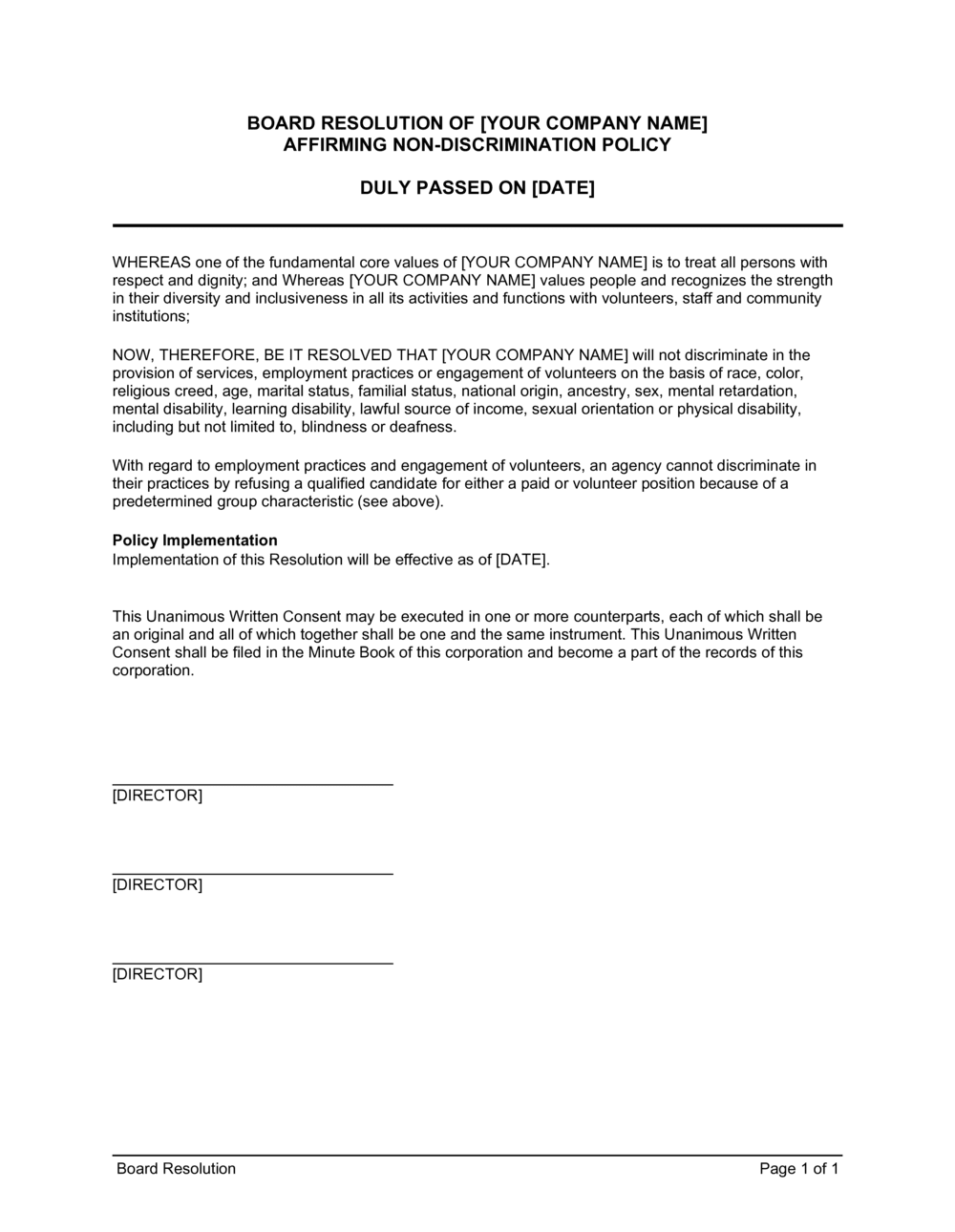
A Board Resolution Affirming Non-Discrimination Policy is a formal document by which an organization's board of directors officially adopts and ratifies the company's commitment to equal treatment across all protected classes. This free Word download provides a structured, board-ready template you can edit online and export as PDF for inclusion in board minutes, grant applications, or regulatory filings.
When you need it
Use it when the board needs to formally adopt or reaffirm a non-discrimination policy β€” typically at founding, when applying for tax-exempt status, when a funder or government agency requires documented board-level commitment, or when updating an existing policy to reflect new protected classes or legal requirements.
What's inside
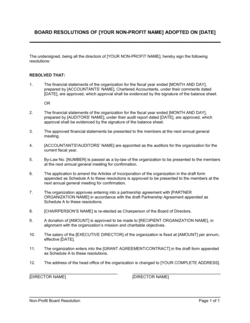
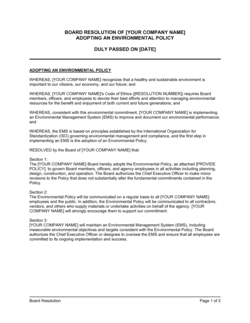
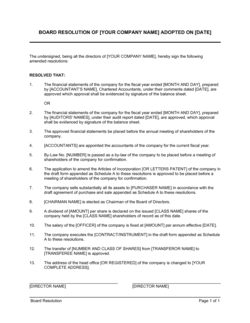
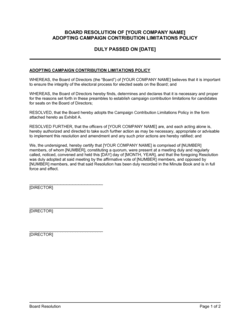
A preamble establishing the board's authority, whereas clauses identifying applicable laws and organizational values, the operative resolution language adopting the policy, a defined scope covering employees, contractors, and third parties, enforcement and reporting mechanisms, and a certification block recording the vote and date of adoption.

What is a Board Resolution Affirming Non-Discrimination Policy?

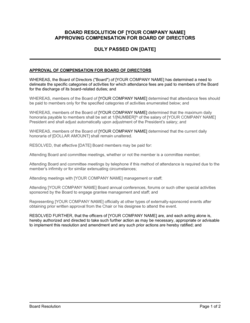
A Board Resolution Affirming Non-Discrimination Policy is a formal governance document by which an organization's board of directors officially adopts and places on record its commitment to equal treatment across all protected classes in employment, service delivery, and organizational activities. The resolution cites applicable federal, state, and local anti-discrimination laws, adopts the organization's written non-discrimination policy by reference, defines who is covered, establishes enforcement responsibility, and records the board vote and date of adoption as a permanent entry in the corporate minutes. It functions as the bridge between an internal policy and a verified, board-level commitment that external parties β€” funders, regulators, and accreditors β€” can rely on.

Why You Need This Document

Without a board-adopted resolution, a non-discrimination policy is an internal document with no formal governance backing β€” and many funders, government agencies, and grant programs will not accept it as evidence of organizational commitment. Federal grant compliance reviewers, state nonprofit oversight bodies, and accreditation programs routinely require a signed, dated board resolution as a condition of eligibility, approval, or continued funding. For organizations applying for 501(c)(3) status, a board-adopted non-discrimination policy is part of demonstrating that the organization operates for public benefit rather than private interest. Beyond compliance, the resolution creates the organizational accountability structure β€” naming who receives complaints, how investigations are conducted, and when the policy must be reviewed β€” that transforms a document into an enforceable standard. This template gives any board the structure to adopt a complete, defensible resolution in a single meeting.

Which variant fits your situation?

If your situation is…Use this template
Nonprofit organization seeking 501(c)(3) status or grant fundingBoard Resolution Affirming Non-Discrimination Policy
Corporation adopting a standalone EEO policy for the employee handbookEqual Employment Opportunity Policy
Organization adopting a broader DEI commitment beyond legal minimumsDiversity and Inclusion Policy
Board formally adopting an anti-harassment and anti-retaliation policyAnti-Harassment Policy
Board ratifying any major operational policy as a standing resolutionGeneral Board Resolution Template
Board adopting a written code of conduct covering all protected-class protectionsCode of Ethics and Conduct

Common mistakes to avoid

❌ Adopting the resolution without attaching the policy

Why it matters: A resolution that references a policy document 'attached hereto' but lacks the attachment is incomplete. Grant reviewers and regulators will reject it, and the policy is unenforceable without its full text on record.

Fix: Finalize the non-discrimination policy document before the board meeting, attach it as Exhibit A, and store both documents together as a single file in the corporate records.

❌ Omitting quorum confirmation

Why it matters: A resolution passed without a documented quorum can be challenged as invalid under the organization's bylaws, exposing the board to liability and forcing a re-vote.

Fix: Record the total number of directors seated, the number present, and confirm the quorum requirement is met in the preamble before the operative clauses.

❌ Using an outdated protected-class list

Why it matters: Omitting sexual orientation and gender identity β€” now covered under federal law since 2020 β€” signals non-compliance to funders and government agencies reviewing the policy.

Fix: Update the list to reflect the current federal standard plus all applicable state and local additions, and include a catch-all phrase: 'or any other characteristic protected by applicable law.'

❌ Designating only the executive director as the complaint recipient

Why it matters: If a discrimination complaint involves the executive director or a board member, there is no independent path for the complainant to escalate β€” creating both a practical and legal conflict of interest.

Fix: Name a secondary designee (board chair, HR officer, or ombudsperson) and specify the escalation path when the primary recipient is implicated in the complaint.

❌ No distribution or training directive

Why it matters: A resolution filed only in the minute book has no operational effect. Federal and state funders require evidence that the policy was actually communicated to covered parties.

Fix: Include an explicit directive naming the responsible officer and the deadline for distribution to all employees, volunteers, and contractors, and require annual acknowledgment signatures.

❌ No review cycle specified

Why it matters: Anti-discrimination law changes regularly; a policy with no review provision becomes outdated silently, exposing the organization to liability for failing to cover newly protected classes.

Fix: Add a review provision requiring the board to revisit the policy at least every two to three years, or sooner upon any material change in applicable law.

The 10 key sections, explained

Caption and identifying information

Preamble and authority statement

Whereas clauses (recitals)

Operative resolution β€” policy adoption

Scope of coverage

Protected characteristics

Enforcement and reporting procedure

Training and communication commitment

Review and amendment provision

Certification and signature block

How to fill it out

  1. 1

    Enter the organization's legal name and meeting details

    Replace all [ORGANIZATION LEGAL NAME] placeholders with the exact registered name. Enter the meeting type (regular or special), date, and location or virtual platform.

    πŸ’‘ Cross-check the name against your state corporate registry or IRS determination letter β€” a mismatch can delay grant approvals.

  2. 2

    Confirm quorum and record attendance

    Enter the names of directors present, confirm the total meets your bylaw quorum requirement, and note any directors participating remotely if your bylaws permit it.

    πŸ’‘ If your bylaws require written notice for special meetings, attach a copy of the notice to the resolution file as supporting documentation.

  3. 3

    Customize the whereas clauses to your applicable laws

    Add the specific federal, state, and local statutes that apply to your organization and jurisdiction. Include any funder or grant program requirements that mandate a non-discrimination commitment.

    πŸ’‘ Nonprofits applying for federal grants should reference the applicable program's civil rights statutes (e.g., Title VI, Section 504, Title IX) in the recitals to satisfy compliance reviewers.

  4. 4

    Complete the protected-characteristics list

    Start from the federal floor (Title VII, ADA, ADEA, GINA, Bostock) and add state and local protected classes applicable to your location β€” common additions include sexual orientation, gender identity, source of income, and familial status.

    πŸ’‘ Check your state's Fair Employment Practices Agency (FEPA) statute for protected classes that exceed the federal minimum β€” many states add 10 or more additional categories.

  5. 5

    Attach the full policy document as Exhibit A

    The resolution adopts the policy by reference β€” so the actual policy document must be attached. If your organization does not yet have a written policy, draft it before the board meeting.

    πŸ’‘ Version-stamp the attached policy (e.g., 'Non-Discrimination Policy v1.0, adopted [DATE]') so future amendments are clearly distinguishable from the originally adopted version.

  6. 6

    Designate the complaint officer and alternate

    Name the title (not just a personal name) of the primary complaint recipient and an alternate for situations involving senior leadership. Enter the contact method β€” email address or phone β€” for reporting.

    πŸ’‘ Using a title rather than a personal name means the designation remains valid when staff turn over, without requiring a board amendment.

  7. 7

    Record the vote and complete the certification block

    Enter the numeric vote tally (in favor, opposed, abstaining), the date of adoption, and have the board secretary sign the certification block.

    πŸ’‘ File the executed resolution with your corporate minute book within five business days of the meeting β€” delayed filing creates gaps that surface in due diligence and audits.

  8. 8

    Distribute and calendar the review date

    Send the adopted resolution and attached policy to all employees, volunteers, and contractors. Set a calendar reminder for the review date specified in the amendment provision.

    πŸ’‘ Store the executed PDF in a centrally accessible location and include the resolution number or date in the filename for easy retrieval during grant audits.

Frequently asked questions

What is a board resolution affirming a non-discrimination policy?

A board resolution affirming a non-discrimination policy is a formal written decision by an organization's board of directors that officially adopts the organization's commitment to equal treatment for all protected classes. It records the board's vote, cites the applicable laws, adopts the policy document by reference, and creates an official entry in the board minutes. It is commonly required by grant funders, government agencies, and accreditation bodies as proof that non-discrimination is a board-level commitment rather than an informal practice.

Why do nonprofits need a board resolution for their non-discrimination policy?

Many federal and state grant programs, as well as the IRS 501(c)(3) application process, require proof that an organization's board has formally adopted a non-discrimination policy. A signed resolution included in board minutes provides that documented evidence. Without it, grant applications may be rejected or tax-exempt status delayed. Some funders require the resolution to be re-adopted or reaffirmed each grant cycle.

What protected classes should the resolution cover?

At minimum, the resolution should cover all classes protected by federal law: race, color, religion, sex (including pregnancy), national origin, age (40 and over), disability, genetic information, and β€” following Bostock v. Clayton County (2020) β€” sexual orientation and gender identity. Many state and local laws add additional classes such as marital status, veteran status, source of income, and familial status. Including a catch-all phrase covering any characteristic protected by applicable law future-proofs the policy against subsequent statutory changes.

Does a board resolution make the non-discrimination policy legally binding?

A board resolution is a formal governance document that demonstrates organizational commitment and satisfies many regulatory and funder requirements, but it does not substitute for compliance with applicable employment law. The organization remains subject to Title VII, the ADA, state fair employment statutes, and other applicable law regardless of whether a resolution exists. The resolution is evidence of good-faith adoption of the policy, which can be relevant in regulatory investigations and litigation.

How often should the board reaffirm its non-discrimination policy?

Best practice is a formal board review every two to three years, or sooner when applicable law changes β€” for example, when a state legislature adds new protected classes or when a court decision expands existing protections. Some grant programs and accreditation bodies require annual reaffirmation. Including a review provision in the resolution itself ensures the board schedules this proactively rather than reactively.

Can a small business use this resolution, or is it only for nonprofits?

Any organization with a board of directors β€” including for-profit corporations, LLCs with a board structure, cooperatives, and community organizations β€” can use this resolution. For-profit businesses may need it to satisfy investor due diligence, government contracting requirements, or workplace certification programs. It is most commonly used by nonprofits because of grant-funding requirements, but the document structure is equally appropriate for any board-governed entity.

What is the difference between a non-discrimination policy and a board resolution?

The non-discrimination policy is the substantive document that defines protected classes, scope, complaint procedures, and enforcement. The board resolution is the governance act by which the board formally adopts that policy β€” creating a dated, voted, and certified record of the board's decision. The two documents work together: the resolution references and attaches the policy, and the policy is what employees and stakeholders actually follow. Neither document is complete without the other.

Does the resolution need to be signed by all board members?

Typically only the board secretary β€” or in some organizations the board chair β€” signs the certification block confirming that the resolution was duly adopted. All members do not need to sign individually, but the vote tally (in favor, opposed, and abstaining) should be recorded to confirm the resolution passed with a proper majority. Check your organization's bylaws, which may specify signatory requirements for board resolutions.

What should we do after the board adopts the resolution?

File the signed resolution in the corporate minute book, attach it to the board meeting minutes, distribute the attached policy to all employees, volunteers, and contractors, and store a signed acknowledgment from each covered party. For nonprofits, keep a copy readily accessible for grant applications and regulatory audits. Set a calendar reminder for the review date specified in the resolution's amendment provision.

How this compares to alternatives

vs Non-Discrimination Policy

The non-discrimination policy is the operative document defining scope, protected classes, and complaint procedures. The board resolution is the governance act that formally adopts it. The policy tells employees what the rules are; the resolution creates the official corporate record that the board decided to follow those rules. Both documents are needed β€” the resolution is incomplete without the attached policy, and the policy lacks board-level authority without the resolution.

vs Equal Employment Opportunity Policy

An EEO policy focuses specifically on employment decisions β€” hiring, promotion, compensation, and termination. A non-discrimination policy is broader, covering employees, clients, volunteers, and program participants in all organizational activities. The board resolution can adopt either or both, depending on the organization's obligations and funder requirements.

vs Code of Ethics and Conduct

A code of conduct covers the full range of behavioral expectations β€” conflicts of interest, confidentiality, financial integrity, and non-discrimination among them. A board resolution affirming a non-discrimination policy is narrower and more specific, creating a standalone record of the board's commitment on this single issue. Grant applications and regulatory filings typically require the specific resolution, not a general code of conduct.

vs Board Meeting Minutes

Board minutes are the comprehensive record of everything discussed and decided at a meeting. A resolution is a discrete, self-contained document recording one specific board action that is excerpted into the minutes. Funders and agencies prefer to receive the standalone resolution rather than full meeting minutes because it isolates the specific commitment without disclosing unrelated board deliberations.

Industry-specific considerations

Nonprofits and Foundations

Federal and state grant funders routinely require a board-adopted non-discrimination resolution as part of the grant application or compliance audit, making this document a prerequisite for funding eligibility.

Government Contractors

Federal contractors subject to Executive Order 11246 and related regulations must maintain board-level documentation of equal employment opportunity commitments as part of their affirmative action program.

Healthcare

Healthcare organizations receiving Medicare, Medicaid, or federal grant funding are required under Section 1557 of the ACA to have adopted non-discrimination policies covering patients and employees, typically evidenced by a board resolution.

Education

Private schools, universities, and educational nonprofits must adopt board-level non-discrimination resolutions to comply with Title VI, Title IX, and Section 504 as conditions of federal financial assistance.

Template vs pro β€” what fits your needs?

PathBest forCostTime
Use the templateNonprofits, small businesses, and any board-governed organization adopting a standard non-discrimination policy for the first time or reaffirming an existing oneFree30–60 minutes to complete; adopted at the next board meeting
Template + professional reviewOrganizations with complex grant compliance requirements, government contracting obligations, or operating in multiple jurisdictions with different protected-class statutes$200–$500 for a one-hour HR attorney or compliance consultant review1–3 days
Custom draftedLarge employers, federally regulated industries, or organizations facing active EEOC investigations or litigation where the resolution language requires specific legal precision$500–$2,000+1–2 weeks

Glossary

Board Resolution
A formal written decision made by an organization's board of directors, recorded in the minutes, that creates an official record of board action.
Whereas Clause
A recital paragraph beginning with 'Whereas' that sets out the factual background and rationale leading to the operative resolution.
Operative Clause
The binding paragraph in a resolution β€” typically introduced by 'Be It Resolved' β€” that states the actual decision or commitment the board is adopting.
Protected Class
A group of people sharing a characteristic β€” such as race, sex, religion, national origin, disability, or age β€” that anti-discrimination laws prohibit using as a basis for adverse decisions.
Equal Employment Opportunity (EEO)
The principle and legal requirement that employment decisions must be based on qualifications and performance, not on characteristics protected by law.
Scope of Policy
The explicit definition of which people and activities the non-discrimination policy covers β€” typically employees, applicants, contractors, volunteers, and clients.
Enforcement Mechanism
The designated process and responsible parties for receiving complaints, investigating violations, and applying remedies under the policy.
Quorum
The minimum number of board members who must be present for a meeting to be valid and for any resolution passed at that meeting to be binding.
Certification Block
The section of the resolution signed by the board secretary or chair that records the vote count, date of adoption, and confirms the resolution is a true copy of the board's action.
Minutes
The official written record of a board meeting's proceedings, including resolutions passed, votes recorded, and attendees present.

Part of your Business Operating System

This document is one of 3,000+ business & legal templates included in Business in a Box.

  • Fill-in-the-blanks β€” ready in minutes
  • 100% customizable Word document
  • Compatible with all office suites
  • Export to PDF and share electronically

Create your document in 3 simple steps.

From template to signed document β€” all inside one Business Operating System.
1
Download or open template

Access over 3,000+ business and legal templates for any business task, project or initiative.

2
Edit and fill in the blanks with AI

Customize your ready-made business document template and save it in the cloud.

3
Save, Share, Send, Sign

Share your files and folders with your team. Create a space of seamless collaboration.

Save time, save money, and create top-quality documents.

β˜…β˜…β˜…β˜…β˜…

"Fantastic value! I'm not sure how I'd do without it. It's worth its weight in gold and paid back for itself many times."

Managing Director Β· Mall Farm
Robert Whalley
Managing Director, Mall Farm Proprietary Limited
β˜…β˜…β˜…β˜…β˜…

"I have been using Business in a Box for years. It has been the most useful source of templates I have encountered. I recommend it to anyone."

Business Owner Β· 4+ years
Dr Michael John Freestone
Business Owner
β˜…β˜…β˜…β˜…β˜…

"It has been a life saver so many times I have lost count. Business in a Box has saved me so much time and as you know, time is money."

Owner Β· Upstate Web
David G. Moore Jr.
Owner, Upstate Web

Run your business with a system β€” not scattered tools

Stop downloading documents. Start operating with clarity. Business in a Box gives you the Business Operating System used by over 250,000 companies worldwide to structure, run, and grow their business.

Free Forever PlanΒ Β·Β No credit card required