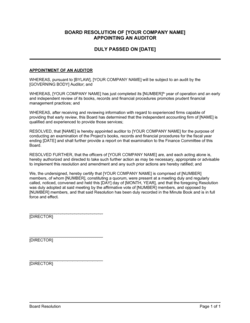
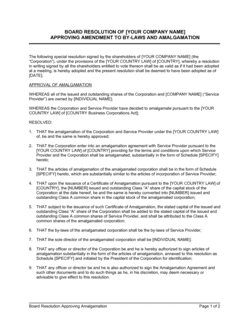
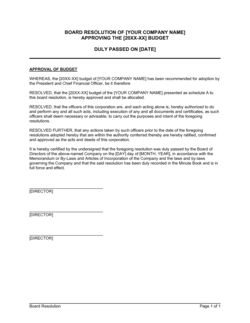
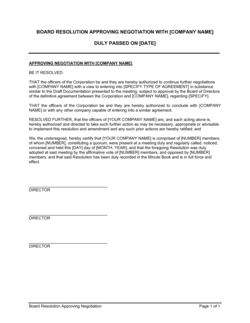
Non-Profit Board Resolution Template

Free Word download β€’ Edit online β€’ Save & share with Drive β€’ Export to PDF

1 pageβ€’20–30 min to fillβ€’Difficulty: Standardβ€’Signature requiredβ€’Legal review recommended
Learn more ↓
FreeNon-Profit Board Resolution Template

At a glance

What it is
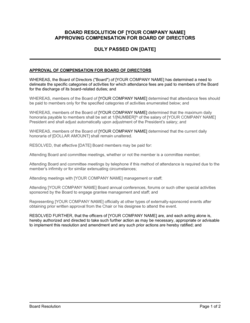
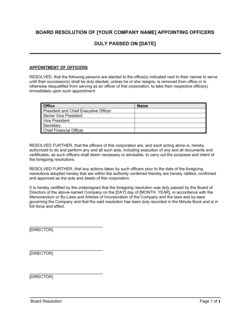
A Non-Profit Board Resolution is a formal written record of a decision officially adopted by a nonprofit organization's board of directors. This free Word download captures the resolution text, meeting details, voting outcome, and authorized signatures in a format accepted by banks, funders, government agencies, and auditors as binding evidence of board governance.
When you need it
Use it whenever your board must formally authorize an action β€” accepting a grant, signing a contract, appointing an officer, opening a bank account, approving a budget amendment, or launching a new program β€” and an external party requires documented proof that the decision was made with proper authority.
What's inside
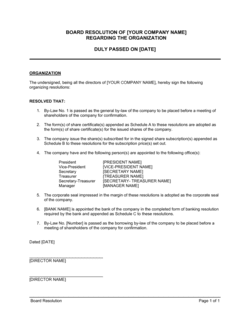
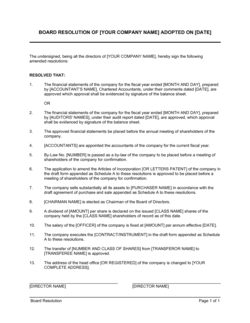
Organization name and legal status, meeting date and quorum confirmation, resolution number, whereas clauses establishing the rationale, a resolved clause stating the specific authorized action, vote tally, officer certification, and authorized signatures from the board chair and secretary.

What is a Non-Profit Board Resolution?

A Non-Profit Board Resolution is a formal written document recording a specific decision officially adopted by a nonprofit organization's board of directors, creating a certified governance record accepted by banks, funders, auditors, and regulatory agencies as proof of authorized action. It captures the organization's legal identity, the meeting at which the decision was made, the factual rationale in recital clauses, the precise action authorized in operative language, the vote outcome, conflict of interest disclosures, and the certifying signatures of the board chair and secretary. Unlike informal email approvals or verbal agreements, a properly adopted resolution creates a defensible, dated record that a grant monitor, IRS examiner, or bank compliance officer can verify independently.

Why You Need This Document

Without a board resolution, your organization cannot open bank accounts in its name, accept most government and foundation grants, or execute contracts above the dollar thresholds in your bylaws β€” because the counterparty has no proof the board authorized the action. Funders routinely hold grant disbursements until a compliant resolution is received, and banks will not add or remove account signatories without one. Beyond triggering specific transactions, resolutions protect board members individually: when a fiduciary decision is documented with a quorum confirmation, a vote tally, and a conflict of interest disclosure, it demonstrates the board exercised its duty of care β€” reducing personal liability exposure in audits or litigation. This template gives your board a legally structured, auditor-ready resolution in under 30 minutes, eliminating the delays and rejections that come from incomplete or informally worded governance documents.

Which variant fits your situation?

If your situation is…Use this template
Authorizing a new officer or signatory on a bank accountBoard Resolution to Open Bank Account
Formally accepting a government or foundation grant awardBoard Resolution to Accept Grant
Approving an executive director's employment terms or compensationBoard Resolution β€” Executive Compensation Approval
Authorizing the organization to enter a major contractBoard Resolution to Execute Contract
Amending the organization's bylawsBoard Resolution to Amend Bylaws
Approving an annual budget or mid-year budget amendmentBoard Resolution β€” Budget Approval
Documenting any board decision via written consent without a meetingWritten Consent in Lieu of Meeting

Common mistakes to avoid

❌ Using a DBA or program name as the organization name

Why it matters: Banks and funders match the resolution to the IRS determination letter and bank account by legal entity name. A name mismatch can freeze grant disbursements or prevent account changes from being processed.

Fix: Always use the exact legal name from the articles of incorporation. If the organization operates under a DBA, add 'doing business as [DBA NAME]' after the legal name.
❌ Omitting the quorum confirmation

Why it matters: A resolution adopted without quorum is void under most state nonprofit statutes and organizational bylaws. Without a written quorum confirmation, the resolution can be challenged and any action taken under it reversed.

Fix: State the number of directors present, the total seated, and the quorum threshold from the bylaws β€” for example, '7 of 12 seated directors present; quorum requires 7.'

❌ Open-ended banking and signatory authorizations with no expiration

Why it matters: Former officers and staff who appear on an undated banking resolution may retain account access indefinitely. Banks are not required to remove signatories unless presented with a superseding resolution.

Fix: Include an effective date and either a specific expiration date or a clause stating the resolution is superseded by any subsequent board resolution on the same subject.

❌ Having the executive director certify instead of the board secretary

Why it matters: Banks and major funders specifically require the board secretary's certification because the secretary holds responsibility for official corporate records. An ED-signed certification is routinely rejected, causing delays in grant disbursements and account changes.

Fix: Route all resolutions through the board secretary for certification before distribution. If the secretary position is vacant, document interim certification authority in a separate resolution.

❌ Vague resolved clause language without named authority or dollar limits

Why it matters: Resolved clauses that say 'the board supports this initiative' or authorize 'the staff' without naming a specific title are not accepted as authorization by banks, government funders, or major foundations.

Fix: Name the authorized person by title and full name, state the specific permitted action, and include any applicable dollar ceiling or time limit in the resolved clause itself.

❌ Failing to document conflict of interest disclosures in the resolution

Why it matters: IRS Form 990 asks whether the organization documents and follows a conflict of interest policy. Resolutions with undisclosed conflicts become evidence of governance failure during regulatory audits and can jeopardize tax-exempt status.

Fix: Add a conflict of interest clause to every resolution, even if only to state that no conflicts were disclosed. When a conflict exists, record the director's name, the nature of the interest, and that they were recused.

The 10 key clauses, explained

Organization identification and legal status

In plain language: States the full legal name of the nonprofit, its state or province of incorporation, and its tax-exempt status β€” establishing the entity on whose behalf the board acts.

Sample language
[ORGANIZATION FULL LEGAL NAME], a nonprofit corporation duly organized and existing under the laws of the State of [STATE], and recognized as tax-exempt under Section 501(c)(3) of the Internal Revenue Code.

Common mistake: Using a DBA or program name instead of the registered legal entity name. Funders and banks match the resolution to IRS determination letter and articles of incorporation by legal name β€” a mismatch can freeze account access or void a grant award.

Meeting date, type, and quorum confirmation

In plain language: Records whether the resolution was adopted at a regular, special, or annual meeting (or by written consent), the date, and confirmation that a quorum was present and voting.

Sample language
At a [regular / special] meeting of the Board of Directors held on [DATE], at which a quorum of [NUMBER] directors were present out of [TOTAL] seated directors, the following resolution was duly adopted.

Common mistake: Omitting the quorum confirmation. Without it, the resolution may be challenged as improperly adopted β€” particularly if a funding dispute arises or a disgruntled board member later contests the vote.

Resolution number and title

In plain language: Assigns a unique sequential identifier and a short descriptive title to the resolution for tracking, cross-referencing in minutes, and audit retrieval.

Sample language
Resolution No. [YYYY-###] β€” [SHORT TITLE, e.g., 'Authorization to Accept Grant Award from [FUNDER NAME]']

Common mistake: Skipping sequential numbering and using only a title. Boards that lack a numbering system cannot reliably locate prior resolutions during audits, and auditors note the gap as a governance deficiency.

Whereas clauses (recitals)

In plain language: One to three factual recital statements that explain the circumstances, need, or legal basis prompting the resolution β€” they justify the action but are not themselves the operative decision.

Sample language
WHEREAS, [ORGANIZATION NAME] has been awarded a grant in the amount of $[AMOUNT] by [FUNDER NAME] for the purpose of [PURPOSE]; and WHEREAS, the acceptance of said grant requires formal board authorization;

Common mistake: Writing whereas clauses so broadly that the resolved clause cannot be tied to a specific, identifiable action. Vague recitals make it impossible for a bank or auditor to confirm the scope of authorization.

Resolved clause (operative action)

In plain language: The core of the resolution β€” a precise, unambiguous statement of exactly what the board has decided or authorized, naming roles, dollar amounts, counterparties, and time limits where applicable.

Sample language
NOW, THEREFORE, BE IT RESOLVED that the Executive Director, [NAME], is hereby authorized to execute the Grant Agreement with [FUNDER NAME] in the amount of $[AMOUNT] and to take all actions necessary to fulfill the requirements of said agreement.

Common mistake: Using passive or open-ended language such as 'the board supports pursuing grant opportunities.' Resolutions must name the authorized person by title (or name), the specific action, and any dollar or time limits β€” otherwise banks and funders will reject them as insufficient authorization.

Vote tally and dissent record

In plain language: Records the numerical outcome of the vote β€” how many directors voted in favor, against, or abstained β€” and notes any recusals due to conflict of interest.

Sample language
The foregoing resolution was adopted by a vote of [NUMBER] in favor, [NUMBER] opposed, and [NUMBER] abstaining. Director [NAME] recused herself due to a disclosed conflict of interest.

Common mistake: Recording only 'approved unanimously' without the actual vote count. If quorum is later disputed or a director claims they were not present, a bare 'unanimously' entry provides no corroborating detail.

Conflict of interest disclosure

In plain language: Documents that any board member with a personal or financial interest in the matter disclosed that interest and did not participate in deliberation or voting on the resolution.

Sample language
Prior to the vote, Director [NAME] disclosed a potential conflict of interest with respect to [DESCRIPTION OF INTEREST] and was excused from deliberation and voting on this resolution in accordance with the Organization's Conflict of Interest Policy.

Common mistake: Omitting this clause when a conflict exists. IRS Form 990 Part VI asks specifically whether the organization follows a written conflict of interest policy β€” undocumented conflicts in resolutions are a red flag in regulatory reviews and grant audits.

Effective date and duration

In plain language: States when the authorization takes effect and whether it expires β€” important for banking resolutions and continuing authorizations that should not be open-ended.

Sample language
This resolution shall be effective as of [DATE] and shall remain in effect until [DATE / REVOKED BY SUBSEQUENT BOARD ACTION / the conclusion of the transaction described herein].

Common mistake: Leaving banking and signatory resolutions with no expiration or review mechanism. Signatories who leave the organization can retain unauthorized account access if the resolution has no sunset clause and the bank is never notified of a superseding resolution.

Secretary's certification

In plain language: A signed statement from the board secretary certifying that the resolution was duly adopted at a properly convened meeting with a quorum present, and that the text is a true, complete, and unaltered record.

Sample language
I, [SECRETARY NAME], Secretary of [ORGANIZATION NAME], hereby certify that the foregoing is a true and correct copy of a resolution duly adopted by the Board of Directors at a meeting held on [DATE], at which a quorum was present and voting throughout.

Common mistake: Having the executive director (rather than the board secretary) certify the resolution. Banks and major funders specifically require the secretary's certification because the secretary is responsible for the official records β€” an ED-signed certification may be rejected.

Authorized signatures block

In plain language: Signature lines for the board chair and secretary (and sometimes a third officer), confirming formal adoption β€” not just approval in principle.

Sample language
Board Chair: ___________________________ Date: __________ | Board Secretary: ___________________________ Date: __________

Common mistake: Collecting only one signature. Most funders, banks, and state charity regulators require at least two independent officer signatures to guard against unilateral action.

How to fill it out

  1. 1

    Enter the organization's full legal name and tax-exempt status

    Use the exact name from your articles of incorporation and IRS determination letter. Add your EIN, state of incorporation, and 501(c)(3) or applicable tax-exempt designation.

    πŸ’‘ Keep a saved master header with this information β€” it should be identical across all resolutions and match your IRS filings exactly.

  2. 2

    Record the meeting details and confirm quorum

    Enter the meeting date, type (regular, special, or annual), and the number of directors present versus the total seated on the board. Confirm that the number present meets your bylaws' quorum requirement.

    πŸ’‘ Check your bylaws before filling in the quorum count β€” some organizations require a supermajority for certain actions such as budget amendments or real estate transactions.

  3. 3

    Assign a sequential resolution number and title

    Use a YYYY-### format (e.g., 2026-014) and a short descriptive title. Log the number in your resolution register or board minutes index so it is retrievable for future audits.

    πŸ’‘ Maintain a running spreadsheet of all resolution numbers, titles, and dates. Auditors and grant monitors routinely request a full list.

  4. 4

    Draft the whereas clauses with specific facts

    Write one to three recital statements that name the specific grant, contract, funder, amount, or circumstance prompting the resolution. Tie each recital to a verifiable fact β€” dollar amount, grant number, or counterparty name.

    πŸ’‘ Whereas clauses are read by bank compliance teams and grant auditors; the more specific they are, the less likely the resolution is to be questioned or returned for revision.

  5. 5

    Write the resolved clause with full authorization details

    Name the authorized person by title and name, state the specific action, include any dollar limit, and add a time boundary if the authority should not be permanent. Review it against the specific request from the bank, funder, or counterparty to confirm it meets their requirements.

    πŸ’‘ Call the bank or funder before finalizing the resolved clause β€” they often have a specific format or magic language they require and will reject anything that deviates.

  6. 6

    Record the vote tally and any conflicts of interest

    Enter the numerical vote count. If any director had a conflict, document their disclosure and recusal explicitly by name and the nature of the conflict. Do not substitute 'unanimous' for the actual numbers.

    πŸ’‘ If the vote was not unanimous, note the dissent without editorializing β€” 'Director X voted in opposition' is sufficient; the reasons belong in the meeting minutes, not the resolution.

  7. 7

    Have the board secretary sign and certify

    The board secretary must sign the certification block, confirming quorum and the accuracy of the text. The board chair countersigns the signature block. Both signatures should be dated on or after the meeting date.

    πŸ’‘ Collect wet (ink) signatures for banking resolutions β€” many financial institutions will not accept digital-only signatures on corporate authorization documents without a separate signature verification form.

Frequently asked questions

What is a non-profit board resolution?

A non-profit board resolution is a formal written document recording a specific decision officially adopted by a nonprofit organization's board of directors. It identifies the organization, the meeting at which the decision was made, the action authorized, the vote outcome, and the certifying officers. Funders, banks, auditors, and government regulators accept it as proof that the board exercised proper governance authority over the documented action.

When does a nonprofit need a board resolution?

A board resolution is typically required when accepting a grant award, opening or modifying a bank account, authorizing an officer to sign a contract above a dollar threshold, approving executive compensation, amending the bylaws, purchasing or selling real property, or launching a new program that materially changes the organization's activities. Most funders specify in their grant agreements that a board resolution must be submitted before funds are released.

Does a board resolution need to be notarized?

Notarization is not required for most nonprofit board resolutions in the US, Canada, or the UK. The board secretary's certification β€” confirming quorum, accurate text, and proper adoption β€” is the accepted form of authentication. A small number of state charity registration filings and real estate transactions require notarized signatures; confirm the specific requirement with the requesting party before finalizing.

Can a nonprofit board pass a resolution without holding a meeting?

Yes. Most US state nonprofit corporation acts and equivalent statutes in Canada and the UK permit boards to adopt resolutions by written consent β€” sometimes called action by unanimous written consent β€” where every director (or the required majority, depending on the statute) signs a written resolution without convening. The signed document must be filed with the official corporate records and referenced in the next meeting's minutes. Check your bylaws for the specific unanimity or majority requirement.

What is the difference between a board resolution and board minutes?

Board minutes are a comprehensive narrative record of an entire meeting β€” attendance, discussions, motions, votes, and follow-up items. A board resolution is a standalone document recording a single specific decision in formal operative language. Resolutions are typically attached to or referenced within the minutes but circulate separately to banks, funders, and regulators who need evidence of a particular authorization without receiving the full meeting minutes.

How long should a nonprofit keep its board resolutions?

Permanently, as a matter of best practice. The IRS recommends that nonprofits retain governance records β€” including board resolutions β€” indefinitely, as they establish the authority basis for major organizational decisions. State charity registration laws in many jurisdictions require retention of corporate records for at least 7 years. Grant-specific resolutions should be kept for the life of the grant plus the funder's required audit retention period, which is typically 3–7 years after the grant closes.

How many signatures does a nonprofit board resolution need?

Most banks, funders, and regulators require at least two independent officer signatures β€” typically the board chair and the board secretary. Some financial institutions require three. The board secretary's certification signature is distinct from the approval signature block: the certification attests to accuracy of the record; the approval signatures confirm formal adoption. Check the specific requirements of the requesting party before circulating for signatures.

Can the executive director sign a board resolution?

An executive director may sign as an authorized officer if they also serve as a voting board member, but they should never be the sole signatory on governance documents. The board secretary must certify the resolution independently. For banking resolutions in particular, the authorized signatory named in the resolved clause and the certifying officer should be different people to satisfy the bank's dual-control requirements.

What makes a board resolution legally valid?

A board resolution is generally considered valid when it is adopted at a properly convened meeting (or by valid written consent), a quorum of directors was present, the required vote threshold was met, the text accurately reflects the decision made, and it is certified by the board secretary. Compliance with your bylaws' specific requirements for notice, quorum, and voting thresholds is essential β€” a resolution that skips any of these steps may be voidable even if everyone agrees on the underlying decision.

How this compares to alternatives

vs Board Meeting Minutes

Minutes are a narrative record of an entire board meeting β€” attendance, discussion, and all motions. A board resolution is a standalone operative document for a single decision, formatted for submission to banks, funders, and regulators. Resolutions are typically attached to or referenced within minutes but circulate separately. Both are required for complete governance records.

vs Written Consent in Lieu of Meeting

A written consent allows the board to adopt a resolution without convening a formal meeting by having all (or a statutory majority of) directors sign a document. A standard board resolution presupposes a meeting was held. Use written consent for urgent or routine actions between meetings; use a meeting-adopted resolution for major governance actions where deliberation and attendance records matter.

vs Nonprofit Bylaws

Bylaws are the foundational governance rules that establish how the board operates β€” quorum, notice requirements, officer roles, and voting thresholds. A board resolution is a specific decision made under those rules. Bylaws cannot authorize individual transactions; resolutions cannot establish governance structure. Both documents must coexist and reference each other consistently.

vs Corporate Resolution (For-Profit)

A for-profit corporate resolution authorizes shareholder-related and profit-distribution actions alongside operational decisions. A nonprofit board resolution operates in the same structural way but references tax-exempt status, grant compliance, and fiduciary duties specific to charitable organizations. Substituting a for-profit resolution template for a nonprofit can create compliance gaps with IRS and state charity requirements.

Industry-specific considerations

Human services and social services

Government grant awards from HHS, HUD, or state agencies almost universally require a board resolution as a condition of executing the grant agreement before any funds are disbursed.

Education and higher education

Private K-12 schools and community colleges rely on resolutions to authorize tuition policy changes, facility contracts, and accreditation-related governance actions required by their accrediting bodies.

Healthcare and community health

Federally Qualified Health Centers and hospital foundations must document board approval of HRSA compliance actions, executive compensation, and major vendor contracts as part of federal oversight requirements.

Arts and culture

Museums, theaters, and arts organizations use resolutions to authorize NEA and state arts council grant acceptances, deaccession of collection items, and real estate lease agreements for performance venues.

Jurisdictional notes

United States

Nonprofit corporations are governed by state law β€” typically the state's Nonprofit Corporation Act β€” not federal law. Quorum requirements, action by written consent, and officer authority vary by state. IRS Form 990 Part VI asks governance questions that require supporting resolution records. California, New York, and Florida impose additional state-level charity registration and audit requirements that depend on properly maintained resolution archives.

Canada

Federal nonprofits incorporated under the Canada Not-for-profit Corporations Act (NFP Act) and provincial counterparts (e.g., Ontario's Not-for-Profit Corporations Act, 2010) both require that significant decisions be documented by board resolution. French-language documentation is required for federally regulated organizations operating in Quebec. CRA expects organizations claiming charitable status to maintain board governance records supporting their public benefit activities.

United Kingdom

Charities registered with the Charity Commission for England and Wales must maintain trustee meeting records and formal resolutions as part of their governance obligations under the Charities Act 2011. Scottish charities are regulated by OSCR under the Charities and Trustee Investment (Scotland) Act 2005, which has similar record-keeping requirements. Major financial decisions β€” grants above Β£25,000, property transactions, and trustee remuneration β€” typically require a formally adopted resolution.

European Union

Association and foundation governance requirements vary significantly across EU member states β€” German Vereine, French associations loi 1901, and Dutch foundations each have distinct documentation standards. Cross-border grant recipients funded by EU structural funds or Horizon Europe programs must maintain board authorization records in compliance with the specific grant agreement's audit trail requirements. GDPR implications arise when resolutions reference personal data of beneficiaries or employees β€” these should be handled with care in publicly disclosed documents.

Template vs lawyer β€” what fits your deal?

PathBest forCostTime
Use the templateStandard resolutions for grant acceptances, bank accounts, officer appointments, and routine contract authorizations at established nonprofitsFree15–30 minutes per resolution
Template + legal reviewResolutions authorizing real estate transactions, executive compensation packages, or major program restructuring above $250,000$200–$500 (nonprofit attorney or CPA review)1–3 days
Custom draftedMulti-year federal awards with complex compliance conditions, merger or dissolution resolutions, or any action that modifies the organization's tax-exempt purposes$800–$3,000+1–2 weeks

Glossary

Board Resolution
A formal written document recording a specific decision made by a board of directors, serving as the official record of that action.
Quorum
The minimum number of board members who must be present for a meeting to be valid and for any votes taken to be binding β€” typically a simple majority of seated directors.
Whereas Clause
Introductory recital statements in a resolution that set out the background facts and rationale justifying the board's decision.
Resolved Clause
The operative language in a resolution that states precisely what the board has decided or authorized, beginning with the words 'BE IT RESOLVED' or 'NOW, THEREFORE, BE IT RESOLVED.'
Written Consent in Lieu of Meeting
A procedure allowing board members to adopt a resolution by signing a written document without holding a formal meeting, permitted by most state nonprofit statutes.
Fiduciary Duty
The legal obligation of board members to act in the best interests of the organization β€” encompassing duties of care, loyalty, and obedience.
Authorized Signatory
A person formally designated by the board to sign contracts, checks, or other legal documents on behalf of the organization.
IRS Form 990
The annual information return filed by tax-exempt organizations with the IRS, which includes governance disclosures that require supporting board resolution records.
Conflict of Interest
A situation where a board member has a personal or financial interest in a matter before the board β€” requiring disclosure and recusal from the vote.
Secretary's Certificate
A statement signed by the board secretary certifying that a resolution was duly adopted, that a quorum was present, and that the attached text is a true and accurate record.

Part of your Business Operating System

This document is one of 3,000+ business & legal templates included in Business in a Box.

  • Fill-in-the-blanks β€” ready in minutes
  • 100% customizable Word document
  • Compatible with all office suites
  • Export to PDF and share electronically

Create your document in 3 simple steps.

From template to signed document β€” all inside one Business Operating System.
1
Download or open template

Access over 3,000+ business and legal templates for any business task, project or initiative.

2
Edit and fill in the blanks with AI

Customize your ready-made business document template and save it in the cloud.

3
Save, Share, Send, Sign

Share your files and folders with your team. Create a space of seamless collaboration.

Save time, save money, and create top-quality documents.

β˜…β˜…β˜…β˜…β˜…

"Fantastic value! I'm not sure how I'd do without it. It's worth its weight in gold and paid back for itself many times."

Managing Director Β· Mall Farm
Robert Whalley
Managing Director, Mall Farm Proprietary Limited
β˜…β˜…β˜…β˜…β˜…

"I have been using Business in a Box for years. It has been the most useful source of templates I have encountered. I recommend it to anyone."

Business Owner Β· 4+ years
Dr Michael John Freestone
Business Owner
β˜…β˜…β˜…β˜…β˜…

"It has been a life saver so many times I have lost count. Business in a Box has saved me so much time and as you know, time is money."

Owner Β· Upstate Web
David G. Moore Jr.
Owner, Upstate Web

Run your business with a system β€” not scattered tools

Stop downloading documents. Start operating with clarity. Business in a Box gives you the Business Operating System used by over 250,000 companies worldwide to structure, run, and grow their business.

Start freeΒ Β·Β No credit card required