Board Resolution Adopting an Environmental Policy Template

Free Word download • Edit online • Save & share with Drive • Export to PDF

2 pages20–25 min to fillDifficulty: Standard
Learn more ↓
FreeBoard Resolution Adopting an Environmental Policy Template

At a glance

What it is
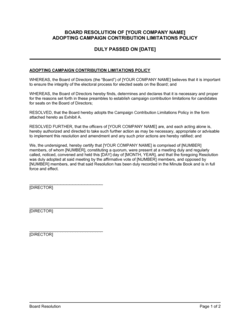
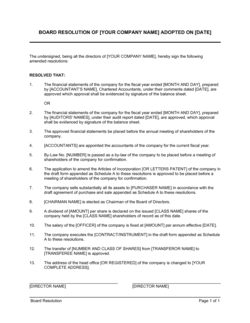
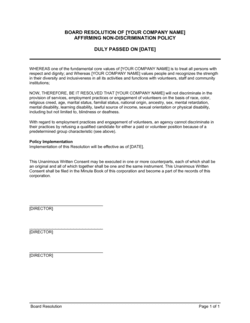
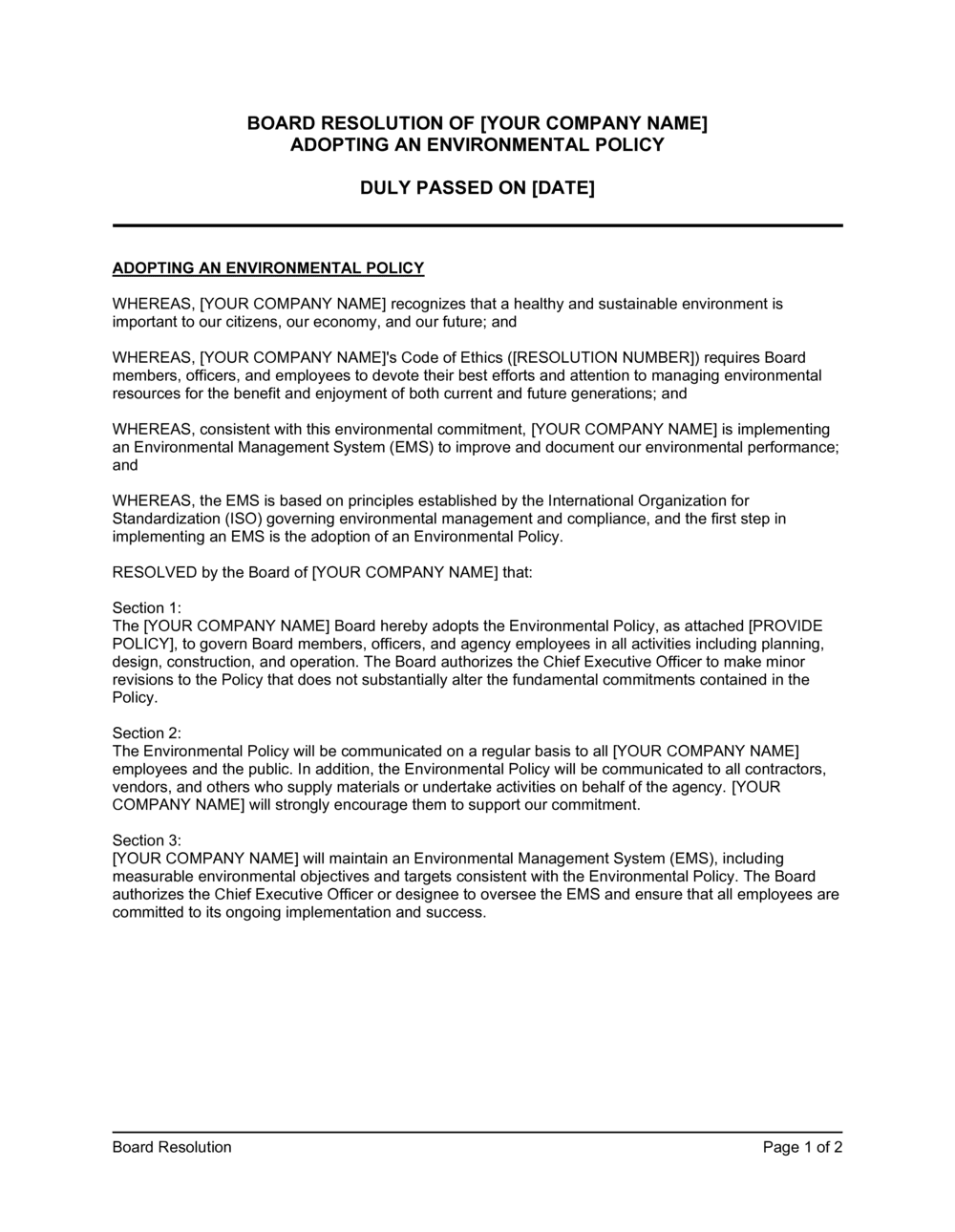
A Board Resolution Adopting An Environmental Policy is a formal corporate governance document in which a company's board of directors officially approves and adopts the organization's environmental commitments, obligations, and sustainability standards. This free Word download gives you a ready-to-use template you can edit online and export as PDF for inclusion in board minutes or distributed to stakeholders.
When you need it
Use it when your board needs to formally ratify a new or updated environmental policy — for regulatory compliance, ESG reporting, investor relations, or as a prerequisite for certification programs such as ISO 14001. It is also required when a lender, government body, or major client requests documented board-level environmental commitments.
What's inside
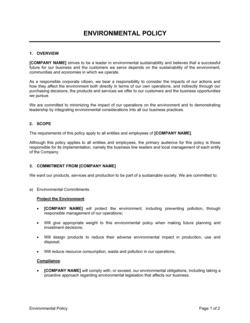
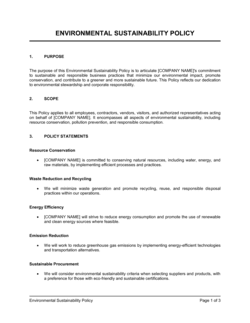
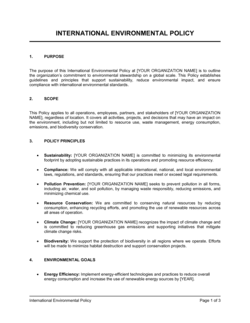
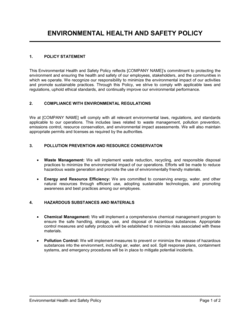
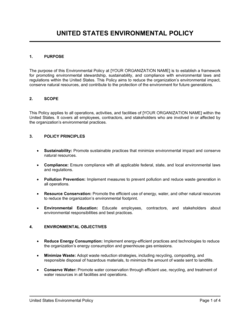
Recitals establishing the rationale and authority for the resolution, the formal adoption clause for the environmental policy, delegated responsibilities for implementation and monitoring, and attestation by the board secretary. The environmental policy itself covers resource use, waste reduction, regulatory compliance, and continuous improvement goals.

What is a Board Resolution Adopting an Environmental Policy?

A Board Resolution Adopting an Environmental Policy is a formal corporate governance document through which a company's board of directors officially approves and records the organization's environmental commitments as binding corporate policy. It transforms a management-level sustainability statement into a board-level directive — establishing who is accountable, what the company commits to, how performance will be measured, and how often the policy will be reviewed. The resolution includes formal recitals establishing the rationale, operative clauses adopting the policy and delegating implementation authority, and a certified attestation by the corporate secretary confirming the board's decision.

Why You Need This Document

Operating without a board-adopted environmental policy creates real governance gaps. Regulatory agencies, ISO 14001 certification auditors, and ESG rating frameworks require documented evidence that the board — not just management — has formally committed to the company's environmental obligations. Without this resolution, a company's environmental policy is an unenforceable internal statement with no clear accountability chain. When regulators investigate an environmental incident or a certifying body conducts an audit, the first document they request is proof of board-level adoption. For companies responding to institutional investor ESG questionnaires or qualifying for government contracts with mandatory environmental requirements, a missing resolution can disqualify an application entirely. This template gives you a correctly structured, immediately usable resolution that satisfies governance best practices and the documentation standards of the most widely used environmental frameworks — in the time it takes to fill in your company's details.

Which variant fits your situation?

If your situation is…Use this template
Adopting a general corporate environmental policy for the first timeBoard Resolution Adopting An Environmental Policy
Updating or replacing an existing environmental policyBoard Resolution Amending a Corporate Policy
Adopting a standalone sustainability or ESG strategyCorporate Sustainability Plan
Adopting a health and safety policy alongside the environmental policyBoard Resolution Adopting a Health and Safety Policy
Formalizing board approval of a code of conduct or ethics policyBoard Resolution Adopting a Code of Ethics
Recording a broader set of board decisions in a single meetingBoard Meeting Minutes
Establishing a new environmental committee to oversee complianceBoard Resolution Forming a Committee

Common mistakes to avoid

❌ Adopting the resolution without attaching Exhibit A

Why it matters: A resolution that formally adopts a policy 'attached hereto' with no exhibit is legally incomplete — auditors, certifying bodies, and courts will treat the policy as unadopted.

Fix: Finalize the full environmental policy text before the board meeting and attach it as Exhibit A. Never pass the resolution as a placeholder to be completed later.

❌ Delegating implementation to 'management' without a named role

Why it matters: Vague delegation means no single person is accountable — environmental reporting obligations are missed, and the resolution offers no protection when regulators ask who is responsible.

Fix: Name a specific title (e.g., Chief Operating Officer or Environmental Compliance Manager) in the delegation clause and define the minimum reporting frequency to the board.

❌ Omitting a policy review schedule

Why it matters: ISO 14001, many environmental permits, and ESG reporting frameworks require evidence that the board actively maintains the policy — an undated commitment with no review cycle fails this test.

Fix: Add a 'Be It Further Resolved' clause committing to an annual board review and record the first review date on the corporate calendar at the time of adoption.

❌ Using aspirational language with no measurable commitments

Why it matters: A policy that says only 'we strive to protect the environment' cannot be audited, enforced, or used to demonstrate compliance — regulators and certification auditors will reject it.

Fix: Include at least one specific, measurable commitment in Exhibit A — such as a target reduction percentage for energy or waste — alongside the general principles.

The 9 key sections, explained

Resolution header and meeting details

Recitals (Whereas clauses)

Adoption operative clause

Environmental policy commitments

Delegation of implementation authority

Review and update schedule

Communication and training clause

Exhibit A — the environmental policy document

Secretary attestation and signatures

How to fill it out

  1. 1

    Enter the company's registered legal name and meeting details

    Replace every instance of [COMPANY NAME] with the exact legal entity name on your corporate registration. Record the meeting date and whether the resolution is adopted at a regular meeting, a special meeting, or by unanimous written consent.

    💡 Cross-check the entity name against your state or provincial corporate registry before circulating the draft — a mismatch can invalidate the document for certification bodies.

  2. 2

    Customize the recitals to reflect your actual compliance drivers

    Identify the specific laws, regulations, certifications, or stakeholder requirements driving adoption — e.g., ISO 14001 certification, a client procurement requirement, or a state environmental permit condition. Add a 'Whereas' clause for each.

    💡 Specific recitals create a stronger audit trail. 'Whereas the Company is seeking ISO 14001 certification' is more useful than 'Whereas the Board deems it appropriate.'

  3. 3

    Set the effective date in the adoption clause

    Enter a specific calendar date in the operative clause. If the resolution is adopted by written consent, the effective date is typically the date the last director signs.

    💡 Align the effective date with the start of a reporting period — quarter or fiscal year — so environmental performance can be tracked cleanly from day one.

  4. 4

    Draft or attach the full environmental policy as Exhibit A

    Write the environmental policy document covering scope, commitments (compliance, resource reduction, waste, pollution prevention, continuous improvement), and applicable facilities. Attach it as Exhibit A and confirm the reference in the resolution body matches the exhibit title.

    💡 Keep policy commitments specific enough to audit — 'reduce energy consumption by 10% per year' is verifiable; 'minimize energy use where possible' is not.

  5. 5

    Name the responsible officer or committee

    Replace [NAME/TITLE] in the delegation clause with the specific executive or committee accountable for implementation — typically the CEO, COO, sustainability officer, or an environmental committee chair.

    💡 If you name a committee rather than an individual, attach or reference the committee's terms of reference so the reporting obligation is clear.

  6. 6

    Set the review cycle and reporting frequency

    Enter the review period (12 months is standard for most compliance frameworks) and the reporting frequency to the board (annually or quarterly). Both should align with your fiscal year calendar.

    💡 Calendar the first review date immediately after adoption — environmental policy reviews are among the most commonly missed governance commitments.

  7. 7

    Obtain director signatures or written consents

    Circulate the resolution to all directors for signature at the meeting or by written consent. Record the vote count or note unanimous consent in the attestation block.

    💡 For written consent resolutions, collect all signatures before filing — a partially signed consent is not a valid resolution in most jurisdictions.

  8. 8

    File the executed resolution in the corporate minute book

    Store the signed resolution and Exhibit A together in the corporate minute book. Distribute a copy to the designated implementation officer and, where required, to regulators, certifying bodies, or key clients.

    💡 Scan and store a PDF copy in your document management system immediately after execution — physical minute books are lost or damaged more often than companies expect.

Frequently asked questions

What is a board resolution adopting an environmental policy?

A board resolution adopting an environmental policy is a formal corporate governance document in which the board of directors officially approves and records its adoption of the company's environmental commitments. It creates an official record that the board — not just management — has endorsed the policy, which is required by regulatory bodies, certification standards such as ISO 14001, and many institutional investors and lenders.

Why does the board need to formally adopt an environmental policy?

Board-level adoption establishes that environmental governance is a fiduciary matter, not merely an operational preference. Many regulatory permits, ESG disclosure frameworks, and certification programs explicitly require documented evidence of board endorsement. Without a formal resolution, a company's environmental policy is simply a management document with no binding organizational authority and no clear accountability structure.

Does every company need a board-adopted environmental policy?

Not every company faces a legal mandate, but the business case is broad. Companies seeking ISO 14001 certification, responding to ESG investor questionnaires, applying for certain government contracts, or operating in regulated industries such as manufacturing, construction, or resource extraction typically need one. Even small companies benefit from the governance clarity a formal resolution provides, particularly when working with large corporate customers that require supplier environmental commitments.

What should the environmental policy itself include?

At minimum, the policy should cover the company's commitment to complying with applicable environmental laws, reducing resource consumption (energy, water, materials), minimizing waste and promoting recycling, preventing pollution, and continuously improving environmental performance. It should state the scope of operations covered, name the responsible officer, and reference the review cycle. The policy is typically attached to the resolution as Exhibit A.

Can a board resolution and the environmental policy be the same document?

They serve distinct functions and should be kept separate. The resolution is the governance record of the board's decision. The environmental policy is the substantive statement of commitments that the resolution adopts. Combining them makes it difficult to update the policy without re-adopting the resolution, and creates confusion in audit and compliance review. Attach the policy as a clearly labeled Exhibit A.

How often should the board review the environmental policy?

Annual review is the standard required by ISO 14001 and most environmental management frameworks. The review should assess whether the policy remains appropriate given changes to the company's operations, applicable regulations, and environmental performance data. When material changes are needed, the board should adopt an amending resolution referencing the original adoption date.

What is the difference between a board resolution and board meeting minutes?

Board meeting minutes are a comprehensive record of an entire board meeting — attendees, agenda items, discussions, and all decisions made. A resolution is the formal record of a single specific decision, which may be passed at a meeting (and recorded in the minutes) or by unanimous written consent outside of a meeting. Resolutions are filed as standalone governance documents and referenced in the minutes; they are not a substitute for them.

How this compares to alternatives

vs Board Meeting Minutes

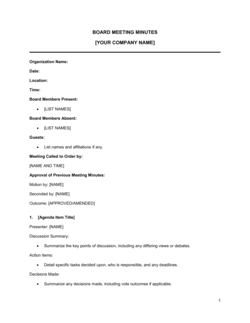
Board meeting minutes record everything that occurs during a full board meeting — agenda, attendance, discussion, and all decisions. A resolution is the standalone formal record of a single decision, which may be extracted from the minutes or adopted separately by written consent. Both should be maintained, but the resolution is the document referenced by auditors and certifying bodies for the specific policy adoption.

vs Corporate Environmental Policy (standalone)

A standalone environmental policy document sets out the company's environmental commitments but carries no formal governance authority on its own. The board resolution is what elevates the policy from a management document to a board-level commitment. The two documents work together — the policy is typically attached as Exhibit A to the resolution.

vs Sustainability Plan

A sustainability plan is an operational roadmap detailing specific initiatives, targets, timelines, and resource allocation for achieving environmental and social goals. A board resolution adopting an environmental policy is a governance document establishing the board's high-level commitment. The resolution typically precedes and authorizes the sustainability plan rather than replacing it.

vs Board Resolution Adopting a Code of Ethics

A code of ethics resolution establishes the company's behavioral and ethical standards for directors, officers, and employees — covering conflicts of interest, confidentiality, and fair dealing. An environmental policy resolution specifically addresses the company's commitments to environmental responsibility. Both are governance documents adopted through the same resolution mechanism but cover entirely separate subject matter.

Industry-specific considerations

Manufacturing

Emissions controls, waste disposal compliance, and ISO 14001 certification requirements make a board-adopted environmental policy a standard operating prerequisite for manufacturers.

Construction

Site-specific environmental management plans, stormwater permits, and government contract requirements routinely mandate documented board-level environmental commitments.

Professional Services

Corporate clients increasingly require supplier environmental policies as part of procurement qualification, making board adoption a competitive necessity even for office-based firms.

SaaS / Technology

Data center energy consumption, e-waste management, and ESG investor disclosure requirements drive formal environmental policy adoption among technology companies of all sizes.

Retail / E-commerce

Packaging waste, supply chain emissions, and growing consumer ESG expectations make a board-adopted environmental policy an increasingly standard governance document for retailers.

Food & Beverage

Water use, packaging, agricultural sourcing, and food waste reduction commitments require formal board endorsement to satisfy retailer supplier codes and regulatory environmental permits.

Template vs pro — what fits your needs?

PathBest forCostTime
Use the templateCompanies adopting a standard environmental policy for the first time, meeting basic supplier or ESG requirementsFree1–2 hours
Template + professional reviewCompanies seeking ISO 14001 certification, responding to regulatory permit conditions, or operating in environmentally sensitive industries$300–$800 (environmental consultant or legal review)1–3 days
Custom draftedPublicly listed companies, companies subject to mandatory ESG disclosure, or those operating under complex multi-jurisdictional environmental permits$1,500–$5,000+1–3 weeks

Glossary

Board Resolution
A formal written record of a decision made by a company's board of directors, carrying the same authority as a vote taken at a duly convened board meeting.
Recitals
The introductory 'Whereas' clauses in a resolution that state the factual background, purpose, and authority behind the board's decision.
Operative Clause
The 'Resolved' or 'Be It Resolved' statement that constitutes the actual decision of the board — as distinct from the recitals, which only provide context.
Environmental Policy
A statement of an organization's principles and commitments regarding its impact on the natural environment, including resource use, emissions, waste, and regulatory compliance.
ISO 14001
An internationally recognized standard for environmental management systems that requires documented board-level commitment to an environmental policy as a prerequisite for certification.
ESG (Environmental, Social, and Governance)
A framework used by investors and stakeholders to evaluate a company's sustainability performance, in which a board-adopted environmental policy is a foundational governance element.
Delegated Authority
A clause in a resolution that empowers a named officer or committee to implement, monitor, and report on the adopted policy on behalf of the board.
Corporate Secretary
The officer responsible for maintaining official corporate records, including board minutes and resolutions, and certifying their accuracy.
Continuous Improvement
A commitment embedded in most environmental policies requiring the organization to regularly review and raise its environmental performance targets over time.
Attestation
The formal certification by the corporate secretary that a resolution was duly adopted by the board, making it part of the official corporate record.

Part of your Business Operating System

This document is one of 3,000+ business & legal templates included in Business in a Box.

  • Fill-in-the-blanks — ready in minutes
  • 100% customizable Word document
  • Compatible with all office suites
  • Export to PDF and share electronically

Create your document in 3 simple steps.

From template to signed document — all inside one Business Operating System.
1
Download or open template

Access over 3,000+ business and legal templates for any business task, project or initiative.

2
Edit and fill in the blanks with AI

Customize your ready-made business document template and save it in the cloud.

3
Save, Share, Send, Sign

Share your files and folders with your team. Create a space of seamless collaboration.

Save time, save money, and create top-quality documents.

★★★★★

"Fantastic value! I'm not sure how I'd do without it. It's worth its weight in gold and paid back for itself many times."

Managing Director · Mall Farm
Robert Whalley
Managing Director, Mall Farm Proprietary Limited
★★★★★

"I have been using Business in a Box for years. It has been the most useful source of templates I have encountered. I recommend it to anyone."

Business Owner · 4+ years
Dr Michael John Freestone
Business Owner
★★★★★

"It has been a life saver so many times I have lost count. Business in a Box has saved me so much time and as you know, time is money."

Owner · Upstate Web
David G. Moore Jr.
Owner, Upstate Web

Run your business with a system — not scattered tools

Stop downloading documents. Start operating with clarity. Business in a Box gives you the Business Operating System used by over 250,000 companies worldwide to structure, run, and grow their business.

Start free · No credit card required