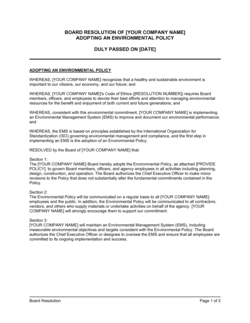
Board Resolution Adopting Campaign Contribution Limitations Policy Template

Free Word download β€’ Edit online β€’ Save & share with Drive β€’ Export to PDF

2 pagesβ€’20–25 min to fillβ€’Difficulty: Standard
Learn more ↓
FreeBoard Resolution Adopting Campaign Contribution Limitations Policy Template

At a glance

What it is
A Board Resolution Adopting a Campaign Contribution Limitations Policy is a formal corporate governance document in which a company's board of directors officially enacts written restrictions on the organization's political contributions β€” including direct donations, PAC funding, trade association payments used for political purposes, and related expenditures. This free Word download gives boards a structured, ready-to-customize starting point that can be edited online and exported as PDF for the corporate minute book.
When you need it
Use it when the board wants to establish or formalize written limits on corporate political spending, when institutional shareholders or proxy advisors request a documented policy, or when legal or compliance counsel recommends governance controls ahead of an election cycle or regulatory review.
What's inside
Recitals establishing the board's authority and rationale, defined scope of covered contributions, specific dollar thresholds and approval requirements, disclosure obligations, compliance and oversight assignments, and the formal board authorization language that makes the policy operative.

What is a Board Resolution Adopting a Campaign Contribution Limitations Policy?

A Board Resolution Adopting a Campaign Contribution Limitations Policy is a formal corporate governance document in which a company's board of directors officially enacts written restrictions on the organization's political spending. It records the board's authority and rationale, defines which contribution types are covered β€” from direct candidate donations to trade association payments used for political purposes β€” sets specific dollar thresholds requiring tiered approvals, and designates compliance and oversight responsibilities. The resolution incorporates the full policy text as an attached exhibit, making both documents part of the permanent corporate minute book.

Why You Need This Document

Without a board-authorized policy, any officer or manager with signatory authority can write a check to a political campaign or PAC with no documented approval chain β€” creating exposure to FEC enforcement, state campaign finance penalties, and shareholder litigation. Proxy advisory firms including ISS and Glass Lewis now flag companies that lack formal political spending policies as governance deficiencies, which directly affects institutional shareholder votes. For nonprofits, operating without written limits on political activity puts tax-exempt status at risk with no documented evidence of board diligence. This template gives your board a structured, immediately actionable starting point β€” covering thresholds, approval tiers, recordkeeping, and annual disclosure β€” so the first political expenditure your company makes after adoption is the first one with a complete, auditable paper trail.

Which variant fits your situation?

If your situation is…Use this template
Company has an existing PAC and needs board-level spending limitsBoard Resolution Adopting Campaign Contribution Limitations Policy
Board needs to authorize formation of a separate segregated fund (PAC)Board Resolution Establishing a Political Action Committee
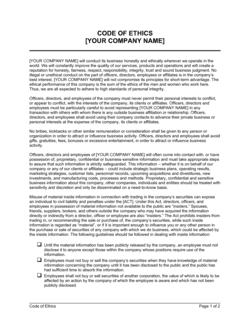
Board is adopting a broader ethics and political activity code of conductCode of Ethics and Business Conduct Policy
Company needs a standalone employee political activities policyEmployee Political Activity Policy
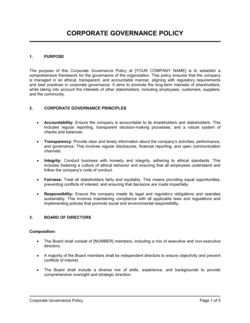
Board is adopting a general corporate governance policy manualCorporate Governance Policy
Organization needs to document all board actions in a single recordBoard Meeting Minutes
Board is ratifying prior political expenditures retroactivelyBoard Resolution Ratifying Prior Actions

Common mistakes to avoid

❌ Adopting the resolution without attaching the policy as an exhibit

Why it matters: The resolution authorizes and incorporates the policy by reference β€” if no exhibit is attached, there is no operative policy document and the resolution has no substantive effect.

Fix: Draft the full policy text as a standalone Exhibit A, attach it before the board votes, and confirm the exhibit is included in every filed copy.

❌ Using vague dollar thresholds with no named approver

Why it matters: A threshold that says 'material contributions require prior approval' without specifying an amount or designating an approver is unenforceable β€” employees and officers cannot follow a standard that isn't defined.

Fix: Set specific dollar figures for each approval tier and designate the exact title of the officer with approval authority at each tier.

❌ Covering only federal campaign finance rules and ignoring state law

Why it matters: Dozens of states impose stricter prohibitions than federal law on corporate political contributions β€” a policy limited to FEC compliance will leave the company exposed in states where it operates or makes political expenditures.

Fix: Have counsel map every state where the company operates or donates and confirm the policy's prohibitions meet or exceed each applicable state standard.

❌ Failing to assign ownership of the annual disclosure commitment

Why it matters: A public commitment to disclose political spending that goes unfulfilled is worse than no commitment β€” proxy advisors flag it as a governance deficiency and activist shareholders use it as evidence of board inattention.

Fix: Name a specific officer responsible for producing the annual disclosure on a fixed date, and add the deliverable to the board's annual compliance calendar.

The 10 key sections, explained

Title and introductory recitals

Scope and definitions

Prohibition on direct corporate treasury contributions

Dollar thresholds and tiered approval requirements

PAC administration and voluntary contribution rules

Disclosure and recordkeeping obligations

Oversight and compliance responsibilities

Shareholder and public disclosure commitments

Policy review and amendment

Board authorization and effective date

How to fill it out

  1. 1

    Insert the corporation's legal name and state of incorporation

    Replace every [COMPANY LEGAL NAME] placeholder with the exact registered corporate name as it appears in your articles of incorporation. Include the state of incorporation in the introductory recitals.

    πŸ’‘ Use the name exactly as filed with your state's secretary of state β€” not a trade name or abbreviation β€” so the resolution is unambiguous in the corporate minute book.

  2. 2

    Confirm the date and method of board action

    Enter the date the board voted on the resolution. Note whether it was adopted at a duly noticed meeting or by unanimous written consent, and confirm that quorum requirements were satisfied.

    πŸ’‘ For written consent resolutions, verify your jurisdiction's requirements β€” some states require that written consents be unanimous rather than majority-based.

  3. 3

    Define the scope of covered contributions for your organization

    Review the scope section and confirm that every contribution type relevant to your company is explicitly listed β€” trade association dues with political use, ballot measure spending, and in-kind contributions should each be addressed, not left to implication.

    πŸ’‘ Have your compliance team pull a list of all political payments made in the prior 12 months and verify the scope language captures every category.

  4. 4

    Set specific dollar thresholds for tiered approvals

    Replace the [AMOUNT] placeholders in the approval tiers with actual figures that reflect your company's typical political spending levels. Calibrate the board-approval threshold to catch material contributions without burdening the board with routine small donations.

    πŸ’‘ A common structure for mid-size companies is: General Counsel approval up to $2,500; CEO + GC approval up to $25,000; Board approval above $25,000.

  5. 5

    Address your PAC structure if one exists

    If your company administers a PAC, confirm that the voluntary participation language and anti-coercion provisions align with the PAC's existing FEC-filed solicitation policy. If no PAC exists, note that the section is not applicable or remove it to avoid confusion.

    πŸ’‘ Any discrepancy between the board resolution and the PAC's FEC-filed policy creates an inconsistency that could surface in an enforcement inquiry β€” reconcile both documents simultaneously.

  6. 6

    Designate a named officer for compliance and annual reporting

    Fill in the specific title β€” and optionally the name β€” of the officer responsible for maintaining the Contribution Log and delivering the annual compliance report to the board.

    πŸ’‘ Name a backup designee so that responsibility does not lapse during officer transitions or leaves of absence.

  7. 7

    Attach the policy as Exhibit A

    Prepare the full Campaign Contribution Limitations Policy as a separate document and attach it to the resolution as Exhibit A. The resolution text references and incorporates the exhibit β€” without the attachment, the resolution is incomplete.

    πŸ’‘ Date Exhibit A to match the resolution date and include a header referencing the resolution title so the two documents are clearly linked.

  8. 8

    File the resolution in the corporate minute book

    Once signed or consented to by the required board members, file the executed resolution β€” with Exhibit A attached β€” in the corporate minute book alongside the other board resolutions for the applicable fiscal year.

    πŸ’‘ Distribute a copy to General Counsel, the Chief Compliance Officer, and your corporate secretary simultaneously so everyone working from the same operative version.

Frequently asked questions

What is a board resolution adopting a campaign contribution limitations policy?

It is a formal corporate governance document in which a company's board of directors votes to enact written restrictions on the organization's political spending β€” covering direct contributions, PAC funding, trade association payments used for political purposes, and related expenditures. The resolution records the board's authority, rationale, and vote, while the attached policy sets the operative rules officers and employees must follow.

Why do companies adopt campaign contribution limitation policies?

Companies adopt these policies for three primary reasons: to comply with federal and state campaign finance laws that prohibit or limit corporate political spending, to respond to shareholder proposals or proxy advisor expectations around political spending transparency, and to reduce reputational and legal risk from unauthorized or controversial political contributions made without board oversight.

Are corporations allowed to make political contributions?

At the federal level, corporations are prohibited from making direct contributions from treasury funds to candidates for federal office under the Federal Election Campaign Act. Corporations may fund a separate segregated fund (PAC) using voluntary contributions from eligible individuals. State rules vary considerably β€” some states permit direct corporate contributions to state candidates up to a specified limit, while others impose an outright ban. Always verify applicable state law before making any contribution.

What is the difference between a board resolution and the policy itself?

The resolution is the formal record of the board's vote β€” it records that the board acted, cites the authority for the action, and incorporates the policy by reference. The policy (typically attached as an exhibit) is the operative document containing the actual rules, thresholds, approval requirements, and compliance procedures. Both are needed: the resolution without the policy has no substantive content; the policy without the resolution lacks board authorization.

Do nonprofits need a campaign contribution limitations policy?

501(c)(3) organizations are prohibited from participating in or intervening in political campaigns for or against any candidate β€” a campaign contribution limitations policy is a critical governance safeguard to protect tax-exempt status. 501(c)(4) social welfare organizations may engage in some political activity but must ensure it is not their primary purpose. A written policy adopted by the board documents the organization's commitment to staying within applicable limits and demonstrates good governance to regulators and funders.

How often should this policy be reviewed?

Best practice is an annual review timed to coincide with the start of each election cycle or fiscal year, whichever comes first. The policy should also be reviewed whenever there is a material change in federal or state campaign finance law, a change in the company's political spending activity, or a new shareholder proposal or proxy advisor recommendation that addresses political spending.

What records should a company maintain under this policy?

At minimum, a Contribution Log recording the date, amount, recipient, election or ballot measure, business purpose, and name of the approving officer for every covered contribution. Supporting documentation β€” approval emails, board minutes, and copies of any disclosure filings β€” should be retained alongside the log. FEC enforcement actions can run up to five years after the contribution, so records should be kept for at least that period.

Can shareholders require a company to adopt a campaign contribution policy?

Shareholders may submit non-binding proposals under SEC Rule 14a-8 requesting that a company adopt or strengthen a political spending policy. Institutional investors and proxy advisory firms like ISS and Glass Lewis increasingly recommend voting in favor of such proposals. While the board is not legally required to implement a non-binding shareholder proposal, a pattern of ignored majority votes creates significant governance credibility risk.

Does this resolution need to be filed with any government agency?

The resolution itself is an internal corporate governance document and is not filed with government agencies. However, political contributions made pursuant to the policy β€” and any PAC activity β€” are subject to separate FEC disclosure reporting and applicable state campaign finance filing requirements. The resolution supports compliance but does not substitute for required contribution disclosure filings.

How this compares to alternatives

vs Board Meeting Minutes

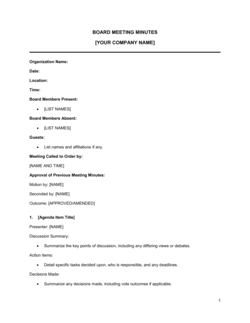
Board meeting minutes record the proceedings of a full board meeting β€” agenda items, discussions, votes, and attendees. A board resolution is a focused document recording a single specific board action and is typically attached to the minutes as an exhibit or adopted as a standalone written consent. Minutes provide context; the resolution is the operative authorization document.

vs Corporate Governance Policy

A corporate governance policy is a broad framework document addressing the board's structure, roles, and oversight responsibilities across all governance topics. A campaign contribution limitations resolution is a targeted action document adopting one specific policy within that broader framework. The governance policy sets principles; this resolution enacts a concrete rule with dollar thresholds and approval requirements.

vs Code of Ethics and Business Conduct

A code of ethics sets general standards of conduct for all employees and officers, including sections on political activity. A campaign contribution limitations resolution goes further by establishing specific dollar limits, approval tiers, a designated compliance officer, recordkeeping requirements, and board oversight β€” making it a compliance control document rather than a general principles statement.

vs Lobbying Policy

A lobbying policy governs the company's engagement with legislators and regulators β€” direct advocacy, registered lobbyist relationships, and grassroots campaigns. A campaign contribution limitations policy governs financial contributions to political campaigns, parties, and PACs. The two policies are complementary but address distinct legal frameworks and disclosure regimes, and should be maintained as separate documents.

Industry-specific considerations

Financial Services

Banks and investment firms face heightened scrutiny from regulators and proxy advisors on political spending, making a board-authorized policy essential for governance ratings and regulatory examinations.

Healthcare

Healthcare companies with significant lobbying activity and PAC programs use this resolution to establish board-level controls that separate corporate treasury spending from voluntary PAC contributions.

Professional Services

Law firms, accounting firms, and consulting organizations adopt contribution limitations policies to manage partner-level political activity and protect the firm's nonpartisan client relationships.

Manufacturing

Manufacturers with unionized workforces and active trade association memberships use this policy to document the separation between corporate political spending and union-related political activity.

Template vs pro β€” what fits your needs?

PathBest forCostTime
Use the templatePrivate companies and nonprofits establishing a written political contribution policy for the first time with straightforward PAC or no-PAC structuresFree1–2 hours
Template + professional reviewPublic companies, companies with active PACs, or organizations operating in multiple states with varying campaign finance restrictions$500–$1,500 for a compliance counsel or election law attorney review3–5 business days
Custom draftedLarge public companies with significant PAC programs, active lobbying, and institutional shareholder scrutiny requiring a fully bespoke governance framework$3,000–$8,000 for election law counsel2–4 weeks

Glossary

Board Resolution
A formal written record of a decision made by a company's board of directors, which becomes part of the official corporate minute book.
Campaign Contribution
Any monetary or in-kind donation made to a political candidate, party committee, ballot measure campaign, or political organization.
Political Action Committee (PAC)
A registered organization that pools contributions from employees, shareholders, or other sources to make donations to political campaigns within FEC-regulated limits.
Separate Segregated Fund (SSF)
The legal structure through which a corporation or union establishes and administers a PAC, funded by voluntary contributions from eligible individuals β€” not corporate treasury funds.
FEC (Federal Election Commission)
The independent US federal agency responsible for enforcing campaign finance law, including limits on contributions to federal candidates and disclosure requirements.
Corporate Treasury Contribution
A political donation made directly from a corporation's general operating funds β€” prohibited for federal elections in the US and restricted under many state laws.
Trade Association Political Spending
Dues or payments made to a trade association that are subsequently used for political advertising, lobbying, or candidate support β€” subject to disclosure under some state and federal rules.
Recitals
The 'whereas' clauses at the opening of a resolution that state the facts, authority, and rationale supporting the board's action.
Threshold Approval Requirement
A governance control requiring contributions above a stated dollar amount to receive explicit board or committee approval before being made.
Proxy Advisor
A firm (such as ISS or Glass Lewis) that provides institutional investors with voting recommendations on shareholder proposals, including those related to corporate political spending.
Independent Expenditure
A political expenditure made without coordination with a candidate or party β€” subject to separate FEC reporting rules and not counted against contribution limits.
Bundling
The practice of collecting and forwarding multiple individual contributions to a candidate or committee, which triggers separate FEC registration and disclosure obligations.

Part of your Business Operating System

This document is one of 3,000+ business & legal templates included in Business in a Box.

  • Fill-in-the-blanks β€” ready in minutes
  • 100% customizable Word document
  • Compatible with all office suites
  • Export to PDF and share electronically

Create your document in 3 simple steps.

From template to signed document β€” all inside one Business Operating System.
1
Download or open template

Access over 3,000+ business and legal templates for any business task, project or initiative.

2
Edit and fill in the blanks with AI

Customize your ready-made business document template and save it in the cloud.

3
Save, Share, Send, Sign

Share your files and folders with your team. Create a space of seamless collaboration.

Save time, save money, and create top-quality documents.

β˜…β˜…β˜…β˜…β˜…

"Fantastic value! I'm not sure how I'd do without it. It's worth its weight in gold and paid back for itself many times."

Managing Director Β· Mall Farm
Robert Whalley
Managing Director, Mall Farm Proprietary Limited
β˜…β˜…β˜…β˜…β˜…

"I have been using Business in a Box for years. It has been the most useful source of templates I have encountered. I recommend it to anyone."

Business Owner Β· 4+ years
Dr Michael John Freestone
Business Owner
β˜…β˜…β˜…β˜…β˜…

"It has been a life saver so many times I have lost count. Business in a Box has saved me so much time and as you know, time is money."

Owner Β· Upstate Web
David G. Moore Jr.
Owner, Upstate Web

Run your business with a system β€” not scattered tools

Stop downloading documents. Start operating with clarity. Business in a Box gives you the Business Operating System used by over 250,000 companies worldwide to structure, run, and grow their business.

Start freeΒ Β·Β No credit card required