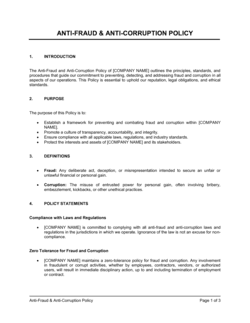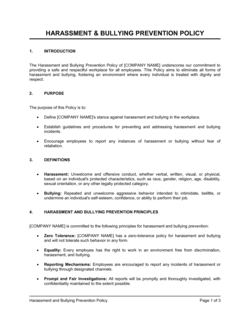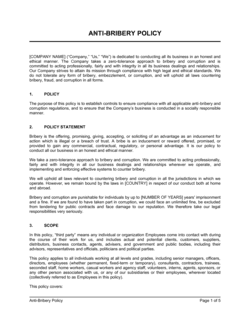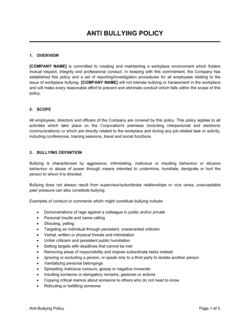
Anti Harassment Policy Template

Free Word download β€’ Edit online β€’ Save & share with Drive β€’ Export to PDF

4 pagesβ€’20–30 min to fillβ€’Difficulty: Standard
Learn more ↓
FreeAnti Harassment Policy Template

At a glance

What it is
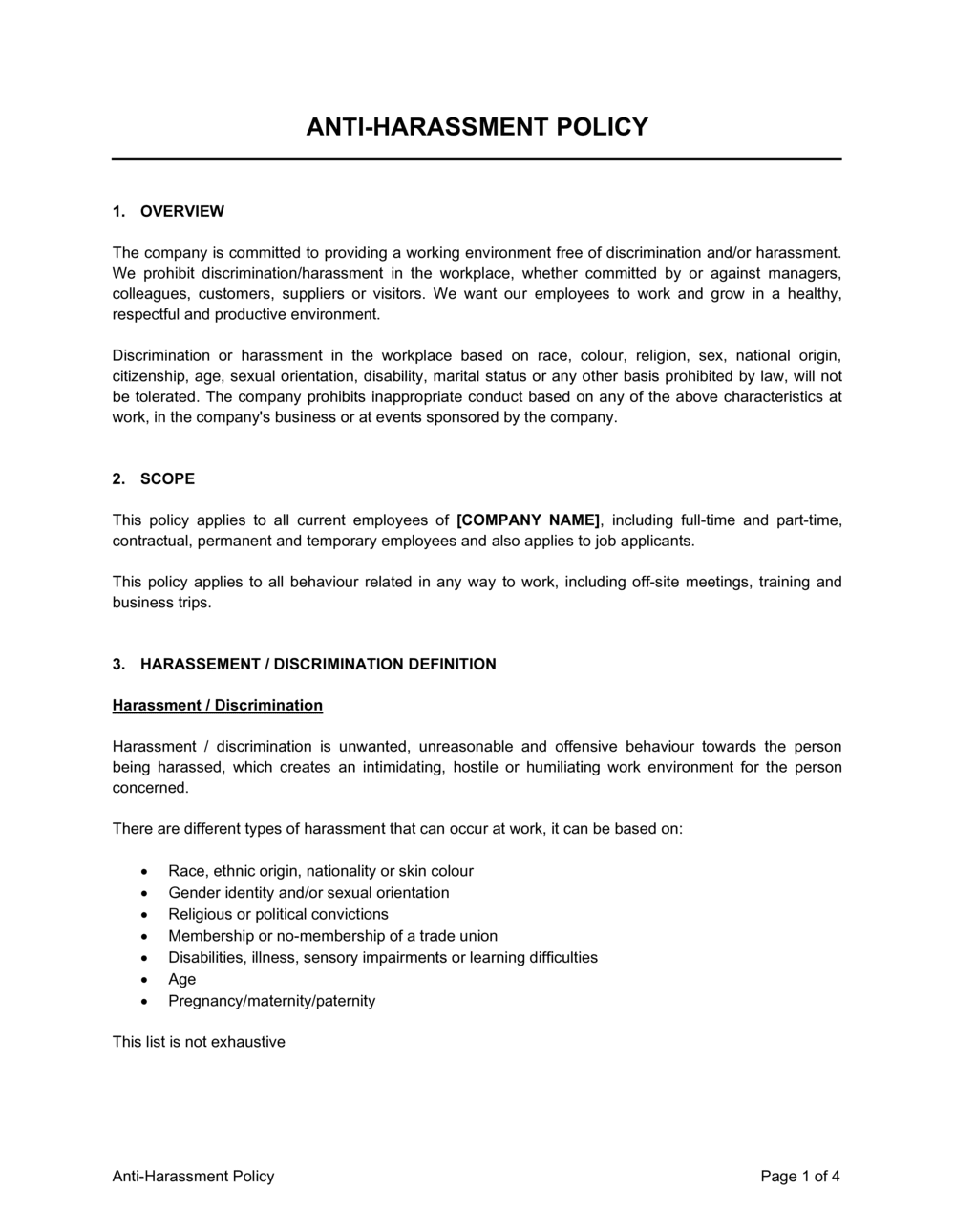
An Anti Harassment Policy is a formal workplace document that defines prohibited conduct, establishes reporting procedures, and outlines how complaints are investigated and resolved. This free Word download gives employers a structured, editable template they can tailor to their organization and share with all employees as part of onboarding or an employee handbook.
When you need it
Use it when onboarding new employees, updating your employee handbook, responding to a complaint that reveals a policy gap, or meeting a jurisdictional requirement to have a written harassment policy in place.
What's inside
Policy purpose and scope, definitions of harassment and prohibited conduct, examples of unacceptable behavior, reporting channels, investigation procedures, confidentiality protections, corrective action guidelines, and anti-retaliation provisions.

What is an Anti Harassment Policy?

An Anti Harassment Policy is a formal workplace document that defines prohibited conduct based on protected characteristics, establishes clear channels for reporting incidents, and outlines the process the employer follows to investigate complaints and impose corrective action. It applies to all employees, contractors, and third parties in any work-related context β€” including remote work, company events, and digital communications. Unlike a general code of conduct, an anti harassment policy focuses specifically on conduct tied to legally protected characteristics such as race, sex, religion, disability, age, and national origin, and it creates an enforceable internal framework for addressing that conduct consistently and fairly.

Why You Need This Document

Without a written anti harassment policy, your organization has no documented standard to point to when a complaint arises, no defined process for investigating it, and no evidence that employees were put on notice of the rules. In jurisdictions where written policies are mandated β€” including California, New York, and Illinois β€” operating without one exposes the company to regulatory fines on top of underlying liability. Even where no statute requires it, a documented policy is the foundation of the Faragher-Ellerth affirmative defense under federal law, which can substantially limit employer liability when the company can show it took reasonable steps to prevent and promptly correct harassment. Complaints that land in an organization with no policy, no reporting channel, and no investigation process are far more likely to escalate to agency charges or litigation β€” and far more expensive to resolve when they do. This template gives you a compliant, customizable starting point you can tailor and distribute in under two hours.

Which variant fits your situation?

If your situation is…Use this template
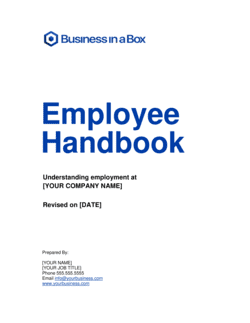
Including harassment policy as part of a full employee handbookEmployee Handbook
Addressing sexual harassment specifically with training acknowledgmentSexual Harassment Policy
Documenting a formal complaint after an incident occursEmployee Complaint Form
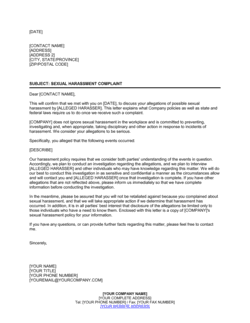
Outlining investigation steps and findings in writingHR Investigation Report
Recording disciplinary action taken following a policy violationEmployee Warning Letter
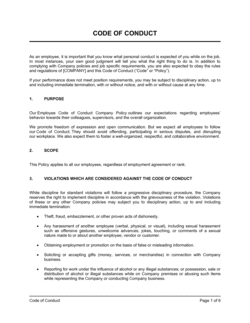
Setting broader standards of professional conduct in the workplaceCode of Conduct Policy
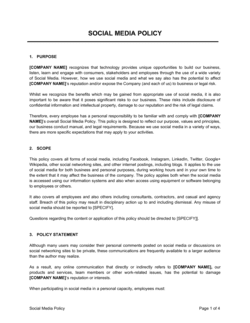
Addressing online and social media harassment among employeesSocial Media Policy

Common mistakes to avoid

❌ Limiting scope to full-time employees only

Why it matters: Contractors, interns, vendors, and customers can both commit and experience harassment. A policy that covers only employees leaves the employer unprotected in the most common third-party scenarios.

Fix: Explicitly state that the policy applies to all individuals in any work-related context, including remote settings, off-site events, and communications on personal devices.
❌ Single reporting channel when the manager is the respondent

Why it matters: Employees who are harassed by their own manager will not report through a channel that routes to that manager. A single-channel policy silences complaints at the source.

Fix: Provide at least two independent reporting options β€” HR direct, an anonymous hotline, or a senior leader outside the employee's chain of command.

❌ Promising complete confidentiality

Why it matters: Investigators must share complaint details with the respondent and witnesses to conduct a fair investigation. A blanket confidentiality promise creates a false expectation and can expose the employer to breach-of-promise claims.

Fix: State that confidentiality will be maintained to the extent practicable, but that some disclosure is necessary to investigate and resolve complaints.

❌ No defined investigation timeline

Why it matters: Without deadlines, investigations stall for weeks, complainants lose confidence in the process, and delayed findings are harder to defend in litigation or agency proceedings.

Fix: Set explicit deadlines for each investigation stage: acknowledgment within 2 business days, investigator assigned within 5, findings issued within 30–45 business days.

❌ Omitting the anti-retaliation provision

Why it matters: Employees who fear job loss, demotion, or social exclusion after reporting will stay silent. Retaliation claims are among the most common and costly employment liability exposures in the US.

Fix: Include a standalone anti-retaliation section that names specific prohibited retaliatory acts and states that retaliation is itself a terminable offense.

❌ Distributing the policy without collecting signed acknowledgments

Why it matters: Without proof that each employee received and read the policy, the employer cannot establish that the employee was on notice β€” a key element in defending harassment liability.

Fix: Require a dated, signed acknowledgment from every employee at hire and each time the policy is materially updated. Store signed copies in personnel files.

The 10 key sections, explained

Purpose and scope

Definitions of prohibited conduct

Examples of unacceptable behavior

Reporting procedures

Investigation procedures

Confidentiality protections

Anti-retaliation provision

Corrective action

Manager responsibilities

Policy acknowledgment and training

How to fill it out

  1. 1

    Enter company name and effective date

    Replace all [COMPANY NAME] placeholders with your registered legal entity name and set the policy effective date at the top of the document.

    πŸ’‘ Use your full legal entity name β€” not a trade name β€” so the policy is tied unambiguously to the employing entity.

  2. 2

    Confirm the list of protected characteristics

    Review the listed protected characteristics and add any required by your state or local jurisdiction. Federal law covers race, color, religion, sex, national origin, age, disability, and genetic information β€” many states add sexual orientation, gender identity, marital status, and others.

    πŸ’‘ Check your state's fair employment practices law before finalizing this list β€” omitting a locally protected category creates a compliance gap.

  3. 3

    Set reporting channels and contact details

    Insert the names or titles of designated complaint recipients, the HR email address, and the phone number or link for any anonymous reporting tool. Confirm at least two channels so there is always an alternative when the direct manager is the respondent.

    πŸ’‘ Test each reporting channel before the policy goes live to confirm they are actively monitored.

  4. 4

    Define investigation timelines

    Fill in the acknowledgment window (typically 2 business days), the investigator assignment deadline (typically 5 business days), and the target completion timeframe for the full investigation (typically 30–45 business days for complex cases).

    πŸ’‘ Shorter timelines signal seriousness to complainants and reduce the risk of evidence degrading or witnesses becoming unavailable.

  5. 5

    Tailor the corrective action language

    Confirm that the corrective action section reflects your actual disciplinary framework and that it does not conflict with any applicable collective bargaining agreement or statutory requirements.

    πŸ’‘ Include explicit language that severe or violent conduct may result in immediate termination without following a progressive discipline sequence.

  6. 6

    Add manager reporting obligations

    Insert the specific timeframe within which managers must escalate complaints to HR β€” 24 hours is common β€” and name the HR contact they report to.

    πŸ’‘ Make clear that a manager's duty to report is triggered by what they observe, not just what is formally filed with them.

  7. 7

    Attach a signed acknowledgment form

    Append a one-page acknowledgment form for each employee to sign and date. Retain signed copies in each employee's personnel file.

    πŸ’‘ Collect digital acknowledgments through your HRIS if possible β€” they are timestamped automatically and easier to retrieve during an investigation or litigation hold.

  8. 8

    Schedule an annual policy review

    Set a calendar reminder to review and reissue the policy at least once per year and whenever applicable laws in your jurisdiction change.

    πŸ’‘ Track harassment-related legislative changes in your state at the start of each calendar year β€” several states update training and policy requirements annually.

Frequently asked questions

What is an anti harassment policy?

An anti harassment policy is a formal workplace document that defines what constitutes harassment, identifies the protected characteristics covered, establishes how employees report incidents, and explains how the company investigates and resolves complaints. It applies to all work-related interactions β€” in person, remote, and at company events β€” and sets out the consequences for confirmed violations.

Are employers legally required to have a written anti harassment policy?

Federal law does not mandate a written policy, but having one is a key factor in the Faragher-Ellerth affirmative defense, which can shield employers from liability in certain harassment claims. Many states β€” including California, New York, Illinois, and Maine β€” require written harassment policies and mandate periodic employee training. Check your state's fair employment practices law to confirm local requirements.

Who should the anti harassment policy apply to?

The policy should apply to everyone in a work-related context: full-time and part-time employees, contractors, interns, volunteers, vendors, and visitors. Coverage should extend to remote work, company-sponsored events, and communications on personal devices when the conduct affects the workplace. Limiting coverage to full-time employees on company premises leaves significant gaps.

What types of harassment should the policy cover?

At minimum, the policy should cover harassment based on all federally protected characteristics: race, color, religion, sex, national origin, age, disability, and genetic information. Most employers add state-protected categories β€” commonly sexual orientation, gender identity, pregnancy, and marital status. The policy should cover verbal, physical, visual, and digital forms of harassment, including conduct through messaging apps and social media.

How should employees report harassment under this policy?

Employees should have at least two reporting channels available so there is always an alternative when their direct supervisor is the respondent. Common channels include a designated HR contact, an anonymous hotline, or a senior leader outside the employee's chain of command. The policy should identify each channel by name, email, and phone number so employees know exactly how to reach them.

How long should a harassment investigation take?

Most investigations should be completed within 30 to 45 business days for straightforward cases, with complex matters taking up to 60 days. The employer should acknowledge receipt of the complaint within 2 business days and assign an investigator within 5. Prolonged investigations erode complainant trust, allow evidence to degrade, and increase the risk of retaliation occurring during the process.

What is the difference between an anti harassment policy and a code of conduct?

An anti harassment policy focuses specifically on prohibited conduct based on protected characteristics, complaint and investigation procedures, and corrective action. A code of conduct is a broader document covering general professional behavior expectations β€” conflicts of interest, confidentiality, use of company assets, and overall workplace standards. Many employers include the harassment policy as a dedicated section within a broader code of conduct.

Should employees sign an acknowledgment of the anti harassment policy?

Yes. A signed acknowledgment is the employer's primary evidence that the employee received and understood the policy. Without it, an employee can credibly claim they were never informed of the rules or reporting channels, which undermines both the Faragher-Ellerth defense and any disciplinary action taken for a violation. Collect acknowledgments at hire and whenever the policy is materially revised.

Can this policy template be used as a standalone document or only as part of a handbook?

It works as a standalone document distributed at onboarding or posted on an internal portal. It can also be embedded directly into an employee handbook as a dedicated section. Either approach is valid; the more important factor is that all employees receive, read, and acknowledge it β€” regardless of whether it lives in a handbook or as a separate file.

How this compares to alternatives

vs Code of Conduct Policy

A code of conduct covers broad professional behavior standards across all workplace contexts β€” conflicts of interest, asset use, and general conduct. An anti harassment policy is a focused document addressing prohibited conduct based on protected characteristics, complaint procedures, and investigation steps. Many organizations use both: the code of conduct sets overall standards; the harassment policy provides the detailed process for addressing a specific and legally significant category of misconduct.

vs Employee Handbook

An employee handbook is a comprehensive reference covering all employment policies β€” benefits, PTO, performance management, and conduct expectations. An anti harassment policy is a standalone document that can be incorporated into the handbook or distributed independently. If speed of implementation matters, deploying the policy first and adding it to a future handbook revision is a practical approach.

vs Disciplinary Action Policy

A disciplinary action policy governs the process and sequence of consequences for any policy violation, including attendance and performance issues. An anti harassment policy addresses a specific category of misconduct and typically reserves the right to skip progressive discipline steps for severe conduct. The two documents work together: the harassment policy triggers the investigation; the disciplinary policy governs what happens after a finding is made.

vs Workplace Violence Prevention Policy

A workplace violence prevention policy addresses physical threats, intimidation, and acts of violence β€” conduct that may overlap with but goes beyond the scope of harassment. An anti harassment policy covers a wider range of protected-characteristic-based conduct that need not involve physical threat. Organizations in higher-risk industries often maintain both policies as complementary documents.

Industry-specific considerations

Technology / SaaS

Remote and distributed teams require explicit coverage of digital harassment across Slack, email, video calls, and social media channels.

Healthcare

Patient-to-staff harassment must be addressed alongside colleague-to-colleague conduct, with clear guidance on how clinical staff escalate incidents involving patients or family members.

Retail / Hospitality

High customer-facing exposure means third-party harassment from customers is a primary risk; the policy must empower front-line managers to remove or ban customers who engage in harassing conduct.

Professional Services

Client-site work and after-hours client entertainment create harassment risks outside the physical office that the policy scope must explicitly address.

Manufacturing

Shift structures and physical proximity on the floor create distinct harassment vectors; supervisory power over scheduling makes the anti-retaliation and alternative reporting provisions especially critical.

Education

Staff-to-staff and staff-to-student harassment both require coverage, with separate reporting pathways aligned to Title IX obligations where applicable.

Template vs pro β€” what fits your needs?

PathBest forCostTime
Use the templateSmall and mid-size businesses establishing a written policy for the first time or updating an outdated versionFree1–2 hours to customize and distribute
Template + professional reviewEmployers in states with mandatory harassment policy or training requirements, or organizations with 50+ employees$300–$800 for an HR consultant or employment attorney review3–5 business days
Custom draftedHeavily regulated industries, multi-state employers, or organizations that have experienced a formal harassment complaint or agency charge$1,000–$3,000+ for employment counsel1–3 weeks

Glossary

Harassment
Unwelcome conduct based on a protected characteristic that creates a hostile, intimidating, or offensive work environment.
Protected characteristic
A personal attribute β€” such as race, sex, religion, disability, age, or national origin β€” that employment law prohibits using as the basis for adverse treatment.
Hostile work environment
A workplace condition created by severe or pervasive harassment that unreasonably interferes with an employee's ability to do their job.
Quid pro quo harassment
A form of sexual harassment where a person in authority conditions a job benefit or threatens a job detriment based on an employee's acceptance or rejection of sexual advances.
Complainant
The individual who reports experiencing or witnessing harassing conduct.
Respondent
The individual against whom a harassment complaint is made.
Retaliation
Any adverse action taken against an employee for reporting harassment, participating in an investigation, or opposing prohibited conduct.
Corrective action
Disciplinary or remedial measures the employer takes in response to a substantiated harassment finding, ranging from a written warning to termination.
Confidentiality
The obligation to limit disclosure of complaint details to those directly involved in investigation and resolution, to the extent practicable.
Third-party harassment
Harassing conduct directed at employees by customers, vendors, contractors, or other non-employees that the employer has a duty to address.

Part of your Business Operating System

This document is one of 3,000+ business & legal templates included in Business in a Box.

  • Fill-in-the-blanks β€” ready in minutes
  • 100% customizable Word document
  • Compatible with all office suites
  • Export to PDF and share electronically

Create your document in 3 simple steps.

From template to signed document β€” all inside one Business Operating System.
1
Download or open template

Access over 3,000+ business and legal templates for any business task, project or initiative.

2
Edit and fill in the blanks with AI

Customize your ready-made business document template and save it in the cloud.

3
Save, Share, Send, Sign

Share your files and folders with your team. Create a space of seamless collaboration.

Save time, save money, and create top-quality documents.

β˜…β˜…β˜…β˜…β˜…

"Fantastic value! I'm not sure how I'd do without it. It's worth its weight in gold and paid back for itself many times."

Managing Director Β· Mall Farm
Robert Whalley
Managing Director, Mall Farm Proprietary Limited
β˜…β˜…β˜…β˜…β˜…

"I have been using Business in a Box for years. It has been the most useful source of templates I have encountered. I recommend it to anyone."

Business Owner Β· 4+ years
Dr Michael John Freestone
Business Owner
β˜…β˜…β˜…β˜…β˜…

"It has been a life saver so many times I have lost count. Business in a Box has saved me so much time and as you know, time is money."

Owner Β· Upstate Web
David G. Moore Jr.
Owner, Upstate Web

Run your business with a system β€” not scattered tools

Stop downloading documents. Start operating with clarity. Business in a Box gives you the Business Operating System used by over 250,000 companies worldwide to structure, run, and grow their business.

Start freeΒ Β·Β No credit card required