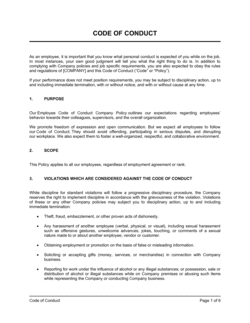
Equal Opportunity Policy Template

Free Word download β€’ Edit online β€’ Save & share with Drive β€’ Export to PDF

3 pagesβ€’20–30 min to fillβ€’Difficulty: Standard
Learn more ↓
FreeEqual Opportunity Policy Template

At a glance

What it is
An Equal Opportunity Policy is a formal written statement that commits an organization to making employment decisions β€” hiring, promotion, compensation, discipline, and termination β€” based on merit rather than protected characteristics such as race, sex, age, disability, or religion. This free Word download gives you a structured, ready-to-edit template you can tailor to your organization and export as PDF for inclusion in your employee handbook or HR policy library.
When you need it
Use it when onboarding your first employees, updating your employee handbook, responding to a regulatory audit, or formalizing HR practices ahead of a funding round or government contract bid. Most jurisdictions require or strongly recommend a written EEO policy for any organization with five or more employees.
What's inside
A policy statement and scope, a list of protected characteristics, hiring and promotion commitments, anti-harassment and anti-discrimination provisions, reasonable accommodation procedures, a complaint and investigation process, and an enforcement and non-retaliation clause.

What is an Equal Opportunity Policy?

An Equal Opportunity Policy is a formal written statement committing an organization to making every employment decision β€” including recruiting, hiring, promotion, compensation, training, discipline, and termination β€” based on qualifications, performance, and legitimate business criteria, without regard to protected personal characteristics such as race, sex, age, religion, national origin, or disability. It establishes the legal baseline for non-discrimination across the employment relationship, identifies protected classes, sets out procedures for requesting accommodations and reporting complaints, and defines consequences for violations. For most employers, it is both a standalone HR document and a foundational section of the employee handbook.

Why You Need This Document

Operating without a written equal opportunity policy leaves your organization exposed on multiple fronts simultaneously. Regulators treat the absence of a documented policy as evidence of systemic indifference β€” and that inference can turn a single employee complaint into a pattern-of-discrimination investigation. Without a formal complaint procedure, employees who experience discrimination have no internal option and go directly to the EEOC or a plaintiff's attorney, removing any chance of early resolution. Banks, institutional investors, and government contract officers now routinely request written HR policies during due diligence, and the absence of an EEO policy can disqualify a bid or delay a funding close. This template gives you a professionally structured, ready-to-customize policy that covers protected classes, accommodation procedures, a two-channel complaint process, and a non-retaliation clause β€” everything you need to meet baseline compliance and demonstrate a genuine commitment to fair employment practice.

Which variant fits your situation?

If your situation is…Use this template
General workforce covering all employment decisionsEqual Opportunity Policy
Organization with 15+ employees subject to Title VII and ADAEqual Employment Opportunity (EEO) Policy β€” US Extended
Federal contractor subject to OFCCP affirmative action requirementsAffirmative Action Plan
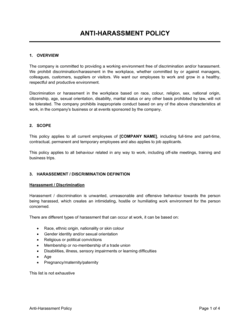
Policy focused specifically on preventing workplace harassmentAnti-Harassment Policy
Broader HR policy covering all conduct and workplace behaviorCode of Conduct
Documenting specific accommodations for employees with disabilitiesReasonable Accommodation Request Form
Comprehensive people policy document for new hiresEmployee Handbook

Common mistakes to avoid

❌ Listing only federally protected classes

Why it matters: State and local laws frequently extend protection to additional characteristics. An employee in a state that protects marital status or criminal history can still prevail on a discrimination claim even if the federal categories are covered.

Fix: Research each jurisdiction where you have employees and add state-specific protected classes to the policy before finalizing it.
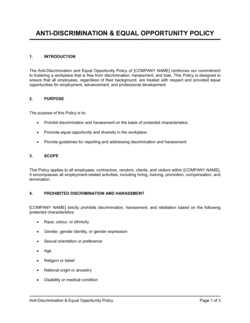

❌ Single complaint reporting contact

Why it matters: If the designated contact is the subject of the complaint, employees have no internal recourse β€” most will go directly to the EEOC or a plaintiff's attorney rather than escalate internally.

Fix: Designate at least two reporting options β€” an HR contact and an alternative such as the CEO, a board member, or an anonymous hotline.

❌ Publishing the policy without collecting acknowledgments

Why it matters: Without a signed or electronic acknowledgment, an employee can credibly claim they never received or read the policy, undermining disciplinary actions and litigation defenses.

Fix: Require a dated acknowledgment from every employee at hire and each time the policy is materially updated. Store acknowledgments in each employee's file.

❌ No named owner or review schedule

Why it matters: Policies without an owner and review date become outdated and unenforceable. Regulators specifically look for evidence that policies are actively maintained, not just filed.

Fix: Assign a specific role (e.g., HR Director) as policy owner and calendar an annual review. Document each review with a date and the name of the reviewer.

❌ Defining harassment only in sexual terms

Why it matters: Race-based, age-based, disability-based, and religion-based harassment are equally prohibited under federal and most state law and generate as many EEOC charges as sexual harassment.

Fix: Broaden the harassment definition to cover all protected characteristics and include examples of each type β€” verbal, visual, and physical β€” in the policy language.

❌ Omitting the interactive accommodation process

Why it matters: Simply approving or denying accommodation requests without documenting an interactive process exposes the organization to ADA liability even when the outcome would have been the same.

Fix: Describe the specific steps β€” request intake, HR assessment, manager consultation, written decision β€” and reference any accommodation request form employees should use.

The 10 key sections, explained

Policy statement and commitment

Scope and applicability

Protected characteristics

Hiring and promotion commitments

Anti-harassment provisions

Reasonable accommodation procedure

Complaint and investigation process

Non-retaliation clause

Enforcement and accountability

Acknowledgment and distribution

How to fill it out

  1. 1

    Insert your organization's legal name and locations

    Replace all instances of [COMPANY NAME] with your registered legal entity name. If the policy covers multiple jurisdictions, list each location or note that it applies to all company locations globally.

    πŸ’‘ Use the exact legal entity name β€” not a trade name β€” so the policy is enforceable on behalf of the correct employer.

  2. 2

    Customize the protected characteristics list

    Start with the federally mandated categories, then add any state or local protected classes applicable to your locations. Common additions include marital status, sexual orientation (where not federally covered), criminal history, and source of income.

    πŸ’‘ Cross-reference the EEOC protected categories plus your state's fair employment agency list β€” a 15-minute check now prevents a costly omission later.

  3. 3

    Designate the complaint reporting contacts

    Name at least two complaint recipients β€” a primary HR contact and an alternative (such as a senior manager or board member) for cases where the HR contact is the subject of the complaint.

    πŸ’‘ Include both a name/title and a direct email address so employees know exactly how to reach each contact without going through a supervisor.

  4. 4

    Define your investigation timeline

    Fill in the specific number of business days for acknowledging a complaint, completing an investigation, and communicating the outcome. Common benchmarks: acknowledge within 2 business days, complete investigation within 20–30 business days.

    πŸ’‘ Shorter stated timelines create legal obligations β€” only commit to timelines your HR capacity can reliably meet.

  5. 5

    Describe the accommodation request process

    Name the person who receives accommodation requests, identify any forms required, and describe the interactive process steps β€” intake, assessment, decision, and documentation.

    πŸ’‘ Reference your accommodation request form by name if you have one; employees are far more likely to use a formal process when they know a specific form exists.

  6. 6

    Set the acknowledgment method and deadline

    Decide whether acknowledgment will be a wet signature, an electronic signature, or a click-through confirmation in your HRIS. Enter the number of days new hires have to complete it.

    πŸ’‘ Electronic acknowledgment through an HRIS creates a timestamped audit trail that is far easier to produce in litigation than paper signature pages.

  7. 7

    Add the annual review date and policy owner

    Enter a specific calendar date (e.g., January 15 each year) for the annual policy review and name the role responsible for conducting it.

    πŸ’‘ Calendar the review date immediately after finalizing the policy β€” a review that isn't scheduled won't happen.

  8. 8

    Integrate the policy into your employee handbook

    Insert the finalized policy into the HR or conduct section of your employee handbook and update the handbook's table of contents and version date.

    πŸ’‘ Keep the policy as a standalone document as well β€” auditors and regulators often request individual policies, not the full handbook.

Frequently asked questions

What is an equal opportunity policy?

An equal opportunity policy is a formal written commitment that an organization will make all employment decisions β€” hiring, promotion, compensation, discipline, and termination β€” based on merit and job-related criteria, without regard to protected characteristics such as race, sex, age, disability, or religion. It sets out the protected classes covered, the complaint procedure, and the consequences for violations. Most jurisdictions require or strongly recommend a written policy for any employer with five or more employees.

Is an equal opportunity policy legally required?

In the United States, federal law does not require a standalone written EEO policy for private employers, but the EEOC treats the absence of one as an aggravating factor in discrimination investigations. Employers with 15 or more employees are subject to Title VII, the ADA, and the ADEA β€” all of which are easier to defend when a written policy and complaint procedure exist. Many state laws and most government contracts explicitly require a written policy. Outside the US, requirements vary by country but a written policy is standard practice in the UK, Canada, and across the EU.

What protected characteristics should the policy cover?

At minimum, include all federally protected classes: race, color, religion, sex (including pregnancy, gender identity, and sexual orientation), national origin, age (40 or older), disability, genetic information, and veteran status. Then add any state or local protected classes applicable to your locations β€” common additions include marital status, source of income, criminal history, and political affiliation. Many organizations also voluntarily include categories not yet legally mandated as a DEI commitment.

What is the difference between an equal opportunity policy and an anti-harassment policy?

An equal opportunity policy covers the full spectrum of employment decisions β€” hiring, promotion, pay, and discipline β€” across all protected characteristics. An anti-harassment policy focuses specifically on prohibited conduct in the workplace, defining what constitutes harassment, how to report it, and how it will be investigated. The two documents complement each other and are typically included together in an employee handbook. Many organizations combine them into a single policy covering both EEO commitments and anti-harassment provisions.

How often should an equal opportunity policy be updated?

Review the policy at least once a year and whenever employment law changes at the federal, state, or local level. Trigger updates when your organization expands to a new jurisdiction, changes its reporting structure, or revises its complaint procedures. Document each review with a date and the reviewer's name, and re-distribute the updated policy to all employees with a new acknowledgment requirement.

What happens if an employee violates the equal opportunity policy?

The policy should state a range of disciplinary consequences β€” from a formal written warning for a first offense through suspension to termination for serious or repeated violations. The specific consequence depends on the severity of the conduct, whether it was a first incident, and whether the employee cooperated with the investigation. Documenting the investigation and the disciplinary decision consistently is as important as the policy language itself.

Do contractors and vendors need to follow the equal opportunity policy?

Best practice is to extend the policy's scope to contractors, interns, and third-party vendors who interact with your workforce, even if they are not direct employees. Harassment or discrimination by a contractor can still create liability for the host employer if the employer knew or should have known about the conduct and failed to act. Including contractors in the policy scope and communicating it to them at engagement is the most defensible approach.

What is the interactive accommodation process?

The interactive process is the back-and-forth dialogue between an employer and an employee (or applicant) requesting a disability or religious accommodation. It involves the employer gathering medical or other relevant information, assessing whether the requested accommodation is effective and feasible, considering alternatives if the first option creates undue hardship, and documenting the decision in writing. Skipping this process β€” even when the employer grants the accommodation β€” can itself constitute an ADA violation.

Should the equal opportunity policy be included in the employee handbook?

Yes β€” the EEO policy should appear in the HR or conduct section of the employee handbook so new hires encounter it during onboarding. It should also exist as a standalone document that can be provided to auditors, government agencies, and potential employees on request. Some organizations post it on their careers page as a signal to applicants. Keeping both versions current and consistent is important.

How this compares to alternatives

vs Anti-Harassment Policy

An anti-harassment policy focuses narrowly on prohibited workplace conduct β€” defining harassment, setting reporting procedures, and outlining investigation steps. An equal opportunity policy covers the full range of employment decisions, including hiring, promotion, pay, and termination. The two policies address different legal obligations and are typically maintained as separate documents within the same employee handbook.

vs Code of Conduct

A code of conduct governs overall employee behavior β€” ethics, conflicts of interest, confidentiality, and professional standards β€” across all business interactions. An equal opportunity policy is specifically focused on non-discrimination and accommodation in employment decisions. A code of conduct may reference the EEO policy but cannot replace it, as regulators and courts look for a standalone EEO commitment.

vs Employee Handbook

An employee handbook is the master HR policy document that incorporates the equal opportunity policy alongside dozens of other policies covering benefits, leave, compensation, and workplace conduct. The EEO policy should exist as both a section of the handbook and as a standalone document for audit and external disclosure purposes. Updating one requires updating the other to maintain consistency.

vs Diversity and Inclusion Policy

A diversity and inclusion policy goes beyond legal compliance to articulate proactive commitments β€” representation goals, DEI training programs, and inclusion initiatives. An equal opportunity policy establishes the legal baseline of non-discrimination. Most organizations need both: the EEO policy for legal defensibility and the D&I policy to signal organizational values and drive measurable progress.

Industry-specific considerations

Technology / SaaS

Fast-growing teams in competitive talent markets use the policy to signal inclusive hiring practices to candidates and satisfy investor ESG due diligence requests.

Healthcare

Patient-facing organizations must extend EEO principles to service delivery as well as employment, and state licensing bodies often review HR policies during facility audits.

Professional Services

Law firms, accounting firms, and consultancies face heightened scrutiny on promotion and partnership decisions, making documented EEO criteria essential for defending advancement practices.

Manufacturing

Government contract requirements under Executive Order 11246 mandate written affirmative action programs for federal contractors, with the EEO policy as a foundational document.

Template vs pro β€” what fits your needs?

PathBest forCostTime
Use the templateSmall and mid-size businesses formalizing HR policies in a single domestic jurisdictionFree30–60 minutes
Template + professional reviewOrganizations operating in multiple states, government contractors, or companies with 50+ employees subject to additional compliance requirements$200–$600 (HR consultant or employment attorney review)1–3 days
Custom draftedMultinational employers, federal contractors requiring affirmative action integration, or organizations responding to an active EEOC investigation$1,000–$3,500+1–3 weeks

Glossary

Protected Characteristic
A personal attribute β€” such as race, sex, age, disability, or religion β€” that employment law prohibits employers from using as a basis for employment decisions.
Equal Employment Opportunity (EEO)
The principle that all job applicants and employees must be evaluated on qualifications and performance, free from discrimination based on protected characteristics.
Disparate Treatment
Intentional discrimination where an employer treats an employee or applicant less favorably because of a protected characteristic.
Disparate Impact
A facially neutral employment policy that disproportionately disadvantages a protected group, even without discriminatory intent.
Reasonable Accommodation
A modification to a job, work environment, or the way work is performed that enables a qualified person with a disability or religious observance requirement to perform the role without undue hardship to the employer.
Undue Hardship
A significant difficulty or expense that would result from providing a reasonable accommodation, assessed relative to the employer's size, resources, and operations.
Non-Retaliation Clause
A policy provision prohibiting adverse action against any employee who reports a discrimination or harassment complaint in good faith.
Affirmative Action
Proactive steps taken by an employer to increase representation of underrepresented groups in hiring and promotion β€” required for US federal contractors above a threshold contract value.
EEOC
The US Equal Employment Opportunity Commission β€” the federal agency that enforces federal workplace anti-discrimination laws and investigates employee complaints.
Bona Fide Occupational Qualification (BFOQ)
A narrow exception allowing an employer to consider a protected characteristic β€” such as sex or age β€” when it is genuinely necessary to perform the essential functions of a specific job.

Part of your Business Operating System

This document is one of 3,000+ business & legal templates included in Business in a Box.

  • Fill-in-the-blanks β€” ready in minutes
  • 100% customizable Word document
  • Compatible with all office suites
  • Export to PDF and share electronically

Create your document in 3 simple steps.

From template to signed document β€” all inside one Business Operating System.
1
Download or open template

Access over 3,000+ business and legal templates for any business task, project or initiative.

2
Edit and fill in the blanks with AI

Customize your ready-made business document template and save it in the cloud.

3
Save, Share, Send, Sign

Share your files and folders with your team. Create a space of seamless collaboration.

Save time, save money, and create top-quality documents.

β˜…β˜…β˜…β˜…β˜…

"Fantastic value! I'm not sure how I'd do without it. It's worth its weight in gold and paid back for itself many times."

Managing Director Β· Mall Farm
Robert Whalley
Managing Director, Mall Farm Proprietary Limited
β˜…β˜…β˜…β˜…β˜…

"I have been using Business in a Box for years. It has been the most useful source of templates I have encountered. I recommend it to anyone."

Business Owner Β· 4+ years
Dr Michael John Freestone
Business Owner
β˜…β˜…β˜…β˜…β˜…

"It has been a life saver so many times I have lost count. Business in a Box has saved me so much time and as you know, time is money."

Owner Β· Upstate Web
David G. Moore Jr.
Owner, Upstate Web

Run your business with a system β€” not scattered tools

Stop downloading documents. Start operating with clarity. Business in a Box gives you the Business Operating System used by over 250,000 companies worldwide to structure, run, and grow their business.

Free Forever PlanΒ Β·Β No credit card required