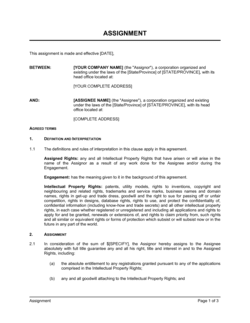
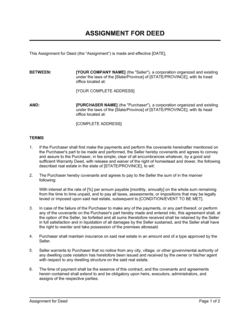
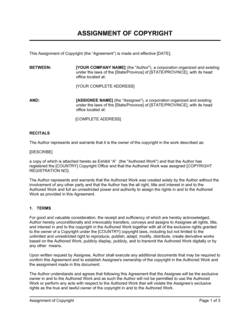
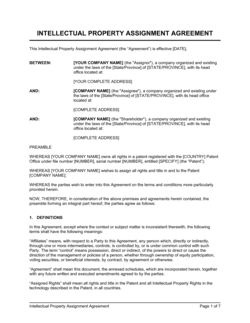
Assignment of a Claim for Damages Template

Free Word download • Edit online • Save & share with Drive • Export to PDF

1 page20–30 min to fillDifficulty: StandardSignature requiredLegal review recommended
Learn more ↓
FreeAssignment of a Claim for Damages Template

At a glance

What it is
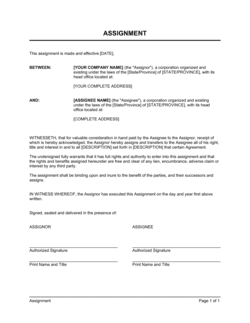
An Assignment of a Claim for Damages is a legally binding agreement by which one party (the assignor) transfers their right to pursue or recover compensation for a loss or injury to another party (the assignee). This template is a free Word download you can edit online and export as PDF, covering the full chain of transfer: identification of the claim, scope of rights assigned, representations by the assignor, and obligations of the assignee.
When you need it
Use it when a business or individual wants to sell, transfer, or otherwise convey their right to a monetary recovery — for example, after an insurance settlement, a commercial dispute, a personal injury matter, or a subrogation arrangement. It is also used in debt portfolio sales and litigation-funding transactions where a third party funds litigation in exchange for a share or all of the recovery.
What's inside
Identification of the assignor, assignee, and the underlying claim; a clear description of what rights are being transferred; representations and warranties about the claim's validity; consideration paid; obligations of each party post-assignment; anti-assignment and notice provisions; and governing law and dispute resolution clauses.

What is an Assignment of a Claim for Damages?

An Assignment of a Claim for Damages is a legally binding agreement through which one party — the assignor — transfers their right to pursue or receive compensation for a loss, injury, or breach to another party — the assignee. Once the assignment is executed and the opposing party is notified, the assignee steps into the assignor's legal position and holds the exclusive right to negotiate, litigate, settle, and collect the recovery. The document must precisely identify the claim being transferred, confirm the assignor's title to that claim, set out what consideration is being paid, and address how the parties will coordinate in pursuing the recovery. Unlike a general contract assignment, this document concerns only a monetary entitlement that has already arisen — typically from a breach of contract, a tortious act, an insurance event, or a business dispute.

Why You Need This Document

Without a properly executed assignment, a third party who steps in to fund or pursue your claim has no legally recognized right to the recovery — leaving them exposed and you potentially in breach of an agreement you made but cannot enforce. Courts require clear written evidence of a claim transfer before they will recognize a substituted party's standing; an undocumented oral agreement or informal email is routinely rejected. For insurance subrogation, debt purchases, and litigation finance transactions, the assignment is the instrument that converts an informal arrangement into an enforceable asset with a clear chain of title. A well-drafted assignment also protects the assignor: it caps their obligations, triggers indemnification if the claim is double-sold, and provides a clear record of exactly which rights were transferred and which — if any — were retained. This template gives both parties a professionally structured starting point that covers every essential clause, reducing the risk of scope disputes, priority conflicts, and costly post-execution litigation between assignor and assignee.

Which variant fits your situation?

If your situation is…Use this template
Insurer stepping into policyholder's shoes after paying a claimSubrogation Agreement
Selling a judgment already entered by a court to a third partyAssignment of Judgment
Transferring all contract rights, including damage claims, to a buyerAssignment of Contract
Partial transfer of a claim in exchange for litigation financingLitigation Funding Agreement
Assigning a personal injury claim settlement to a structured settlement purchaserStructured Settlement Transfer Agreement
Transferring intellectual property infringement damages claimsIP Assignment Agreement
Assigning a debt-collection right arising from a breach of contractDebt Assignment Agreement

Common mistakes to avoid

❌ Assigning a claim that is legally non-assignable

Why it matters: Some claims — particularly personal injury claims in certain jurisdictions and claims under contracts with valid anti-assignment clauses — cannot be transferred without the opposing party's consent. An assignment of a non-assignable claim is void, leaving the assignee with no rights and the assignor in breach.

Fix: Before signing, confirm whether the underlying claim or contract contains anti-assignment language, and check the governing jurisdiction's rules on assignability of tort versus contract claims.

❌ Omitting a detailed description of the assigned claim

Why it matters: A vague description — 'all claims against XYZ Corp' — can sweep in claims the assignor did not intend to transfer and creates disputes about scope that courts resolve unpredictably.

Fix: Identify the claim by incident date, claim or case number, nature of loss, and approximate value. Attach supporting documentation as exhibits.

❌ Failing to give timely notice to the opposing party

Why it matters: If the opposing party is not notified, they may pay the original assignor in good faith and discharge the debt. The assignee then has a claim against the assignor but loses the right to collect from the debtor.

Fix: Require the assignor to deliver written notice within a fixed number of business days of execution, and confirm receipt before treating the assignment as fully effective.

❌ No cooperation obligation on the assignor

Why it matters: After assignment, the assignor has little financial incentive to assist the assignee in prosecuting the claim. Without a written obligation, the assignee cannot compel cooperation — including access to evidence, witnesses, or records — and the claim may fail.

Fix: Include a specific post-assignment cooperation clause requiring the assignor to provide documents, execute further instruments, and make themselves available as a witness at the assignee's reasonable request.

❌ Ignoring whether the claim is already in litigation

Why it matters: If a lawsuit is already filed, most courts require a formal substitution of parties or joinder of the assignee. Failing to notify the court can invalidate any judgment in the assignee's favor or expose the assignor to sanctions.

Fix: Check whether any litigation is pending and, if so, consult counsel to file the appropriate court notice or motion to substitute parties before the assignment takes effect.

❌ No allocation of litigation costs between assignor and assignee

Why it matters: If the agreement is silent on who bears legal fees, expert costs, and court expenses, both parties will assume the other is responsible — leading to underfunded litigation and eventual disputes over the split of any recovery.

Fix: Specify in the consideration clause who funds ongoing litigation costs, whether advances are recoupable from first recovery, and how shared costs are allocated before the net proceeds split is applied.

The 10 key clauses, explained

Identification of Parties and Recitals

In plain language: Names the assignor and assignee as legal entities, and provides background context — the nature of the underlying claim, how it arose, and why the assignment is being made.

Sample language
This Assignment of Claim for Damages ('Agreement') is entered into as of [DATE] by and between [ASSIGNOR FULL LEGAL NAME] ('Assignor') and [ASSIGNEE FULL LEGAL NAME] ('Assignee'). WHEREAS, Assignor holds a claim for damages against [OPPOSING PARTY NAME] arising from [BRIEF DESCRIPTION OF INCIDENT OR BREACH] on or about [DATE OF INCIDENT].

Common mistake: Using a trade name instead of the registered legal entity for either party. Courts have dismissed assignments where the assignor named on the document does not match the party who actually holds the claim.

Description of the Assigned Claim

In plain language: Precisely identifies the claim being transferred — the opposing party, the nature of the loss or injury, the approximate amount claimed, any pending litigation, and relevant case or file numbers.

Sample language
Assignor hereby assigns to Assignee all right, title, and interest in and to the claim for damages against [OPPOSING PARTY] in connection with [DESCRIPTION OF LOSS], including but not limited to: [CASE NUMBER / CLAIM REFERENCE], filed on [DATE], with an estimated value of $[AMOUNT].

Common mistake: Describing the claim so broadly that it inadvertently captures unrelated claims against the same opposing party. Specificity protects both parties from scope disputes after execution.

Scope of Rights Transferred

In plain language: Defines exactly what is being transferred — all rights, or only specific rights such as the right to settle, the right to litigate, or the right to receive a capped portion of proceeds.

Sample language
The assignment includes the right to pursue, negotiate, settle, and collect all damages, costs, interest, and recoveries arising from the Assigned Claim. [OPTIONAL: Excluded from this assignment are [SPECIFIC RIGHTS RETAINED BY ASSIGNOR].] Assignee shall have sole authority to make all decisions regarding the prosecution of the claim.

Common mistake: Failing to specify whether the assignor retains any rights — especially the right to approve settlements. Ambiguity here routinely leads to disputes when the assignee accepts a settlement the assignor considers inadequate.

Consideration

In plain language: States what the assignee is paying or providing in exchange for the claim — a fixed sum, a percentage of recovery, an assumption of costs, or a combination.

Sample language
In consideration of this assignment, Assignee shall pay Assignor [OPTION A: the sum of $[AMOUNT] upon execution] [OPTION B: [X]% of all net recoveries received]. The parties acknowledge this consideration is adequate and receipt is hereby acknowledged.

Common mistake: Omitting consideration entirely or using nominal consideration ($1). Courts in several jurisdictions have found assignments without real consideration to be unenforceable, particularly when the assignor later contests the transfer.

Representations and Warranties of the Assignor

In plain language: The assignor confirms they own the claim outright, have not previously assigned it, it is not subject to a lien or court order restricting transfer, and they are not aware of any defenses the opposing party could raise that have not been disclosed.

Sample language
Assignor represents and warrants that: (a) Assignor is the sole owner of the Assigned Claim; (b) the Assigned Claim has not been previously assigned, pledged, or encumbered; (c) no court order restricts transfer of the Assigned Claim; and (d) Assignor has disclosed to Assignee all material facts known to Assignor regarding the Assigned Claim.

Common mistake: Omitting a warranty that the claim has not been previously assigned. Double-assignment — where the same claim is sold to two different buyers — occurs and creates costly priority disputes.

Obligations Post-Assignment

In plain language: Sets out what the assignor must do after signing — cooperate in prosecution of the claim, provide documents and testimony, execute further instruments, and refrain from interfering with the assignee's pursuit of the claim.

Sample language
Following execution, Assignor agrees to: (a) promptly provide Assignee with all documents, evidence, and records relating to the Assigned Claim; (b) cooperate fully and execute any further instruments reasonably requested; and (c) refrain from independently pursuing, settling, or releasing the Assigned Claim or any portion thereof.

Common mistake: No post-assignment cooperation obligation. The assignee often depends entirely on the assignor for evidence and witness testimony — without a written cooperation duty, the assignee has no contractual remedy if the assignor becomes unresponsive.

Notice of Assignment

In plain language: Requires the assignor to notify the opposing party (or debtor) of the transfer, specifying the method, timing, and form of that notice, and confirming that post-notice payments must be directed to the assignee.

Sample language
Assignor shall, within [X] business days of execution, deliver written notice of this assignment to [OPPOSING PARTY / DEBTOR NAME] at [ADDRESS], in substantially the form attached as Exhibit A. Following such notice, all payments and communications regarding the Assigned Claim shall be directed to Assignee.

Common mistake: Leaving notice as the assignee's responsibility without also imposing an obligation on the assignor. If the opposing party has no notice, they may discharge their obligation by paying the original assignor — and the assignee loses priority.

Indemnification

In plain language: Requires the assignor to hold the assignee harmless from losses arising out of any breach of the assignor's representations — particularly if the claim was previously assigned, is subject to a prior lien, or is legally non-assignable.

Sample language
Assignor shall indemnify, defend, and hold harmless Assignee from any claims, losses, costs, or expenses (including reasonable attorneys' fees) arising from any breach of Assignor's representations and warranties in this Agreement or from any prior encumbrance on the Assigned Claim.

Common mistake: No indemnification cap. Open-ended indemnity from a party with limited assets gives the assignee theoretical protection but no practical recovery. Consider a cap tied to the consideration paid.

Governing Law and Dispute Resolution

In plain language: Specifies which jurisdiction's law governs the agreement and how disputes between assignor and assignee are resolved — litigation, arbitration, or mediation — and where proceedings must take place.

Sample language
This Agreement shall be governed by the laws of [STATE / PROVINCE / COUNTRY]. Any dispute arising hereunder shall be resolved by [binding arbitration administered by [AAA/JAMS] in [CITY] / litigation in the courts of [JURISDICTION]], and the parties consent to exclusive jurisdiction therein.

Common mistake: Choosing a governing law that differs from the jurisdiction where the underlying claim will be litigated. Conflict-of-laws issues can invalidate or complicate the assignment in the court handling the main claim.

Entire Agreement and Severability

In plain language: Confirms that this document is the complete agreement between the parties on the subject matter, superseding any prior discussions, and that if one clause is unenforceable the rest of the agreement remains valid.

Sample language
This Agreement constitutes the entire agreement of the parties with respect to the assignment of the Assigned Claim and supersedes all prior negotiations and representations. If any provision is found unenforceable, the remaining provisions shall continue in full force and effect.

Common mistake: Omitting severability entirely. Without it, a court finding one clause unenforceable — such as an overbroad non-interference obligation — may void the entire assignment rather than severing only the offending provision.

How to fill it out

  1. 1

    Identify and verify the parties

    Enter the full registered legal names of both the assignor and assignee. Confirm the assignor is actually the party who holds the claim — check any underlying contract, court filing, or insurance policy to verify title.

    💡 If the assignor is a company, confirm the entity type and state of incorporation to ensure the signatory has authority to execute the assignment.

  2. 2

    Describe the underlying claim precisely

    Enter the opposing party's name, the nature of the loss or breach, the date it occurred, any case or claim reference numbers, and the approximate value. The more specific, the harder it is for the opposing party to dispute the scope of the transfer.

    💡 Attach supporting documents — demand letters, court filings, or insurer claim acknowledgments — as exhibits and reference them in this clause.

  3. 3

    Define the scope of rights being transferred

    Decide whether the entire claim is being assigned or only specified rights (e.g., right to collect but not to litigate). If the assignor retains any rights — such as approval over settlements above a threshold — state them explicitly.

    💡 If the assignor will still be a party of record in any pending litigation, note this expressly to avoid confusion about who controls litigation decisions.

  4. 4

    Set the consideration

    State the exact payment amount or percentage formula. If payment is contingent on recovery, define 'net recovery' to avoid disputes about whether litigation costs are deducted before the split is calculated.

    💡 A percentage-of-recovery formula should define the deductions (legal fees, court costs, expert fees) that reduce gross recovery to net recovery before the split applies.

  5. 5

    Complete the representations and warranties block

    Review each representation carefully with the assignor. If any warranty is not true — for example, if the claim is subject to a prior lien — disclose the exception in writing rather than deleting the warranty entirely.

    💡 Ask the assignor to confirm in writing whether there is any existing assignment, pledge, or court order affecting the claim before signing.

  6. 6

    Draft and send notice of assignment

    Prepare a notice letter addressed to the opposing party, referencing the claim by name and number, and deliver it within the timeframe specified in the agreement. Keep proof of delivery.

    💡 Send notice by certified mail or a documented electronic method so you have a dated receipt — priority between competing assignees is often determined by who gave notice first.

  7. 7

    Execute with authorized signatures

    Both parties must sign, and each signatory must have actual authority to bind their respective entity. For companies, a board resolution or officer certificate may be needed.

    💡 If the underlying claim is subject to litigation and a court must approve the assignment, file the assignment with the court before treating it as fully effective.

  8. 8

    Retain executed copies and update your records

    Store the fully executed agreement with all exhibits in your contract management system. Update any court filings, insurer records, or accounting entries to reflect the new holder of the claim.

    💡 Notify your attorney of record immediately so they can substitute the assignee into any pending proceedings — delay can cause the court to treat the assignor as still controlling the case.

Frequently asked questions

What is an assignment of a claim for damages?

An assignment of a claim for damages is a legal agreement by which one party — the assignor — transfers their right to pursue or receive compensation for a loss or injury to another party — the assignee. After the assignment is executed and notice is given, the assignee steps into the assignor's shoes and has the right to negotiate, litigate, settle, and collect the recovery. It is commonly used in insurance subrogation, litigation funding, and commercial debt transfers.

Are claims for damages always assignable?

No. Assignability depends on the nature of the claim and the governing jurisdiction. Contract-based damage claims are generally assignable in most common-law jurisdictions. Personal injury and defamation claims are often non-assignable because they are considered personal in nature — many US states, Canadian provinces, and UK courts will not enforce an assignment of a tort claim that is purely personal. Always check the applicable law and the underlying contract before executing an assignment.

What happens if the underlying contract has an anti-assignment clause?

An anti-assignment clause in the contract from which the claim arises can block the transfer without the other contracting party's consent. Assigning in violation of such a clause may make the assignment void or voidable and could constitute a breach of the underlying contract. Before signing, the assignor should review the original agreement for any restriction on assignment and obtain written consent from the other contracting party if required.

What consideration is required to make the assignment binding?

The assignment must be supported by real consideration — something of actual value — to be enforceable in most jurisdictions. This can be a fixed cash payment, a percentage of future recovery, an assumption of litigation costs, or a release of another obligation. Nominal consideration of $1 is generally sufficient in theory but is sometimes challenged in practice, particularly if the assignor later claims the transfer was unconscionable. Documenting genuine consideration with a realistic value is the safer approach.

What is the difference between an assignment of a claim and subrogation?

Subrogation is a specific legal doctrine — most common in insurance — where the insurer automatically steps into the policyholder's shoes after paying a loss, without requiring a formal assignment. An assignment of a claim is a voluntary contractual transfer that requires an executed agreement. Subrogation arises by operation of law or by policy provision; assignment arises by contract. Many insurers use a formal assignment agreement to supplement their subrogation rights and ensure clear documentation of the transfer.

What if the assigned claim is already being litigated?

If a lawsuit is already filed, the assignment does not automatically substitute the assignee as the plaintiff. In most jurisdictions, a motion to substitute parties or an order permitting joinder is required. Failing to notify the court can result in a judgment that technically runs in favor of the assignor — making enforcement by the assignee procedurally complicated. Consult litigation counsel promptly when a claim in active litigation is being assigned.

Can I assign only part of a claim for damages?

Yes. A partial assignment is possible — the assignor can transfer a defined percentage of the recovery while retaining the remainder. However, partial assignments can complicate litigation because both assignor and assignee may have standing to participate in the proceedings. Courts in some jurisdictions require all partial holders of a claim to be joined as parties. The assignment document should clearly address control of litigation decisions and settlement approval when rights are split.

Do I need a lawyer to prepare an assignment of a claim for damages?

For straightforward commercial claim transfers between businesses, a high-quality template will handle the core structure. Legal review is strongly recommended when the claim is already in active litigation, when it involves personal injury (given assignability restrictions), when the opposing party is a government entity, or when the value of the claim is material. An attorney review for a claim-assignment document typically costs $400–$1,200 and is well justified for any claim above $25,000.

How this compares to alternatives

vs Assignment of Contract

An assignment of contract transfers all rights and obligations under a living contract — including future performance duties — to a new party. An assignment of a claim for damages transfers only the right to recover compensation for a past breach or loss. Use an assignment of contract when the underlying agreement is still active; use an assignment of a claim when the only remaining right is a monetary recovery.

vs Subrogation Agreement

Subrogation arises automatically by law or insurance policy provision when an insurer pays a covered loss; a subrogation agreement documents and formalizes that transfer. An assignment of a claim is a stand-alone voluntary transfer that can be used by any party, not just insurers. When both subrogation rights and a formal assignment exist, the assignment provides stronger contractual documentation of the transfer.

vs Assignment of Account Receivable

An assignment of accounts receivable transfers the right to collect undisputed invoiced amounts owed under completed contracts — a clean financial asset. An assignment of a claim for damages transfers a disputed or contingent right to recover compensation, which carries higher legal risk and typically requires litigation or negotiation to realize. The two documents serve different financing and recovery purposes.

vs Debt Assignment Agreement

A debt assignment transfers an acknowledged debt obligation — typically a loan or overdue invoice — from one creditor to another. An assignment of a claim for damages transfers a right that must still be established through negotiation or litigation; the amount is not yet determined or acknowledged. Damages claims carry significantly higher uncertainty and require different representations about claim validity and potential defenses.

Industry-specific considerations

Insurance

Insurers routinely take formal assignments of policyholders' damage claims against negligent third parties to supplement statutory subrogation rights and ensure clear evidentiary standing in recovery litigation.

Financial Services

Banks, debt purchasers, and factoring companies acquire portfolios of damage claims and contractual breach rights as financial assets, requiring precise assignment documentation to establish chain of title for enforcement.

Construction

Contractors and subcontractors assign defect and delay damage claims to project financiers or legal funders, with cooperation obligations critical because the assignor holds the key technical evidence and witness relationships.

Professional Services

Law firms acting on contingency and litigation finance companies take assignments of commercial dispute claims, making scope-of-rights and cost-allocation clauses the most negotiated provisions in the transaction.

Healthcare

Healthcare providers and insurers assign medical expense damage claims arising from third-party liability incidents, subject to state-specific anti-assignment statutes that often restrict personal injury claim transfers.

Real Estate

Property owners and developers assign construction defect and contractor breach claims to buyers or investors, typically as part of a property sale or portfolio transaction, with disclosure of known defenses essential.

Jurisdictional notes

United States

Under the Uniform Commercial Code and common law, contract-based damage claims are generally freely assignable unless the underlying contract prohibits it. Personal injury claims, however, are non-assignable in many states — including California, New York, and Texas — under anti-champerty and maintenance doctrines. State-specific rules on notice priority (first-to-notify vs. first-to-execute) vary; consult the law of the governing state before relying on timing for priority.

Canada

Each province has its own Assignments of Book Debts Act or equivalent legislation governing the priority and registration of assignments. Ontario and most common-law provinces permit assignment of contract damage claims but restrict personal injury claim assignments under maintenance and champerty principles. Quebec, as a civil law jurisdiction, has distinct rules under the Civil Code governing the transfer of claims (cession de créance) and requires notification to the debtor to be effective against third parties.

United Kingdom

Under the Law of Property Act 1925, a legal assignment of a chose in action requires the assignment to be absolute, in writing, and supported by express notice to the debtor. Equitable assignments are effective without notice but carry priority risks. UK courts have substantially relaxed the historic maintenance and champerty restrictions, making litigation-funding assignments generally enforceable, though the courts retain a discretion to refuse enforcement of assignments that offend public policy.

European Union

There is no unified EU instrument governing assignment of claims for damages; rules are set at the member-state level. Germany (BGB §§398–413), France (Code civil Articles 1321–1326), and the Netherlands have detailed rules on the effectiveness and priority of claim assignments, most requiring notification to the debtor. GDPR considerations arise when the assigned claim involves personal data about data subjects — the assignee may need to satisfy data-transfer requirements before gaining access to claim-related personal information.

Template vs lawyer — what fits your deal?

PathBest forCostTime
Use the templateStraightforward commercial claim transfers between businesses where the claim is undisputed in ownership and not yet in active litigationFree30–60 minutes
Template + legal reviewClaims above $25,000, claims already in litigation, or assignments involving regulated industries such as insurance or healthcare$400–$1,2002–5 business days
Custom draftedLitigation finance transactions, portfolio claim acquisitions, multi-party complex disputes, or any personal injury claim where assignability is legally uncertain$1,500–$5,000+1–3 weeks

Glossary

Assignor
The party who currently holds the claim for damages and is transferring their rights under this agreement to the assignee.
Assignee
The party receiving the transferred claim and who will henceforth hold the right to pursue recovery.
Underlying Claim
The specific cause of action, right to compensation, or damage entitlement being transferred — identified by date, incident, parties, and nature of loss.
Subrogation
A legal doctrine allowing an insurer who has paid a loss to step into the policyholder's shoes and pursue the liable third party for reimbursement.
Consideration
Something of value exchanged between the parties to make the assignment binding — typically a cash payment, a percentage of recovery, or a release of obligation.
Chose in Action
A legal term for an intangible right to sue or recover money, as opposed to a physical asset — a claim for damages is a classic example of a chose in action.
Notice of Assignment
A formal communication sent to the opposing party or debtor informing them that the claim has been transferred to a new holder.
Anti-Assignment Clause
A provision in the underlying contract that prohibits or restricts the original party from transferring their rights without consent — which may affect the validity of this assignment.
Warranties of Title
Representations by the assignor that they actually own the claim, have the right to transfer it, and have not previously assigned it to anyone else.
Proceeds
The monetary recovery obtained from the opposing party following a successful claim — assignment documents often specify how proceeds are split between assignor and assignee.
Indemnification
An obligation by the assignor to compensate the assignee for losses arising from a breach of the assignor's representations — for example, if the claim was already assigned elsewhere.

Part of your Business Operating System

This document is one of 3,000+ business & legal templates included in Business in a Box.

  • Fill-in-the-blanks — ready in minutes
  • 100% customizable Word document
  • Compatible with all office suites
  • Export to PDF and share electronically

Create your document in 3 simple steps.

From template to signed document — all inside one Business Operating System.
1
Download or open template

Access over 3,000+ business and legal templates for any business task, project or initiative.

2
Edit and fill in the blanks with AI

Customize your ready-made business document template and save it in the cloud.

3
Save, Share, Send, Sign

Share your files and folders with your team. Create a space of seamless collaboration.

Save time, save money, and create top-quality documents.

★★★★★

"Fantastic value! I'm not sure how I'd do without it. It's worth its weight in gold and paid back for itself many times."

Managing Director · Mall Farm
Robert Whalley
Managing Director, Mall Farm Proprietary Limited
★★★★★

"I have been using Business in a Box for years. It has been the most useful source of templates I have encountered. I recommend it to anyone."

Business Owner · 4+ years
Dr Michael John Freestone
Business Owner
★★★★★

"It has been a life saver so many times I have lost count. Business in a Box has saved me so much time and as you know, time is money."

Owner · Upstate Web
David G. Moore Jr.
Owner, Upstate Web

Run your business with a system — not scattered tools

Stop downloading documents. Start operating with clarity. Business in a Box gives you the Business Operating System used by over 250,000 companies worldwide to structure, run, and grow their business.

Free Forever Plan · No credit card required