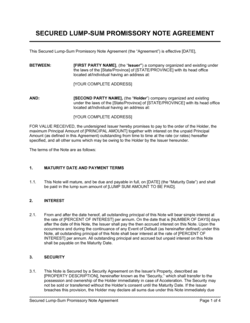
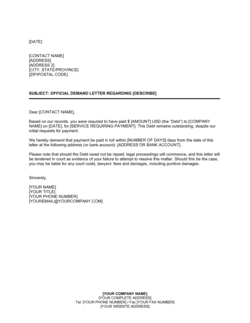
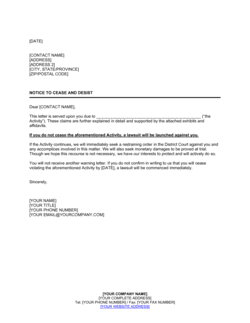
Settlement Agreement Template

Free Word download • Edit online • Save & share with Drive • Export to PDF

8 pages30–40 min to fillDifficulty: ComplexSignature requiredLegal review recommended
Learn more ↓
FreeSettlement Agreement Template

At a glance

What it is
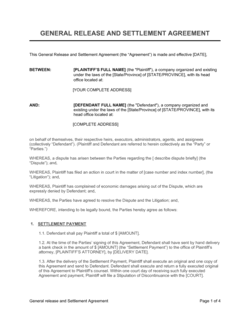
A Settlement Agreement is a legally binding contract between two or more parties that resolves an existing or potential dispute without proceeding to court. This free Word download gives you a structured template you can edit online and export as PDF — covering payment terms, mutual release of claims, confidentiality, non-disparagement, and governing law in a single document.
When you need it
Use it when both sides of a dispute — contract breach, employment claim, property damage, debt collection, or business disagreement — agree to settle on defined terms rather than litigate. It is typically executed after negotiations conclude and before any court filing is withdrawn or avoided.
What's inside
Party identification, recitals summarizing the dispute, settlement payment terms and schedule, a mutual or one-sided release of all claims, confidentiality and non-disparagement obligations, representations and warranties, and a governing law clause with dispute resolution mechanism.

What is a Settlement Agreement?

A Settlement Agreement is a legally binding contract in which two or more parties formally resolve an existing or anticipated dispute — without a court deciding the outcome. In exchange for a payment, a concession, or some other agreed consideration, each party waives its right to pursue the underlying claims further. The agreement captures the complete terms of resolution: the amount to be paid, the schedule, a release of all related claims, confidentiality obligations, and any ongoing restrictions such as non-disparagement. Once executed, it functions as the definitive record of how the dispute ended and the basis for enforcement if either party fails to perform.

Why You Need This Document

Resolving a dispute on a handshake — or through an exchange of emails — leaves both parties exposed. Without a signed settlement agreement, the "settled" matter can be relitigated: the claimant may assert new or related claims, dispute what was actually agreed, or deny that any binding resolution was ever reached. Courts routinely decline to enforce oral settlements when the parties disagree on terms. The practical consequences are severe: a dispute you believed was closed resurfaces months later, legal costs compound, and any confidentiality you relied on evaporates. A properly drafted settlement agreement with a clear release, a payment schedule with a default clause, and a confidentiality provision closes the dispute conclusively — giving both sides certainty, protecting reputations, and eliminating the cost and unpredictability of litigation. This template gives you a structured, attorney-reviewed starting point that handles the essential clauses correctly the first time.

Which variant fits your situation?

If your situation is…Use this template
Resolving an employment or workplace dispute between employer and employeeEmployment Settlement Agreement
Settling a debt or unpaid invoice between a creditor and debtorDebt Settlement Agreement
Closing out a co-founder or shareholder disputeShareholders Settlement Agreement
Ending a personal injury or property damage claimGeneral Release Agreement
Settling a dispute arising from a specific commercial contract breachContract Settlement Agreement
Resolving a landlord-tenant deposit or damages disputeLandlord-Tenant Settlement Agreement
Documenting agreed terms to avoid a threatened lawsuit before filingDemand Letter and Settlement Offer

Common mistakes to avoid

❌ Dismissing litigation before receiving full payment

Why it matters: Once a case is dismissed with prejudice, the claimant has permanently surrendered their lawsuit. A defaulting payer faces only a breach-of-contract action on the settlement — not the original stronger claim.

Fix: Condition the dismissal on receipt of the final payment, or file a dismissal without prejudice and convert it to with prejudice only after all installments clear.

❌ Releasing only known claims

Why it matters: A release limited to known claims leaves the door open for a party to later assert claims they claim to have discovered after signing — especially in disputes involving complex financials or undisclosed conduct.

Fix: Include explicit language releasing both known and unknown claims, and add a §1542 waiver for California parties or equivalent language in other jurisdictions.

❌ No default or acceleration mechanism for installment payments

Why it matters: Without a default clause, a paying party can miss scheduled payments with no immediate contractual consequence, forcing the receiving party back into expensive collection proceedings.

Fix: Include a clause stating that any missed payment accelerates the entire remaining balance and allows the non-breaching party to seek immediate enforcement.

❌ Confidentiality clause without a compelled-disclosure carve-out

Why it matters: If a party is later subpoenaed, audited, or required by a regulator to disclose the settlement, a strict confidentiality clause with no carve-out puts them in breach of the agreement for complying with the law.

Fix: Add a carve-out permitting disclosure when required by applicable law, court order, or regulatory authority, with an obligation to provide prompt notice to the other party where legally permissible.

❌ Skipping the representations and warranties section

Why it matters: If a party has previously assigned their claims to an insurer or litigation funder, the settlement may not bind that third party — leaving the paying party exposed to a second action on the same underlying dispute.

Fix: Require each party to represent that no claims have been assigned and that no third party holds any interest in the released matters.

❌ Using overly broad non-disparagement language that covers government disclosures

Why it matters: Clauses that purport to prevent truthful reporting to the EEOC, NLRB, SEC, or equivalent agencies are unenforceable and can expose the drafting party to regulatory sanctions.

Fix: Include an explicit carve-out stating that nothing in the non-disparagement clause prevents either party from making truthful disclosures to government agencies or in legally compelled proceedings.

The 10 key clauses, explained

Parties and Recitals

In plain language: Identifies both parties by full legal name and entity type, then summarizes the background — the nature of the dispute, any prior proceedings, and the shared intent to resolve the matter.

Sample language
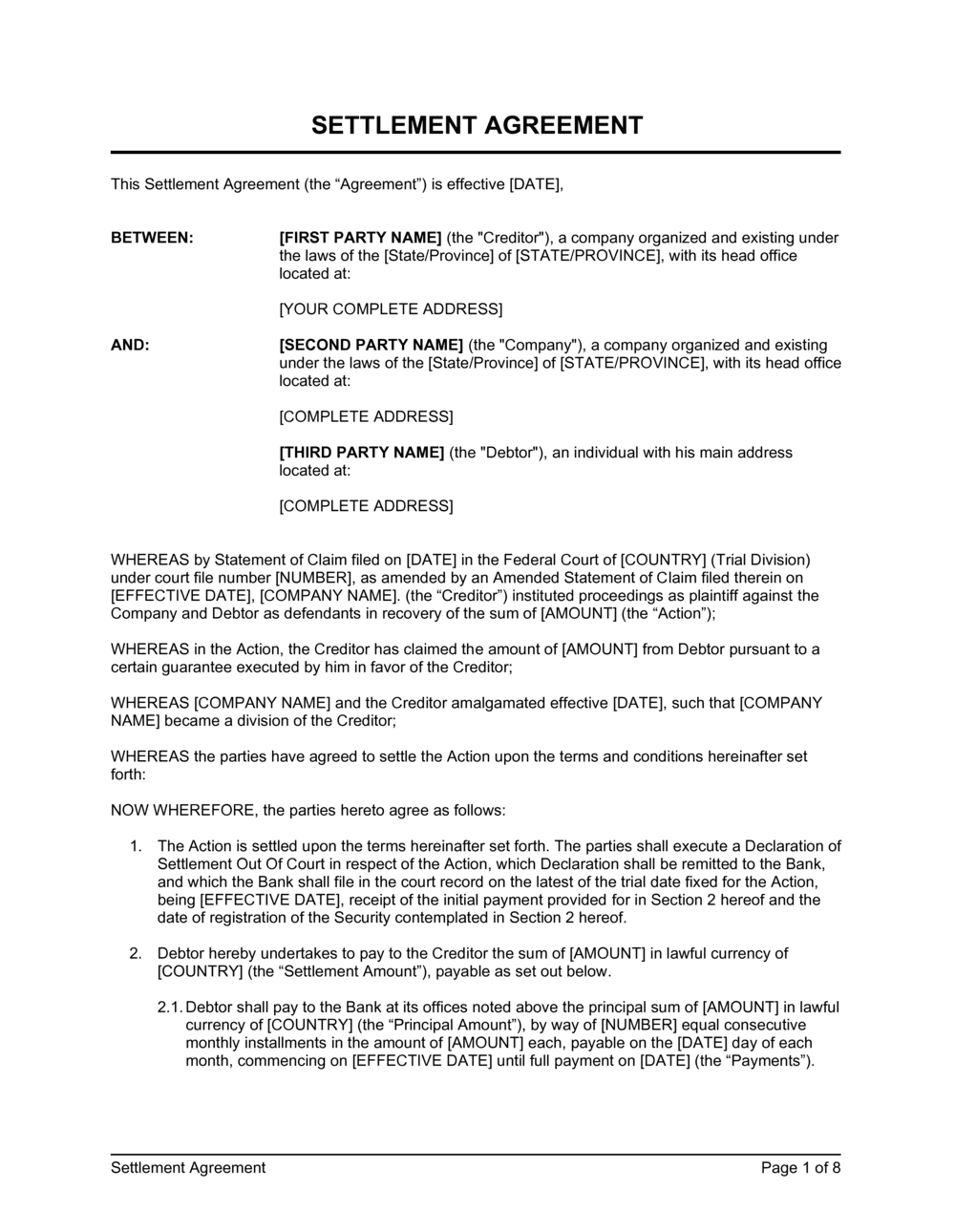
This Settlement Agreement ('Agreement') is entered into as of [DATE] by and between [PARTY A LEGAL NAME], a [STATE/COUNTRY] [ENTITY TYPE] ('Party A'), and [PARTY B LEGAL NAME], a [STATE/COUNTRY] [ENTITY TYPE] ('Party B'). WHEREAS, a dispute has arisen between the parties regarding [BRIEF DESCRIPTION OF DISPUTE]; and WHEREAS, the parties desire to resolve said dispute on the terms set forth herein.

Common mistake: Using trade names or informal names instead of registered legal entity names. If the named party does not match the entity that holds the underlying obligation, enforcing the settlement against the correct entity becomes legally complicated.

Settlement Payment and Schedule

In plain language: States the total amount to be paid, who pays whom, in how many installments, by which dates, and by what method — and what happens if a payment is missed.

Sample language
Party A shall pay Party B the total sum of $[AMOUNT] ('Settlement Amount') as follows: (a) $[FIRST INSTALLMENT] on or before [DATE]; (b) $[SECOND INSTALLMENT] on or before [DATE]. Payment shall be made by [WIRE TRANSFER / CHECK] to [ACCOUNT / ADDRESS]. Failure to make any payment when due shall constitute a material breach and accelerate the full remaining balance.

Common mistake: Omitting an acceleration or default clause. If installment payments are missed and there is no default mechanism, the paying party can delay indefinitely with no contractual consequence.

Release of Claims

In plain language: Each party (or just one, depending on the dispute) permanently waives all known and unknown claims, demands, and causes of action arising out of the dispute as of the signing date.

Sample language
In consideration of the Settlement Amount and the mutual covenants herein, each party hereby irrevocably releases and discharges the other party and its officers, directors, employees, and agents from any and all claims, demands, damages, actions, and causes of action, known or unknown, arising out of or related to [DESCRIPTION OF DISPUTE], up to and including the date of this Agreement.

Common mistake: Releasing only known claims and omitting 'unknown claims.' Without language covering unknown claims — or a California Civil Code §1542 waiver where applicable — a party can later assert a claim they claim not to have known about at signing.

Covenant Not to Sue

In plain language: Goes beyond the release to actively promise that neither party will initiate or continue any legal proceedings related to the settled dispute.

Sample language
Each party covenants and agrees that it will not, and will not cause or permit any person or entity acting on its behalf to, commence, prosecute, or assist in any claim, action, or proceeding against the other party arising out of or related to the matters released in Section [X] of this Agreement.

Common mistake: Relying on the release clause alone and omitting a separate covenant not to sue. In some jurisdictions, a release bars a defense but does not prevent a new filing — the covenant provides a second line of protection.

Confidentiality

In plain language: Prohibits both parties from disclosing the existence, terms, or underlying facts of the settlement to anyone except their lawyers, accountants, and immediate family — or as required by law.

Sample language
The parties agree to keep the existence, terms, and conditions of this Agreement strictly confidential and shall not disclose same to any third party without the prior written consent of the other party, except (a) to their respective legal and financial advisors who are bound by confidentiality; (b) as required by applicable law or court order; or (c) to enforce this Agreement.

Common mistake: No carve-out for legally compelled disclosure. If a party is subpoenaed or required by a regulator to disclose the settlement, failing to include a legal-compulsion carve-out puts them in breach of their own agreement.

Non-Disparagement

In plain language: Each party agrees not to make negative, harmful, or misleading statements about the other — publicly or privately — following the settlement.

Sample language
Each party agrees that it will not make, publish, or communicate to any person or entity any disparaging, defamatory, or negative remarks, comments, or statements — whether oral or written — concerning the other party, its products, services, employees, or business practices.

Common mistake: Including non-disparagement without a carve-out for truthful statements made to regulators, law enforcement, or in legal proceedings. Courts in several jurisdictions have invalidated overly broad clauses that appear to suppress legally protected disclosures.

Representations and Warranties

In plain language: Each party confirms they have the authority to enter the agreement, that no third party holds an interest in the released claims, and that they have not already assigned any of those claims to someone else.

Sample language
Each party represents and warrants that: (a) it has full authority to execute this Agreement; (b) no other person or entity has any interest in or claim to the matters released herein; (c) it has not assigned, transferred, or conveyed to any third party any claim, demand, or cause of action covered by this Agreement.

Common mistake: Skipping the representations section entirely in the interest of brevity. If a party has already assigned a claim to a litigation funder or insurer, the settlement may not extinguish it — and discovering this post-signing triggers costly litigation.

Return or Destruction of Materials

In plain language: Requires each party to return or certify the destruction of confidential documents, data, or property exchanged during the dispute or litigation process.

Sample language
Within [10] business days of the Effective Date, each party shall return or, at the other party's election, destroy all documents, records, and materials — including electronic copies — received from the other party in connection with [THE DISPUTE / LITIGATION]. Each party shall provide written certification of destruction upon request.

Common mistake: Omitting this clause in disputes involving shared confidential data or trade secrets. Without it, sensitive information exchanged during mediation or discovery remains in the opposing party's possession indefinitely.

Dismissal of Proceedings

In plain language: If litigation has already been filed, this clause requires the applicable party to file a dismissal with prejudice — or without prejudice until payment is complete — within a specified number of days.

Sample language
Within [5] business days of receipt of the final Settlement Amount, Party B shall file a stipulation of dismissal with prejudice of [CASE NAME], [COURT], [CASE NUMBER], with each party bearing its own attorneys' fees and costs.

Common mistake: Agreeing to dismiss with prejudice before the full settlement amount is received. If the paying party defaults after dismissal, the injured party has lost their lawsuit and must start a new breach-of-contract action.

Governing Law and Dispute Resolution

In plain language: Specifies which jurisdiction's law governs the agreement and how any breach of the settlement itself will be resolved — court, arbitration, or mediation.

Sample language
This Agreement shall be governed by and construed in accordance with the laws of the State of [STATE], without regard to its conflict-of-laws principles. Any dispute arising out of or relating to this Agreement shall be resolved by binding arbitration administered by [AAA / JAMS] in [CITY, STATE], except that either party may seek injunctive relief in a court of competent jurisdiction.

Common mistake: Selecting a governing law that has no connection to where either party operates or where the dispute arose. Courts in several states will apply local law regardless of the contract's choice-of-law clause if there is no meaningful nexus to the chosen jurisdiction.

How to fill it out

  1. 1

    Identify all parties with their full legal names

    Enter the registered legal name of each party — individual or entity — exactly as it appears on corporate registration documents or government-issued ID. Include entity type (LLC, corporation, sole proprietor) and state or country of formation.

    💡 If an individual is signing on behalf of a company, include both the entity name and the signatory's title to confirm authority.

  2. 2

    Draft the recitals to summarize the dispute

    Write two to four 'WHEREAS' clauses that describe the nature of the dispute, any prior proceedings or demand letters, and the parties' intent to settle. Keep this factual and neutral — recitals are not findings of fault.

    💡 Avoid admitting liability in the recitals. Use language like 'the parties dispute the claims' rather than acknowledging wrongdoing.

  3. 3

    Define the settlement payment terms precisely

    State the total amount, currency, payment schedule with specific calendar dates, payment method (wire, ACH, check), and the account or address for delivery. Include an acceleration clause that makes the full balance due immediately upon a missed payment.

    💡 For installment payments, consider holding the dismissal of proceedings in escrow until the final payment is received — this preserves leverage without delaying settlement.

  4. 4

    Draft the release of claims clause

    Decide whether the release is mutual (both parties release each other) or one-sided (only the claimant releases). Include both known and unknown claims. If either party is based in California, add an explicit waiver of California Civil Code §1542.

    💡 Define the scope of released claims precisely — 'arising out of or related to [SPECIFIC DISPUTE]' is narrower and more defensible than a general release of all claims.

  5. 5

    Add confidentiality and non-disparagement terms

    Specify who is bound, what information is covered, and the permitted carve-outs (legal advisors, compelled disclosure, enforcement). For the non-disparagement clause, include a carve-out for truthful statements made to government authorities.

    💡 If one party is a public company, add a carve-out for required securities disclosures — failure to disclose a material settlement can itself create regulatory liability.

  6. 6

    Include representations, warranties, and integration clause

    Have each party confirm authority to sign, that no claims have been assigned, and that no third party holds an interest in the released matters. Close with an integration clause stating the agreement supersedes all prior negotiations.

    💡 If either party previously engaged a litigation funder or assigned insurance rights, get written confirmation that the funder or insurer consents to the release before signing.

  7. 7

    Specify dismissal timing and conditions

    If litigation is pending, state exactly when and how the case will be dismissed — with or without prejudice — and which party is responsible for filing the dismissal papers. Tie dismissal timing to receipt of the final payment.

    💡 A 'without prejudice until full payment, then with prejudice' structure is the safest approach for installment settlements.

  8. 8

    Execute with proper signatures before the agreed deadline

    Both parties must sign and date the agreement. If a party is an entity, the signatory must have authority — check that the officer or manager has board or operating-agreement authorization. Counterpart signatures (signing separate copies) are generally acceptable when expressly permitted.

    💡 Use timestamped electronic signatures with audit trails to eliminate disputes about when and by whom the agreement was executed.

Frequently asked questions

What is a settlement agreement?

A settlement agreement is a legally binding contract that resolves an existing or threatened dispute between two or more parties without proceeding to a court judgment. It typically includes a payment from one party to the other, a mutual release of all related claims, and confidentiality obligations. Once signed, it extinguishes the parties' rights to pursue the settled claims in court.

Is a settlement agreement legally binding?

Yes — a settlement agreement is generally enforceable as a binding contract when it meets the standard requirements: offer, acceptance, and consideration (typically the payment and the release of claims). Courts consistently uphold properly executed settlement agreements and will enforce them through specific performance or damages for breach. Having legal counsel review the agreement before signing strengthens enforceability, particularly for complex disputes.

What is the difference between a settlement agreement and a release?

A release is a single-clause document in which one party gives up their right to pursue a claim. A settlement agreement is broader — it contains the release plus payment terms, confidentiality, non-disparagement, representations, and dispute resolution mechanics. Most substantial commercial or employment disputes require a full settlement agreement rather than a standalone release.

Does a settlement agreement need to be notarized?

In most jurisdictions, notarization is not required for a settlement agreement to be enforceable — signatures of the parties (or authorized representatives for entities) are sufficient. Notarization may be required in specific contexts, such as when the settlement resolves a real property dispute or when recording the agreement with a court. Check the requirements of the governing jurisdiction before finalizing.

Can a settlement agreement be challenged after signing?

Challenges are possible but difficult. Courts have set aside settlement agreements for fraud, duress, mutual mistake, or lack of capacity — but the bar is high. A party cannot simply change their mind or claim buyer's remorse. The best protection against a later challenge is ensuring both parties had independent legal counsel, the terms were negotiated at arm's length, and the agreement was signed voluntarily with adequate time for review.

What should a settlement payment clause include?

At minimum: the total settlement amount, currency, payment method (wire transfer, ACH, or check), specific payment dates or schedule, payee details, and a default or acceleration clause. For installment payments, include the consequences of a missed payment — typically acceleration of the remaining balance and reinstatement of the right to seek enforcement. Vague payment terms like 'promptly' or 'within a reasonable time' consistently generate post-settlement disputes.

Should a settlement agreement include a non-disparagement clause?

For most commercial and employment disputes, yes — a non-disparagement clause prevents either party from publicly undermining the settlement's value. However, the clause must include carve-outs for truthful statements made to government agencies, law enforcement, and in legally required disclosures. Overly broad non-disparagement clauses — particularly in employment settlements — have been struck down or have attracted regulatory scrutiny in the US, UK, and EU.

What is a mutual release and when should I use it?

A mutual release is a clause in which both parties simultaneously waive all claims against each other related to the dispute. Use it when both sides have potential claims — for example, a vendor and client who each allege the other breached their contract. Use a one-sided release only when the dispute is clearly asymmetric and the paying party has no viable counterclaim worth preserving protection against.

Do I need a lawyer to draft a settlement agreement?

For low-value, straightforward disputes — unpaid invoices under $10,000, minor contract disagreements — a well-structured template with careful completion is typically sufficient. Engage a lawyer when the dispute involves significant money, equity, employment claims, regulatory exposure, or cross-border parties; when litigation is already filed; or when the other party has legal representation. A 1–2 hour review typically costs $300–$800 and is worthwhile for any settlement above $25,000.

How this compares to alternatives

vs General Release Agreement

A general release is a single-purpose document in which one party surrenders their right to pursue a claim, typically in exchange for a one-time payment. A settlement agreement is broader — it includes the release but also governs payment schedules, confidentiality, non-disparagement, representations, and breach remedies. For any dispute involving ongoing obligations or meaningful money, a full settlement agreement is the appropriate document.

vs Mutual Non-Disclosure Agreement

An NDA governs how parties handle confidential information shared during a business relationship or negotiation. A settlement agreement's confidentiality clause specifically covers the facts and terms of a dispute resolution. When settling a dispute that involved shared proprietary information, both documents may be needed — the NDA to govern pre-existing confidentiality obligations and the settlement to close the dispute itself.

vs Debt Settlement Agreement

A debt settlement agreement specifically addresses the resolution of an outstanding monetary obligation — typically reducing the amount owed in exchange for faster or lump-sum payment. A general settlement agreement covers a broader range of disputes and claims, not just debt. Use the debt settlement form when the sole issue is an unpaid balance; use the settlement agreement when the dispute involves additional claims, IP, confidentiality, or employment matters.

vs Mediation Agreement

A mediation agreement governs the process by which parties agree to attempt resolution through a neutral third-party mediator — it does not resolve the dispute itself. A settlement agreement is the binding outcome document that records the terms reached, whether through mediation, direct negotiation, or otherwise. The two documents are sequential: the mediation agreement enables the process; the settlement agreement captures the result.

Industry-specific considerations

Professional Services

Contract disputes over deliverable quality or scope creep are common; settlement agreements typically include a payment adjustment, mutual release, and non-disparagement to protect both parties' reputations.

Technology / SaaS

IP ownership disputes, SLA breach claims, and co-founder disagreements are frequently resolved via settlement; agreements must address return or destruction of shared code and data alongside the monetary terms.

Retail and E-commerce

Supplier non-delivery, product defect claims, and chargebacks generate high-volume settlement needs; straightforward payment-and-release structures with tight timelines are standard.

Real Estate and Property Management

Landlord-tenant security deposit disputes, property damage claims, and contractor payment disagreements are settled with agreements specifying payment amounts, move-out timelines, and mutual releases to avoid small-claims filings.

Financial Services

Regulatory considerations and securities disclosure obligations require carefully drafted confidentiality carve-outs; clawback and indemnification provisions are more common than in other sectors.

Healthcare

Patient billing disputes, vendor contract claims, and employment matters intersect with HIPAA and privacy obligations; settlement agreements must ensure that confidentiality terms do not conflict with mandatory reporting duties.

Jurisdictional notes

United States

Settlement agreements are governed by state contract law and are generally enforceable nationwide. California parties should include an express waiver of Civil Code §1542 (unknown claims) or the release may not cover claims discovered after signing. In employment-related settlements, federal and state anti-retaliation laws limit how broadly confidentiality and non-disparagement clauses can restrict disclosures to government agencies such as the EEOC and NLRB. Tax treatment of settlement payments varies depending on the nature of the claim — payments for physical injury are typically tax-free; payments for breach of contract or emotional distress are generally taxable.

Canada

Settlement agreements in Canada are binding contracts governed by provincial common law (or civil law in Quebec). Employment settlement agreements must meet provincial Employment Standards Act minimums — a settlement that pays less than statutory termination entitlements is unenforceable to that extent. Quebec agreements should be in French for provincially regulated employers and are subject to the Civil Code of Quebec rather than common law. Confidentiality clauses in employment settlements have been scrutinized by provincial human rights tribunals when they appear to prevent complaints to regulatory bodies.

United Kingdom

Employment settlement agreements in the UK are specifically governed by the Employment Rights Act 1996 and must meet strict requirements to validly waive statutory employment claims: the agreement must be in writing, relate to a specific complaint, and the employee must have received independent legal advice from a qualified adviser. Non-employment commercial settlements are governed by general contract law and are broadly enforceable. Confidentiality clauses ('gagging clauses') in employment settlements have been significantly restricted following post-Weinstein legislative reforms — clauses that prevent disclosure to the police, a regulated professional, or a legal adviser are void.

European Union

Settlement agreements are recognized across EU member states but enforceability and formal requirements vary significantly. The EU Mediation Directive (2008/52/EC) provides a framework for cross-border commercial mediation outcomes to be made enforceable by member state courts. GDPR considerations apply when settlement agreements involve personal data — confidentiality clauses cannot override data subjects' rights or mandatory supervisory authority reporting obligations. Employment settlements in France, Germany, and Spain must comply with strict statutory minimum protections; contractual waivers of statutory rights are void to the extent they fall below legislative floors.

Template vs lawyer — what fits your deal?

PathBest forCostTime
Use the templateLow-value commercial disputes under $25,000 with straightforward payment-and-release terms between domestic partiesFree30–60 minutes
Template + legal reviewDisputes involving $25,000–$250,000, employment claims, pending litigation, or parties in multiple jurisdictions$300–$800 for a 1–2 hour attorney review1–3 days
Custom draftedHigh-value disputes over $250,000, regulatory exposure, complex IP or equity claims, or multi-party litigation$1,500–$8,000+1–3 weeks

Glossary

Release of Claims
A contractual provision in which one or both parties permanently give up the right to pursue any claims related to the dispute that existed at the time of signing.
Mutual Release
A release in which both parties waive all claims against each other, as opposed to a one-sided release where only one party gives up rights.
Consideration
The exchange of something of value — typically money, a promise to act, or a promise to refrain from acting — that makes a contract legally enforceable.
Confidentiality Clause
A provision prohibiting one or both parties from disclosing the existence, terms, or circumstances of the settlement to third parties.
Non-Disparagement Clause
A provision preventing either party from making negative public or private statements about the other following the settlement.
Indemnification
An obligation by one party to compensate the other for losses, damages, or legal costs arising from a specified event or third-party claim.
Without Prejudice
A legal designation protecting settlement negotiations and documents from being used as evidence in court proceedings if talks break down.
Recitals
Introductory clauses that provide background context for the agreement — describing the nature of the dispute and the parties' intent to resolve it.
Covenant Not to Sue
A promise by one party not to initiate or continue legal proceedings against the other in connection with the settled dispute.
Integration Clause
A clause stating that the written settlement agreement is the complete and final expression of the parties' agreement, superseding all prior negotiations and representations.
Specific Performance
A remedy requiring a party to carry out a specific act — such as making a payment on schedule — rather than paying damages for breach.

Part of your Business Operating System

This document is one of 3,000+ business & legal templates included in Business in a Box.

  • Fill-in-the-blanks — ready in minutes
  • 100% customizable Word document
  • Compatible with all office suites
  • Export to PDF and share electronically

Create your document in 3 simple steps.

From template to signed document — all inside one Business Operating System.
1
Download or open template

Access over 3,000+ business and legal templates for any business task, project or initiative.

2
Edit and fill in the blanks with AI

Customize your ready-made business document template and save it in the cloud.

3
Save, Share, Send, Sign

Share your files and folders with your team. Create a space of seamless collaboration.

Save time, save money, and create top-quality documents.

★★★★★

"Fantastic value! I'm not sure how I'd do without it. It's worth its weight in gold and paid back for itself many times."

Managing Director · Mall Farm
Robert Whalley
Managing Director, Mall Farm Proprietary Limited
★★★★★

"I have been using Business in a Box for years. It has been the most useful source of templates I have encountered. I recommend it to anyone."

Business Owner · 4+ years
Dr Michael John Freestone
Business Owner
★★★★★

"It has been a life saver so many times I have lost count. Business in a Box has saved me so much time and as you know, time is money."

Owner · Upstate Web
David G. Moore Jr.
Owner, Upstate Web

Run your business with a system — not scattered tools

Stop downloading documents. Start operating with clarity. Business in a Box gives you the Business Operating System used by over 250,000 companies worldwide to structure, run, and grow their business.

Free Forever Plan · No credit card required