1
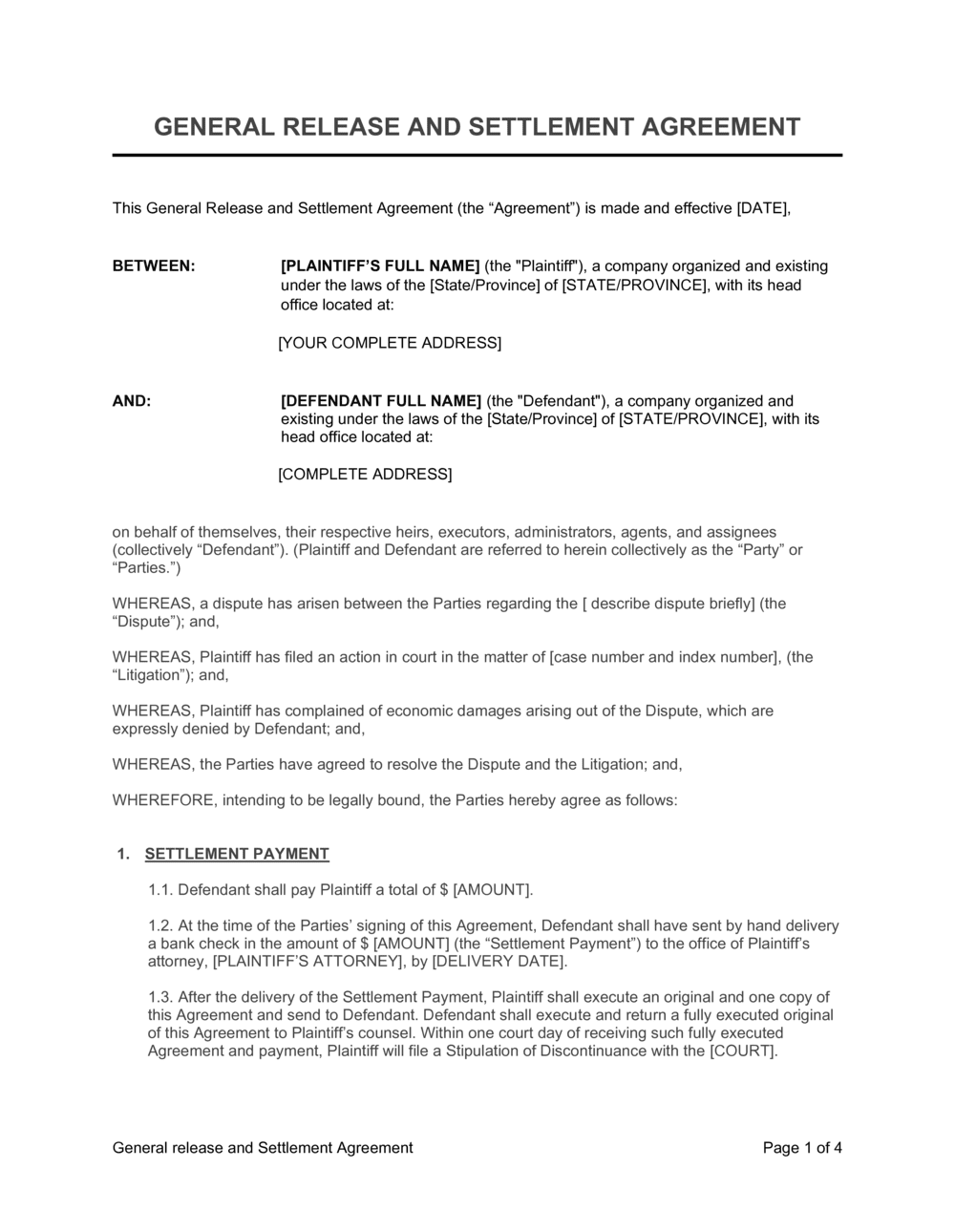
Identify the parties with their full legal names
Enter the full legal name of each party — individuals by legal name, businesses by registered entity name — and their roles in the agreement (Releasing Party / Released Party, or Party A / Party B for mutual releases).
💡 For businesses, verify the exact registered name through the state or provincial corporate registry before drafting — a trade name will not bind the legal entity.
2
Describe the dispute in the recitals with enough specificity
Write two to four sentences in the recitals identifying the nature of the dispute — the contract, transaction, event, or relationship that gave rise to the claims being released.
💡 More specificity in the recitals means a narrower release — if you want a broad release covering all claims between the parties, say so explicitly rather than describing only one incident.
3
State the consideration clearly
Enter the exact payment amount, due date, and payment method. If consideration is non-monetary — such as a waiver of a counter-claim or delivery of property — describe it precisely.
💡 Make the consideration payment conditional on both parties signing. Include language like 'payable within [X] business days of full execution by both parties.'
4
Decide whether the release is unilateral or mutual
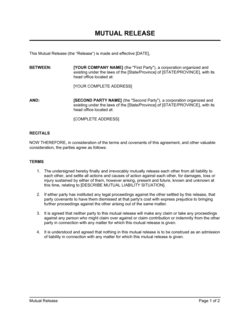
Determine which party or parties are releasing claims. If only one party has claims, use a unilateral release. If both have claims or potential counter-claims, include the mutual release clause.
💡 When in doubt about whether the other party has viable counter-claims, include a mutual release — it costs nothing and prevents future surprise litigation.
5
Include the known and unknown claims waiver if California law applies
If either party is located in California or California law governs, include the explicit §1542 waiver. For other jurisdictions, include equivalent language releasing all claims 'whether known or unknown, suspected or unsuspected.'
💡 Even outside California, including the known-and-unknown claims waiver is best practice for any full and final settlement — it closes the door on facts discovered later.
6
Set confidentiality and non-disparagement scope
Specify what is confidential — at minimum, the settlement amount and terms. Add carve-outs for legal, tax, and regulatory disclosures. Draft non-disparagement obligations reciprocally and include a carve-out for truthful statements in legal proceedings.
💡 If the dispute involved a public-company party, confirm with counsel whether the settlement amount triggers any SEC disclosure obligations before finalizing the confidentiality language.
7
Select governing law tied to the parties' actual location or transaction
Choose the state or country whose law will govern the agreement — typically the jurisdiction where the dispute arose, the contract was performed, or the defendant is located.
💡 Avoid choosing a 'neutral' jurisdiction like Delaware for a simple commercial settlement unless both parties have meaningful ties there — courts may disregard the choice.
8
Execute before the payment is made
Both parties must sign the agreement before any settlement funds are transferred. Confirm signatories have actual authority — officers or directors for corporations, managing members for LLCs.
💡 Use a fully timestamped e-signature platform so the execution record is indisputable. Transfer funds only after you have confirmed the executed counterpart is in hand.