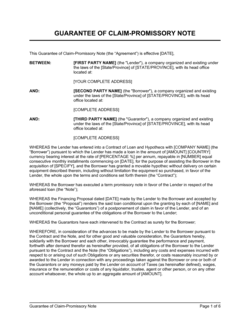
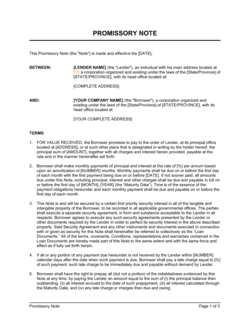
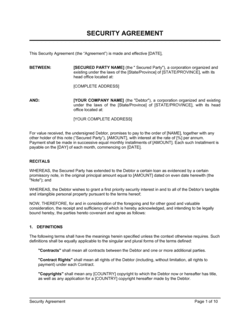
Guarantee Assignement and Postponement of Claim Template

Free Word download • Edit online • Save & share with Drive • Export to PDF

6 pages25–35 min to fillDifficulty: ComplexSignature requiredLegal review recommended
Learn more ↓
FreeGuarantee Assignement and Postponement of Claim Template

At a glance

What it is
A Guarantee Assignment and Postponement of Claim is a legally binding document in which a guarantor or subordinated creditor formally assigns their rights under a guarantee to a senior lender and agrees to postpone — that is, subordinate — any claim they hold against the borrower until the senior debt is fully repaid. This free Word download gives lenders, guarantors, and legal teams a structured starting point they can edit online and export as PDF for execution.
When you need it
Use it when a senior lender requires that a related-party creditor, shareholder loan holder, or guarantor formally subordinate their claims as a condition of approving or continuing a credit facility. It is also used when an existing guarantee is being transferred from one creditor to another as part of a loan syndication, refinancing, or corporate restructuring.
What's inside
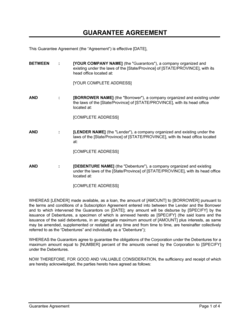
Identification of all parties (assignor, assignee, and borrower), the guarantee being assigned, the postponement and subordination covenant, representations and warranties, conditions on repayment of the subordinated claim, events of default, and governing law and dispute resolution provisions.

What is a Guarantee Assignment and Postponement of Claim?

A Guarantee Assignment and Postponement of Claim is a legally binding document that performs two distinct but related functions in a commercial lending transaction. First, it assigns — that is, formally transfers — the rights held by one creditor under an existing guarantee to a senior lender or new creditor. Second, it requires the original creditor (most often a shareholder or related-party lender) to postpone and subordinate any claim they hold against the borrower until the senior debt has been repaid in full. The document is a standard instrument in commercial banking, leveraged finance, and corporate restructuring, and is typically required by institutional lenders as a condition precedent to approving or drawing down a credit facility where intercompany or shareholder loans are present in the borrower's capital structure.

Why You Need This Document

Without a signed guarantee assignment and postponement of claim, a senior lender has no contractual protection against a shareholder or related-party creditor demanding repayment ahead of the bank when the borrower faces financial difficulty. In insolvency, an unsubordinated shareholder loan ranks equally with the bank's debt and reduces the recoverable assets available to the senior lender — directly affecting how much the bank can recover. For the borrower, failing to provide this document typically means the credit facility is not approved, not renewed, or placed in default. For the shareholder-creditor, signing without legal review carries its own risks: the standstill and permitted-payment provisions can leave them unable to recover their loan for years. This template gives all parties a structured, court-tested starting point that covers the assignment mechanics, the subordination covenant, standstill protections, and the automatic release on repayment — reducing the risk of gaps that become expensive disputes at the worst possible moment.

Which variant fits your situation?

If your situation is…Use this template
Subordinating a shareholder loan to a senior bank facilityGuarantee Assignment and Postponement of Claim
Transferring all rights under a guarantee to a new lenderAssignment of Guarantee
Ranking two creditors' claims relative to each other without a guaranteeIntercreditor Agreement
Subordinating debt obligations between a parent and subsidiarySubordination Agreement
Providing a personal guarantee for a commercial loanPersonal Guarantee Agreement
Releasing a guarantor from obligations after the loan is repaidRelease of Guarantee
Documenting a cross-guarantee structure among group companiesCross-Guarantee Agreement

Common mistakes to avoid

❌ Using generic 'all amounts owing' as the senior debt definition

Why it matters: An undefined or overbroad senior debt definition means the subordination may apply to future unrelated facilities or obligations the assignor never intended to subordinate to, creating an indefinite postponement.

Fix: Define Senior Debt by explicit reference to the named credit facility agreement, its date, and the parties involved. Include a clause confirming that the definition does not extend to subsequently entered facilities unless expressly agreed.

❌ Failing to obtain written borrower acknowledgment of the assignment

Why it matters: In many common-law jurisdictions, an assignment of a guarantee or debt right does not bind the debtor until they receive formal notice. Without acknowledgment, the borrower may continue making payments to the assignor, and the assignee has no direct enforcement right.

Fix: Include a notice of assignment schedule and have the borrower sign an acknowledgment contemporaneously with execution. In civil law jurisdictions, confirm whether notarial or registered notice is required.

❌ Setting a standstill period shorter than the lender's enforcement timeline

Why it matters: If the subordinated creditor can demand repayment or commence proceedings within 30 days of a default while the senior lender needs 90 days to accelerate and enforce, the postponement fails its commercial purpose and may be challenged in insolvency.

Fix: Align the standstill period with the notice and cure periods in the senior facility agreement — 90 to 180 days is the market standard for commercial transactions.

❌ Omitting restrictions on the subordinated creditor taking additional security

Why it matters: A subordinated creditor who takes a charge or mortgage over the borrower's assets after signing the postponement can effectively gain priority over the senior lender for those specific assets, undermining the entire subordination structure.

Fix: Add an explicit prohibition on the assignor taking any form of security for the postponed claim without the senior lender's prior written consent for the duration of the senior debt.

❌ Executing the document after the senior facility has already been drawn

Why it matters: Most senior facility agreements require the guarantee assignment and postponement as a condition precedent to drawdown. Executing it after funding has occurred may mean the subordination is not part of the agreed credit conditions and could be challenged as a preference in insolvency.

Fix: Include this document in the closing checklist and ensure it is fully executed before or simultaneously with the first drawdown under the senior facility.

❌ Governing law inconsistent with the original guarantee or senior facility

Why it matters: When the assignment agreement is governed by a different law than the underlying guarantee, courts may need to apply two sets of rules to determine enforceability — the result is unpredictable and expensive to resolve in litigation.

Fix: Review the governing law clause of both the original guarantee and the senior facility before completing this document and align all three instruments to the same jurisdiction.

The 10 key clauses, explained

Parties and Recitals

In plain language: Identifies the assignor, assignee, borrower, and any consenting parties by their full legal names, and sets out the factual background explaining why the document is being executed.

Sample language
This Agreement is made on [DATE] between [ASSIGNOR LEGAL NAME] ('Assignor'), [ASSIGNEE LEGAL NAME] ('Assignee'), and [BORROWER LEGAL NAME] ('Borrower'). The Assignor holds a guarantee dated [DATE] in favour of the Assignor in respect of the Borrower's obligations.

Common mistake: Using trade names instead of registered legal entity names — if the named party does not match the entity that executed the original guarantee, the assignment may be unenforceable.

Assignment of Guarantee

In plain language: The operative clause by which the assignor unconditionally transfers all rights, title, and interest in the guarantee to the assignee, effective on the date stated.

Sample language
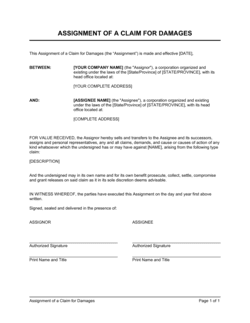
The Assignor hereby assigns absolutely to the Assignee all of the Assignor's right, title, and interest in and to the Guarantee, including all claims, benefits, and proceeds arising thereunder, with effect from [EFFECTIVE DATE].

Common mistake: Assigning only 'some' rights rather than all rights under the guarantee — partial assignments create ambiguity about who can enforce and in what circumstances.

Postponement and Subordination Covenant

In plain language: The core subordination commitment: the assignor agrees that all amounts owed to it by the borrower are deferred until the senior debt is repaid in full.

Sample language
The Assignor agrees that all amounts owing by the Borrower to the Assignor (the 'Postponed Claim') shall be postponed and subordinated to all amounts owing to the Assignee under the [CREDIT FACILITY AGREEMENT dated DATE] until the Senior Debt has been repaid in full and the credit facility cancelled.

Common mistake: Failing to define 'Senior Debt' by reference to a specific facility agreement — an undefined senior debt concept leaves the scope of subordination open to dispute.

Restrictions on the Postponed Claim

In plain language: Prohibits the subordinated creditor from demanding repayment, accepting payments, taking security, or assigning the postponed claim without the senior lender's written consent while the senior debt is outstanding.

Sample language
Until the Senior Debt has been repaid in full, the Assignor shall not, without the prior written consent of the Assignee: (a) demand or accept payment of any part of the Postponed Claim; (b) take any security for the Postponed Claim; or (c) assign or encumber the Postponed Claim.

Common mistake: Omitting the restriction on taking additional security for the postponed claim — a subordinated creditor who secures their loan after signing can effectively jump the priority queue.

Permitted Payments

In plain language: Carves out specific circumstances in which the borrower is allowed to make payments on the subordinated claim — typically when no event of default exists and the senior lender gives written consent.

Sample language
Notwithstanding the foregoing, the Borrower may make scheduled interest payments on the Postponed Claim provided that: (a) no Event of Default has occurred and is continuing; and (b) [ASSIGNEE NAME] has provided prior written consent to each such payment.

Common mistake: Allowing automatic repayment of the subordinated claim on a fixed schedule without an explicit no-default condition — any payment made after a default event may be clawable in insolvency.

Representations and Warranties

In plain language: Each party confirms key facts: the assignor has authority to assign, the guarantee is valid and in full force, no prior assignments have been made, and no undisclosed claims exist.

Sample language
The Assignor represents and warrants that: (a) it has full authority to enter into and perform this Agreement; (b) the Guarantee is valid, binding, and in full force and effect; (c) the Assignor has not previously assigned or encumbered the Guarantee or the Postponed Claim.

Common mistake: No warranty that the guarantee has not been previously assigned — if a prior unrecorded assignment exists, the assignee may receive a worthless interest.

Notice of Assignment

In plain language: Requires the assignor to notify the borrower and any other relevant parties of the assignment, and records the borrower's acknowledgment that future payments must be directed to the assignee.

Sample language
The Assignor shall promptly notify the Borrower of this assignment in the form set out in Schedule [X]. The Borrower acknowledges the assignment and agrees to make all payments in respect of the Guarantee directly to the Assignee at [PAYMENT DETAILS].

Common mistake: Failing to obtain the borrower's written acknowledgment — in some jurisdictions, an assignment of a debt or guarantee right is not effective against the debtor until they receive formal notice.

Events of Default and Standstill

In plain language: Lists the triggers that suspend all rights of the subordinated creditor and imposes a standstill period during which no enforcement action, demand, or repayment may occur.

Sample language
Upon the occurrence of an Event of Default under the [CREDIT FACILITY AGREEMENT], the Assignor shall not, for a period of [180] days (the 'Standstill Period'), demand repayment of the Postponed Claim or take any enforcement action against the Borrower or its assets.

Common mistake: Setting a standstill period that is shorter than the senior lender's enforcement timeline — a 30-day standstill gives the subordinated creditor a head start on enforcement that defeats the purpose of subordination.

Consent and Release on Full Repayment

In plain language: Provides that once the senior debt is repaid in full and the facility cancelled, the postponement and restrictions automatically terminate and the assignor recovers free and unencumbered rights to the postponed claim.

Sample language
Upon confirmation from the Assignee that the Senior Debt has been repaid in full and the [CREDIT FACILITY AGREEMENT] has been terminated, this Agreement shall cease to have effect and the Postponed Claim shall be released from subordination without further action by any party.

Common mistake: Requiring the subordinated creditor to execute a separate release document after repayment — this creates a practical enforcement risk if the senior lender is unresponsive or dissolved.

Governing Law and Dispute Resolution

In plain language: Specifies which jurisdiction's law governs the agreement and the mechanism for resolving disputes — typically litigation in a named court or commercial arbitration.

Sample language
This Agreement shall be governed by and construed in accordance with the laws of [JURISDICTION]. Any dispute arising out of or in connection with this Agreement shall be subject to the exclusive jurisdiction of the courts of [COURT / ARBITRATION BODY, CITY].

Common mistake: Choosing a governing law that differs from the law governing the original guarantee or the senior facility — inconsistent governing law across a credit package creates conflicts of law that are costly to resolve.

How to fill it out

  1. 1

    Identify all parties by registered legal name

    Enter the full registered legal names of the assignor, assignee, and borrower. Confirm each name against the original guarantee document and the senior credit facility agreement to ensure consistency.

    💡 Pull the exact entity name from the relevant corporate registry — a name mismatch between this document and the original guarantee is the most common execution error.

  2. 2

    Reference the original guarantee precisely

    Enter the date, parties, and governing document number of the guarantee being assigned. Attach a copy of the original guarantee as a schedule if the transaction requires it for completeness.

    💡 If the original guarantee has been amended, reference the amendment date as well — assigning an outdated version leaves the amendment's obligations outside the transfer.

  3. 3

    Define senior debt by reference to the specific facility

    In the postponement clause, identify the senior debt by naming the exact credit facility agreement — including date and parties — rather than using a generic description such as 'all amounts owing.'

    💡 Scope matters: if the borrower has multiple facilities with the same lender, specify whether all facilities or only the named one trigger the postponement.

  4. 4

    Set the terms of permitted payments

    Determine whether any payments on the postponed claim are permitted while senior debt is outstanding, and if so, under what conditions. Enter any agreed payment frequency, cap, or consent mechanism in the permitted payments clause.

    💡 Senior lenders typically allow interest-only payments on shareholder loans provided no default exists — document this carve-out explicitly to avoid later dispute.

  5. 5

    Specify the standstill period duration

    Enter the number of days the subordinated creditor must wait before taking enforcement action after an event of default. Align this period with the enforcement timeline in the senior facility agreement.

    💡 A standstill of 90–180 days is standard in commercial lending — anything shorter may be unacceptable to institutional lenders and could render the postponement commercially ineffective.

  6. 6

    Complete the notice of assignment and obtain borrower acknowledgment

    Prepare the notice of assignment in the form required by Schedule [X] and ensure the borrower signs the acknowledgment section before or simultaneously with execution of this agreement.

    💡 In Canada and the UK, an equitable assignment becomes a legal assignment only after formal notice is given — without it, the assignee may not be able to enforce directly against the borrower.

  7. 7

    Confirm governing law is consistent across the credit package

    Check that the governing law selected in this document matches the governing law of the original guarantee and the senior credit facility. Note any jurisdiction-specific requirements for execution — notarization, witnessing, or registration.

    💡 In Quebec and civil law jurisdictions, assignments of claims may need to be perfected by notarial act or registration to be enforceable against third parties.

  8. 8

    Execute in the required signing format before funding

    All parties — assignor, assignee, and borrower — must sign before the senior lender advances funds or extends credit. Counterpart execution by electronic signature is generally valid, but confirm this is acceptable under the governing law.

    💡 Senior lenders typically require a fully executed copy of this document as a condition precedent to drawdown — execute it as part of the closing checklist, not after.

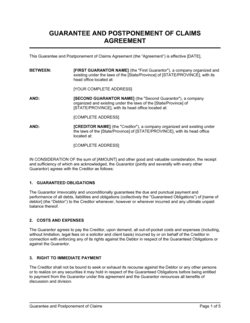
Frequently asked questions

What is a guarantee assignment and postponement of claim?

A guarantee assignment and postponement of claim is a legal document with two distinct functions. First, it transfers (assigns) the rights under an existing guarantee from one creditor to another — typically to a senior lender. Second, it requires the original creditor or guarantor to formally subordinate and postpone any claim they hold against the borrower until the senior lender has been fully repaid. The document is a standard component of commercial lending and restructuring transactions where multiple creditors have claims against the same borrower.

Why do banks require a postponement of claim?

Senior lenders require a postponement of claim to ensure that related-party creditors — most commonly shareholders who have loaned money to their own company — cannot demand repayment ahead of the bank if the borrower gets into financial difficulty. Without a signed postponement, a shareholder loan ranks equally with the bank's debt in insolvency, reducing the assets available to the senior lender. Banks typically require the document as a condition precedent to approving or renewing a credit facility.

What is the difference between subordination and postponement?

Subordination and postponement are closely related but technically distinct. Subordination refers to the general ranking of one debt below another in the capital structure — the subordinated creditor receives payment only after the senior creditor is satisfied. Postponement is the contractual mechanism that achieves subordination: the creditor with the lower-ranking claim agrees not to demand repayment, accept payments, or take enforcement action until the senior debt is cleared. In practice, both terms are often used interchangeably, and many agreements combine both concepts in a single document.

Who are the parties to a guarantee assignment and postponement of claim?

There are typically three parties. The assignor is the party transferring their guarantee rights and agreeing to postpone their claim — often a shareholder, related company, or existing creditor. The assignee is the party receiving the guarantee rights — typically the senior lender or bank. The borrower is the company whose obligations are the subject of the guarantee and the postponed claim. In some structures, the borrower signs as a consenting party rather than a full counterparty.

Can a postponed claim ever be repaid before the senior debt is cleared?

Yes, but only under conditions expressly permitted in the agreement. Most postponement documents allow the borrower to make scheduled interest payments on the subordinated claim provided no event of default has occurred and the senior lender has given written consent. Principal repayments are almost never permitted while senior debt is outstanding without the lender's explicit approval. Any payment made in breach of the postponement covenant may be treated as a preference and clawed back in insolvency proceedings.

Is a guarantee assignment and postponement of claim enforceable in insolvency?

Generally yes, provided the document was properly executed before the insolvency event and was not entered into as a preference or fraudulent transfer. In most jurisdictions, a subordination agreement signed at arm's length as part of a genuine commercial lending transaction is respected by insolvency courts. However, a subordination executed close in time to an insolvency event — particularly if it benefited a connected party — may be challenged as a transaction at undervalue or an unfair preference. Legal advice is strongly recommended when the borrower is in financial difficulty.

Does the borrower need to sign the postponement agreement?

The borrower's signature or written acknowledgment is required in most common-law jurisdictions for the assignment to take full legal effect against them. Without formal notice of the assignment, the borrower may continue paying the assignor rather than the assignee, and the assignee may lack a direct right of enforcement against the borrower. Some structures require only the assignor and assignee to sign, with a separate notice served on the borrower — but obtaining the borrower's acknowledgment in the agreement itself is the safer practice.

What happens when the senior debt is fully repaid?

Once the senior debt is repaid in full and the senior credit facility is cancelled or terminated, the postponement and all related restrictions automatically terminate. The subordinated creditor regains their unrestricted right to demand repayment of the postponed claim from the borrower. Well- drafted agreements include a self-executing release clause so that the assignor does not need to obtain a separate discharge document from the lender — which is particularly important if the lender has been wound up or merged after the repayment.

Do I need a lawyer to complete this document?

For straightforward transactions — such as a shareholder postponing a small intercompany loan to satisfy a standard bank lending condition — a high- quality template is often sufficient with a brief legal review. However, legal advice is strongly recommended when the transaction involves large sums, cross-border parties, complex capital structures, or a borrower that is already in financial difficulty. A lawyer can also confirm whether the assignment must be registered or perfected in the relevant jurisdiction to be effective against third parties and in insolvency.

How this compares to alternatives

vs Personal Guarantee Agreement

A personal guarantee creates a new obligation — the guarantor promises to repay the lender if the borrower defaults. A guarantee assignment and postponement of claim does not create a new obligation; it transfers existing guarantee rights to a new holder and subordinates the assignor's existing claim. Both documents are often used together in the same lending transaction.

vs Subordination Agreement

A standalone subordination agreement ranks one debt below another but does not necessarily transfer the guarantee itself to the senior lender. A guarantee assignment and postponement of claim combines two functions — the transfer of guarantee rights and the subordination of the postponed claim — making it a more comprehensive instrument for transactions where the lender requires both protections simultaneously.

vs Intercreditor Agreement

An intercreditor agreement governs the full relationship between two or more creditors — covering payment waterfall, enforcement rights, amendments, and restructuring votes. A guarantee assignment and postponement of claim is narrower: it addresses one specific guarantee transfer and one specific postponement obligation. For complex multi-lender structures, an intercreditor agreement is required; for simpler bilateral arrangements, this document suffices.

vs Deed of Assignment

A general deed of assignment transfers any contractual right or asset from one party to another. A guarantee assignment and postponement of claim is a specialized instrument that combines the assignment of guarantee rights with a formal subordination covenant — including standstill provisions, permitted payment carve-outs, and insolvency protections that a general deed of assignment does not address.

Industry-specific considerations

Commercial Banking and Lending

Standard condition precedent to drawing down a term loan or revolving credit facility where shareholders have existing intercompany loans that must be subordinated.

Private Equity and Leveraged Finance

Used in leveraged buyout structures to rank mezzanine debt, vendor loans, and management co-invest claims below senior secured facilities.

Real Estate and Property Development

Required by construction lenders when a developer has funded early-stage costs through shareholder loans that must be postponed behind the construction facility.

Manufacturing and Industrial

Applied when owner-operators have made working capital loans to their companies and a bank or equipment finance lender requires formal subordination as a lending condition.

Jurisdictional notes

United States

In the US, subordination agreements are generally enforceable under both state contract law and federal bankruptcy law (11 U.S.C. § 510), which expressly upholds contractual subordination in insolvency proceedings. Enforceability varies by state for specific provisions — California and New York courts, which handle the majority of commercial lending disputes, have well-developed case law supporting arm's-length subordination arrangements. UCC Article 9 may require filing a financing statement if the assignment involves a security interest in commercial tort claims or certain financial assets.

Canada

Canadian courts consistently enforce subordination and postponement agreements in insolvency proceedings under the Bankruptcy and Insolvency Act and the Companies' Creditors Arrangement Act, provided the document was executed at arm's length and not as a preference. In Quebec, the assignment of a claim (cession de créance) must comply with the Civil Code of Quebec and may require notification by a bailiff or notarial act to be opposable against the debtor and third parties. Each province's Personal Property Security Act may require registration to perfect the assignment against third-party creditors.

United Kingdom

Under the Law of Property Act 1925, a legal assignment of a debt or other chose in action requires written notice to the debtor to take full legal effect — without notice, the assignment is merely equitable and the assignee cannot sue in their own name. The Insolvency Act 1986 may subject the postponement to challenge as a preference or transaction at an undervalue if executed within the relevant look-back periods before administration or liquidation. Post-Brexit, EU regulations no longer apply, and English law governs cross-border assignments for most UK-incorporated entities.

European Union

Enforceability of guarantee assignments and subordination arrangements across EU member states is governed primarily by national contract and insolvency law, with significant variation between jurisdictions. The EU Insolvency Regulation (2015/848) governs cross-border insolvency proceedings within the EU and generally respects contractual subordination arrangements. In France and Germany, additional formal requirements — such as signification by huissier in France or notarial execution for certain German security documents — may apply. GDPR considerations arise when the assignment involves the transfer of personal data about the borrower or its directors.

Template vs lawyer — what fits your deal?

PathBest forCostTime
Use the templateStandard shareholder loan postponements required by a domestic bank as a condition of a straightforward SME credit facilityFree30–60 minutes
Template + legal reviewTransactions involving sums above $250,000, cross-border parties, or a borrower with an existing credit history that requires careful subordination scoping$500–$1,5002–5 business days
Custom draftedLeveraged finance transactions, multi-lender capital structures, distressed borrowers, or cross-border deals requiring perfection of the assignment in multiple jurisdictions$3,000–$10,000+1–3 weeks

Glossary

Postponement of Claim
A contractual commitment by a creditor to defer repayment of their claim against a borrower until a senior creditor has been paid in full.
Assignment of Guarantee
The transfer of the benefit and rights under a guarantee from one creditor (the assignor) to another (the assignee).
Subordination
The process by which one creditor's rights to repayment are ranked below those of another creditor in the event of default or insolvency.
Senior Debt
Debt that has the highest priority claim on a borrower's assets in the event of default, typically held by institutional lenders or banks.
Assignor
The party transferring rights under the guarantee — typically the original guarantor or an existing creditor.
Assignee
The party receiving the transferred guarantee rights — typically a senior lender or a new creditor joining a financing structure.
Shareholder Loan
A loan made by a shareholder to their own company, often subject to postponement requirements by institutional lenders as a condition of credit approval.
Intercreditor Arrangement
An agreement or set of agreements governing the relative rights and priorities of two or more creditors with claims against the same borrower.
Event of Default
A defined trigger — such as missed payment, insolvency, or breach of covenant — that accelerates senior debt and may suspend all payments on the subordinated claim.
Standstill Period
A defined period following an event of default during which the subordinated creditor is contractually prohibited from taking any enforcement action or demanding repayment.
Guarantee Obligations
The full set of duties and liabilities a guarantor has undertaken to perform on behalf of the primary debtor, as defined in the original guarantee document.

Part of your Business Operating System

This document is one of 3,000+ business & legal templates included in Business in a Box.

  • Fill-in-the-blanks — ready in minutes
  • 100% customizable Word document
  • Compatible with all office suites
  • Export to PDF and share electronically

Create your document in 3 simple steps.

From template to signed document — all inside one Business Operating System.
1
Download or open template

Access over 3,000+ business and legal templates for any business task, project or initiative.

2
Edit and fill in the blanks with AI

Customize your ready-made business document template and save it in the cloud.

3
Save, Share, Send, Sign

Share your files and folders with your team. Create a space of seamless collaboration.

Save time, save money, and create top-quality documents.

★★★★★

"Fantastic value! I'm not sure how I'd do without it. It's worth its weight in gold and paid back for itself many times."

Managing Director · Mall Farm
Robert Whalley
Managing Director, Mall Farm Proprietary Limited
★★★★★

"I have been using Business in a Box for years. It has been the most useful source of templates I have encountered. I recommend it to anyone."

Business Owner · 4+ years
Dr Michael John Freestone
Business Owner
★★★★★

"It has been a life saver so many times I have lost count. Business in a Box has saved me so much time and as you know, time is money."

Owner · Upstate Web
David G. Moore Jr.
Owner, Upstate Web

Run your business with a system — not scattered tools

Stop downloading documents. Start operating with clarity. Business in a Box gives you the Business Operating System used by over 250,000 companies worldwide to structure, run, and grow their business.

Free Forever Plan · No credit card required