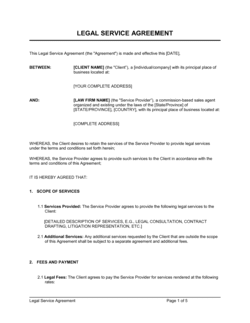
Litigation Agreement Template

Free Word download β€’ Edit online β€’ Save & share with Drive β€’ Export to PDF

5 pagesβ€’25–35 min to fillβ€’Difficulty: Complexβ€’Signature requiredβ€’Legal review recommended
Learn more ↓
FreeLitigation Agreement Template

At a glance

What it is
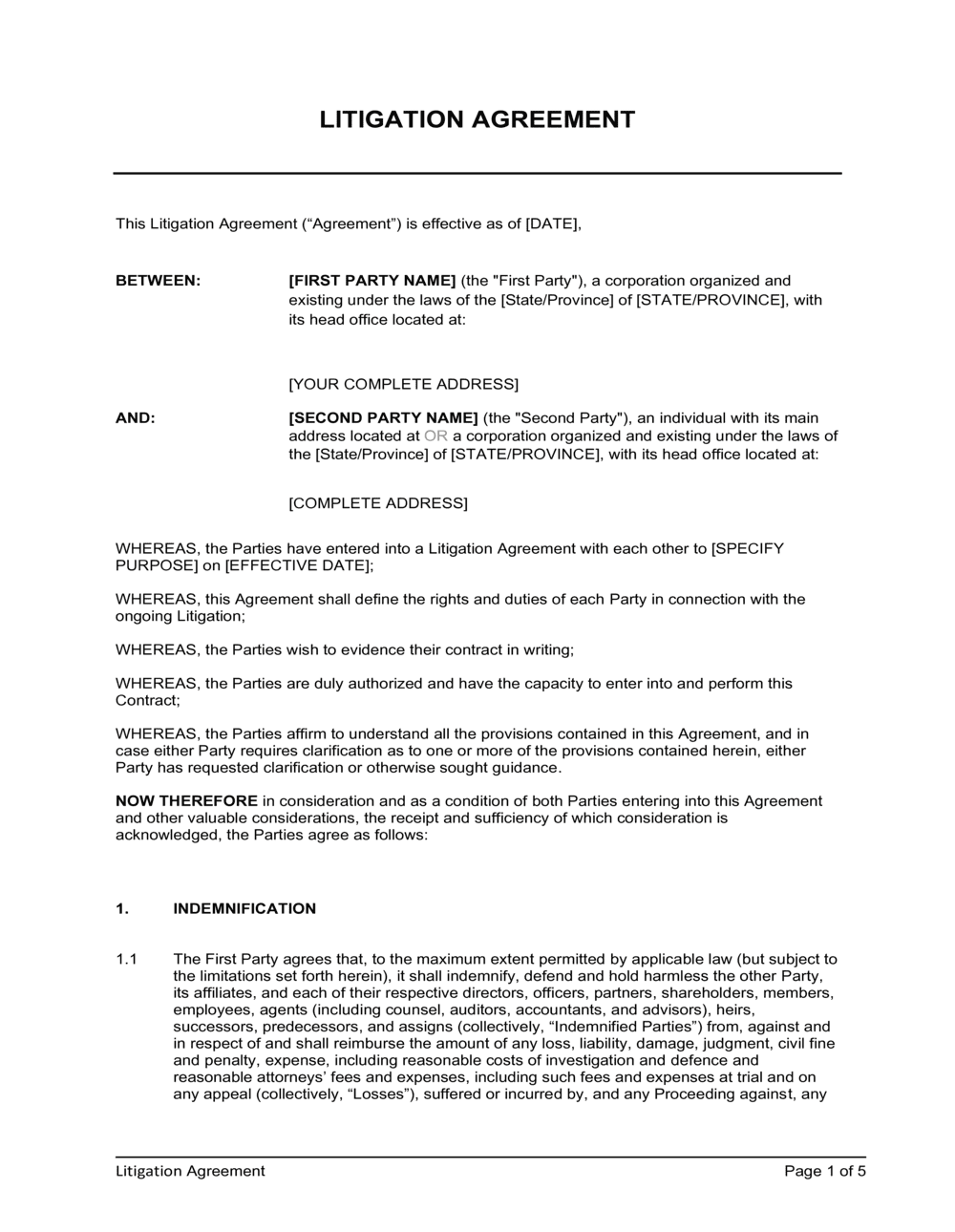
A Litigation Agreement is a binding legal contract that governs the terms under which two or more parties cooperate in, fund, or manage a civil lawsuit or dispute. This free Word download lets you define each party's authority, cost responsibilities, settlement approval rights, and confidentiality obligations in a single enforceable document you can edit online and export as PDF.
When you need it
Use it when co-plaintiffs are jointly pursuing a claim, when a third-party funder is financing litigation costs, or when a business needs to document the internal authority and cost-sharing arrangement before filing suit. It is also used between a company and outside counsel to formalize the scope and budget of litigation engagement.
What's inside
Party identification and recitals, scope of the dispute, cost allocation and funding obligations, decision-making and settlement authority, confidentiality and privilege protections, indemnification, termination rights, and governing law. Together these clauses establish a clear framework so disputes about the litigation itself do not compound the underlying case.

What is a Litigation Agreement?

A Litigation Agreement is a binding legal contract that governs the terms under which two or more parties cooperate in, fund, or manage a civil lawsuit or legal dispute. It defines each party's financial obligations, decision-making authority, settlement approval rights, confidentiality duties, and entitlement to any monetary recovery β€” creating an enforceable framework for the litigation process itself, separate from the underlying legal claim. Unlike a retainer letter or a settlement agreement, a litigation agreement operates throughout the life of the case, from filing through to final resolution or appeal.

Why You Need This Document

Without a litigation agreement, co-plaintiffs and funders routinely face a second dispute layered on top of the first: who approved that expert witness, who authorized the settlement offer, and who owes what when costs spiral past the original estimate. In jurisdictions that apply a loser-pays rule β€” including the UK, Canada, and most EU member states β€” an adverse costs order can equal 60–80% of the winning side's legal fees, and without a written allocation, that liability falls wherever a court decides to place it. A properly executed litigation agreement closes these gaps before they open: it locks in the cost-sharing ratio on day one, establishes a clear settlement threshold that protects every party's interests, preserves attorney-client privilege when strategy is shared across co-parties, and ensures that any recovery is distributed on agreed terms rather than through a second round of negotiation. This template gives you a complete, professionally structured starting point that you can adapt to your specific dispute β€” reducing the time and cost of getting the agreement in place so you can focus on the case itself.

Which variant fits your situation?

If your situation is…Use this template
Third party is financing the lawsuit in exchange for a share of proceedsLitigation Funding Agreement
Parties want to resolve a dispute without going to courtMediation Agreement
Both parties agree to binding arbitration instead of litigationArbitration Agreement
Parties have reached a negotiated resolution and want to document settlement termsSettlement Agreement
Two businesses are co-plaintiffs sharing costs and strategy in a commercial claimJoint Litigation Agreement
Company needs to formally retain and scope an outside litigation firmLegal Services Agreement
Parties are documenting a pre-suit confidential dispute communicationWithout Prejudice Agreement

Common mistakes to avoid

❌ Leaving 'litigation costs' undefined

Why it matters: Without a defined cost list, parties disagree on whether expert fees, travel, e-discovery platforms, and court reporter costs are included β€” often triggering a second dispute about the agreement itself.

Fix: Attach Schedule B with an itemized list of cost categories and a per-item approval threshold. Anything not on the list requires unanimous written consent before it is incurred.

❌ Omitting a joint-privilege or common-interest clause

Why it matters: Sharing privileged litigation strategy with a co-plaintiff or funder without a joint-privilege clause can constitute a waiver, making those communications discoverable by the opposing party.

Fix: Include express language confirming the parties share a common legal interest and that any privileged information exchanged under the agreement retains its privileged status.

❌ No veto right on settlement for co-parties or funders

Why it matters: A lead plaintiff with unilateral settlement authority can accept a sum that covers their own damages and costs while leaving co-plaintiffs or funders with a recovery that does not cover their investment.

Fix: Set a dollar floor below which settlement requires unanimous consent, and give co-parties a time-limited veto window for any offer above that floor.

❌ Signing after litigation costs have already been incurred

Why it matters: Cost-sharing obligations typically attach from the date of the agreement. Costs incurred before signing fall into a gap β€” one party may have paid more than their agreed share with no contractual basis for recovery.

Fix: Execute the agreement before any filing or material cost is incurred. If costs have already been paid, include a retroactive reimbursement clause covering pre-signing expenditure.

❌ No adverse costs allocation clause

Why it matters: In jurisdictions that apply a loser-pays rule β€” the UK, Canada, and most EU member states β€” an adverse costs order can equal 60–80% of the winning side's legal fees. Without a clear allocation, co-parties litigate this between themselves after the case is lost.

Fix: Mirror the adverse costs allocation to the primary cost-sharing ratio in Clause 3 so each party bears the same proportion of any loser-pays exposure they accepted for litigation costs.

❌ Choosing governing law based on the court where the case is filed

Why it matters: The law governing the underlying dispute and the law governing the litigation agreement are separate choices. Defaulting to the court's jurisdiction may be inconvenient or unfavorable for resolving internal disputes between parties.

Fix: Select governing law and a dispute-resolution mechanism β€” ideally arbitration β€” that the parties independently agree is practical and neutral for resolving any disagreement about the agreement itself.

The 9 key clauses, explained

Parties and recitals

In plain language: Identifies every party bound by the agreement β€” including any litigation funder β€” and describes the underlying dispute or case that prompted it.

Sample language
This Litigation Agreement is entered into as of [DATE] between [PARTY A LEGAL NAME] ('Claimant'), [PARTY B LEGAL NAME] ('Co-Claimant' or 'Funder'), and [LAW FIRM NAME] ('Counsel'), in connection with the dispute described in Schedule A (the 'Dispute').

Common mistake: Naming only the primary plaintiff and omitting co-plaintiffs or funders. Parties left out of the agreement are not bound by its cost-sharing or settlement-authority provisions, creating enforcement gaps.

Scope of the dispute

In plain language: Defines the specific claims, proceedings, and courts covered by the agreement so all cost-sharing and authority provisions apply to a clearly bounded matter.

Sample language
This Agreement applies to the claim described in Schedule A, including any appeal, counterclaim, or related proceeding arising from the same facts, filed in [COURT NAME / JURISDICTION]. Claims arising from separate facts require a separate agreement.

Common mistake: Drafting scope language so broadly that it inadvertently covers unrelated disputes between the same parties, triggering cost-sharing obligations the parties never intended.

Cost allocation and funding obligations

In plain language: States who pays which litigation costs, in what proportions, and on what schedule β€” including filing fees, expert witnesses, discovery costs, and counsel fees.

Sample language
[PARTY A] shall bear [X]% and [PARTY B] shall bear [X]% of all Litigation Costs, as defined in Schedule B. Costs shall be invoiced monthly by Counsel and paid within [30] days. Neither party shall incur any single expense exceeding $[AMOUNT] without prior written consent of the other.

Common mistake: Leaving 'litigation costs' undefined and assuming the parties share an understanding. Disputes over whether expert-witness fees or travel costs are covered are among the most common triggers for litigation within the litigation agreement itself.

Decision-making and settlement authority

In plain language: Sets out which party has authority to make strategic decisions β€” filing motions, accepting depositions, engaging experts β€” and the approval threshold required before any settlement offer can be accepted.

Sample language
Day-to-day litigation decisions shall be made by [DESIGNATED REPRESENTATIVE]. No settlement offer shall be accepted without written consent of all parties if the settlement amount is below $[THRESHOLD]. For settlements above $[THRESHOLD], [PARTY A] has sole authority to accept, subject to [PARTY B]'s right to veto within [10] business days.

Common mistake: Granting one party sole settlement authority with no floor or veto right for co-parties or funders. A funded party can accept a settlement that covers their costs but leaves the funder or co-plaintiff with nothing.

Confidentiality and privilege preservation

In plain language: Obliges all parties to keep litigation strategy, counsel communications, and settlement discussions confidential, and confirms that sharing privileged information under the agreement does not waive attorney-client privilege.

Sample language
All information exchanged under this Agreement, including counsel's advice and case strategy, is confidential and subject to joint privilege. No party shall disclose such information to any third party without prior written consent. Disclosure required by law is permitted upon [5] business days' written notice to the other parties.

Common mistake: Omitting a joint-privilege or common-interest clause. Without it, documents shared between co-plaintiffs or with a funder can be deemed a waiver of privilege and become discoverable by the opposing party.

Indemnification and adverse costs

In plain language: Allocates liability if the case is lost and an adverse costs order is made, and specifies which party bears the cost of any court-ordered payment to the opposing side.

Sample language
In the event of an adverse costs order against the Claimant(s), [PARTY A] and [PARTY B] shall each bear [X]% of such costs, consistent with the cost-allocation ratios in Clause 3. Neither party shall be liable for the other's consequential losses arising from an unsuccessful outcome.

Common mistake: Failing to address adverse costs orders entirely. Without a clear allocation, a losing party may seek full reimbursement from their co-plaintiff under general indemnity principles, leaving the other party with an unexpected liability.

Proceeds and distribution

In plain language: Defines how any monetary recovery β€” judgment, settlement, or costs award β€” is distributed among the parties after deducting counsel fees and litigation costs.

Sample language
Any proceeds recovered shall first be applied to outstanding Litigation Costs and Counsel fees. The remaining net proceeds shall be distributed as follows: [X]% to [PARTY A], [X]% to [PARTY B], and [X]% to [FUNDER], as set out in Schedule C.

Common mistake: Calculating funder returns as a percentage of gross proceeds rather than net proceeds. This can leave the claimant with a fraction of the actual recovery after costs and the funder's share are deducted.

Termination and withdrawal

In plain language: States the circumstances under which a party may exit the agreement β€” including insolvency, material breach, or strategic disagreement β€” and what obligations survive termination.

Sample language
Either party may terminate this Agreement on [30] days' written notice if the other party materially breaches any provision and fails to cure within [15] days. Upon termination, the withdrawing party remains liable for its share of Litigation Costs incurred to the date of termination. Confidentiality and indemnification obligations survive termination.

Common mistake: Allowing any party to withdraw without any cost obligation for work already performed. A party that terminates after significant costs have been incurred should remain liable for their proportional share to the exit date.

Governing law and dispute resolution

In plain language: Specifies which jurisdiction's law governs the agreement and how disputes about the agreement itself β€” not the underlying case β€” will be resolved.

Sample language
This Agreement is governed by the laws of [STATE / PROVINCE / COUNTRY]. Any dispute arising under this Agreement shall be resolved by [binding arbitration / mediation followed by arbitration] administered by [INSTITUTION] in [CITY], except that either party may seek injunctive relief in a court of competent jurisdiction.

Common mistake: Choosing the law of the court where the underlying case is filed without considering whether that is the most favorable or convenient jurisdiction for the parties' own contractual dispute.

How to fill it out

  1. 1

    Identify all parties and their roles

    Enter the full legal name and address of every party β€” claimants, co-claimants, any litigation funder, and the law firm if it is a party. Specify each party's role in Schedule A so obligations in later clauses attach correctly.

    πŸ’‘ Use registered corporate names exactly as they appear in the company registry β€” trade names create enforcement ambiguity.

  2. 2

    Define the scope of the dispute in Schedule A

    Describe the underlying claim with enough specificity to distinguish it from other potential disputes between the same parties. Include the court, case number if already filed, and the causes of action covered.

    πŸ’‘ Limit the scope to claims arising from the same set of facts. Broad 'all disputes' language often captures unintended liabilities.

  3. 3

    Set cost-allocation percentages and payment mechanics

    Agree on each party's share of litigation costs and enter the percentages in Clause 3 and Schedule B. Define what counts as a 'litigation cost' β€” itemize categories such as filing fees, expert fees, discovery costs, and counsel fees separately.

    πŸ’‘ Include a per-item approval threshold (e.g., no single expense over $5,000 without joint consent) to prevent one party from committing the others to large unilateral costs.

  4. 4

    Establish decision-making authority and settlement thresholds

    Name the designated representative for each party and set a specific dollar threshold below which settlement requires unanimous consent and above which a lead party may act with a veto window for co-parties.

    πŸ’‘ Make the settlement-authority clause asymmetric if one party has more litigation experience β€” a funder or lead plaintiff often warrants broader authority in exchange for bearing more cost risk.

  5. 5

    Draft the confidentiality and joint-privilege clause

    Confirm that all shared communications are covered by common-interest or joint-prosecution privilege. Specify the disclosure carve-outs (e.g., court order, regulatory requirement) and the notice period required before any compelled disclosure.

    πŸ’‘ Have counsel confirm the joint-privilege language is consistent with the rules of the governing jurisdiction before signing β€” privilege rules vary materially between the US, Canada, the UK, and the EU.

  6. 6

    Specify proceeds distribution in Schedule C

    Enter the net-proceeds distribution formula β€” after deducting costs and counsel fees β€” for each party. If a funder is involved, confirm whether their return is a fixed multiple, a percentage of net proceeds, or an IRR-based formula.

    πŸ’‘ Model at least three recovery scenarios (full judgment, negotiated settlement, partial recovery) to confirm the distribution formula is workable under each outcome before signing.

  7. 7

    Set termination triggers and survival obligations

    Define the specific events that allow termination β€” material breach, insolvency, strategic deadlock β€” and the cure period. Confirm in writing which obligations survive: at minimum, confidentiality, indemnification, and costs incurred to the exit date.

    πŸ’‘ Include a deadlock-resolution mechanism (e.g., a 30-day negotiation period before either party can trigger termination) to prevent one party from using the exit right as a tactical lever.

  8. 8

    Execute before filing or incurring material costs

    All parties must sign before any significant litigation costs are incurred or any pleading is filed. Post-commencement signatures raise consideration problems and may leave early costs unallocated.

    πŸ’‘ Use a timestamped electronic signature with a copy stored in a secure document system β€” execution date is critical if a dispute arises about cost obligations from day one of the case.

Frequently asked questions

What is a litigation agreement?

A litigation agreement is a binding contract that governs how two or more parties cooperate in, fund, or manage a civil lawsuit. It defines each party's financial obligations, decision-making rights, settlement authority, and confidentiality duties so the mechanics of the case are agreed in writing before significant costs are incurred. It is distinct from the underlying lawsuit β€” it is a contract about the lawsuit.

When do you need a litigation agreement?

You typically need one when multiple parties are jointly pursuing a claim and need to allocate costs and decision rights, when a third-party funder is financing litigation in exchange for a share of proceeds, or when a company is formally authorizing outside counsel with defined budget and settlement authority. It is also used internally when a board needs a governance record of an approved litigation decision.

What is the difference between a litigation agreement and a settlement agreement?

A litigation agreement governs the process of pursuing a dispute β€” who pays, who decides, and how proceeds are shared. A settlement agreement documents the resolution of that dispute β€” the terms on which both sides agree to end it. The litigation agreement comes first and may contemplate a settlement; the settlement agreement closes the case. You may need both documents in the same matter.

Does a litigation agreement need to be signed before filing a lawsuit?

Yes, in practice it should be signed before any pleading is filed or significant costs are incurred. Post-commencement signatures create gaps in cost allocation for early expenditures and may raise consideration problems that affect the enforceability of the agreement in common-law jurisdictions. Signing early also confirms that all parties have genuinely committed to the shared strategy before it becomes costly to exit.

What is a litigation funding agreement and how does it differ?

A litigation funding agreement is a specific type of litigation agreement where a third-party investor β€” not a party to the underlying dispute β€” finances costs in exchange for a defined return from any recovery. A general litigation agreement can cover co-plaintiffs, cost sharing, and counsel authority without any external funder. The funded variant adds return mechanics, control rights for the funder, and typically a higher degree of contractual complexity around settlement authority.

Is attorney-client privilege protected when parties share information under a litigation agreement?

It can be, but only if the agreement includes a properly drafted joint-privilege or common-interest clause. Without that clause, sharing privileged strategy documents with a co-plaintiff or funder may constitute a waiver of privilege, making those communications discoverable. The specific requirements for common-interest privilege vary by jurisdiction β€” consider having counsel review this clause before executing.

Can any party withdraw from a litigation agreement?

Yes, typically on the terms set out in the termination clause β€” usually written notice after a cure period for breach, or on broader grounds if the parties negotiated a withdrawal right. A withdrawing party generally remains liable for their share of costs incurred to the exit date. Unrestricted withdrawal rights are a significant risk β€” one party walking away mid-case can leave the other responsible for the full cost burden.

Are litigation agreements enforceable in all jurisdictions?

Generally yes, with important variations. In the US, litigation funding and co-plaintiff agreements are widely enforced, though some states retain older champerty and maintenance doctrines that restrict third-party funding. In the UK, litigation funding agreements are well-established and regulated by the Association of Litigation Funders' Code of Conduct. In Canada and the EU, enforceability depends on the specific jurisdiction and the nature of the arrangement. Engage local counsel before executing in any unfamiliar jurisdiction.

What happens if the litigation is unsuccessful?

The indemnification and adverse costs clauses govern the outcome of a loss. Each party typically bears their contractual share of accumulated litigation costs. In loser-pays jurisdictions β€” the UK, Canada, and most EU member states β€” an adverse costs order can require payment of the winning side's fees, which the agreement should also allocate. A funder who loses their investment generally has no recovery unless the agreement includes specific downside protections.

How this compares to alternatives

vs Settlement Agreement

A litigation agreement governs the conduct of a dispute while it is ongoing β€” costs, authority, and strategy. A settlement agreement documents the final resolution, recording what each side agreed to pay or do to end the case. The litigation agreement comes first; the settlement agreement closes it. In most contested matters, you will need both.

vs Arbitration Agreement

An arbitration agreement redirects a dispute from the courts to a private arbitral tribunal and is typically agreed before a dispute arises or at its outset. A litigation agreement assumes the parties have already chosen to litigate in court and governs how they manage that process together. If both are used, the arbitration agreement determines the forum; the litigation agreement governs the internal relationship between co-parties.

vs Legal Services Agreement

A legal services agreement is a contract between a client and their law firm β€” it governs scope, fees, and billing. A litigation agreement is a contract between the parties to the dispute β€” it governs cost-sharing, settlement authority, and proceeds distribution. Both documents are often needed: the legal services agreement retains counsel, while the litigation agreement governs the co-party relationship.

vs Mediation Agreement

A mediation agreement commits parties to attempt a facilitated negotiated resolution before or instead of litigating. A litigation agreement assumes negotiation has failed or is not the chosen path and formalizes the structure for pursuing a court claim. Parties sometimes use a mediation agreement first and only execute a litigation agreement if mediation breaks down.

Industry-specific considerations

Financial Services

Securities class actions, regulatory enforcement defence, and lender recovery claims frequently involve multiple institutional co-plaintiffs requiring formal cost-sharing and settlement-authority arrangements.

Technology / SaaS

IP enforcement campaigns β€” particularly patent and trade-secret litigation β€” often involve litigation funders and require precise proceeds-distribution formulas tied to licensing recovery milestones.

Construction and Real Estate

Multi-party construction disputes involving owners, contractors, and subcontractors as co-claimants frequently require joinder agreements that allocate costs and decision rights across three or more parties.

Professional Services

Law firms engaging in contingency-fee commercial litigation use litigation agreements to formalize fee arrangements, client settlement authority, and cost-recovery obligations before the matter begins.

Healthcare

Class actions and multi-plaintiff pharmaceutical or device litigation require coordinated litigation agreements to manage lead-plaintiff authority, expert costs, and settlement distribution across large claimant groups.

Manufacturing

Supply-chain contract disputes and product liability claims often involve co-defendants or joint claimants requiring agreed cost-sharing ratios and settlement-consent thresholds before joint defence or recovery strategies are pursued.

Jurisdictional notes

United States

Litigation funding is generally permitted and enforceable across most US states, though a minority still apply champerty and maintenance doctrines that can void third-party funding arrangements. Settlement authority and co-plaintiff agreements are broadly enforced as standard contracts. Attorney fee-sharing arrangements are subject to bar rules in each state β€” confirm compliance with applicable Rules of Professional Conduct before executing any fee-sharing provision.

Canada

Canada has largely abolished champerty and maintenance as grounds to void litigation funding agreements, particularly in Ontario and British Columbia. Adverse costs orders β€” loser-pays β€” are standard in Canadian courts, making adverse costs allocation a critical clause. Quebec follows civil law principles and may treat co-plaintiff arrangements differently from common-law provinces. Legal fee-sharing arrangements must comply with provincial law society rules.

United Kingdom

Third-party litigation funding is well established in England and Wales, governed by the Association of Litigation Funders' voluntary Code of Conduct and the Civil Justice Council's guidelines. Loser-pays costs orders are the default, and after-the-event (ATE) insurance is frequently used alongside litigation funding agreements to cover adverse costs exposure. Damages-based agreements (DBAs) and conditional fee agreements (CFAs) are regulated and must comply with specific statutory requirements.

European Union

Litigation funding regulations vary significantly across EU member states β€” the practice is well developed in Germany and the Netherlands but more restricted in France and some Central European jurisdictions. The European Parliament's 2022 resolution called for harmonized regulation of third-party funding across member states, and rule changes are ongoing. GDPR considerations arise when litigation involves sharing personal data between co-plaintiffs or with funders. Engage local counsel in each relevant member state before executing cross-border litigation agreements.

Template vs lawyer β€” what fits your deal?

PathBest forCostTime
Use the templateStraightforward two-party cost-sharing arrangements or internal governance records for routine commercial disputesFree1–2 hours
Template + legal reviewMulti-party co-plaintiff arrangements, any agreement involving a litigation funder, or disputes in regulated industries$500–$1,500 for a litigation attorney review2–5 days
Custom draftedComplex funded litigation, class actions, cross-border disputes, or matters involving adverse costs exposure above $100K$2,000–$8,000+1–3 weeks

Glossary

Litigation
The process of resolving a legal dispute through the court system, from filing a complaint through trial or judgment.
Third-Party Funder
An entity that is not a party to the underlying dispute but finances litigation costs in exchange for a portion of any recovery.
Settlement Authority
The contractually defined right β€” and dollar threshold β€” above which a party must obtain consent before agreeing to settle a case.
Privilege
Legal protection for confidential communications between a client and their attorney that shields those communications from disclosure in court.
Indemnification
A contractual obligation by one party to compensate the other for specified losses, costs, or liabilities arising from the litigation.
Contingency Fee
A fee arrangement where the attorney is paid a percentage of the recovery rather than an hourly rate, with no fee if the case is lost.
Adverse Costs Order
A court order requiring the losing party to pay some or all of the winning party's legal costs β€” common in the UK and Canada.
Cause of Action
The legal basis for a lawsuit β€” the specific legal theory (e.g., breach of contract, negligence) that entitles a party to seek relief.
Discovery
The pre-trial process by which parties exchange relevant documents, evidence, and witness information under procedural rules.
Without Prejudice
A designation applied to settlement communications indicating they cannot be introduced as evidence in court proceedings.
Joinder
The procedural addition of a new party to an existing lawsuit, typically requiring consent or court approval.

Part of your Business Operating System

This document is one of 3,000+ business & legal templates included in Business in a Box.

  • Fill-in-the-blanks β€” ready in minutes
  • 100% customizable Word document
  • Compatible with all office suites
  • Export to PDF and share electronically

Create your document in 3 simple steps.

From template to signed document β€” all inside one Business Operating System.
1
Download or open template

Access over 3,000+ business and legal templates for any business task, project or initiative.

2
Edit and fill in the blanks with AI

Customize your ready-made business document template and save it in the cloud.

3
Save, Share, Send, Sign

Share your files and folders with your team. Create a space of seamless collaboration.

Save time, save money, and create top-quality documents.

β˜…β˜…β˜…β˜…β˜…

"Fantastic value! I'm not sure how I'd do without it. It's worth its weight in gold and paid back for itself many times."

Managing Director Β· Mall Farm
Robert Whalley
Managing Director, Mall Farm Proprietary Limited
β˜…β˜…β˜…β˜…β˜…

"I have been using Business in a Box for years. It has been the most useful source of templates I have encountered. I recommend it to anyone."

Business Owner Β· 4+ years
Dr Michael John Freestone
Business Owner
β˜…β˜…β˜…β˜…β˜…

"It has been a life saver so many times I have lost count. Business in a Box has saved me so much time and as you know, time is money."

Owner Β· Upstate Web
David G. Moore Jr.
Owner, Upstate Web

Run your business with a system β€” not scattered tools

Stop downloading documents. Start operating with clarity. Business in a Box gives you the Business Operating System used by over 250,000 companies worldwide to structure, run, and grow their business.

Free Forever PlanΒ Β·Β No credit card required